
Frequency-Aware Flow Matching for Continuous and Consistent Robotic Action Generation
FeaturedJianing Guo, Fangzheng Chen, Zihao Mao, Wong Lik Hang Kenny, Zhenhong Wu, Yu Li, Yishuai Cai, Yuanpei Chen, Yikun Ban, Kai Chen, Qi Dou, Yaodong Yang, Xianglong Liu, Huijie Zhao, Simin Li · · 2026
Framework
N/A
License
N/A
Stars
N/A
Summary
Flow matching has emerged as a standard paradigm for robotic manipulation owing to its strong expressive power for modelling complex, multimodal action distributions, alongside similar approaches like diffusion policy.
Abstract Summary
Key Points
- Proposes Frequency-Aware Flow Matching for Continuous and Consistent for robotics.
- Evaluated on real or simulated robotic tasks.
- Primary contribution in ar-vr.
Method
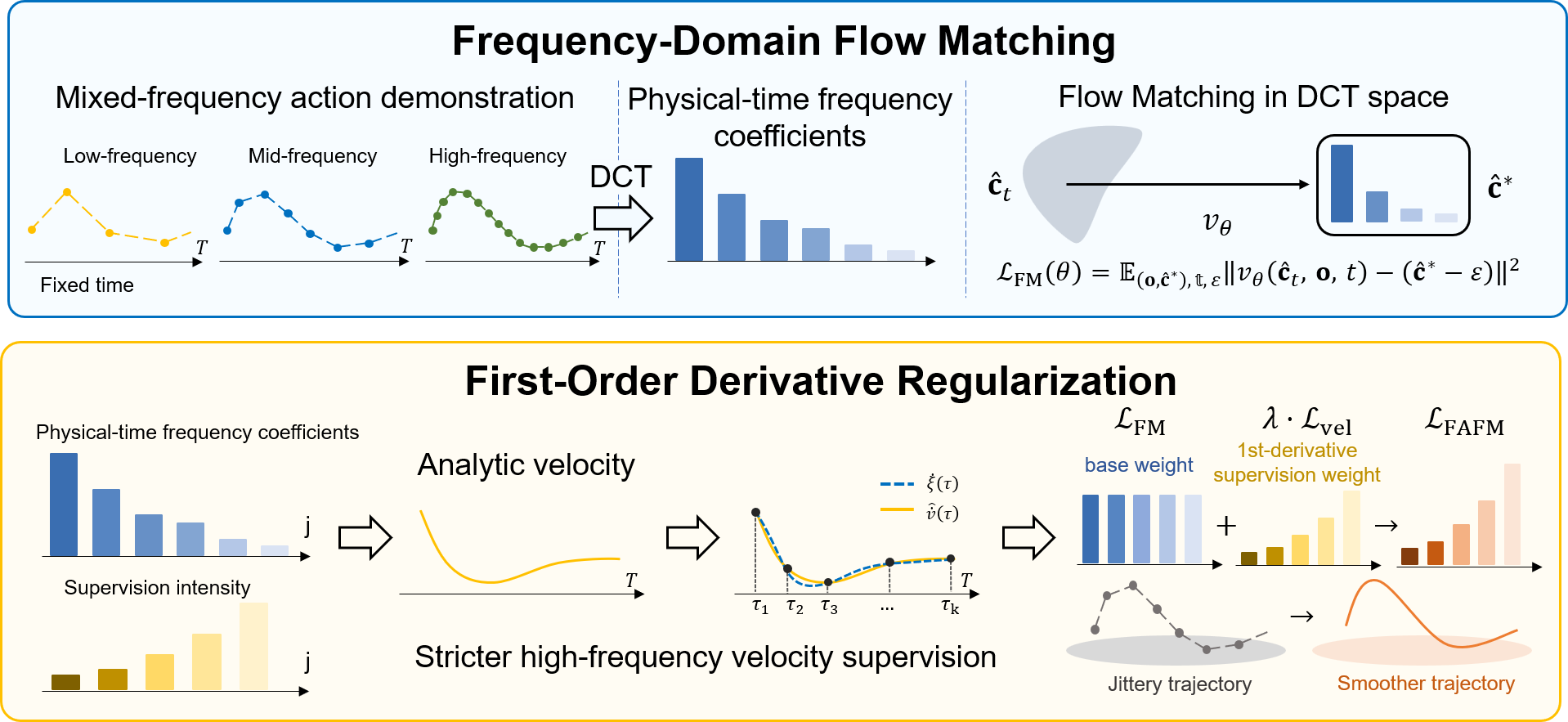
In this section, we propose frequency-aware flow matching to generate continuous and temporally consistent actions. Our overall approach are illustrated in Figure 2 . Problem Formulation. We consider robot action generation as learning $p(\mathbf{A}/\mathbf{o})$ over action chunks $\mathbf{A}=[a_{0},\ldots,a_{K-1}]\in\mathbb{R}^{K\times d}$ given observation $\mathbf{o}$.
Experiments
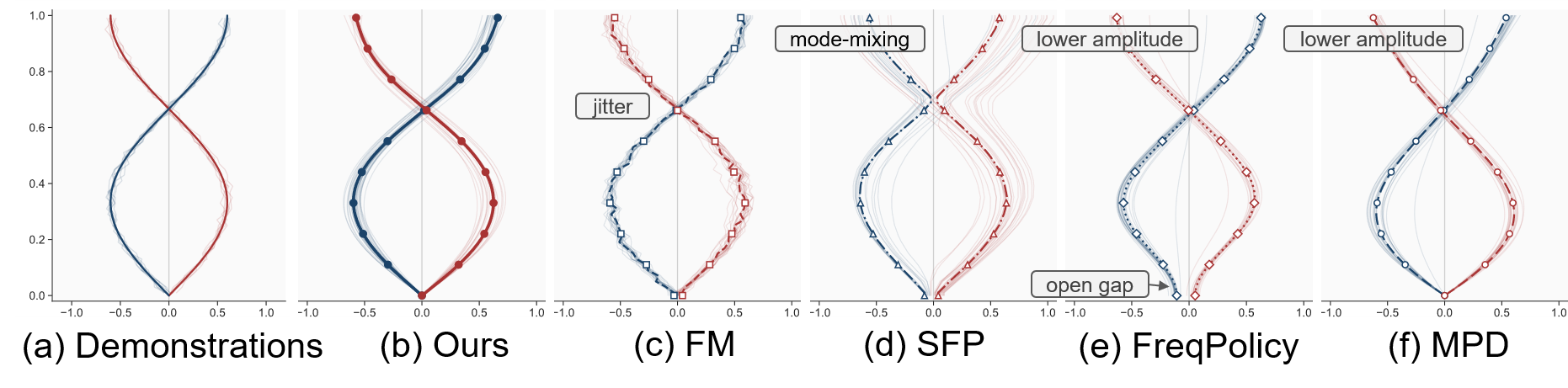
We evaluate FAFM in two stages. First, as a standalone policy, it is assessed on synthetic toy benchmark, obstacle avoidance, LapGym [ 18 ] , and deployed on a real Franka robot. Second, FAFM is integrated into VLA backbones, evaluated on LIBERO [ 19 ] , and again deployed on a real Franka robot. The specific purpose of each environment is described below.
Evaluation metrics : We adopt success rate (SR) as the primary measure of task reliability.
Sources and Demonstrations
Figures are reproduced from Guo et al. See the full paper for experimental details and the project page, when the paper links one, for demonstrations and videos.
Related Papers

Frequency-Aware Flow Matching for Continuous and Consistent Robotic Action Generation
Jianing Guo, Fangzheng Chen, Zihao Mao et al.
Flow matching has emerged as a standard paradigm for robotic manipulation owing to its strong expressive power for modelling complex, multimodal action distributions, alongside similar approaches like diffusion policy.
Co-VLA: Coordination-Aware Structured Action Modeling for Dual-Arm Vision-Language-Action Systems
Yandong Wang, Jiaqian Yu, Xiongfeng Peng et al.
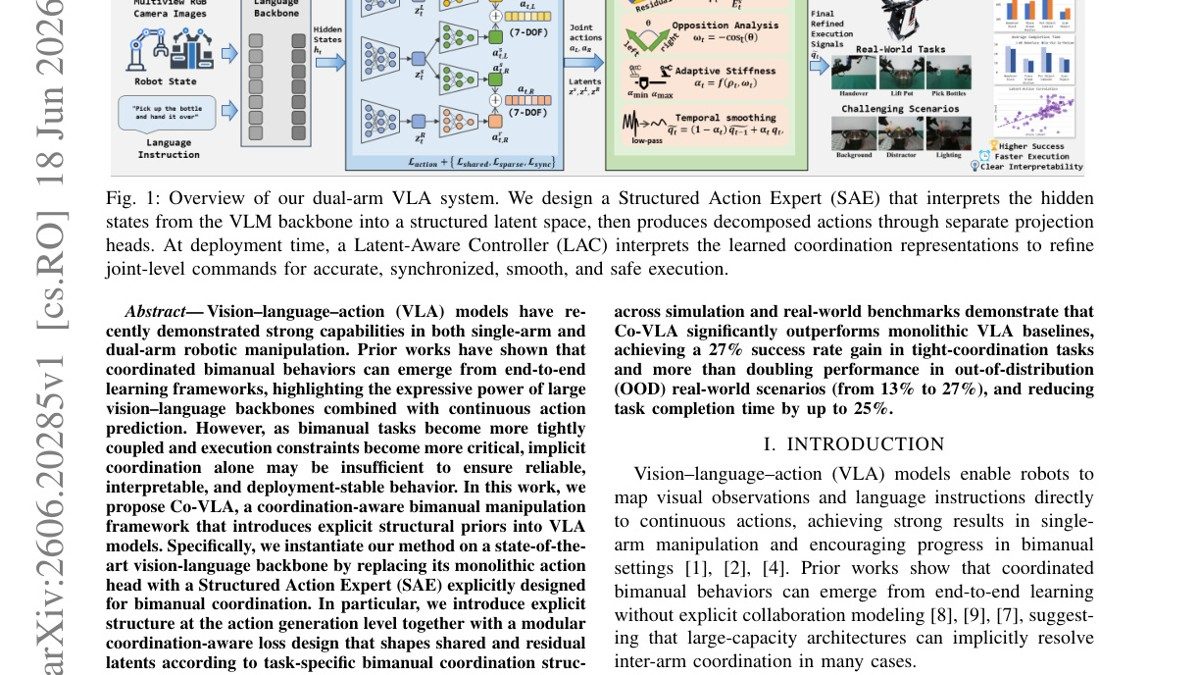
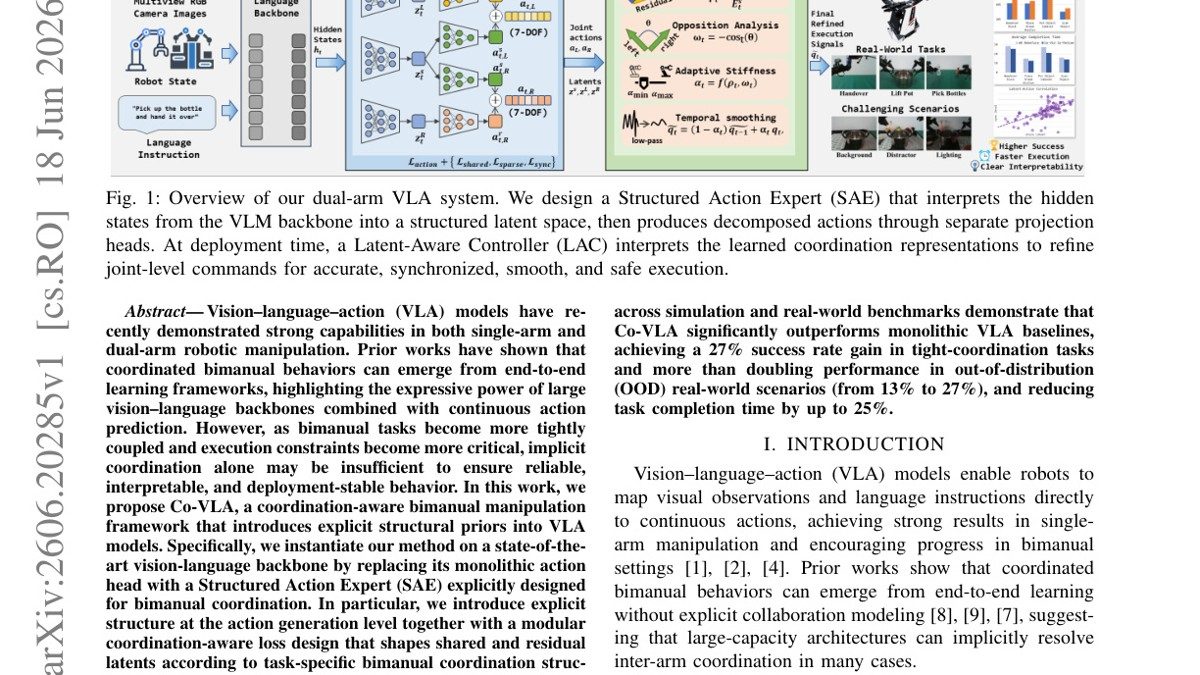
Vision-language-action (VLA) models show strong capabilities in single and dual-arm robotic manipulation. Prior works show coordinated bimanual behaviors can emerge from end-to-end learning, leveraging large vision-language backbones with continuous action prediction.
Co-VLA: Coordination-Aware Structured Action Modeling for Dual-Arm Vision-Language-Action Systems
Yandong Wang, Jiaqian Yu, Xiongfeng Peng et al.
Vision-language-action (VLA) models show strong capabilities in single and dual-arm robotic manipulation. Prior works show coordinated bimanual behaviors can emerge from end-to-end learning, leveraging large vision-language backbones with continuous action prediction.
Finetuning Vision-Language-Action Models Requires Fewer Layers Than You Think
Gia-Binh Nguyen, Trong-Bao Ho, Thien-Loc Ha et al.
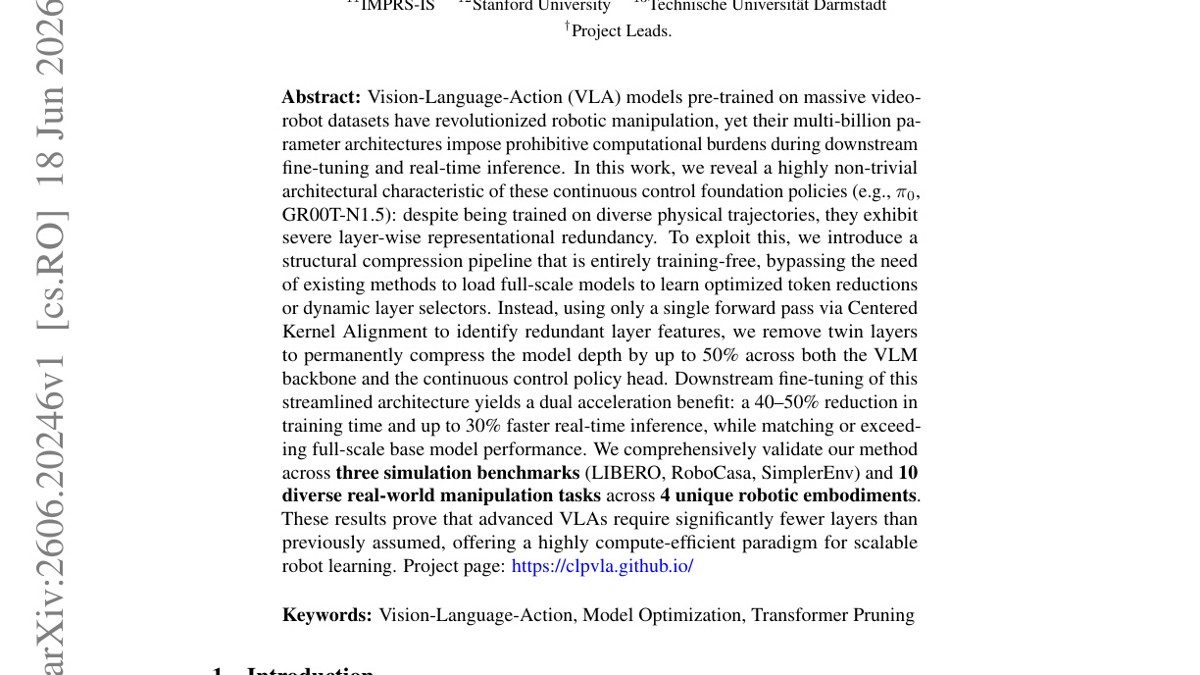
Vision-Language-Action (VLA) models pre-trained on massive video-robot datasets have revolutionized robotic manipulation, yet their multi-billion parameter architectures impose prohibitive computational burdens during downstream fine-tuning and real-time inference.