
TouchTherm: Building Multimodal Digital Twins of Objects for Tactile and Thermal Rendering
Yitao Zhang, Hong Ying, Haoran Guo, Xiaoying Zhou, Guanyu Chen, Chenxi Xiao · N/A · 2026
Framework
N/A
License
N/A
Stars
N/A
Summary
Robotic simulation and virtual reality increasingly require object assets that capture not only visual geometry but also the physical cues underlying tactile and thermal interaction.
Abstract Summary
Key Points
- Robotic simulation and virtual reality increasingly require object assets that capture not only visual geometry but also the physical cues underlying tactile and thermal interaction.
- Existing 3D datasets and reconstruction methods primarily represent object-scale geometry and visual appearance, overlooking microscale surface structure for high-fidelity haptic rendering and transient temperature dynamics for temperature-aware interaction.
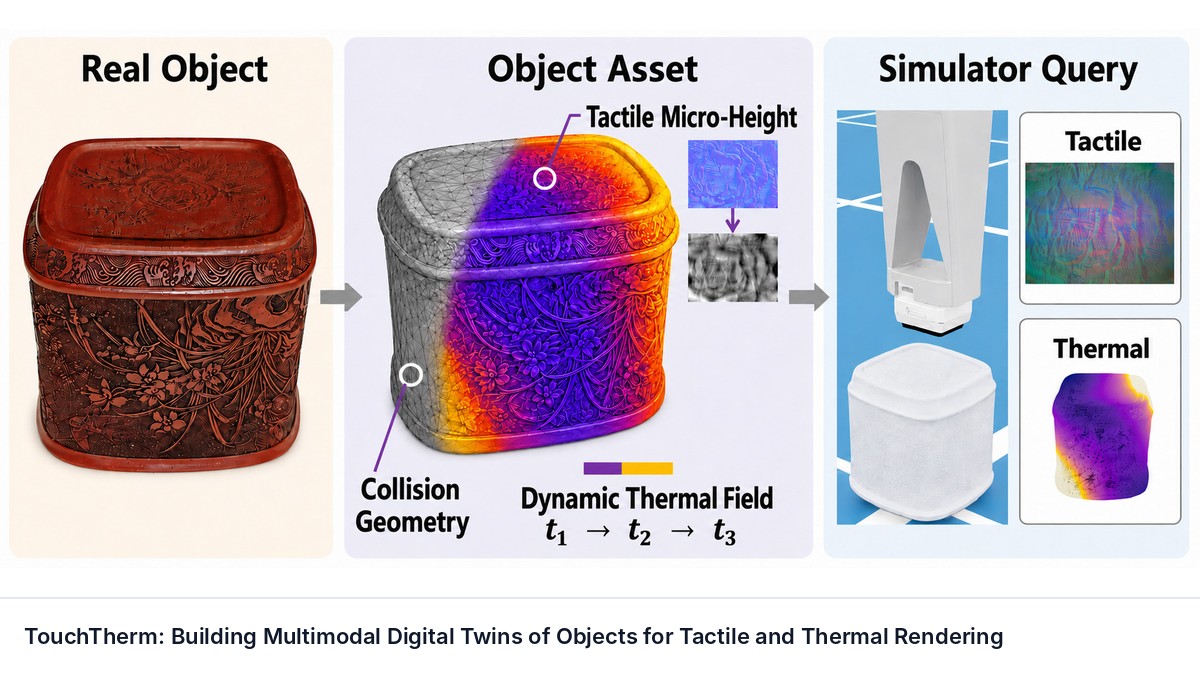
- We present TouchTherm, a framework for constructing simulation-ready visuo-tactile-thermal object assets from real-world objects.
- For visual and tactile reconstruction, we combine structured-light scanning with multiview normal maps obtained from photometric stereo.
- The normal maps are registered to the scanned geometry and transformed into tangent space to recover local micro-height fields for optical tactile rendering, while the coarse mesh handles collision detection.
Methodology
Our goal is to convert a real object into a simulator-ready multimodal asset comprising a coarse mesh, tactile micro-height fields, and a dynamic thermal field. As shown in Fig. 2 , the pipeline aligns object scans, multiview normal maps, and infrared videos to a common object frame, then reconstructs tactile microgeometry and the dynamic thermal field in two parallel branches.
The resulting representations are integrated into a unified object asset. According to this pipeline, the following sections describe the acquisition setup (Sec.
Experiments
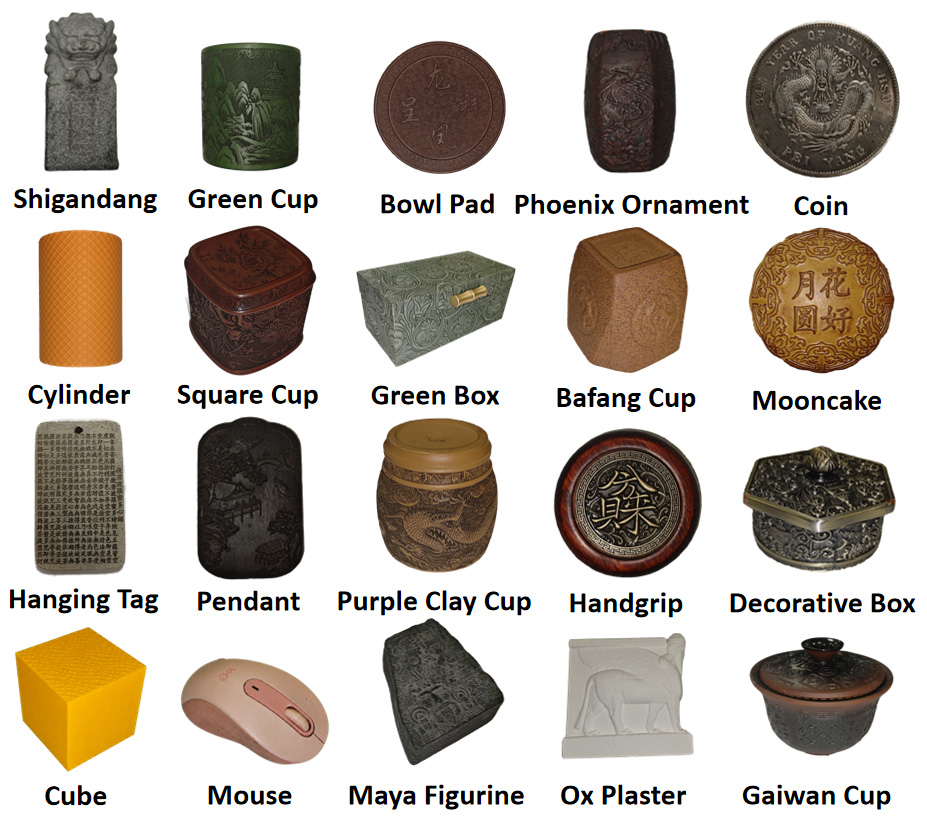
We evaluate TouchTherm from four perspectives: object asset quality (Sec. IV-A ), tactile rendering fidelity (Sec. IV-B ), thermal prediction accuracy (Sec. IV-C ), and downstream utility in perception and interaction tasks (Sec. IV-D ). We constructed digital twins for 20 real objects spanning flat, curved, cylindrical, and free-form geometries, as shown in Fig. 3 .
These objects exhibit smooth, granular, embossed, and anisotropic surface patterns. As summarized in Fig.
Sources and Demonstrations
Figures are reproduced from Zhang et al. See the full paper for experimental details and the project page, when the paper links one, for demonstrations and videos.
Related Papers
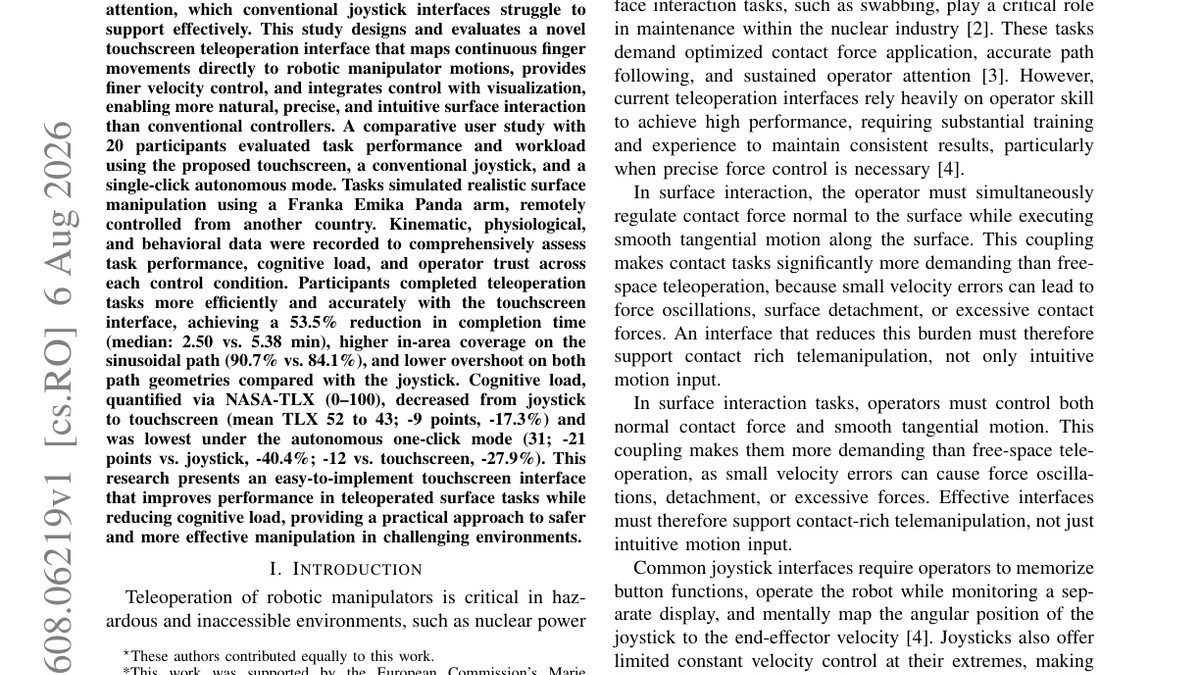
Design and Evaluation of a Touchscreen-Based Teleoperation Interface for Robotic Manipulators
Juan José García Cárdenas, Alperen Kenan, Hamidreza Raei et al.
Intuitive teleoperation interfaces are crucial for the safe and effective operation of robotic manipulators in challenging environments.
DUET: Decoupled Upper- and Lower-Body Execution for Task-Agnostic Humanoid Loco-Manipulation
Kapalik Khanal, Biswash Khatiwada, Stephen Afrifa et al.
Changing a humanoid robot's manipulation policy should not require retraining the controller that maintains the robot's balance.
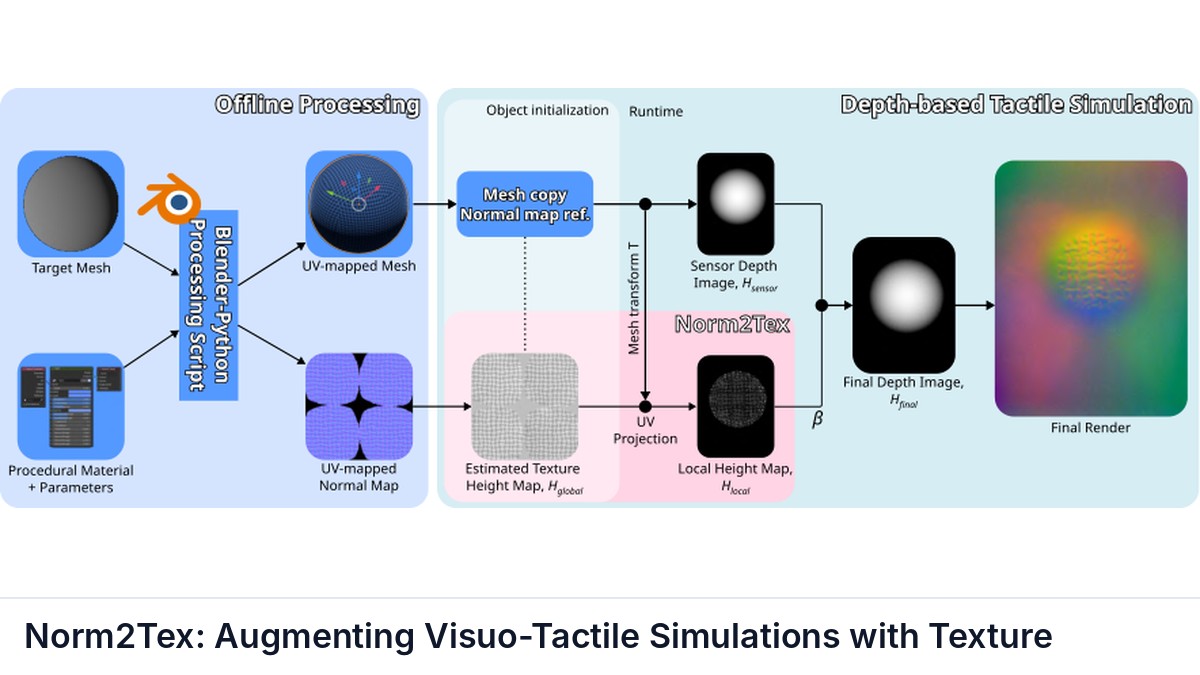
Norm2Tex: Augmenting Visuo-Tactile Simulations with Texture
Seongjin Bien, D\'ebora Oliveira Makowski, Roberto Calandra et al.
Large-scale datasets are essential for training generalist robot control policies. Collecting real-world tactile data is costly and time-consuming, motivating the use of tactile simulations. However, current tactile simulators capture only overall contact geometry and miss fine details like texture.

A Sim-to-Real Integration Pipeline for Training and Deployment of Chunk-Based VLA Manipulation Policies
Mathilde Kappel, Clémence Grislain, Mohamed Chetouani et al.
Vision-Language-Action (VLA) models have become a prominent paradigm for mapping multimodal inputs, including semantic instructions, visual observations of the scene, and proprioceptive observations, to robot actions.