
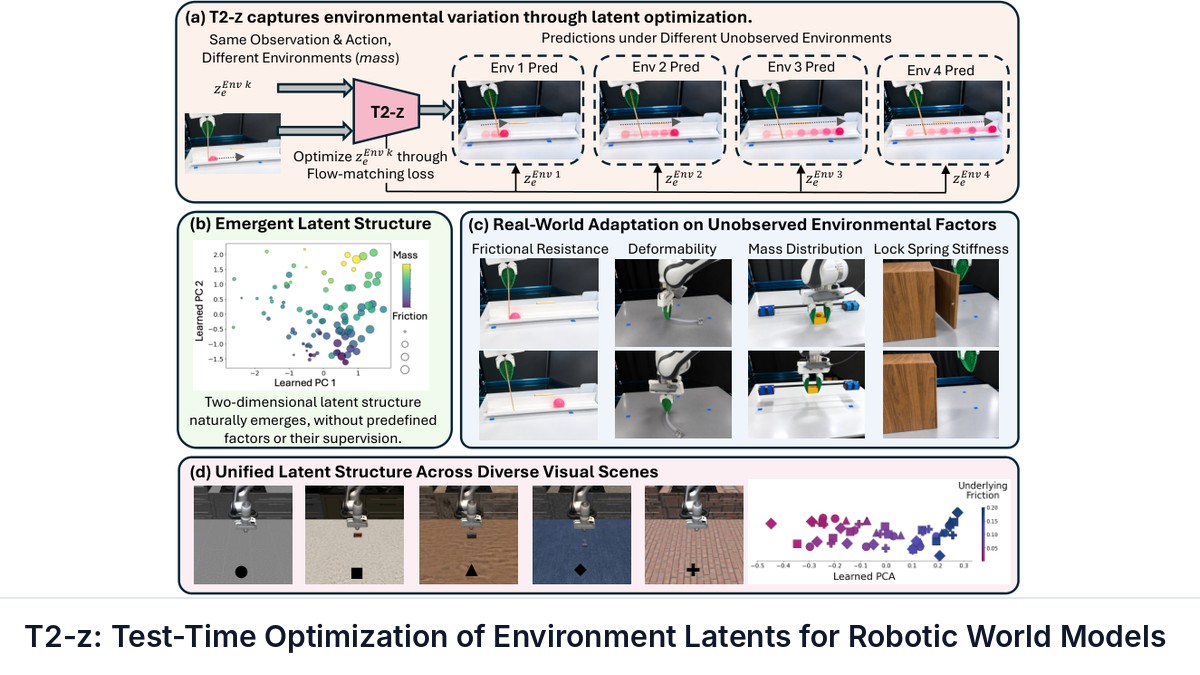
T2-z: Test-Time Optimization of Environment Latents for Robotic World Models
Chenyuan Zhou, Yining Hong, Huang Huang, Yunfan Jiang, Wenlong Huang, David Held, Vitor Campagnolo Guizilini, Yue Wang, Li Fei-Fei, Jiajun Wu, Leonidas Guibas, Yejin Choi · N/A · 2026
Framework
N/A
License
N/A
Stars
N/A
Summary
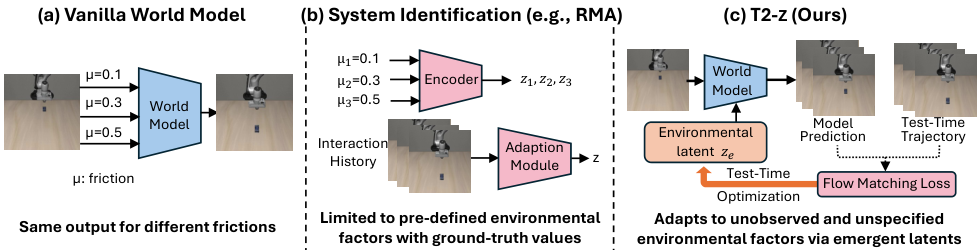
Predicting how the world responds to an action requires more than what can be seen: robots must account for environmental factors that are neither directly observable nor explicitly specified, from physical properties such as friction and mass to human-defined environmental rules.
Abstract Summary
Key Points
- Predicting how the world responds to an action requires more than what can be seen: robots must account for environmental factors that are neither directly observable nor explicitly specified, from physical properties such as friction and mass to human-defined environmental rules.
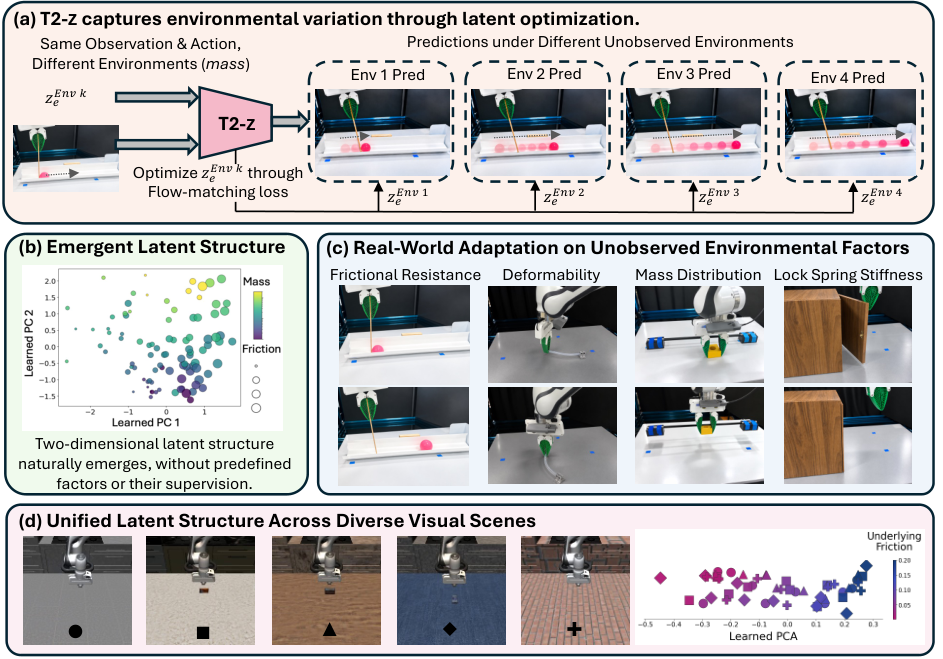
- We introduce T2-Z for test-time optimization of environment latents, which augments a robotic world model with a learnable environment latent to condition world predictions.
- This compact latent captures underlying environmental variation without supervision of what environmental factors exist or what values they take.
- During training, T2-Z alternates between two stages: a world-model optimization stage that fixes the latents and learns general action-conditioned dynamics across environments; and an environment-latent optimization stage that freezes the world model and optimizes the conditioning latents, allowing latent structure to emerge purely through world prediction.
- At test time, the world model remains frozen and a newly initialized environment latent is optimized from one or more test-time interactions, adapting the model to previously unseen environmental configurations.
Method
We introduce T2-z ( fig. 2 & algorithm 1 ), a framework for adapting robotic world models to hidden environmental variation through direct optimization of an environment latent. Our key idea is to separate the general visual predictive capability of a world model from unobserved environment-specific information.
During training, we learn these two components through alternating optimization under a shared flow-matching objective.
Experiments
We evaluate T2-z across 7 simulated settings and 4 real-world robotic tasks. In simulation, Friction requires predicting how far an object moves after a push under different surface friction; Gravity varies gravitational strength and requires predicting the object motion; Mass Collision varies colliding object mass and predicts the resulting collision motion.
Sources and Demonstrations
Figures are reproduced from Zhou et al. See the full paper for experimental details and the project page, when the paper links one, for demonstrations and videos.
Related Papers
3DThinkVLA: Endowing Vision-Language-Action Models with Latent 3D Priors via 3D-Thinking-Guided Co-training
Jiaxin Shi, Xidong Zhang, Fucai Zhu et al.
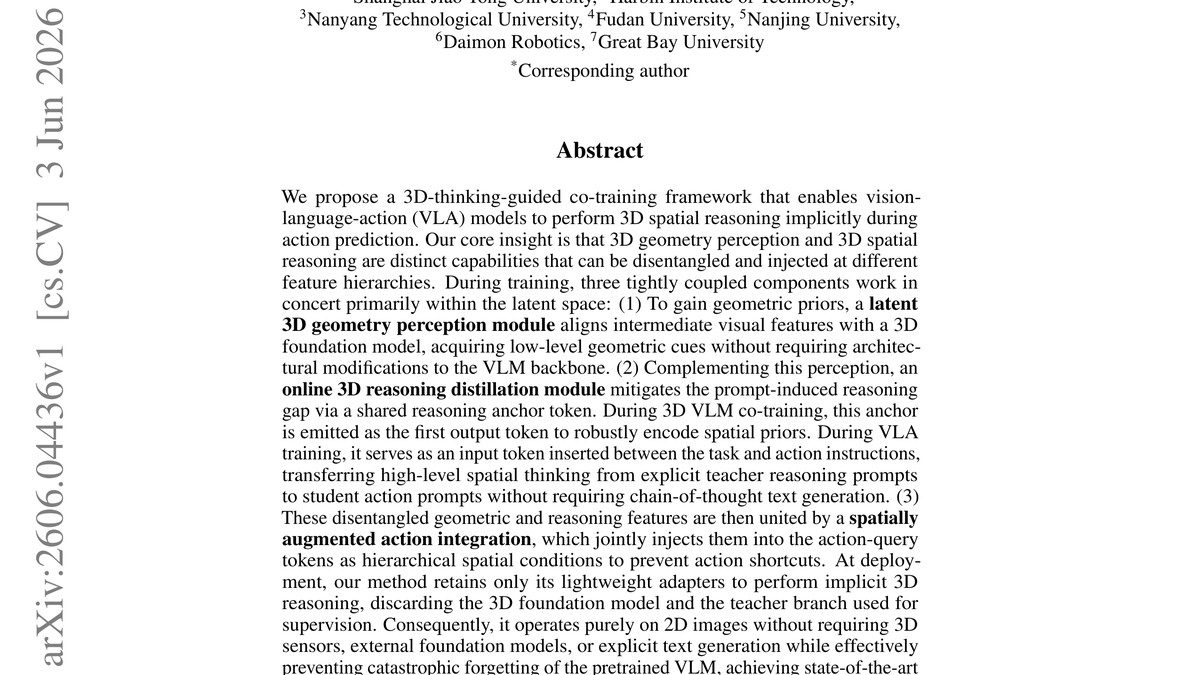
We propose a 3D-thinking-guided co-training framework that enables vision-language-action (VLA) models to perform 3D spatial reasoning implicitly during action prediction.
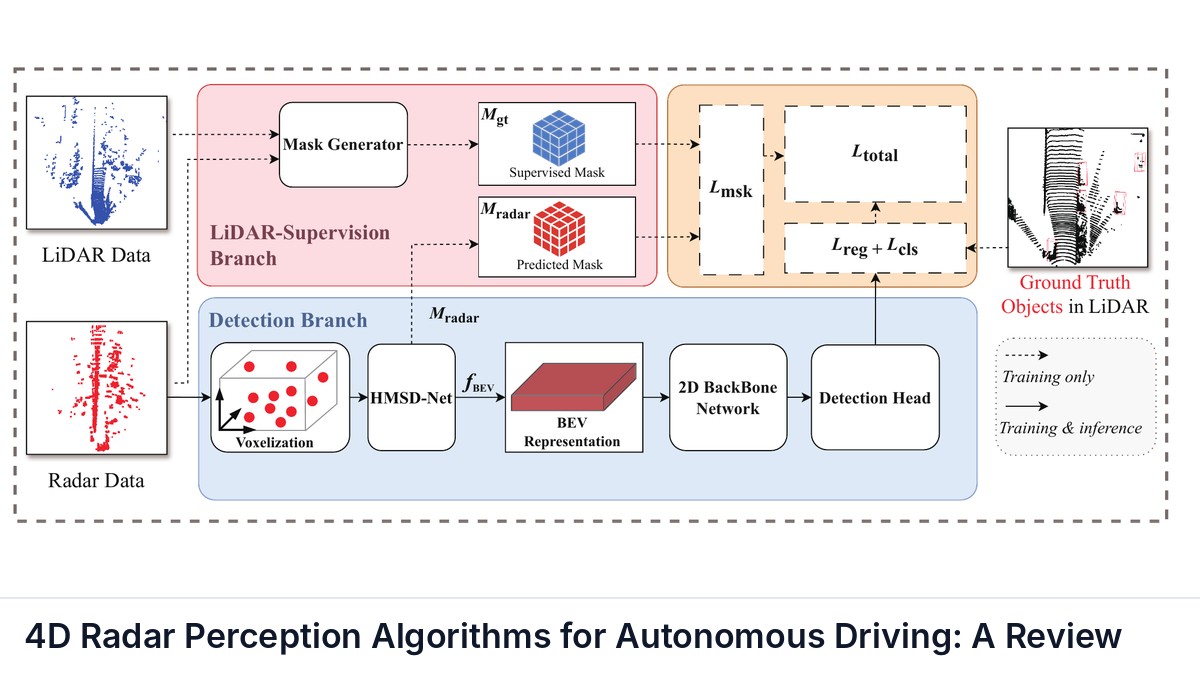
4D Radar Perception Algorithms for Autonomous Driving: A Review
Xumin Wu, Jun Zhou, Jilin Mei et al.
Research on 4D millimeter-wave radar perception algorithms has flourished in recent years, extending from signal processing and object detection to semantic segmentation, motion estimation, occupancy prediction, and dynamic scene reconstruction.
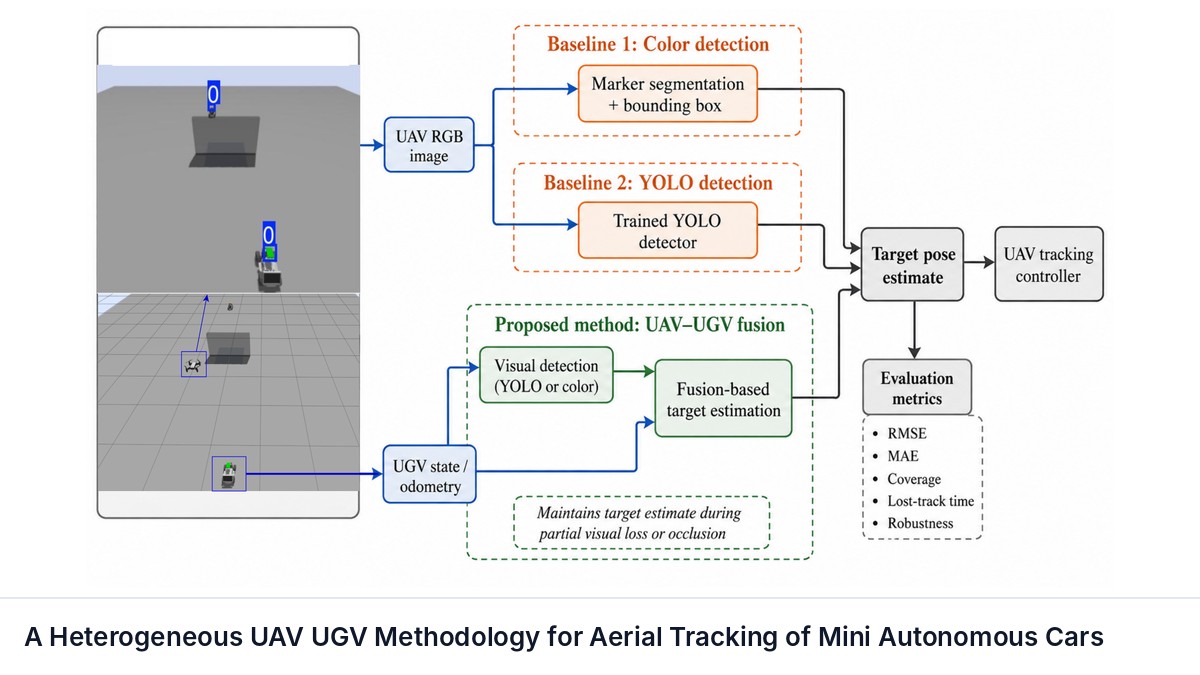
A Heterogeneous UAV UGV Methodology for Aerial Tracking of Mini Autonomous Cars
Santiago Fernandez, Angel da Silva, Hiago Sodre et al.
Aerial tracking of autonomous ground vehicles can provide useful situational awareness in environments where fixed external perception infrastructure is unavailable.
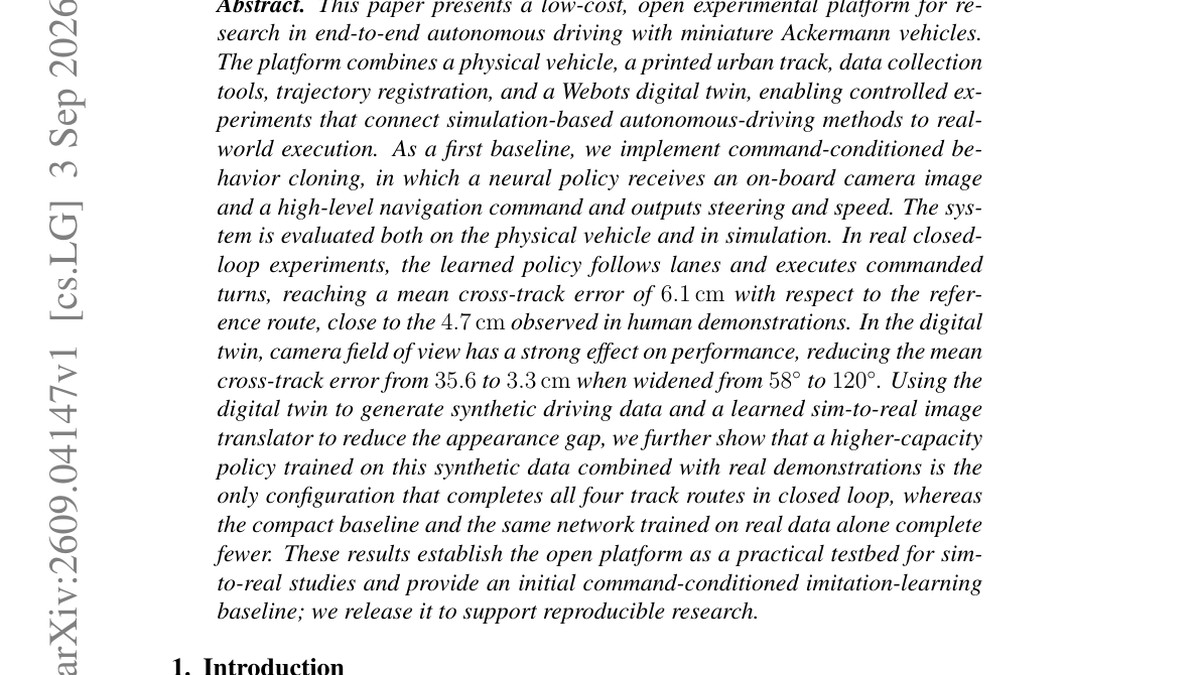
A Low-Cost, Open Platform for End-to-End Autonomous Driving on a Miniature Ackermann Vehicle
Gustavo Claudio Karl Couto, Eric Aislan Antonelo, Gabriel George Zipperer
This paper presents a low-cost, open experimental platform for research in end-to-end autonomous driving with miniature Ackermann vehicles.