
Taming an End-to-End Autonomous Driving Policy for Urban Navigation of Quadruped Robots
Joochan Kim, Chanuk Yang, Tackgeun You, Ziran Wang, Hwasup Lim · N/A · 2026
Framework
N/A
License
N/A
Stars
N/A
Summary
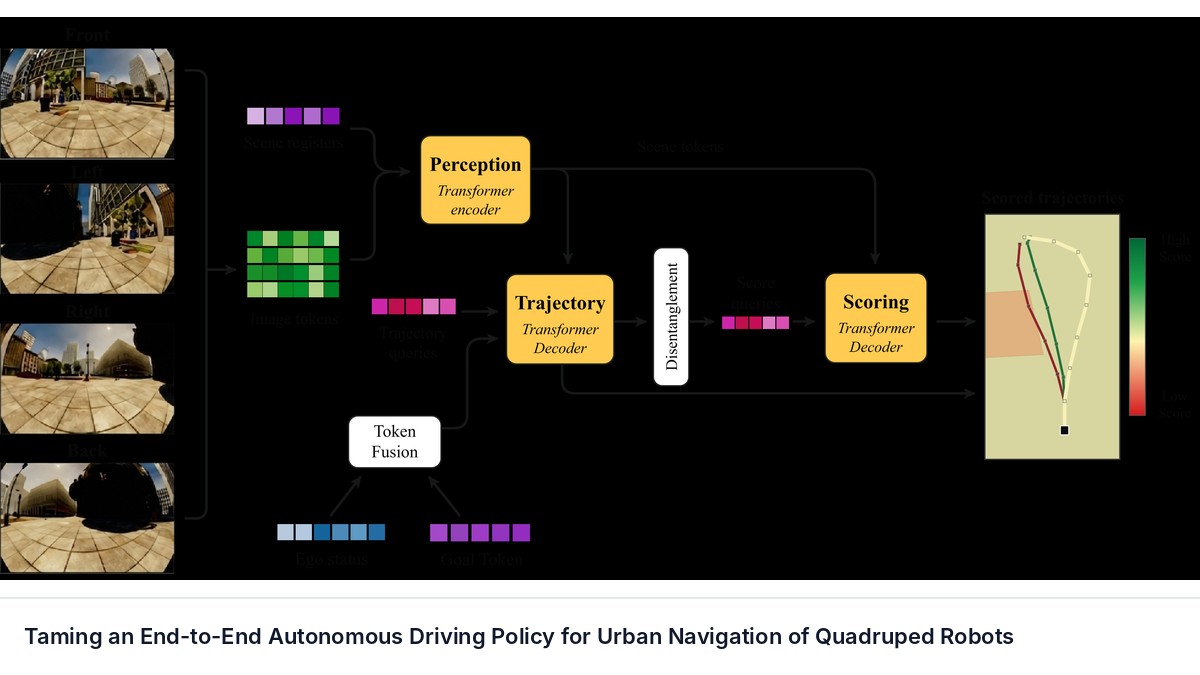
We present Go2-DrivoR, a goal-conditioned adaptation of the end-to-end autonomous driving trajectory planning framework DrivoR for urban navigation with quadrupedal robots.
Abstract Summary
Key Points
- We present Go2-DrivoR, a goal-conditioned adaptation of the end-to-end autonomous driving trajectory planning framework DrivoR for urban navigation with quadrupedal robots.
- By conditioning trajectory generation on a local-frame subgoal through a goal token and adapting the vehicle-centric scoring formulation, the method extends DrivoR to short-horizon goal-conditioned local planning without redesigning its core decoders.
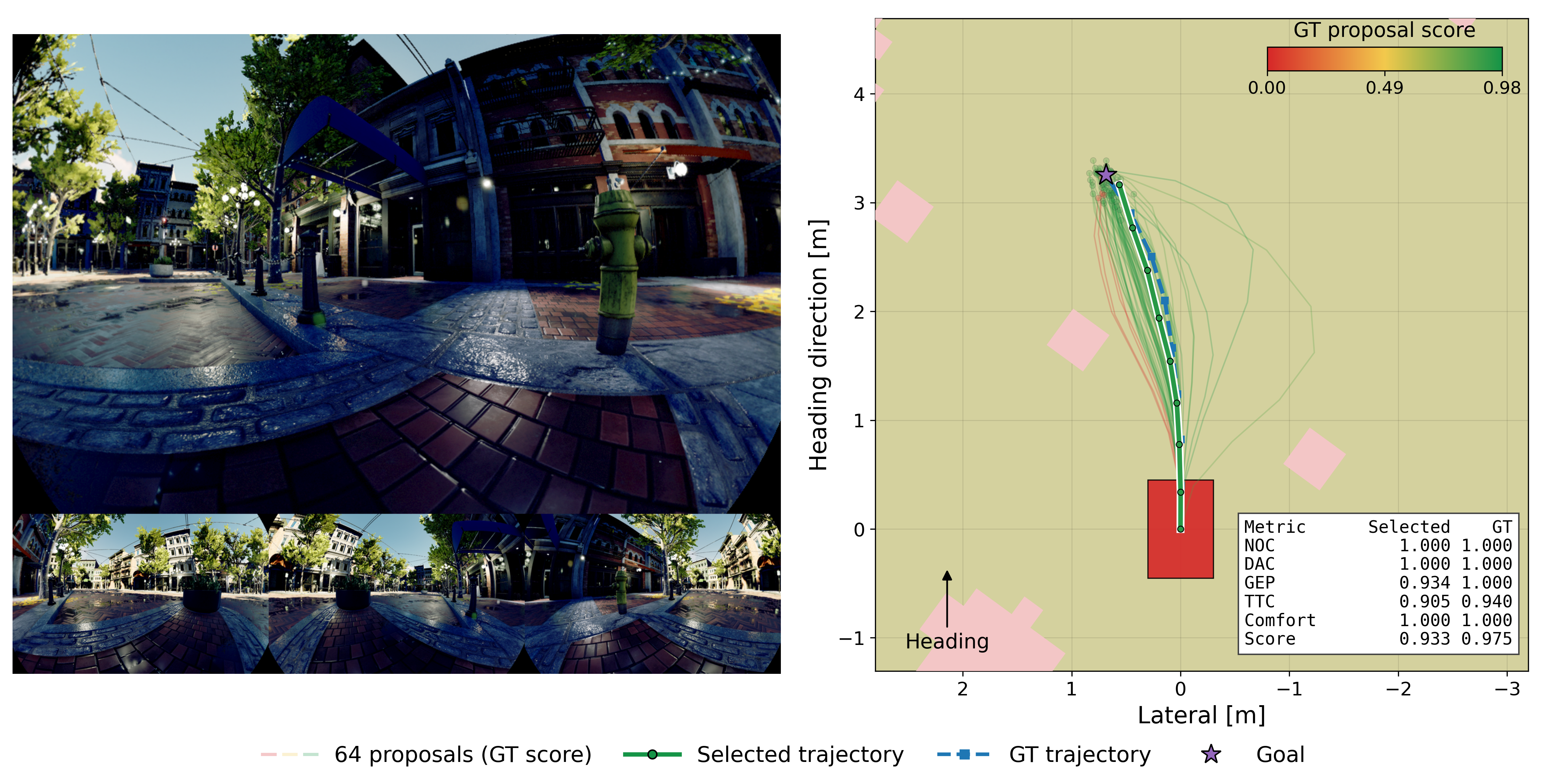
- Specifically, we redefine drivable-area compliance for sidewalk-oriented navigation and reformulate the original ego progress term as goal-conditioned ego progress.
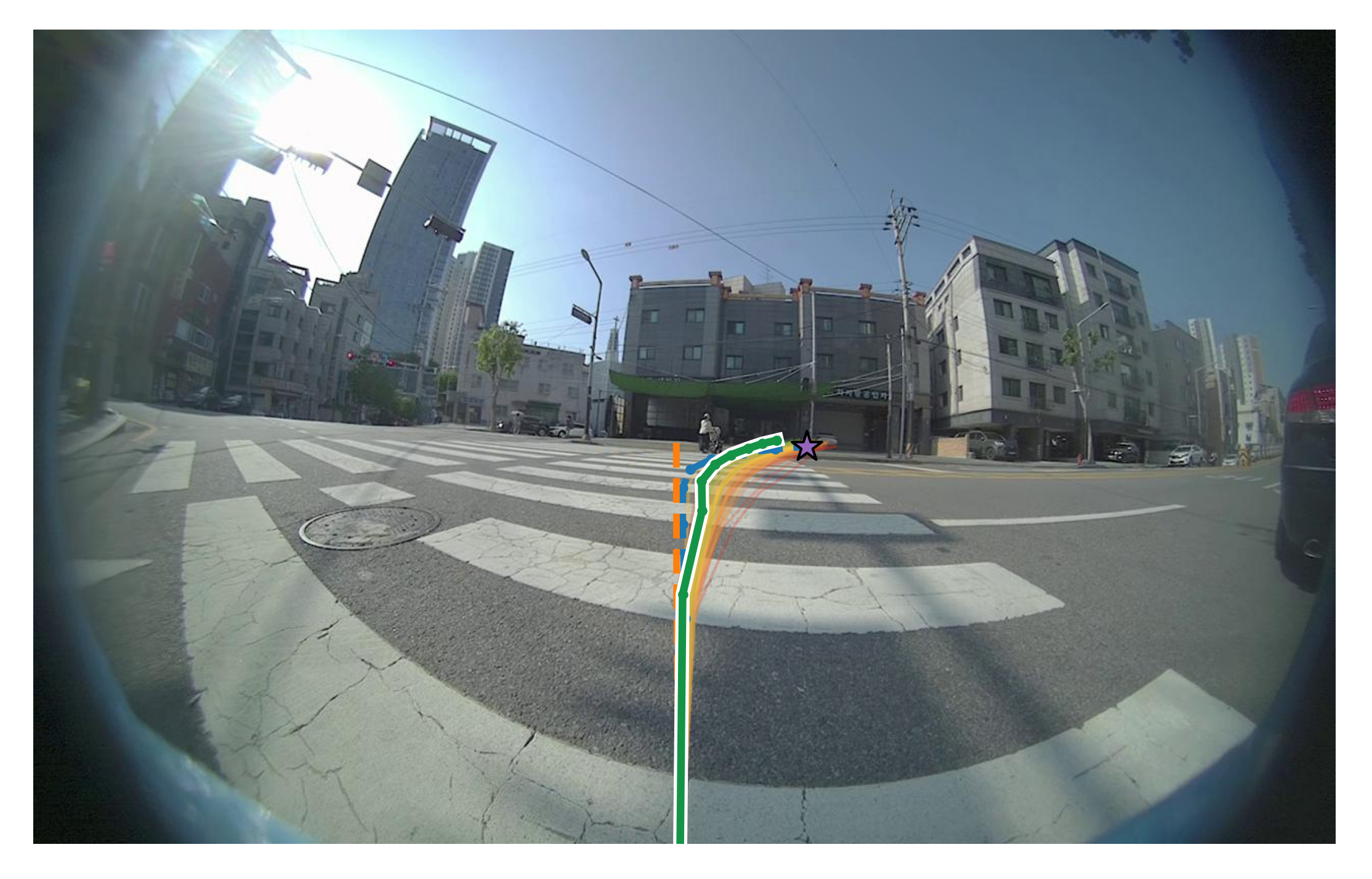
- Trained exclusively on TartanGround simulation data, Go2-DrivoR improves waypoint-conditioned planning performance on unseen simulation environments and transfers zero-shot to open-loop real-world trajectory prediction.
METHODS
We formulate urban quadrupedal navigation as goal-conditioned local trajectory planning. Given four surrounding fisheye images, the robot’s proprioceptive state, a high-level directional command, and a two-dimensional goal in the current ego frame, Go2-DrivoR generates $K$ candidate trajectories and selects the one with the highest predicted score.
The output consists of eight $(x,y,\theta)$ waypoints over a four-second horizon, expressed in the current ego frame.
Experiments
The training data consist of 14,192 local planning samples from the TartanGround dataset [ 8 ] . We train the model for 20 epochs using AdamW [ 10 ] on three NVIDIA H200 GPUs with a global batch size of 48. The learning rate is set to $5\times 10^{-4}$, with a two-epoch warm-up phase, followed by cosine annealing.
Open-loop inference is performed on a single NVIDIA H200 GPU, with measured batch latencies of 10.8 ms at batch size 1 and 94.1 ms at batch size 16.
Sources and Demonstrations
Figures are reproduced from Kim et al. See the full paper for experimental details and the project page, when the paper links one, for demonstrations and videos.
Related Papers
AcousticDiffusion: Semantically Conditioned Audio-Guided Diffusion Policy for Search-and-Rescue Assistance
Iana Zhura, Didar Seyidov, Dmitrii Plotnikov et al.
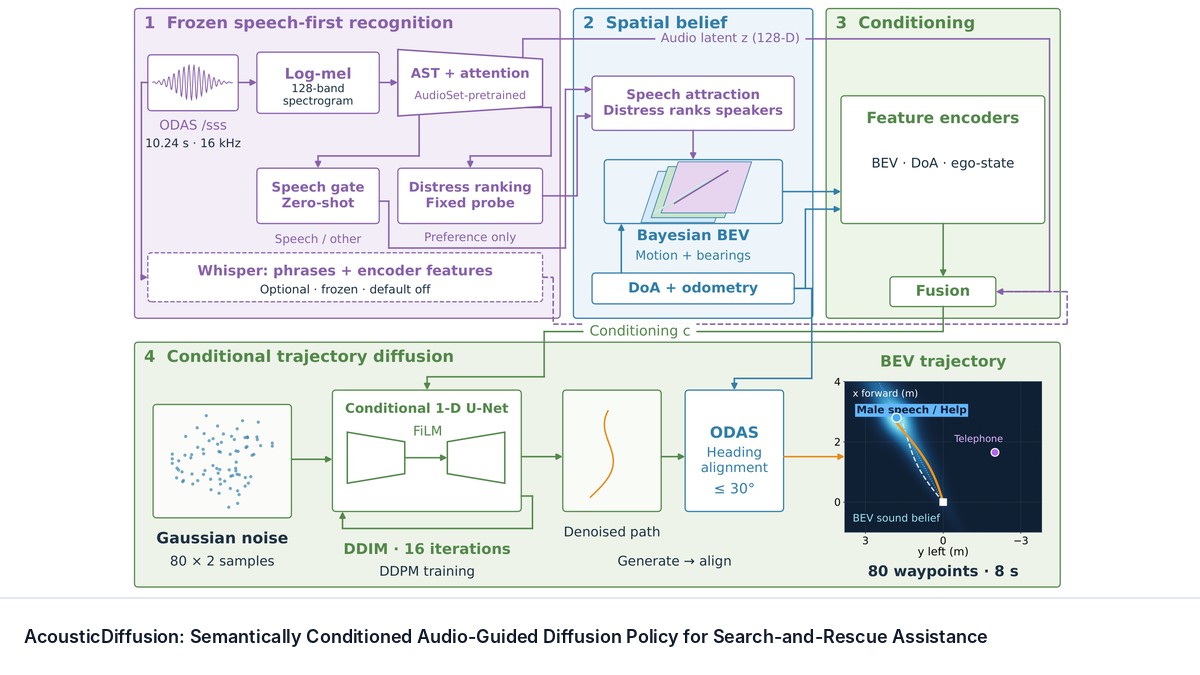
Navigating toward human callers is an important capability for rescue robots operating where visual contact is degraded or occluded. We present AcousticDiffusion, a semantically conditioned, audio-guided diffusion policy for human-directed navigation.
Contact-Rich Motion Planning via GPU-Parallel Mode Evaluation
Jiayun Li, Georgia Chalvatzaki
Contact-rich motion planning (CRMP) is essential for robotic manipulation and locomotion, yet remains computationally challenging due to combinatorial contact decisions.
FlashNeRD: Performance-First Contact-Rich Neural Robot Dynamics
Mohammadmehdi Ataei, Mohammad Amin Nabian, Jie Xu et al.
Compared with analytical physics, learned dynamics models promise robot simulation that is faster, inherently differentiable, and easily adaptable to real data.
Hamilton-Jacobi Reachability for Hybrid Systems: Unified Goal-Driven Control with Safety Guarantees
Javier Borquez, Shuang Peng, Somil Bansal
Hybrid dynamical systems provide a powerful modeling framework for robotic systems, particularly in contact-rich environments. However, ensuring safety and performance in such systems remains challenging due to the intricate coupling between continuous dynamics and discrete mode transitions.