
Hamilton-Jacobi Reachability for Hybrid Systems: Unified Goal-Driven Control with Safety Guarantees
Javier Borquez, Shuang Peng, Somil Bansal · N/A · 2026
Framework
N/A
License
N/A
Stars
N/A
Summary
Hybrid dynamical systems provide a powerful modeling framework for robotic systems, particularly in contact-rich environments. However, ensuring safety and performance in such systems remains challenging due to the intricate coupling between continuous dynamics and discrete mode transitions.
Abstract Summary
Key Points
- Hybrid dynamical systems provide a powerful modeling framework for robotic systems, particularly in contact-rich environments.
- However, ensuring safety and performance in such systems remains challenging due to the intricate coupling between continuous dynamics and discrete mode transitions.
- In this work, we extend classical Hamilton-Jacobi (HJ) reachability analysis, a formal verification method for continuous-time nonlinear systems, to hybrid dynamical systems.
- Our framework characterizes safe sets for hybrid systems through a generalized value function defined over both discrete and continuous states while accounting for control constraints and model uncertainty.
- We additionally provide a numerical algorithm to compute this value function
Problem Formulation
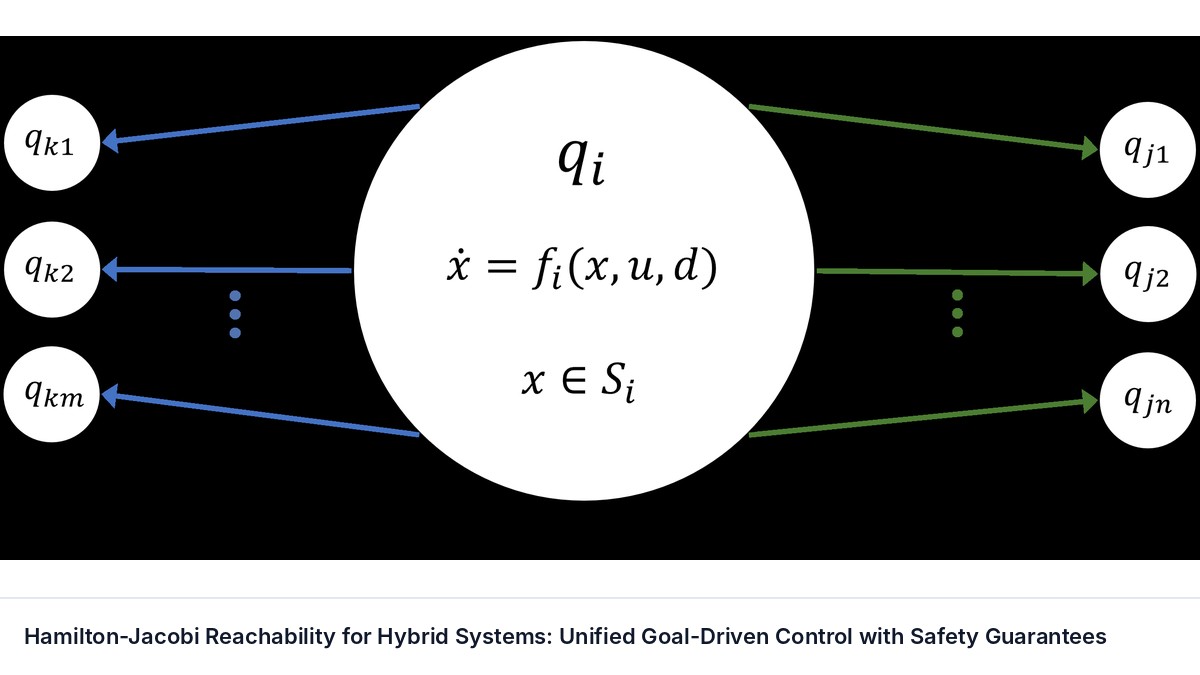
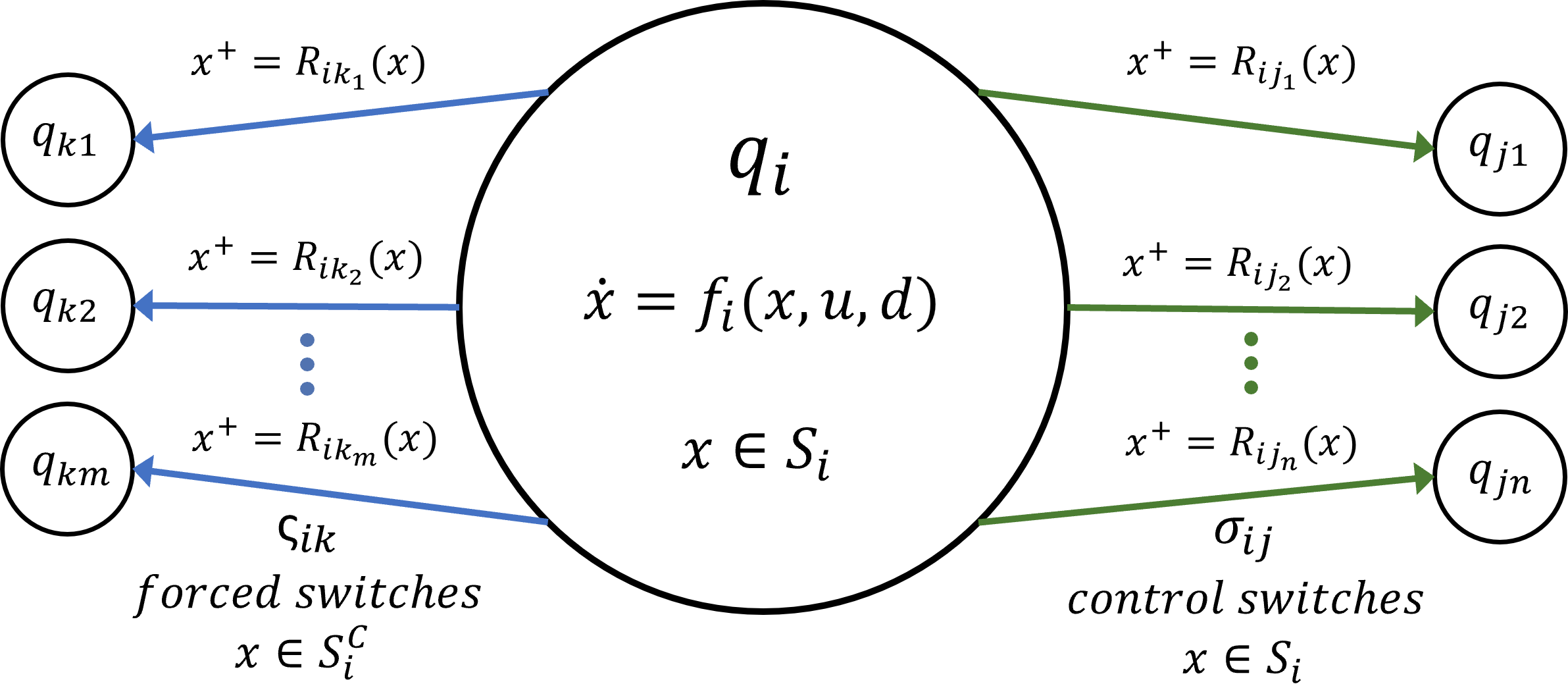
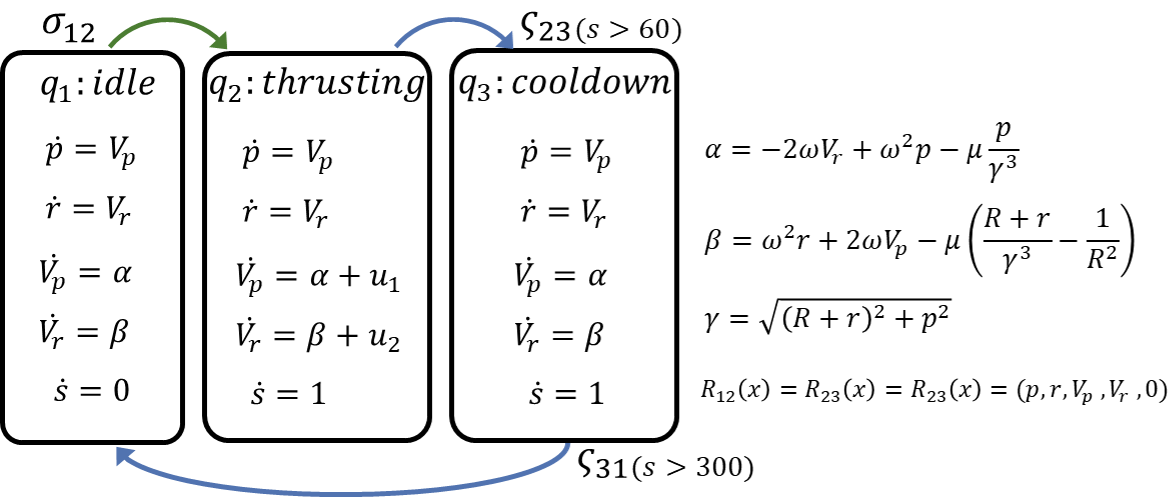
We consider a hybrid dynamical system as defined by Lygeros et al. (2008) : where $Q:=\{q_{1},q_{2},\ldots,q_{N}\}$ is a finite set of discrete modes. We also refer to $q_{i}$ as the discrete state of the system.
Let $x\in X\subset\mathbb{R}^{n_{x}}$ be the continuous state of the system, $u\in U\subset\mathbb{R}^{n_{u}}$ be the continuous control input, and $d\in D\subset\mathbb{R}^{n_{d}}$ be the continuous disturbance in the system.
Safety Filtering for Hybrid Systems
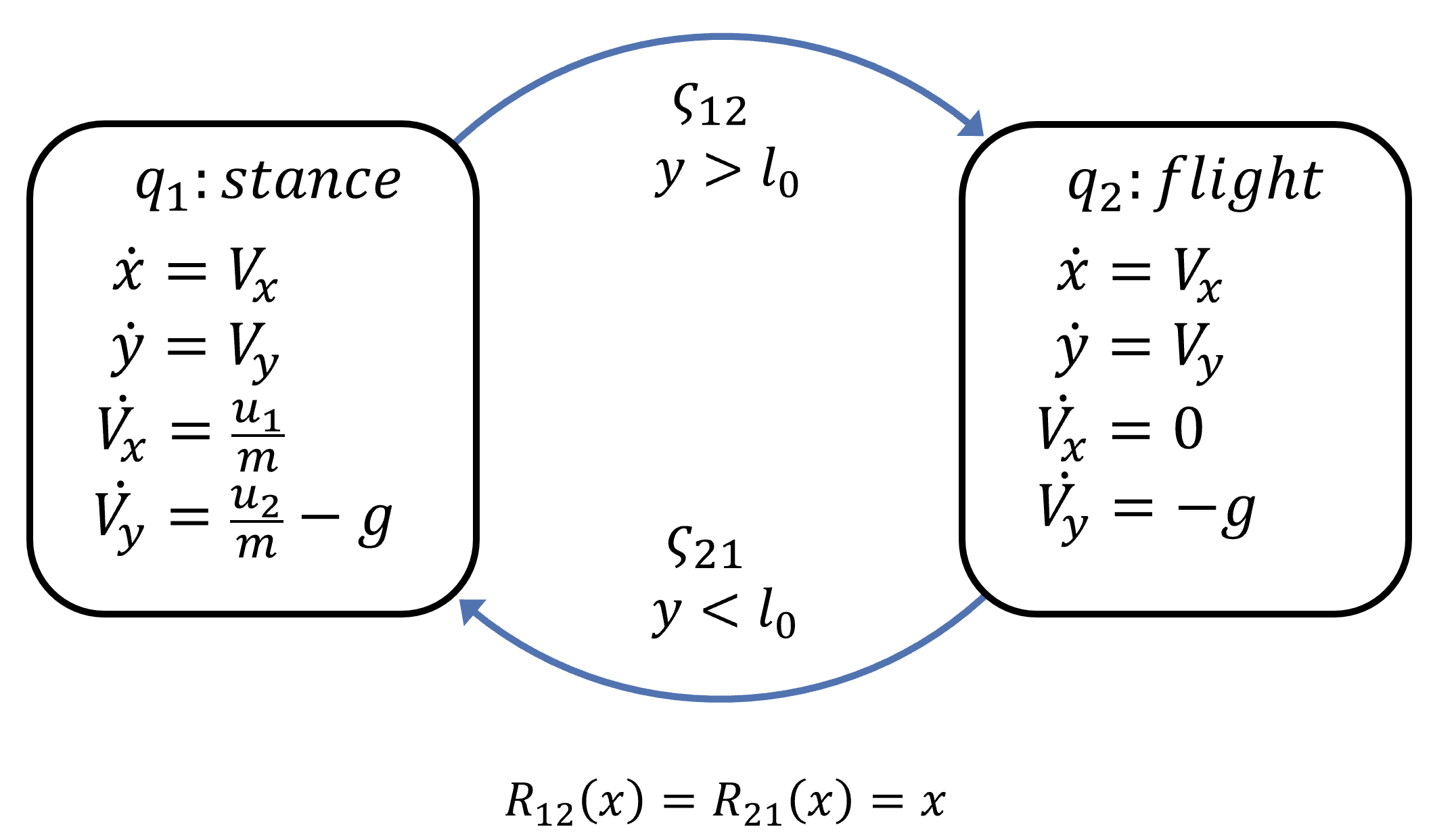
In this section, we address the hybrid safety filtering problem introduced in Subsection 3.2 , where the goal is to enforce safety in a hybrid system by modifying a nominal control policy only when necessary to prevent eventual entry into the failure set.
To this end, we propose and validate a minimally intrusive hybrid safety control filter that wraps around a given nominal hybrid control policy and ensures that the system remains within the safe set throughout its operation.
Reach-Avoid Formulation for Hybrid Systems
In previous sections, we introduced the hLRF as a mechanism to ensure safety by filtering unsafe actions in real time. While this provides strong safety guarantees, many applications also require task completion guarantees, such as reaching a goal location within specific time constraints.
In this section, we address this complementary need by introducing a reach-avoid formulation for hybrid systems that guarantees both safety and task completion.
Full System Experiments
To illustrate feasibility of real-time online execution of the proposed hBRAT framework proposed in Section 6 , we test it on a real-world quadruped experiment in the adapted Barkour ( Caluwaerts et al., 2023 ) benchmarking environment inspired by dog agility competitions. The environment consists of a diverse set of obstacles as shown in Fig.
Sources and Demonstrations
Figures are reproduced from Borquez et al. See the full paper for experimental details and the project page, when the paper links one, for demonstrations and videos.
Related Papers
FlashNeRD: Performance-First Contact-Rich Neural Robot Dynamics
Mohammadmehdi Ataei, Mohammad Amin Nabian, Jie Xu et al.
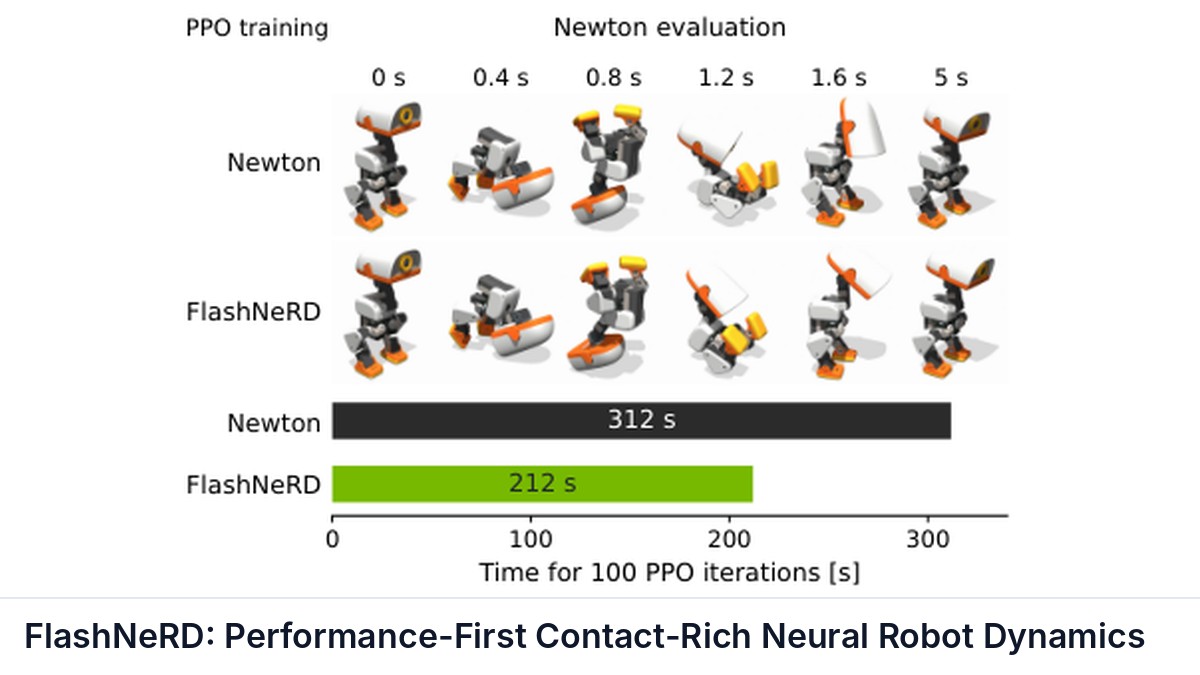
Compared with analytical physics, learned dynamics models promise robot simulation that is faster, inherently differentiable, and easily adaptable to real data.
Has GPT-6-Astra Achieved Embodied Intelligence?
SenseNova, Joint Research Team, : et al.
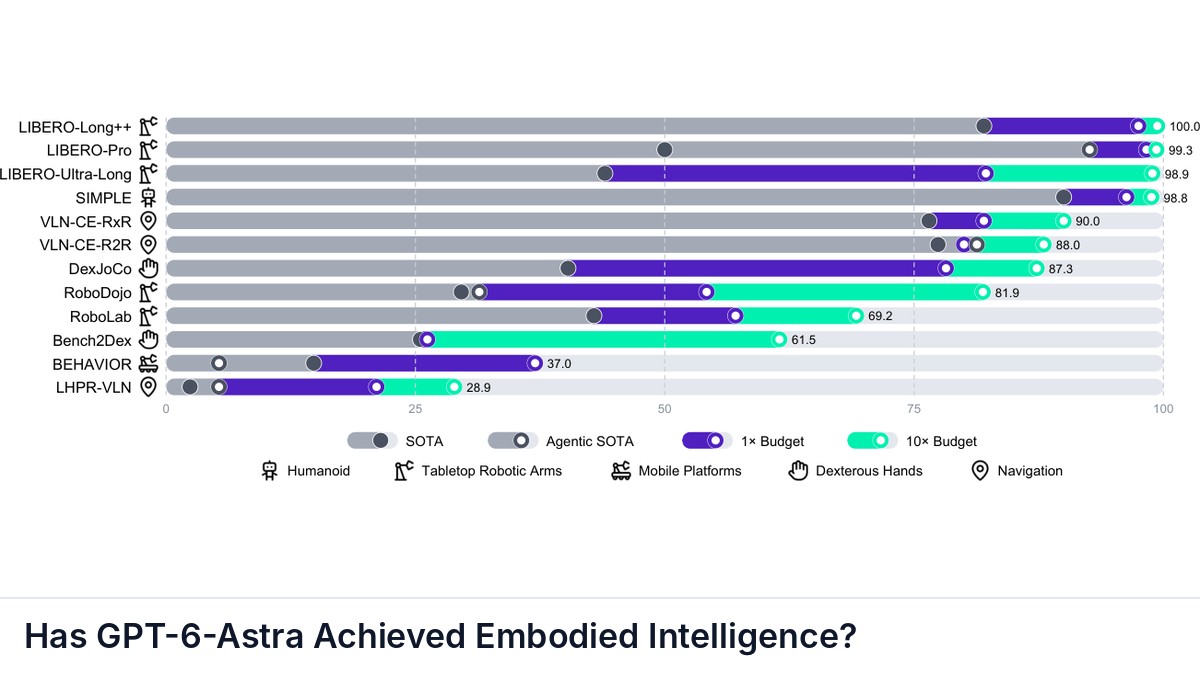
GPT-6-Astra demonstrates a level of competence in robotic manipulation and navigation that challenges the conventional paradigm of building specialized models for individual tasks and embodiments.
Learning Safe Humanoid Navigation from Reduced Order Models
William D. Compton, Zachary Olkin, Ryan Bena et al.
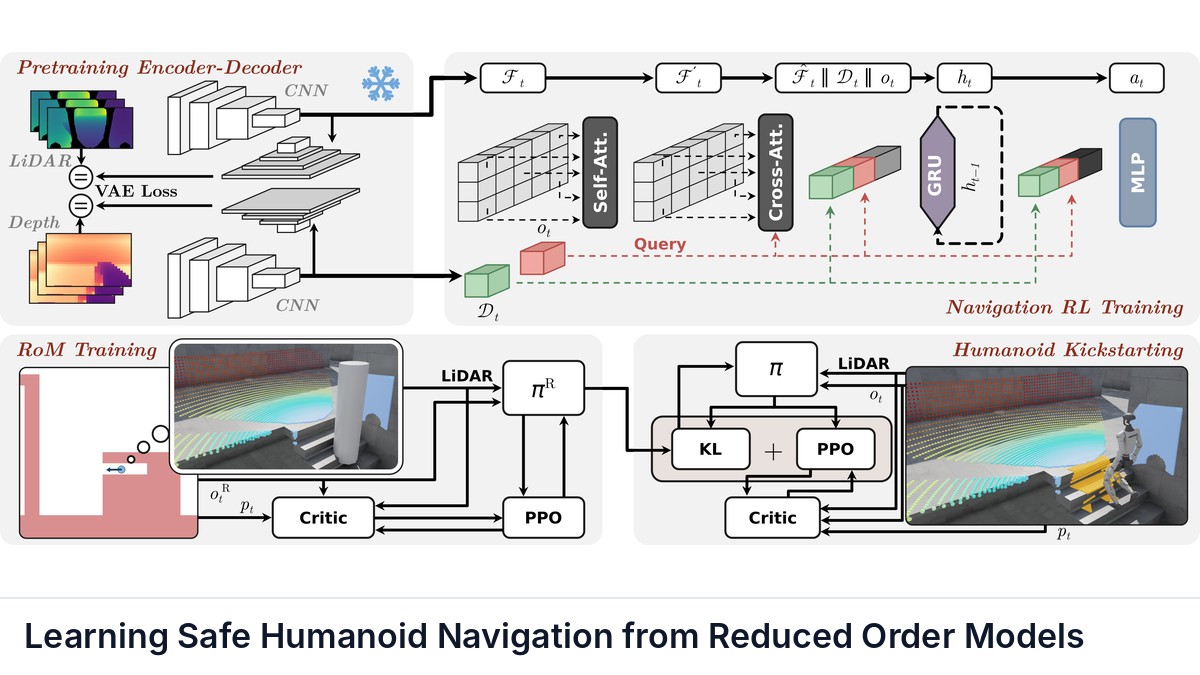
Research in humanoid robotics has achieved rapid progress in locomotion, and recent results have pushed the boundary on autonomous navigation.
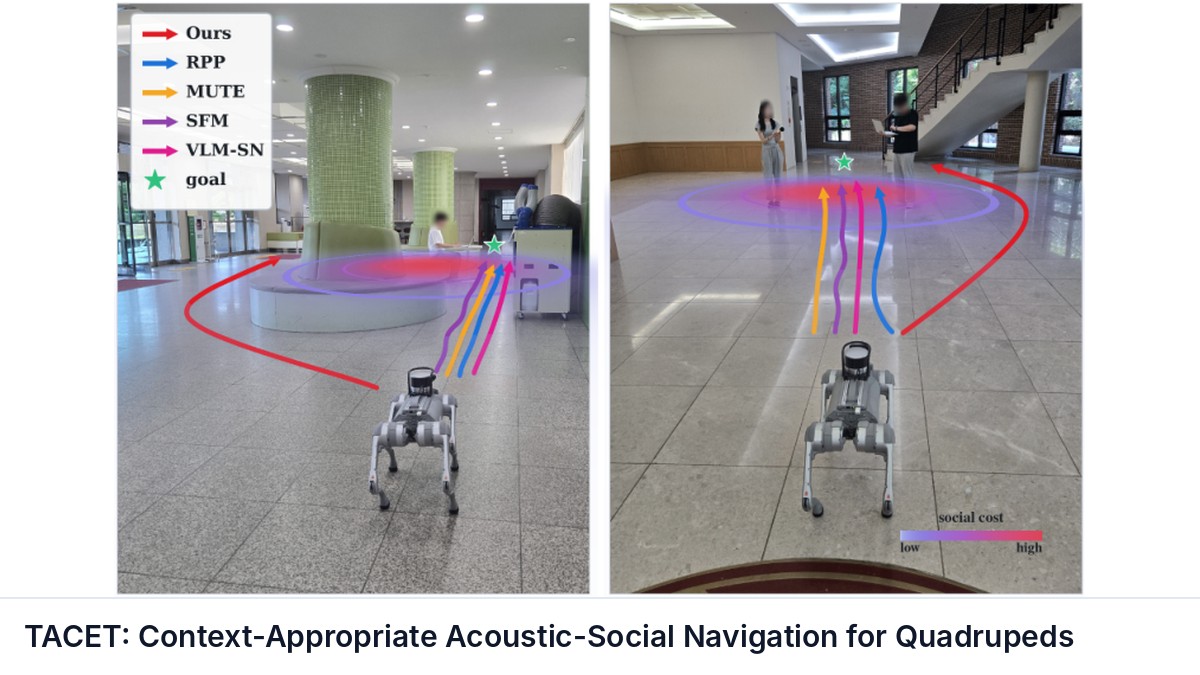
TACET: Context-Appropriate Acoustic-Social Navigation for Quadrupeds
Sungsan Park, Young-Sik Shin, Sanghyun Kim
Quadruped robots entering hospitals, care homes, and quiet offices must be context-appropriate not only in where they move but in how loudly they move: a legged robot's locomotion noise, dominated by foot-ground impacts, is itself a social variable.