
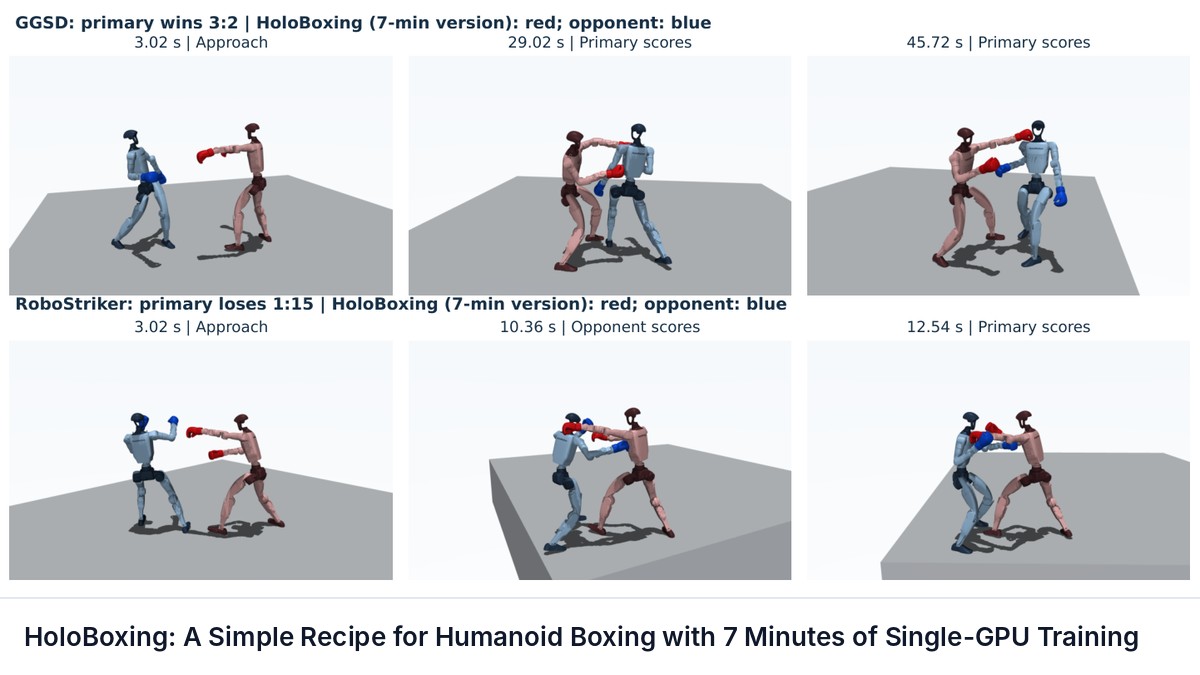
HoloBoxing: A Simple Recipe for Humanoid Boxing with 7 Minutes of Single-GPU Training
Xihan Ma, Bo Zhang, Boxiong Li, Yuhan Bao, Ziyue Liu, Yucheng Wang · N/A · 2026
Framework
N/A
License
N/A
Stars
N/A
Summary
HoloBoxing presents a simple recipe for learning humanoid boxing by building on a pretrained whole-body controller. The recipe separates reusable motor skills from task decisions: a compact planner requests future body-point targets, while the frozen controller handles joint-level execution.
Abstract Summary
Key Points
- HoloBoxing presents a simple recipe for learning humanoid boxing by building on a pretrained whole-body controller.
- The recipe separates reusable motor skills from task decisions: a compact planner requests future body-point targets, while the frozen controller handles joint-level execution.
- A learned decoder maps 32-dimensional actions to structured target windows, and measured-state imitation initializes the planner before reinforcement learning.
- Task learning then refines interaction behavior while reusing the decoder and controller, avoiding the need to relearn whole-body control.
- This combination keeps task optimization focused on a compact upper policy and supplies an initial behavior before reward-driven exploration.
\calmregular 3 \calmregular HoloBoxing
The recipe learns task decisions above a fixed motor controller. It fits a target representation, initializes a feedback planner, and refines that planner through interaction while preserving whole-body execution. For masked observation $M(o_{t})$, the execution chain is Here, $\mathcal{N}(u)=u/\/u\/$ uses a fixed fallback at zero.
The planner $f_{\theta}$ requests targets $g_{t}$ through decoder $D_{\phi}$; the frozen controller $\pi_{\mathrm{HM}}$ combines them with robot feedback $c_{t}$.
\calmregular 4 \calmregular Evaluating short task adaptation
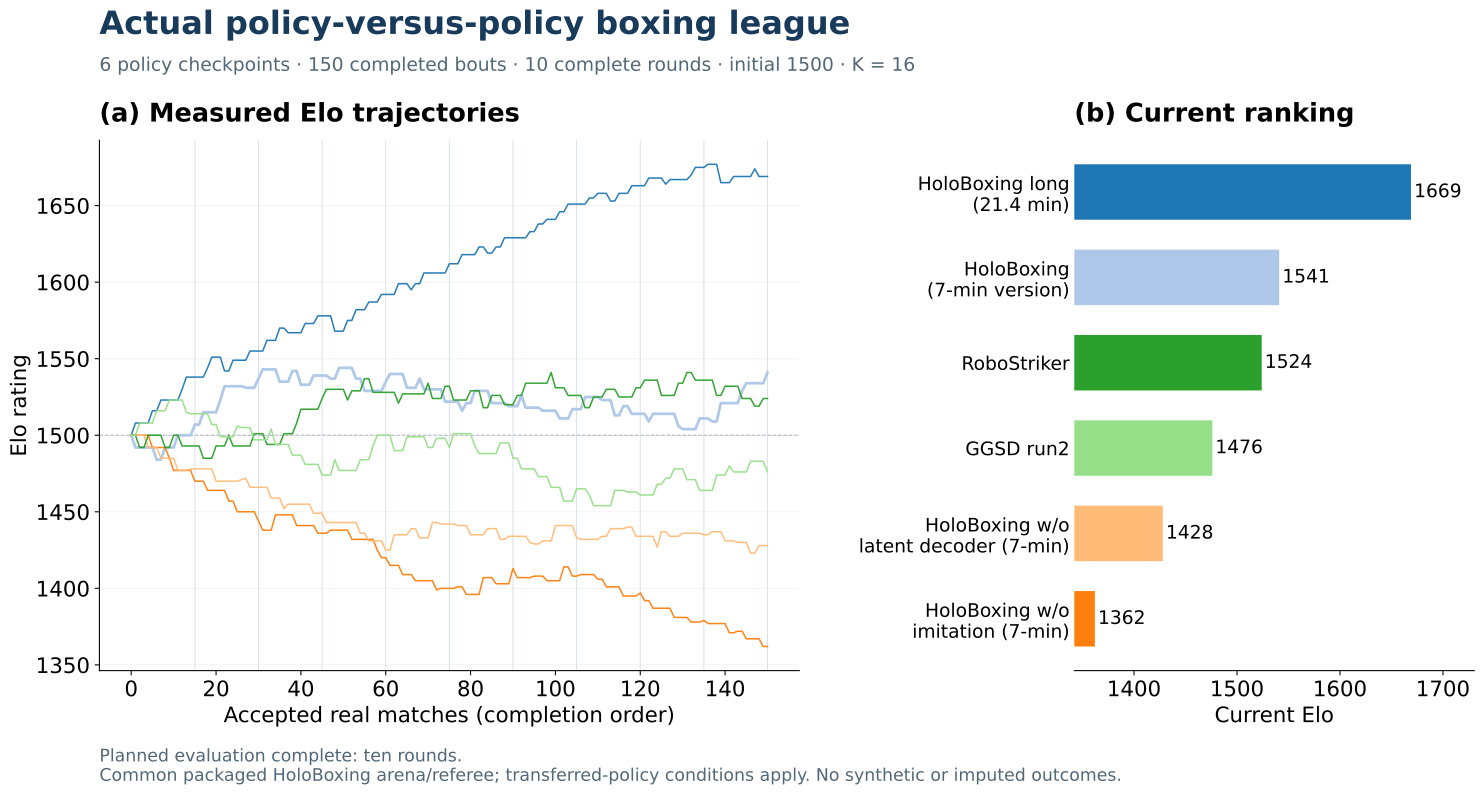
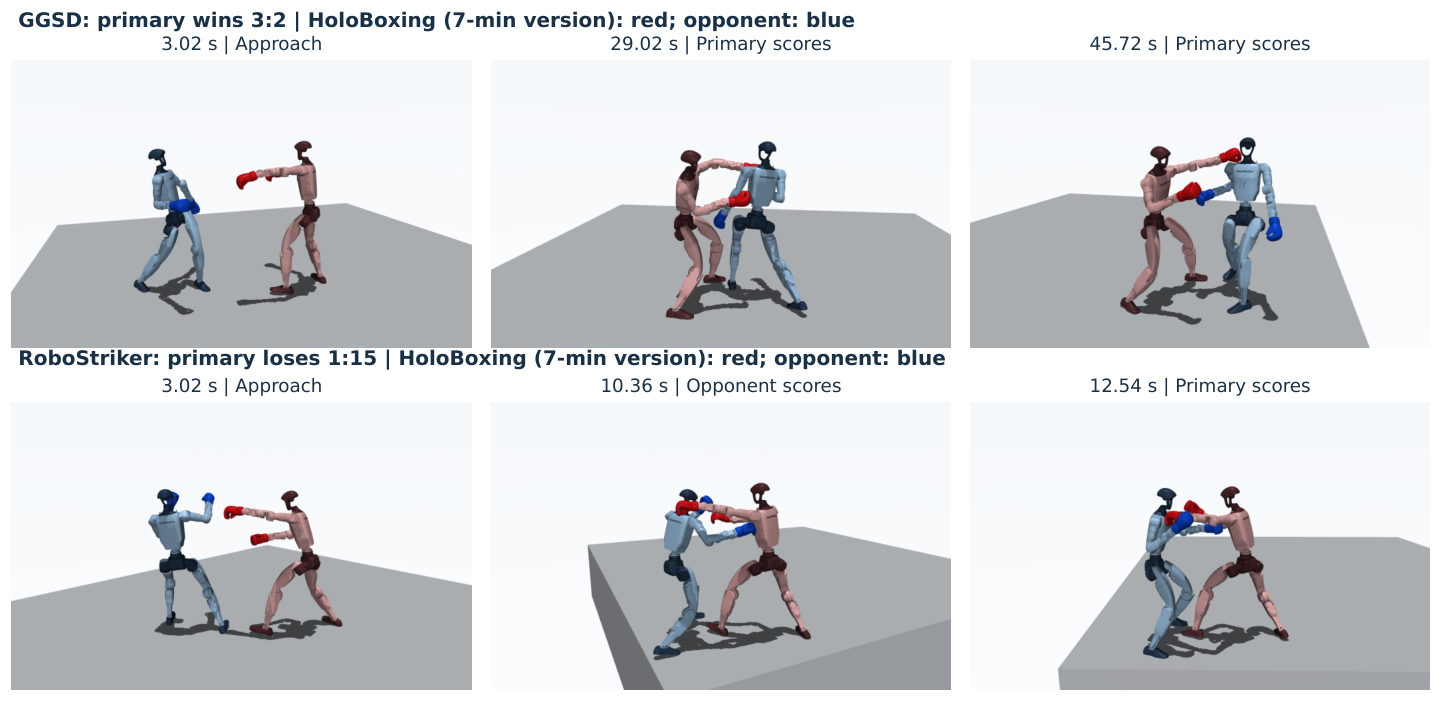
The evaluation asks whether the reused hierarchy produces interactive boxing after the recorded short training procedure. It measures training time, competitive behavior, and the effects of removing task-policy components. These measurements address different parts of the recipe: time quantifies adaptation cost, while behavior tests what that budget achieves.
All evaluated policies share the packaged robot, actuator settings, arena, simulator, and referee.
\calmregular 5 \calmregular Experiments: training cost and resulting behavior
The selected HoloBoxing recipe uses the Unitree G1 and the frozen HoloMotion v2 controller ( Horizon Robotics, 2026 ) . The motion corpus combines paired InterHuman data ( Liang et al., 2024 ) and released RoboStriker trajectories ( RoboStriker Authors, 2026 ) . The 14 original training motions total 212.88 seconds after retargeting; both participants and mirrored versions remain grouped within each split.
Prior fitting uses 21148 training windows, 11074 validation windows, and a separate test population of 3246 windows.
Sources and Demonstrations
Figures are reproduced from Ma et al. See the full paper for experimental details and the project page, when the paper links one, for demonstrations and videos.
Related Papers
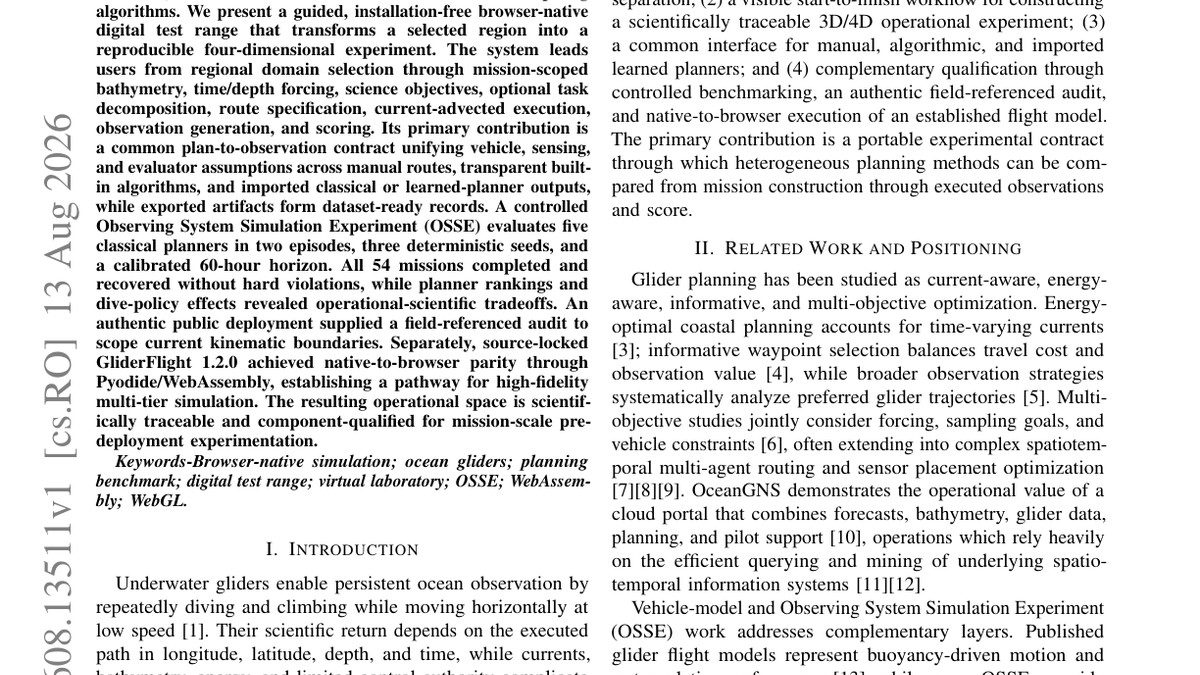
A Browser-Native Digital Test Range for Benchmarking 4D Ocean-Glider Planning Algorithms
Edward Holmberg, Elias Ioup, Mahdi Abdelguerfi
Repeated in-situ evaluation of ocean-glider planners requires scarce vehicles, operators, deployment and recovery resources, and ocean conditions that cannot be reset for competing algorithms.
A Mode-Unified, Continuous, and Biomimetic Control Strategy of a Robotic Lower Limb Prosthesis
Hanjun Kim, Sixu Zhou, John Shim et al.
Existing biomimetic lower-limb prosthesis controllers are commonly designed for discrete locomotion modes, requiring separate parameterizations for level walking, ramps, and stairs.

A Sim-to-Real Integration Pipeline for Training and Deployment of Chunk-Based VLA Manipulation Policies
Mathilde Kappel, Clémence Grislain, Mohamed Chetouani et al.
Vision-Language-Action (VLA) models have become a prominent paradigm for mapping multimodal inputs, including semantic instructions, visual observations of the scene, and proprioceptive observations, to robot actions.
A Unified Kinematic Representation Enables Reusable Biological Joint Moment Estimation
Jinwoo Hwang, Ilseung Park, Changseob Song et al.
Objective: Data-driven models that estimate physiological states, particularly biological joint moments, are widely used in exoskeleton control.