
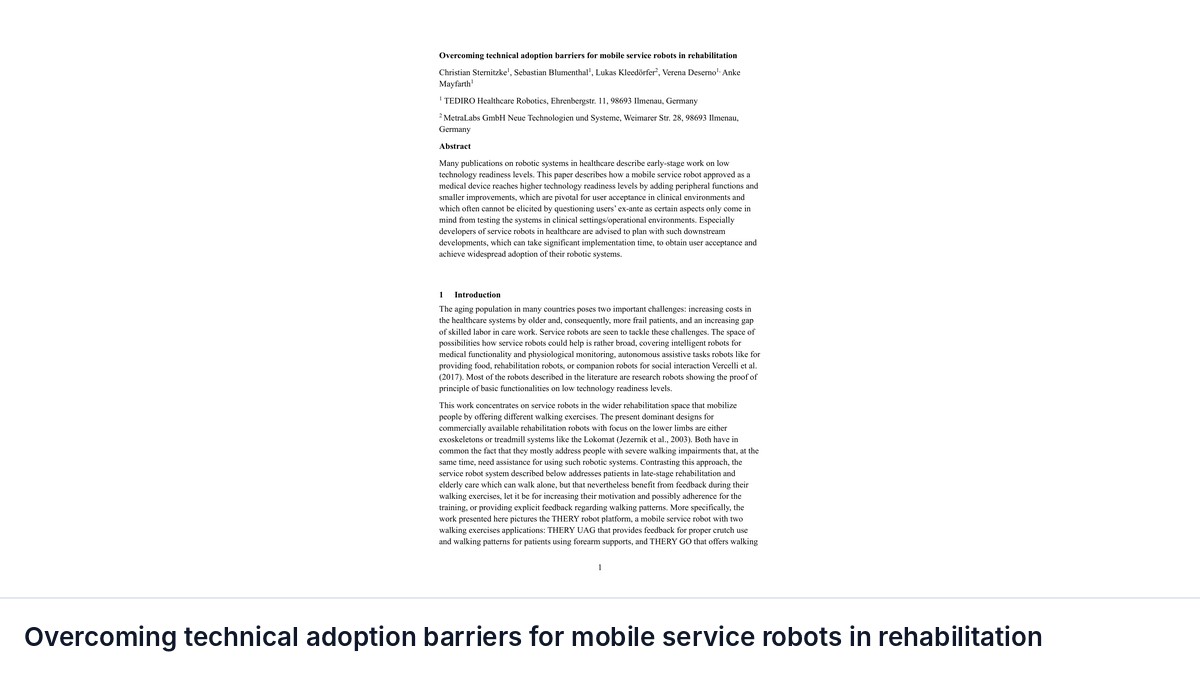
Overcoming technical adoption barriers for mobile service robots in rehabilitation
Christian Sternitzke, Sebastian Blumenthal, Lukas Kleedoerfer, Verena Deserno, Anke Mayfarth · N/A · 2026
Framework
N/A
License
N/A
Stars
N/A
Summary
Many publications on robotic systems in healthcare describe early-stage work on low technology readiness levels.
Abstract Summary
Key Points
- Many publications on robotic systems in healthcare describe early-stage work on low technology readiness levels.
- This paper describes how a mobile service robot approved as a medical device reaches higher technology readiness levels by adding peripheral functions and smaller improvements, which are pivotal for user acceptance in clinical environments and which often cannot be elicited by questioning users ex-ante as certain aspects only come in mind from testing the systems in clinical settings or operational environments.
- Especially developers of service robots in healthcare are advised to plan with such downstream developments, which can take significant implementation time, to obtain user acceptance and achieve widespread adoption of their robotic systems.
Overcoming technical adoption barriers for mobile service robots in rehabilitation
|Authors: Christian Sternitzke, Sebastian Blumenthal, Lukas Kleedoerfer, Verena Deserno, Anke Mayfarth
|Venue: arXiv preprint | Year: 2026
|arXiv: 2609.16996v1
Abstract
Many publications on robotic systems in healthcare describe early-stage work on low technology readiness levels. This paper describes how a mobile service robot approved as a medical device reaches higher technology readiness levels by adding peripheral functions and smaller improvements, which are pivotal for user acceptance in clinical environments and which often cannot be elicited by questioning users ex-ante as certain aspects only come in mind from testing the systems in clinical settings or operational environments. Especially developers of service robots in healthcare are advised to plan with such downstream developments, which can take significant implementation time, to obtain user acceptance and achieve widespread adoption of their robotic systems.
Key Contributions
- Many publications on robotic systems in healthcare describe early-stage work on low technology re…
- This paper describes how a mobile service robot approved as a medical device reaches higher techn…
- Especially developers of service robots in healthcare are advised to plan with such downstream de…
Topics
- reinforcement-learning
Code & Data
No code repository linked in paper metadata.
BibTeX
@article{Sternitzke2026_260916996v1,
  title     = {Overcoming technical adoption barriers for mobile service robots in rehabilitation},
  author    = {Christian Sternitzke and Sebastian Blumenthal and Lukas Kleedoerfer and Verena Deserno and Anke Mayfarth},
  year      = {2026},
  eprint    = {2609.16996v1},
  archivePrefix = {arXiv},
  primaryClass  = {cs.RO},
  url       = {https://arxiv.org/abs/2609.16996v1}
}
Related Papers
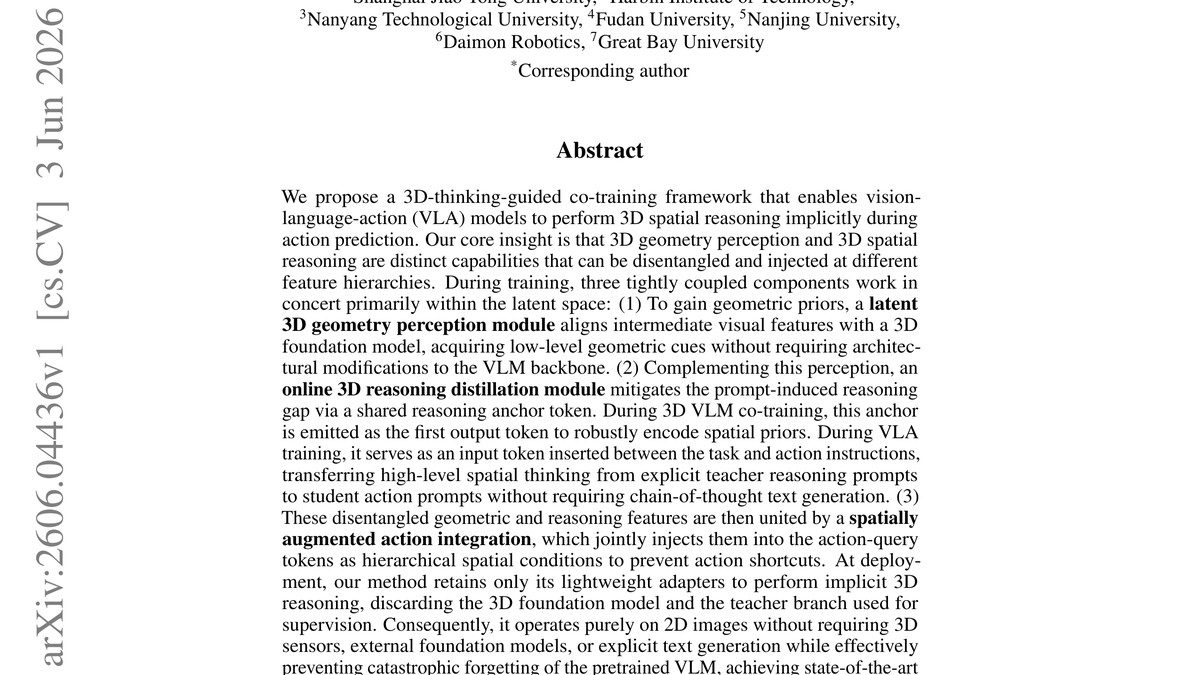
3DThinkVLA: Endowing Vision-Language-Action Models with Latent 3D Priors via 3D-Thinking-Guided Co-training
Jiaxin Shi, Xidong Zhang, Fucai Zhu et al.
We propose a 3D-thinking-guided co-training framework that enables vision-language-action (VLA) models to perform 3D spatial reasoning implicitly during action prediction.
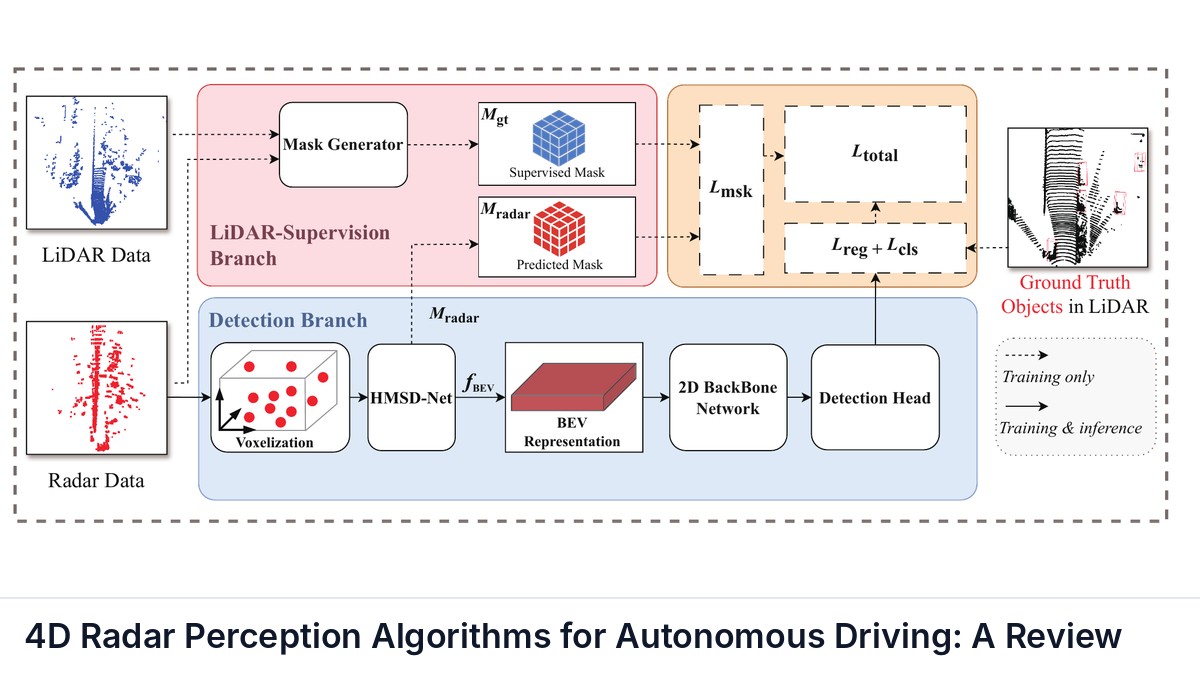
4D Radar Perception Algorithms for Autonomous Driving: A Review
Xumin Wu, Jun Zhou, Jilin Mei et al.
Research on 4D millimeter-wave radar perception algorithms has flourished in recent years, extending from signal processing and object detection to semantic segmentation, motion estimation, occupancy prediction, and dynamic scene reconstruction.
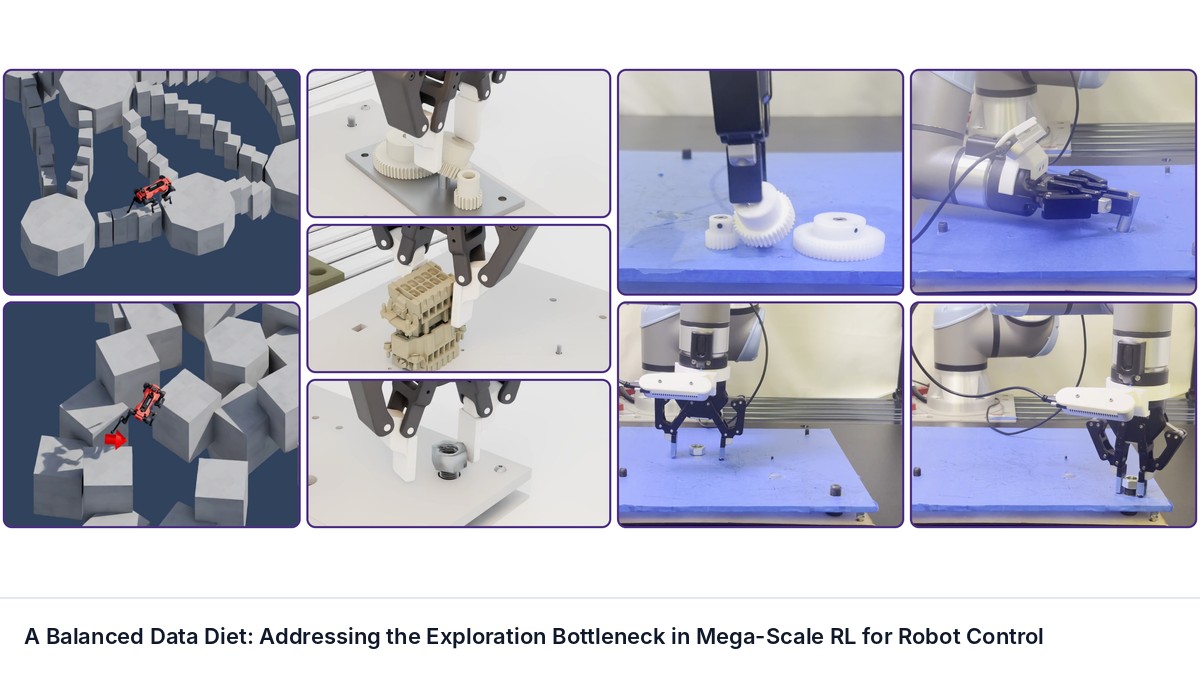
A Balanced Data Diet: Addressing the Exploration Bottleneck in Mega-Scale RL for Robot Control
Octi Zhang, Mateo Guaman Castro, Patrick Yin et al.
General-purpose robots must perform a wide range of tasks from agile locomotion to dexterous manipulation.
A Browser-Native Digital Test Range for Benchmarking 4D Ocean-Glider Planning Algorithms
Edward Holmberg, Elias Ioup, Mahdi Abdelguerfi
Repeated in-situ evaluation of ocean-glider planners requires scarce vehicles, operators, deployment and recovery resources, and ocean conditions that cannot be reset for competing algorithms.