
Trajectory Planning without Trajectory Data: A Manifold-Guided Approach
Silong Yong, Anji Liu, Cunxi Dai, Carl Busart, Guanya Shi, Yilun Du, Katia Sycara, Yaqi Xie · N/A · 2026
Framework
N/A
License
N/A
Stars
N/A
Summary
A common way for trajectory planning is to leverage generative models trained on large collections of expert trajectories. At inference time, the model generates executable trajectories by conditioning on task goal constraints.
Abstract Summary
Key Points
- A common way for trajectory planning is to leverage generative models trained on large collections of expert trajectories.
- At inference time, the model generates executable trajectories by conditioning on task goal constraints.
- However, trajectory-based methods rely on costly supervision, scale poorly with sequence length, and often generalize poorly to unseen constraints such as novel start-goal pairs.
- We propose an alternative to learn the underlying state-space manifold and use the geometry of the manifold for trajectory planning.
- This approach requires only state observations and enables generalization to unseen constraints by con- structing trajectories on the learned manifold of the state space.
Trajectory Construction on the Learned Manifold
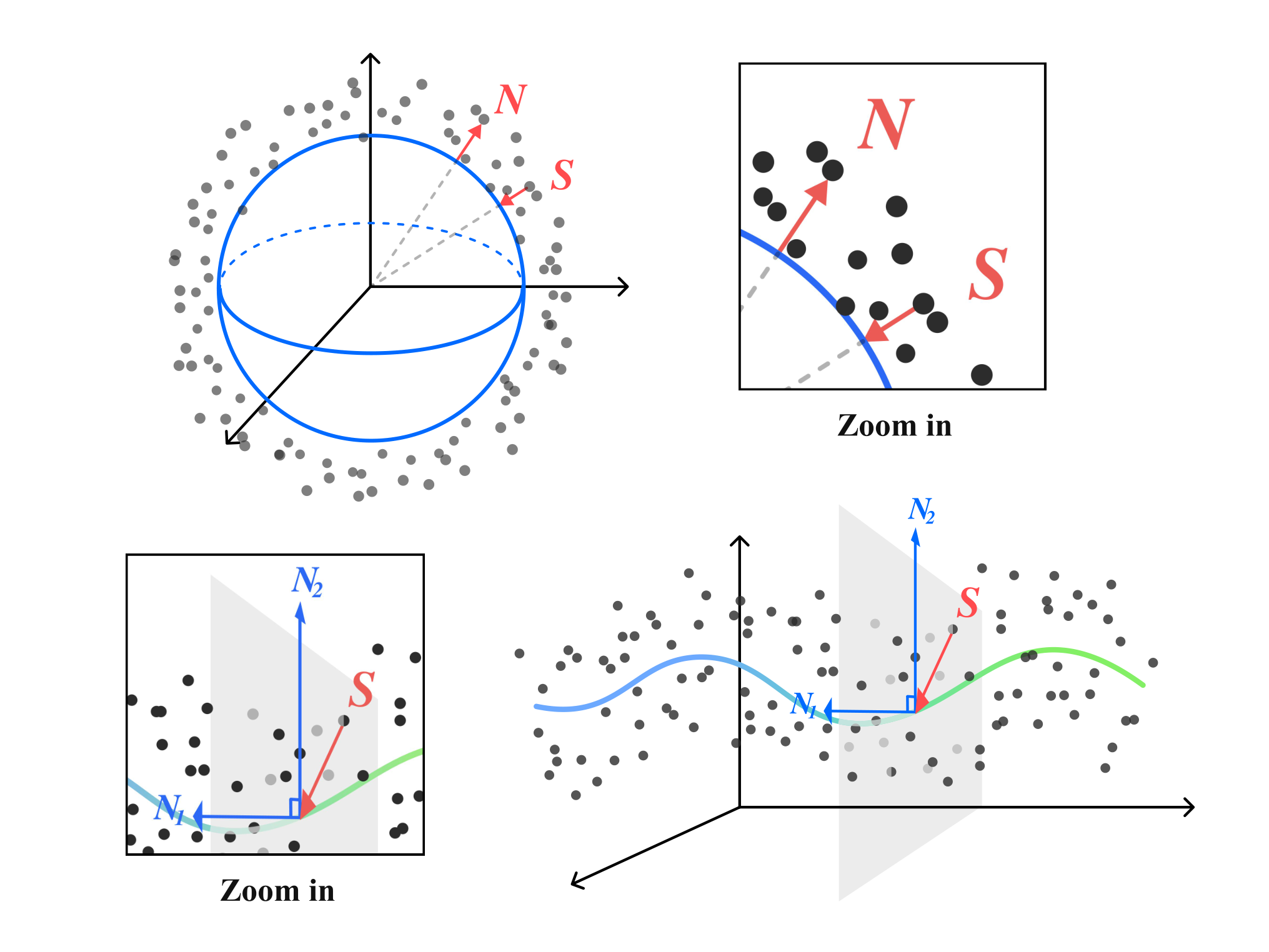
Before proceeding, we briefly clarify the notion of the data manifold. Let $\mathcal{X}\subset\mathbb{R}^{d}$ denote the ambient state space. Given state-only training data sampled from valid system behaviors, we assume that feasible states concentrate around a lower-dimensional subset $\mathcal{M}\subset\mathcal{X}$, which we refer to as the data manifold .
Intuitively, $\mathcal{M}$ represents the set of dynamically feasible and physically valid states of the system.
Incorporating Endpoint Constraints
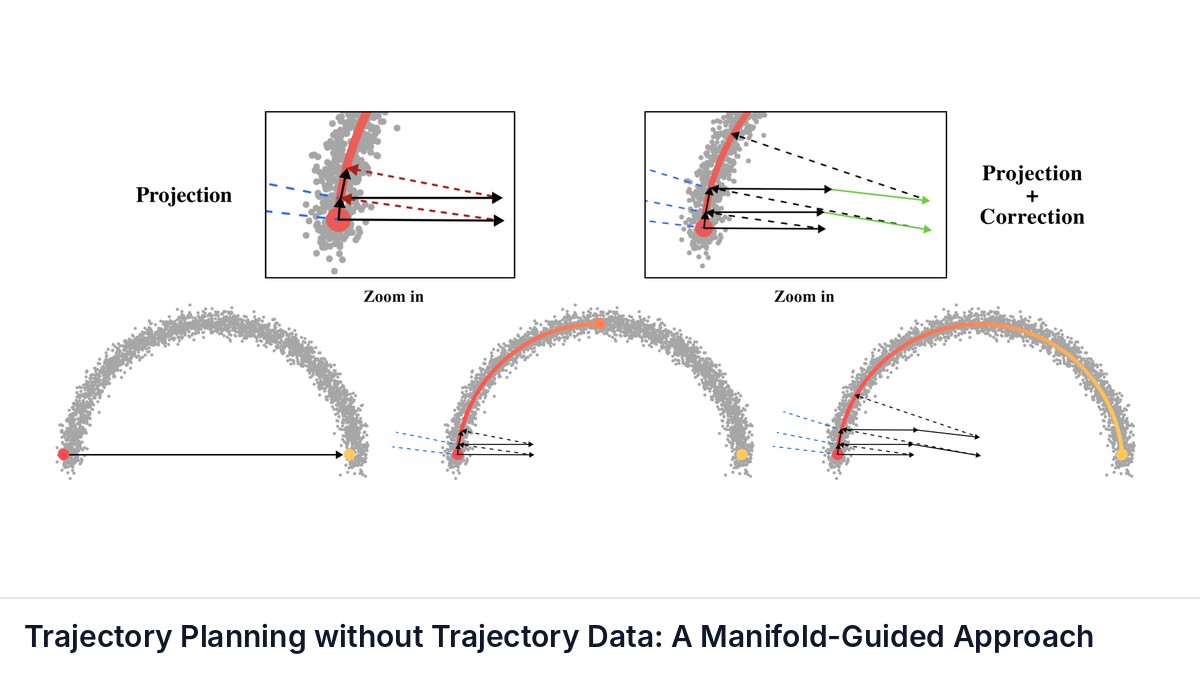
The original move-then-project procedure uses endpoint information through the direction vector pointing toward the target. However, once this direction is projected onto the tangent space, its magnitude and orientation are altered. In particular, the projection removes the normal component of motion, but this removal is not controlled with respect to the remaining progress toward the goal.
Experiments
In practice, we use a straight-line reference path between endpoints, which we find sufficient for stable performance. We further adopt arc-length-based step sizes to ensure consistent progression along the trajectory, and adapt the implementation for different generative models (e.g., diffusion and flow matching) accordingly. Detailed discussions are provided in Appendix E .
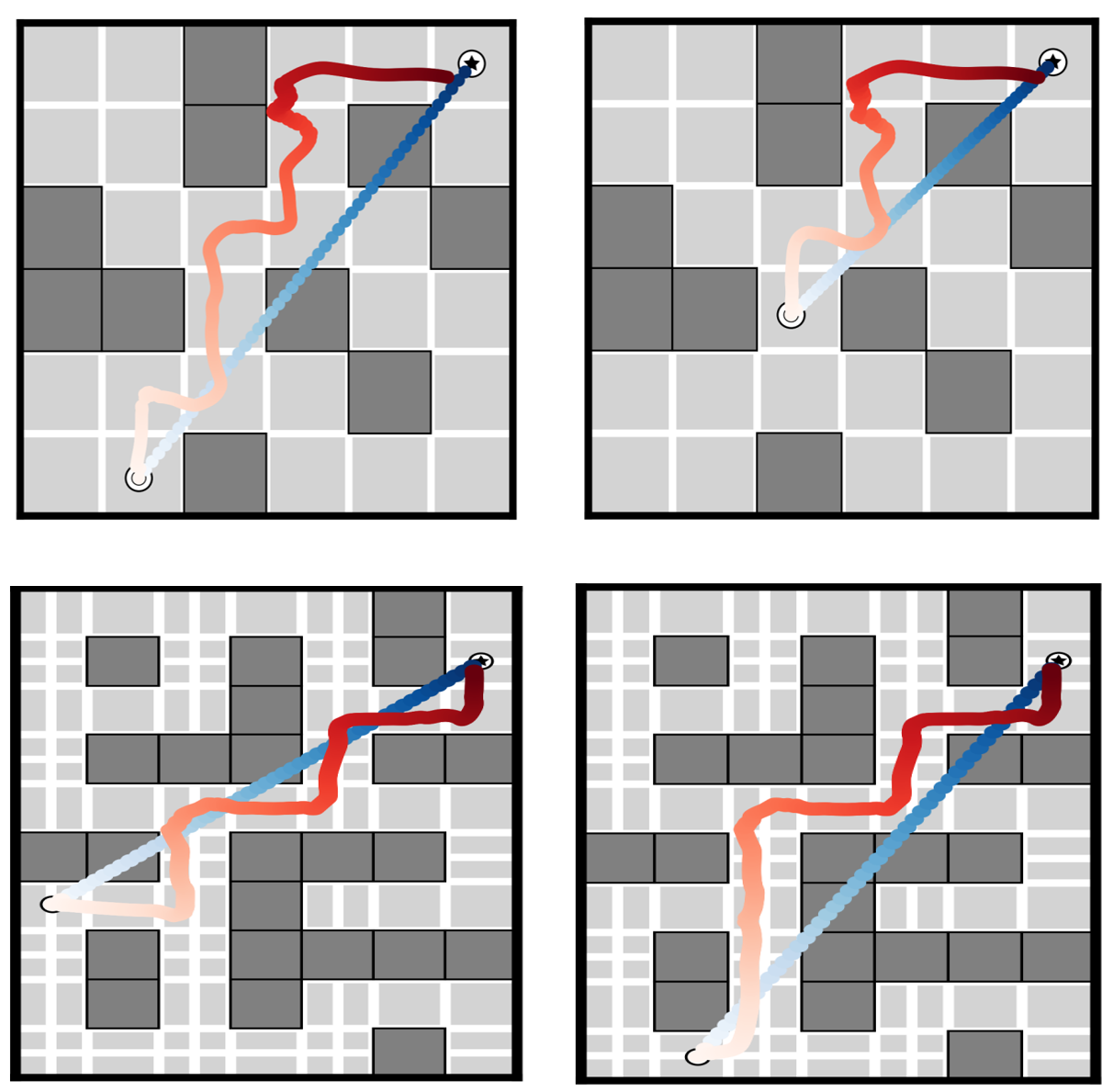
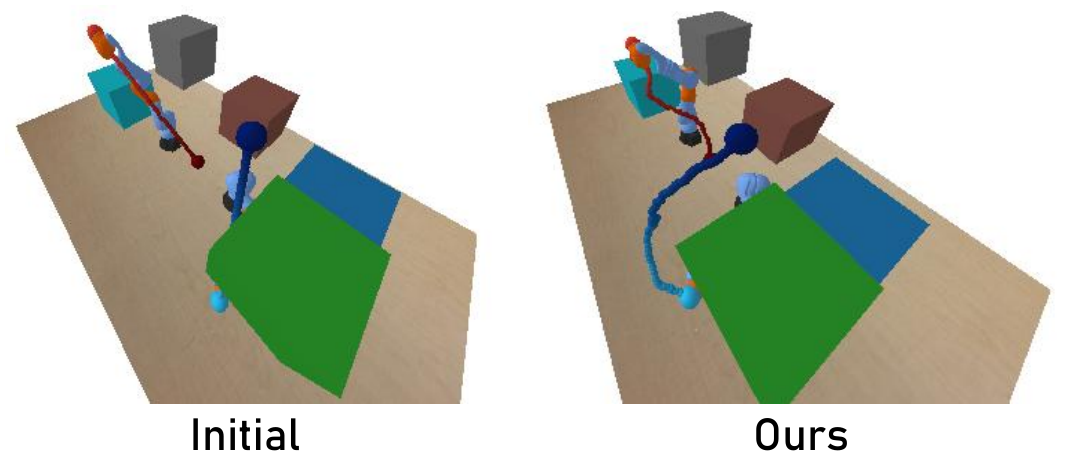
We evaluate Ariadne on three planning benchmarks: Maze2D Janner et al. (2022) ; Fu et al. (2020) , YAM 6D tabletop manipulation, and DualKuka Luo et al. (2024) .
Sources and Demonstrations
Figures are reproduced from Yong et al. See the full paper for experimental details and the project page, when the paper links one, for demonstrations and videos.
Related Papers

Aim Short to Reach Far: Your Frozen World Model Can Plan Better Than You Think
Xvyuan Liu, Jianjie Fang, Chen Gao et al.
Planners built on visual world models commonly score each predicted outcome by its distance to the encoded goal image. We show that this target can limit control even with exact dynamics and globally optimal short-horizon search: reaching a goal may require actions that initially move away from it.
Beyond Episodic Evaluation: Memory Architectural Bottlenecks in Sequential Embodied Question Answering
Zikui Cai, Kaushal Janga, Tan Dat Dao et al.
Embodied question answering (EQA) is traditionally evaluated under an episodic formulation, where agents solve each task independently and reset internal state between episodes.
EditWM: Event-Decomposed World Modeling with Incremental Correction for End-to-End Autonomous Driving
Junjie Yang, Qingwei Zeng, Youyou Li et al.
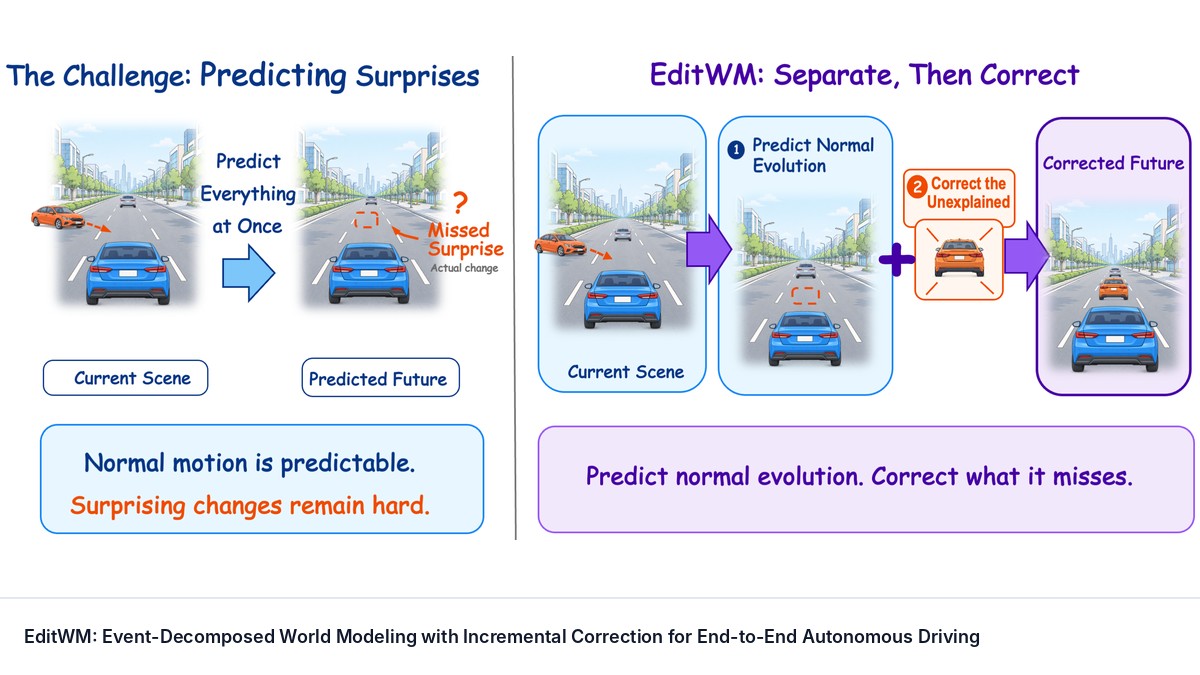
World models support autonomous driving by predicting the scene evolution associated with candidate trajectories. Driving dynamics differ in predictability, motivating a distinction between regular evolution and event-induced deviations that call for selective correction.
Embodied Scene Rearrangement Planning
Canzhi Chen, Zan Wang, Siqi Zhu et al.
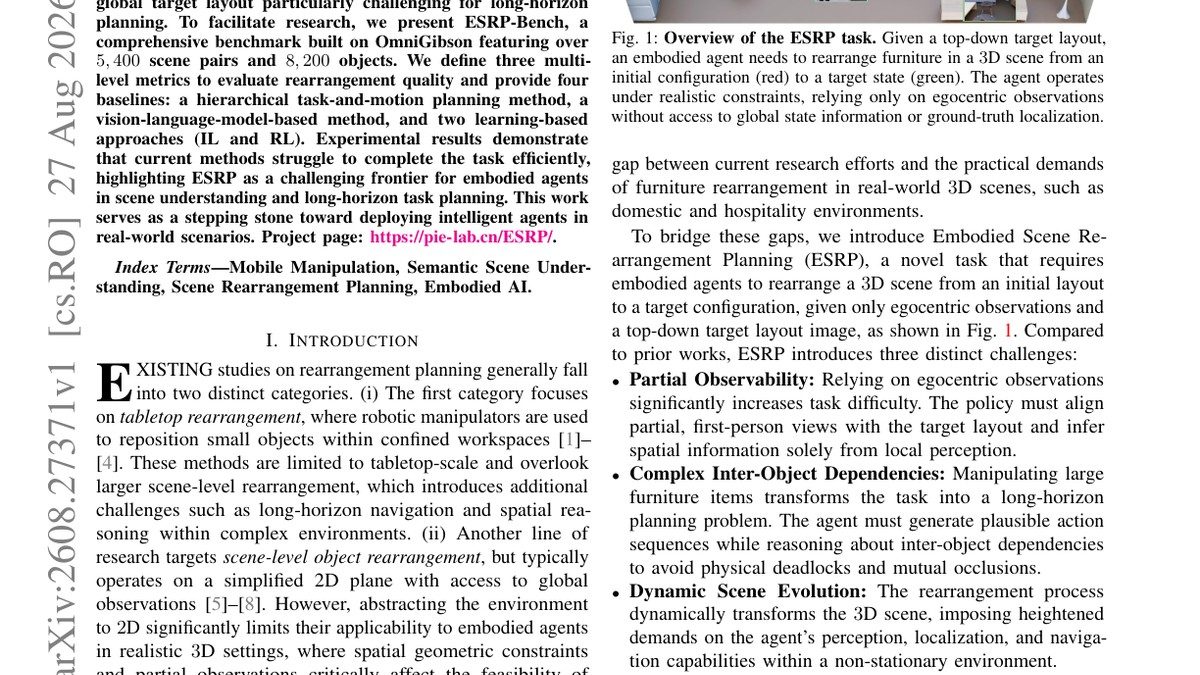
This paper introduces Embodied Scene Rearrangement Planning (ESRP), a novel task requiring embodied agents to rearrange furniture in 3D scenes to match a target configuration using only egocentric observations and a top-down target layout.