
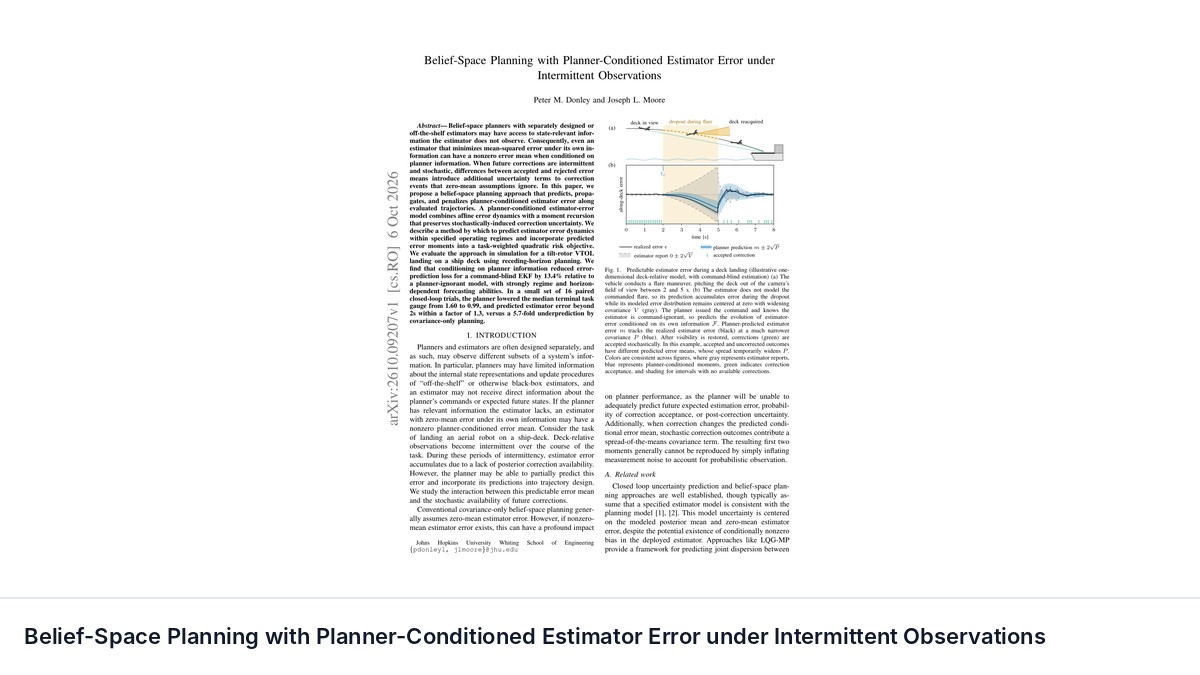
Belief-Space Planning with Planner-Conditioned Estimator Error under Intermittent Observations
Peter M. Donley, Joseph L. Moore · N/A · 2026
Framework
N/A
License
N/A
Stars
N/A
Summary
Belief-space planners with separately designed or off-the-shelf estimators may have access to state-relevant information the estimator does not observe.
Abstract Summary
Key Points
- Belief-space planners with separately designed or off-the-shelf estimators may have access to state-relevant information the estimator does not observe.
- Consequently, even an estimator that minimizes mean-squared error under its own information can have a nonzero error mean when conditioned on planner information.
- When future corrections are intermittent and stochastic, differences between accepted and rejected error means introduce additional uncertainty terms to correction events that zero-mean assumptions ignore.
- In this paper, we propose a belief-space planning approach that predicts, propagates, and penalizes planner-conditioned estimator error along evaluated trajectories.
- A planner-conditioned estimator-error model combines affine error dynamics with a moment recursion that preserves stochastically-induced correction uncertainty.
Belief-Space Planning with Planner-Conditioned Estimator Error under Intermittent Observations
|Authors: Peter M. Donley, Joseph L. Moore
|Venue: arXiv preprint | Year: 2026
|arXiv: 2610.09207
Abstract
Belief-space planners with separately designed or off-the-shelf estimators may have access to state-relevant information the estimator does not observe. Consequently, even an estimator that minimizes mean-squared error under its own information can have a nonzero error mean when conditioned on planner information. When future corrections are intermittent and stochastic, differences between accepted and rejected error means introduce additional uncertainty terms to correction events that zero-mean assumptions ignore. In this paper, we propose a belief-space planning approach that predicts, propagates, and penalizes planner-conditioned estimator error along evaluated trajectories. A planner-conditioned estimator-error model combines affine error dynamics with a moment recursion that preserves stochastically-induced correction uncertainty. We describe a method by which to predict estimator error dynamics within specified operating regimes and incorporate predicted error moments into a task-weighted quadratic risk objective. We evaluate the approach in simulation for a tilt-rotor VTOL landing on a ship deck using receding-horizon planning. We find that conditioning on planner information reduced error-prediction loss for a command-blind EKF by 13.4% relative to a planner-ignorant model, with strongly regime and horizon-dependent forecasting abilities. In a small set of 16 paired closed-loop trials, the planner lowered the median terminal task gauge from 1.60 to 0.99, and predicted estimator error beyond 2s within a factor of 1.3, versus a 5.7-fold underprediction by covariance-only planning.
Key Contributions
- Belief-space planners with separately designed or off-the-shelf estimators may have access to sta…
- Consequently, even an estimator that minimizes mean-squared error under its own information can h…
- When future corrections are intermittent and stochastic, differences between accepted and rejecte…
- In this paper, we propose a belief-space planning approach that predicts, propagates, and penaliz…
- A planner-conditioned estimator-error model combines affine error dynamics with a moment recursio…
Topics
- planning
Code & Data
No code repository linked in paper metadata.
BibTeX
@article{Donley2026_261009207,
  title     = {Belief-Space Planning with Planner-Conditioned Estimator Error under Intermittent Observations},
  author    = {Peter M. Donley and Joseph L. Moore},
  year      = {2026},
  eprint    = {2610.09207},
  archivePrefix = {arXiv},
  primaryClass  = {cs.RO},
  url       = {https://arxiv.org/abs/2610.09207}
}
Related Papers
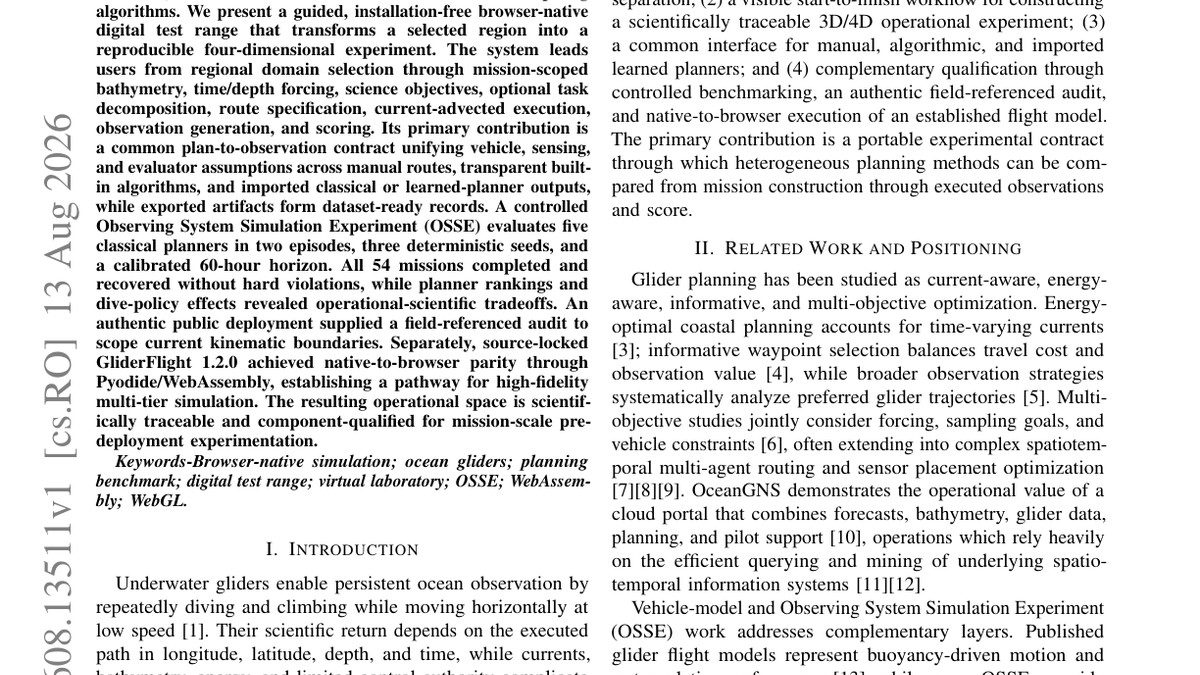
A Browser-Native Digital Test Range for Benchmarking 4D Ocean-Glider Planning Algorithms
Edward Holmberg, Elias Ioup, Mahdi Abdelguerfi
Repeated in-situ evaluation of ocean-glider planners requires scarce vehicles, operators, deployment and recovery resources, and ocean conditions that cannot be reset for competing algorithms.
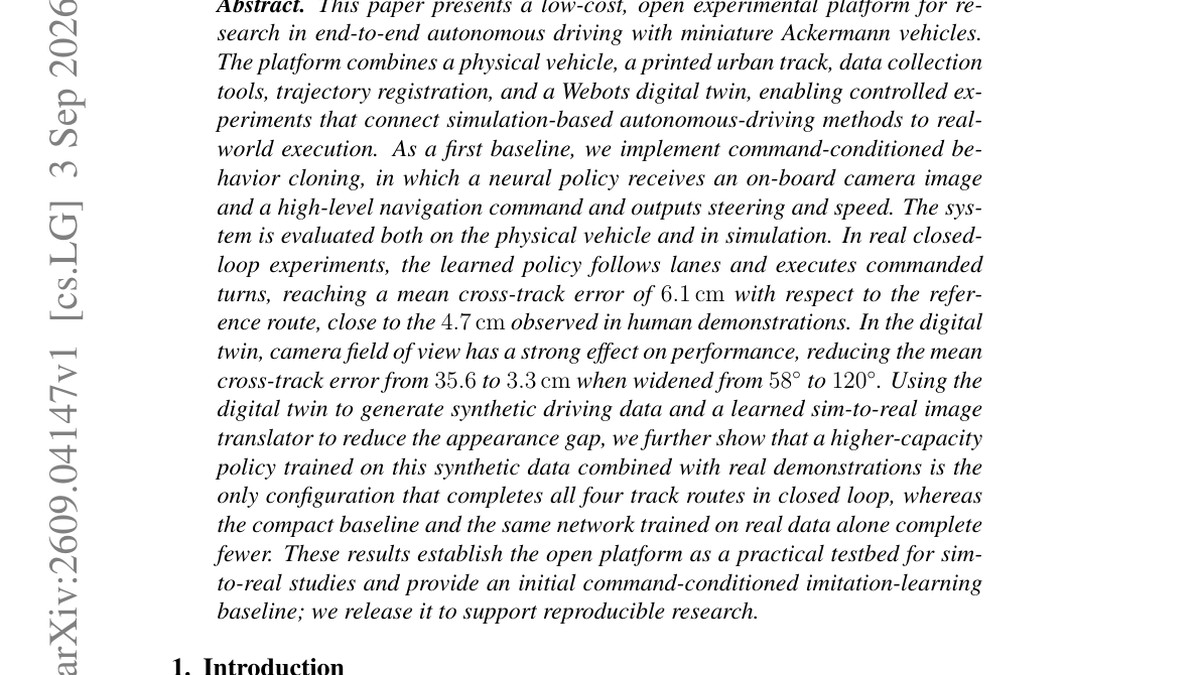
A Low-Cost, Open Platform for End-to-End Autonomous Driving on a Miniature Ackermann Vehicle
Gustavo Claudio Karl Couto, Eric Aislan Antonelo, Gabriel George Zipperer
This paper presents a low-cost, open experimental platform for research in end-to-end autonomous driving with miniature Ackermann vehicles.
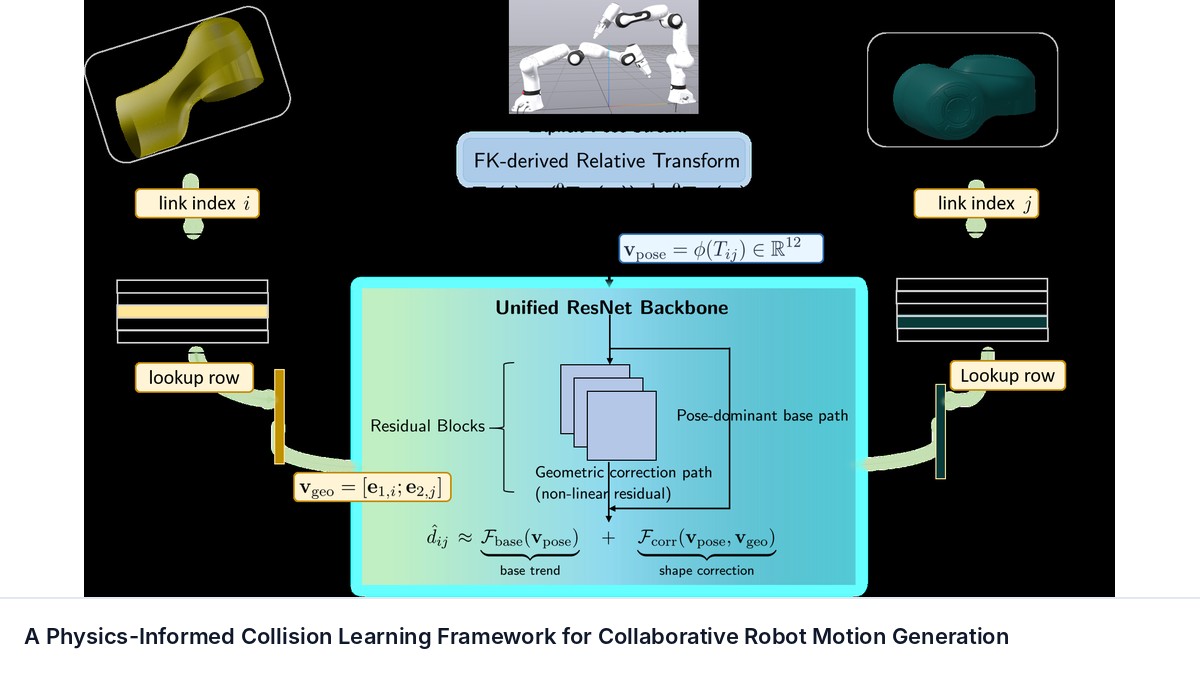
A Physics-Informed Collision Learning Framework for Collaborative Robot Motion Generation
Chen Cai, Steven Liu
Close-proximity multi-arm manipulation requires collision models that are both geometrically accurate and differentiable enough for real-time optimization.
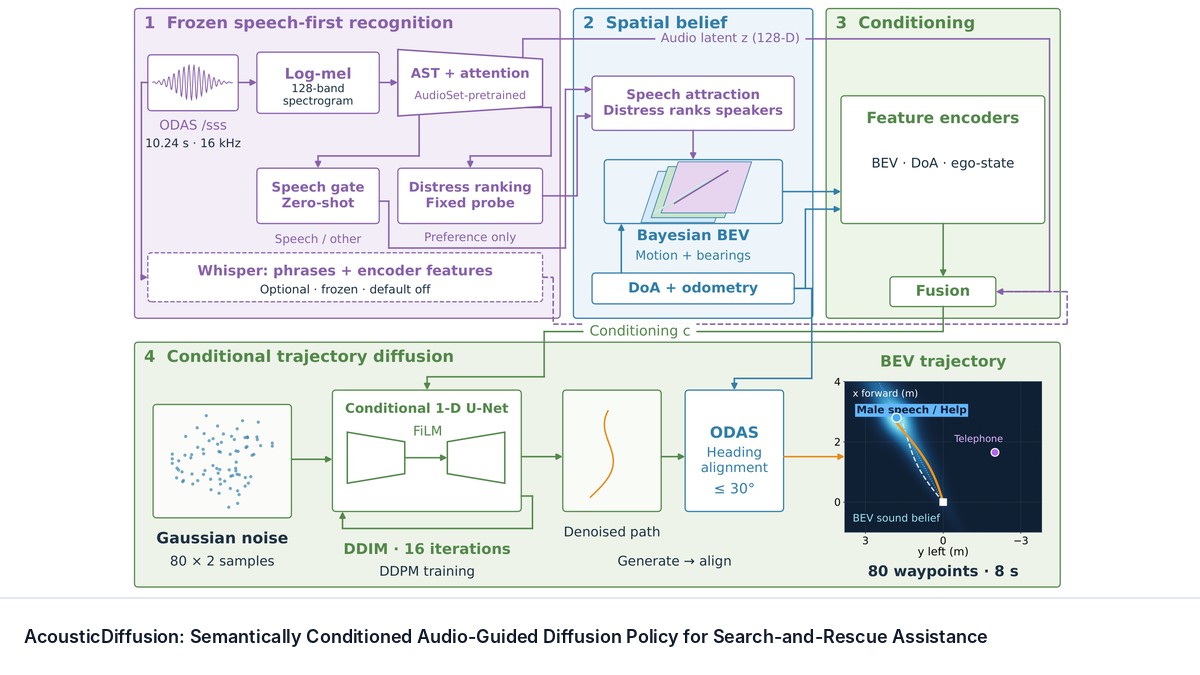
AcousticDiffusion: Semantically Conditioned Audio-Guided Diffusion Policy for Search-and-Rescue Assistance
Iana Zhura, Didar Seyidov, Dmitrii Plotnikov et al.
Navigating toward human callers is an important capability for rescue robots operating where visual contact is degraded or occluded. We present AcousticDiffusion, a semantically conditioned, audio-guided diffusion policy for human-directed navigation.