
Feasibility Ceilings Before Learning: Sizing and Timing Bounds for Drone-Mesh Interception
Dmytro Babarytskyi · N/A · 2026
Framework
N/A
License
N/A
Stars
N/A
Summary
A mesh of interceptors defending a fixed site must spread over the predicted arrival point of an approaching object.
Abstract Summary
Key Points
- A mesh of interceptors defending a fixed site must spread over the predicted arrival point of an approaching object.
- This is a recurring task in multi-agent robotics: N agents, each covering a disc of radius r, spread over a probability density so that a point drawn from it falls within some agent's disc.
- We give closed forms for the quantities that bound performance before any policy is chosen, and validate each by Monte Carlo.
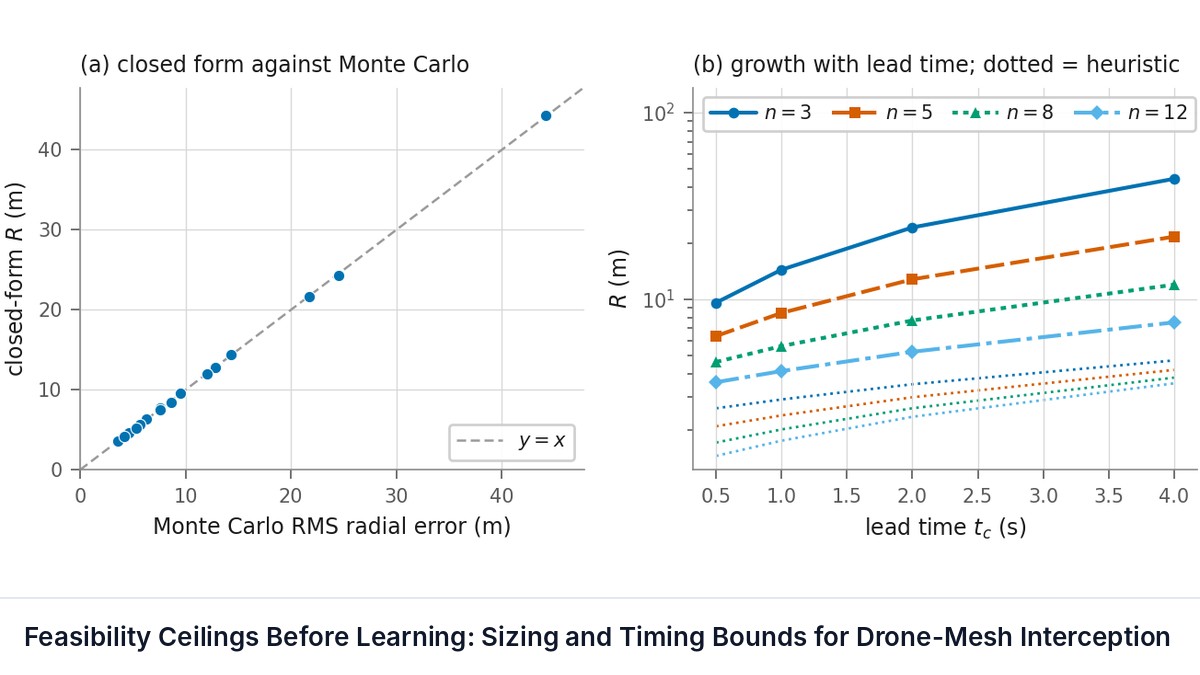
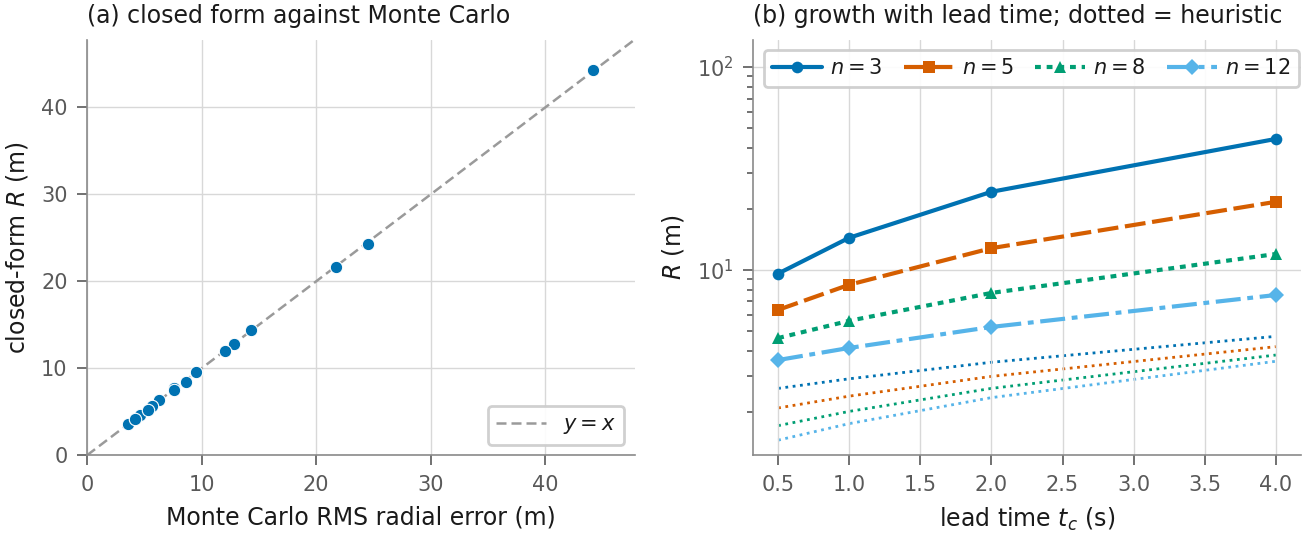
- The uncertainty of a point predicted by extrapolating a noisy linear track follows from least-squares variance propagation plus a delta-method term for the uncertain arrival time, agreeing with simulation to within 1.8%.
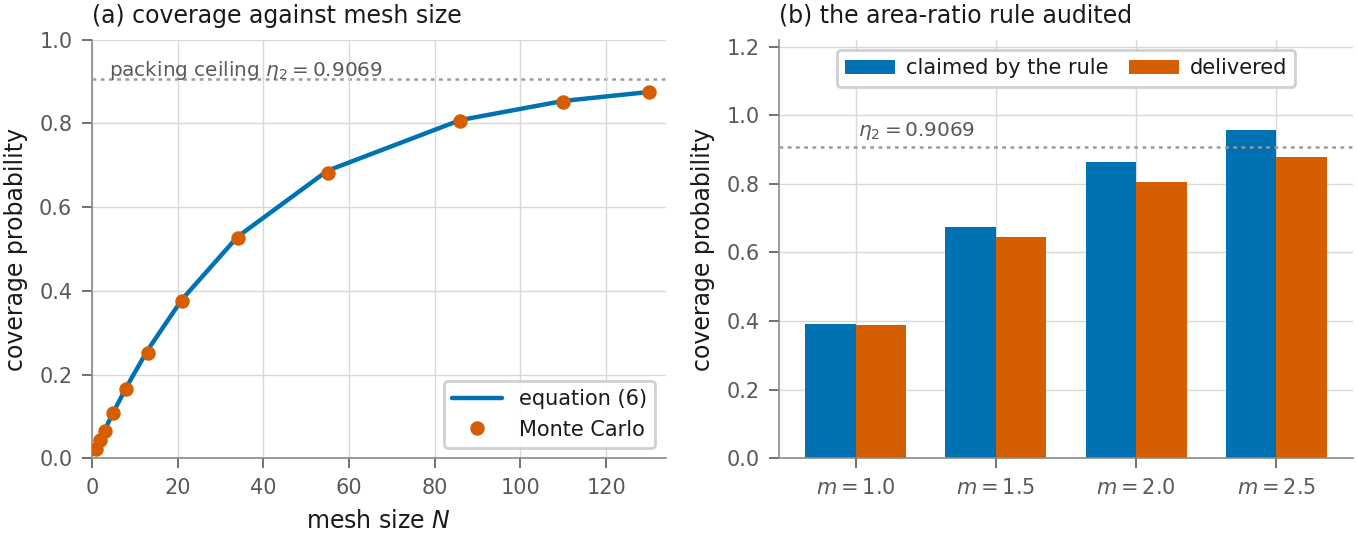
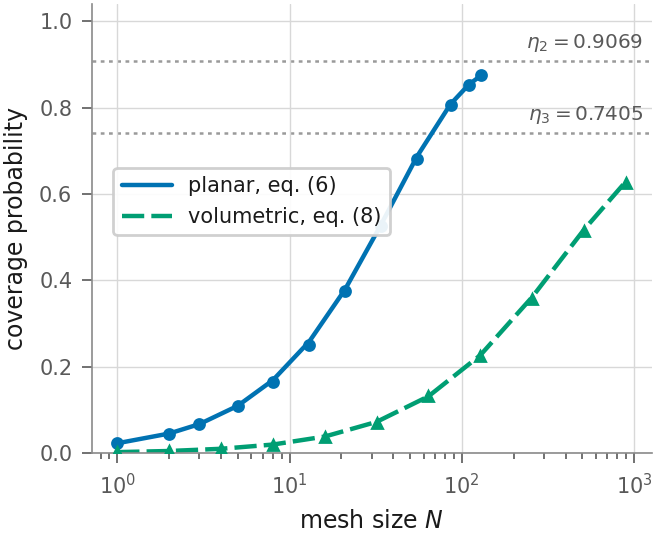
- The coverage probability of a packed mesh admits a closed form accurate to 0.007 absolute, with a volumetric analogue.
Problem Formulation
A point of interest travels on a straight line and will cross a fixed plane $x=x_{p}$ at an unknown in-plane location $\mathbf{c}\in\mathbb{R}^{2}$. A sensor supplies $n$ position fixes at times $t_{1},\dots,t_{n}$, each corrupted by independent Gaussian noise of per-axis standard deviation $\sigma_{s}$. $N$ agents occupy the plane.
Each covers a disc of radius $r$; $r$ is treated throughout as a fixed input parameter of the platform, not a design variable.
Prediction Uncertainty
Fit per-axis ordinary least-squares lines $p_{k}(t)=a_{k}+b_{k}t$ for $k\in\{x,y,z\}$ and solve $p_{x}(t)=x_{p}$ for the crossing time $t_{c}$. With $\bar{t}$ the mean fix time and $S=\sum_{i}(t_{i}-\bar{t})^{2}$, the standard OLS results are The fitted value at an arbitrary time $\tau$ therefore has variance The crossing time is itself an estimate.
Coverage Laws
A natural way to size the mesh is an area ratio: to cover the disc of radius $m\sigma$ with non-overlapping discs of radius $r$, take $N\approx(m\sigma)^{2}/r^{2}$. This is optimistic, because it assumes the discs tile the plane perfectly. They cannot: the densest packing of equal circles covers only $\eta_{2}=\pi/\sqrt{12}$ of the plane [ 6 ] .
Carrying the packing density through, $N$ touching discs of radius $r$ occupy a roughly circular region of area $N\pi r^{2}/\eta_{2}$, that is, out to radius $\rho=r\sqrt{N/\eta_{2}}$.
Is Hexagonal Packing the Right Arrangement?
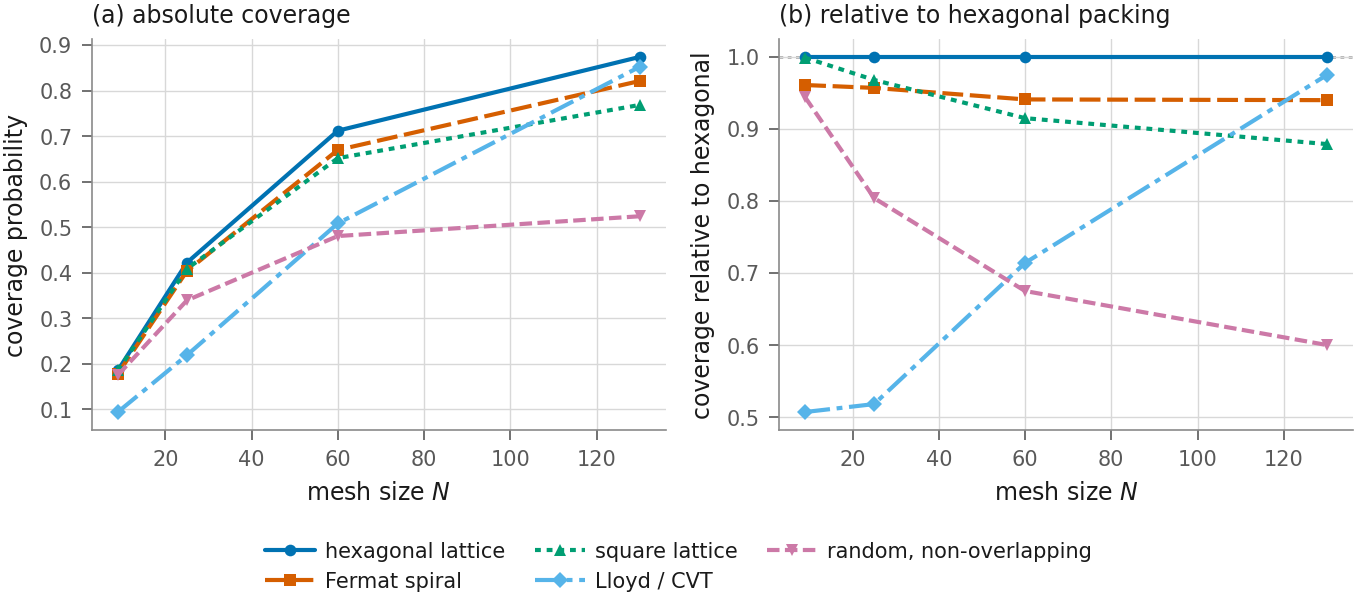
Equation ( 6 ) assumes a hexagonal arrangement, justified by Thue’s theorem. That theorem concerns covering the infinite plane, whereas our mesh covers a finite Gaussian with a finite budget. The assumption therefore deserves an empirical check, and the check is informative about the relation between this problem and classical coverage control.
Robustness of the Error Model
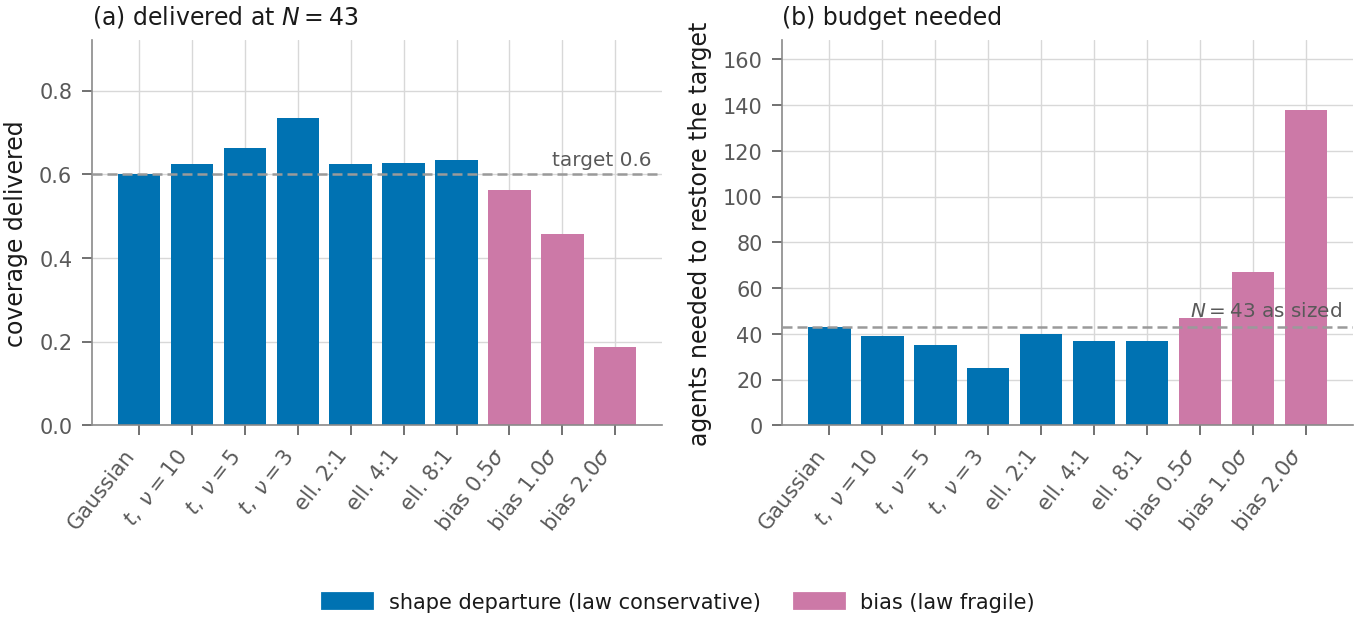
Equation ( 6 ) assumes an isotropic Gaussian error. Two departures are likely in practice. Heavy tails arise from occasional bad fixes, missed manoeuvres or track breaks. Anisotropy arises because crossing geometry rarely leaves the two in-plane axes equally determined. A third, bias, arises when the predictor is systematically off-centre rather than merely imprecise — which is what an unmodelled manoeuvre produces.
The Commit-Time Window
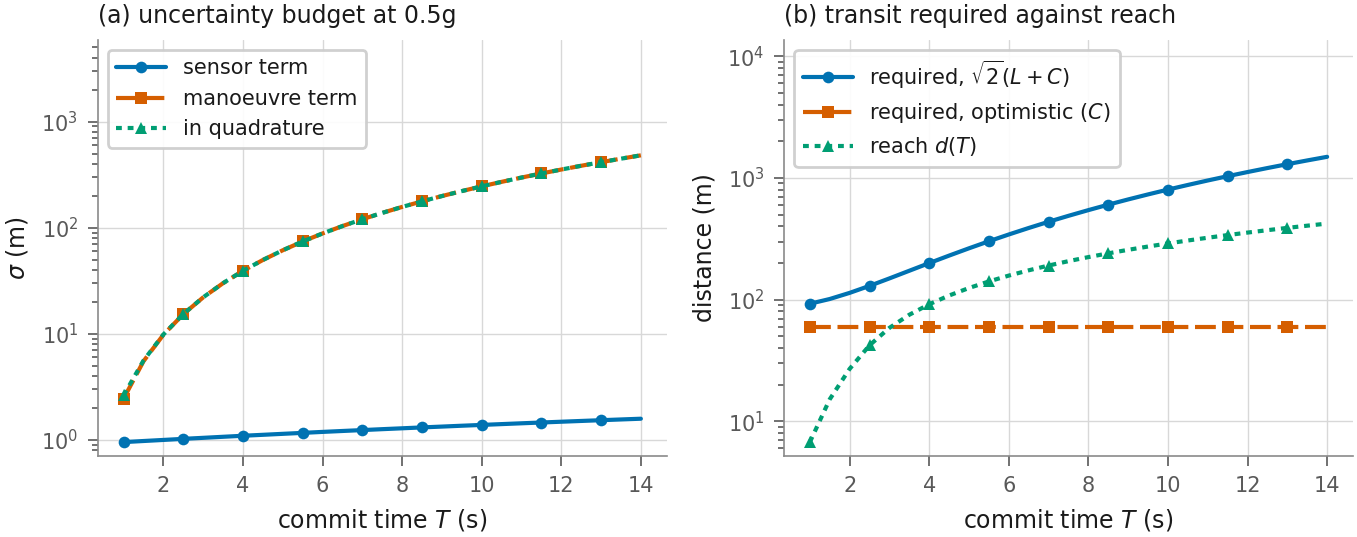
Sections IV and V price a mesh given $\sigma$. A team that must physically reposition faces a further constraint, because $\sigma$ is not exogenous: it depends on how early the team commits. Let $T$ be the commit time — the moment the team stops updating its aim point and flies to the formation. $T$ is squeezed from both sides. Commit late and the prediction is sharp but there is no time to fly.
Commit early and there is ample transit time but the arrival point must be extrapolated further. Two contributions enter $\sigma(T)$ in quadrature.
Applying the Bounds
The results above are individually simple, and their value is in the order they are applied; we set out that order below. Step 1: price the prediction, including what the fit does not model. Compute $R$ from ( 5 ) for the intended cadence and lead time, then add the manoeuvre term of Section VIII in quadrature.
Section VIII is emphatic about the order of magnitude involved: a long track drives the sensor term to a metre or two while the manoeuvre term reaches hundreds, so a budget containing only the first is not conservative but simply wrong.
Implications for Learned Placement
The bounds above were derived after, not before, a sequence of reinforcement-learning experiments on this task in an accompanying prototype. We report those outcomes because the sequence itself is the argument. The geometry is the corrected one of Section X-C : $25$ agents, sector $\pm 35$ m, corridor $\pm 20$ m, $r=3$ m, mean $\sigma=4.57$ m, a $4$ s window.
All policies are evaluated through the identical environment code path over the same $100$ episode seeds, with percentile bootstrap intervals [ 33 ] over episodes.
Reproducibility
The prototype this work analyses — the prediction module, the hexagonal lattice generator, the placement environment and the training scripts — is openly available at https://github.com/DmytroBabarytskyi/drone-training , at commit 4924613 .
The eight experiment scripts, the figure generator and the JSON record of every run reported here are released alongside it, 1 1 1 See the repository’s README for the exact location of the experiment scripts and the archived policy checkpoints.
Declaration on Generative AI
During the preparation of this work, the author used Claude (Anthropic) in order to: search and screen the literature; write the code that produces Figures 1 – 6 from the recorded results; paraphrase and format the manuscript.
The research programme and its framing, the prototype and simulation environment that every experiment runs against, the reinforcement-learning study whose outcomes Section X reports are the author’s own.
Sources and Demonstrations
Figures are reproduced from Babarytskyi See the full paper for experimental details and the project page, when the paper links one, for demonstrations and videos.
Related Papers
A Balanced Data Diet: Addressing the Exploration Bottleneck in Mega-Scale RL for Robot Control
Octi Zhang, Mateo Guaman Castro, Patrick Yin et al.
General-purpose robots must perform a wide range of tasks from agile locomotion to dexterous manipulation.
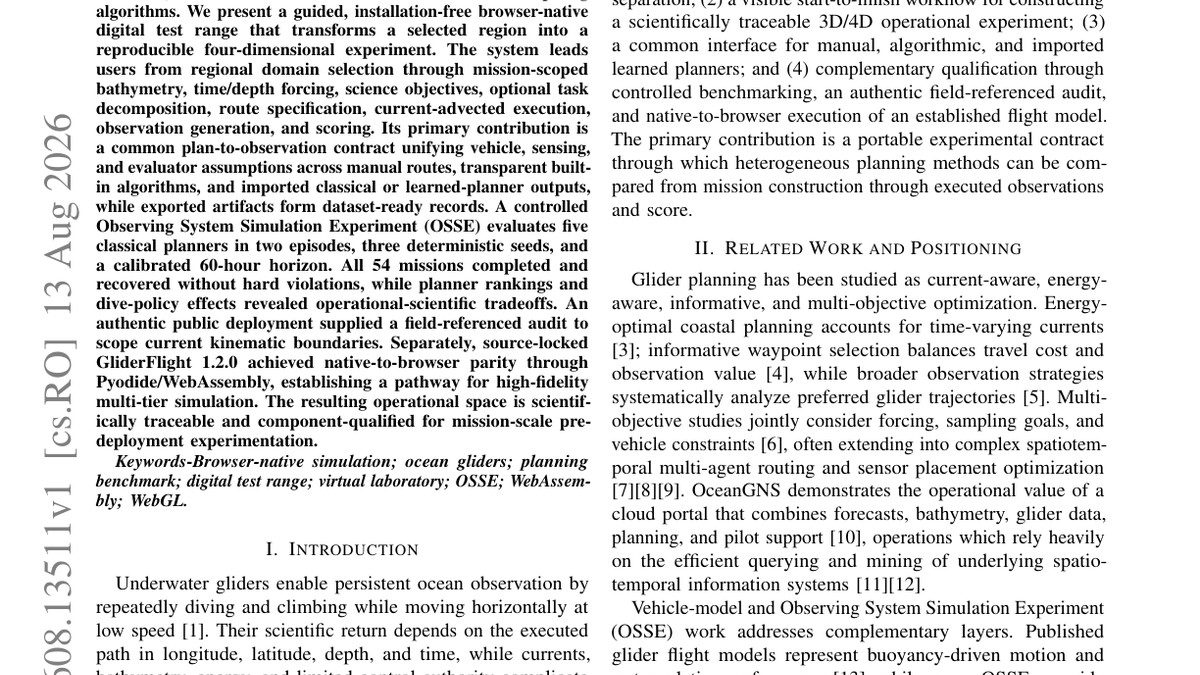
A Browser-Native Digital Test Range for Benchmarking 4D Ocean-Glider Planning Algorithms
Edward Holmberg, Elias Ioup, Mahdi Abdelguerfi
Repeated in-situ evaluation of ocean-glider planners requires scarce vehicles, operators, deployment and recovery resources, and ocean conditions that cannot be reset for competing algorithms.
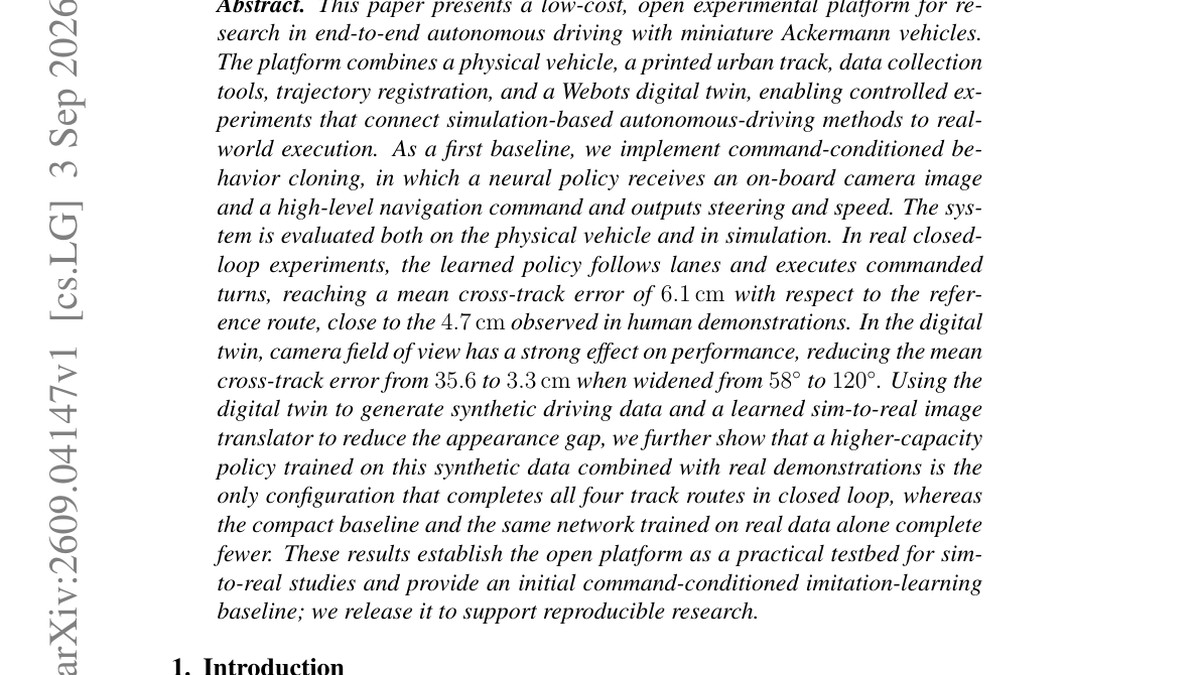
A Low-Cost, Open Platform for End-to-End Autonomous Driving on a Miniature Ackermann Vehicle
Gustavo Claudio Karl Couto, Eric Aislan Antonelo, Gabriel George Zipperer
This paper presents a low-cost, open experimental platform for research in end-to-end autonomous driving with miniature Ackermann vehicles.
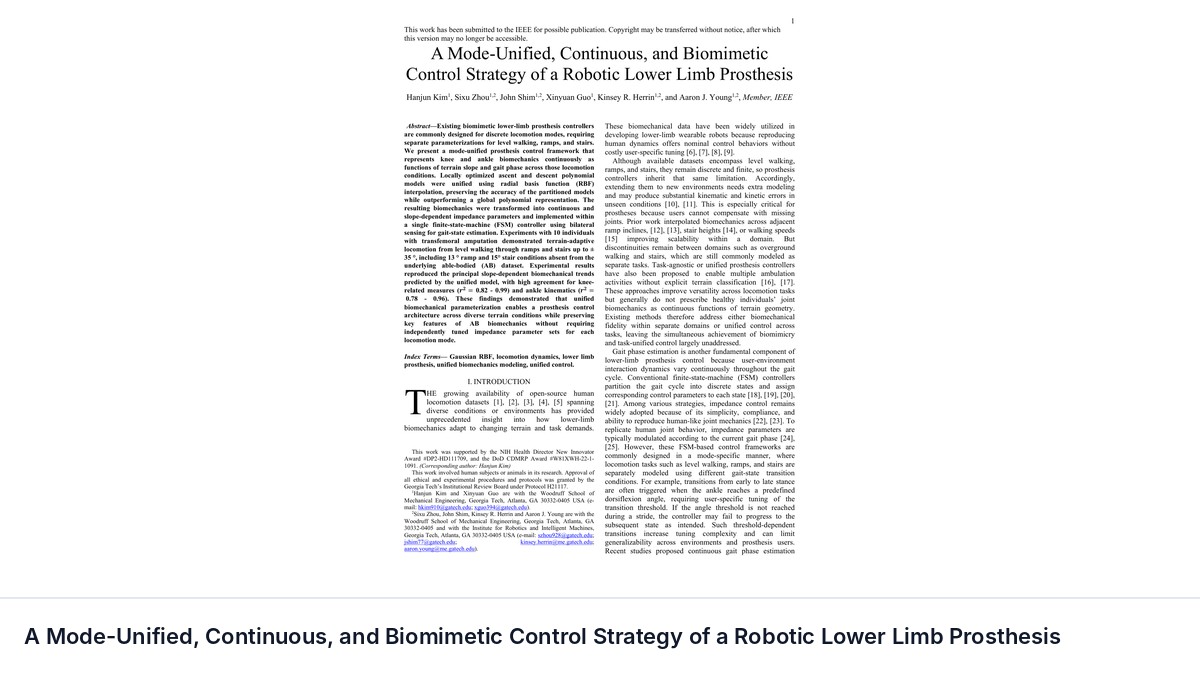
A Mode-Unified, Continuous, and Biomimetic Control Strategy of a Robotic Lower Limb Prosthesis
Hanjun Kim, Sixu Zhou, John Shim et al.
Existing biomimetic lower-limb prosthesis controllers are commonly designed for discrete locomotion modes, requiring separate parameterizations for level walking, ramps, and stairs.