
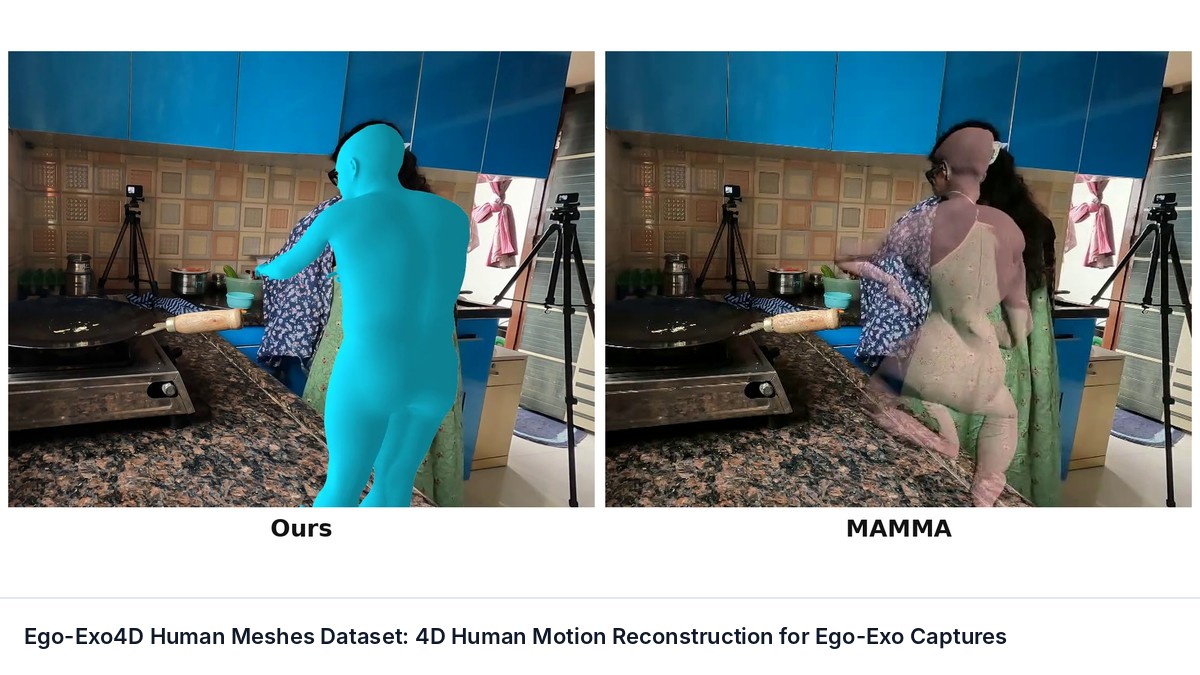
Ego-Exo4D Human Meshes Dataset: 4D Human Motion Reconstruction for Ego-Exo Captures
Abhiram Maddukuri, Georgios Pavlakos · N/A · 2026
Framework
N/A
License
N/A
Stars
N/A
Summary
Ego-Exo4D is a large-scale dataset providing synchronized egocentric and multi-view exocentric video, a rich resource for skill learning and assessment, procedural activity understanding, and embodied AI.
Abstract Summary
Key Points
- Ego-Exo4D is a large-scale dataset providing synchronized egocentric and multi-view exocentric video, a rich resource for skill learning and assessment, procedural activity understanding, and embodied AI.
- However, the dataset ships with only sparse 3D human pose annotations, and reconstructing dense human motion from its multi-view captures is nontrivial.
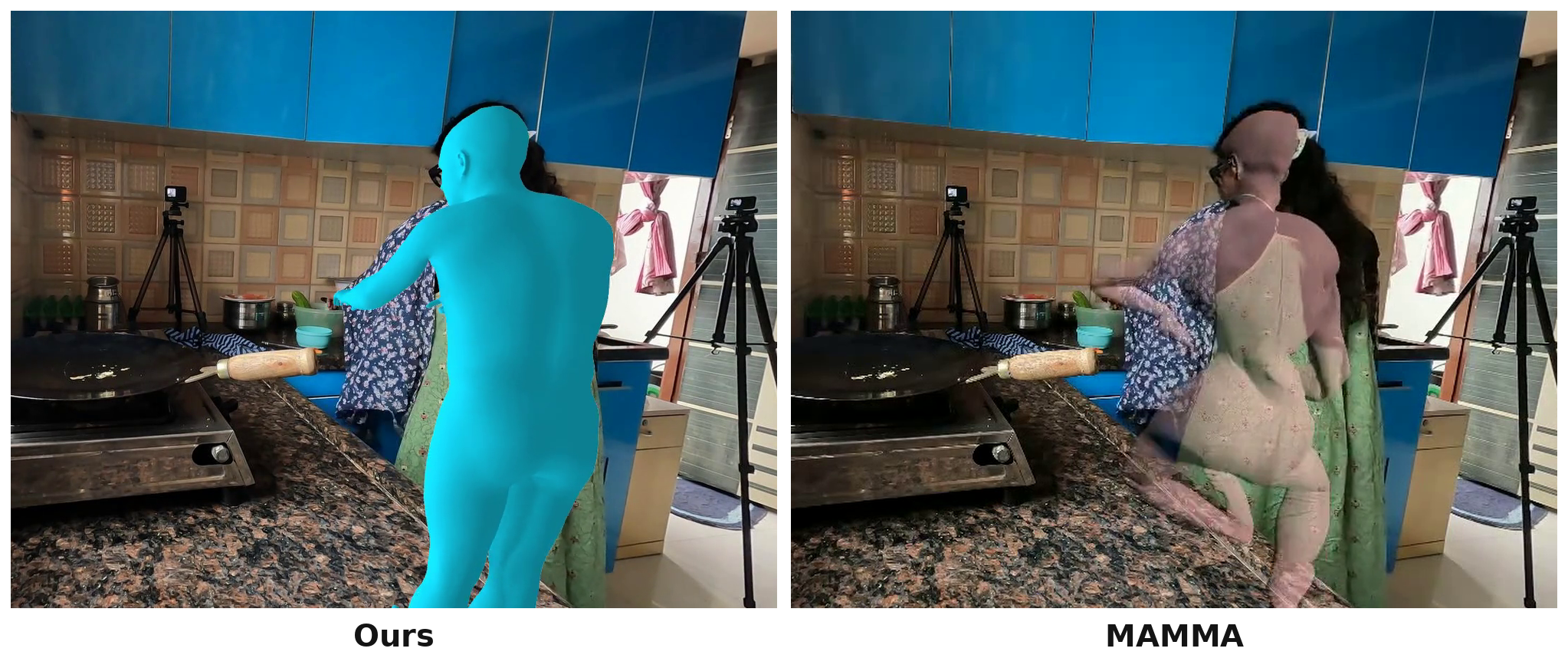
- To this end, we present Ego-Exo4D-HM, a large-scale dataset of 4D human motion reconstructions for Ego-Exo4D's captures, and release the accompanying reconstruction pipeline.
- The code, dataset, and documentation can be found at https://abhiram824.github.io/egoexo4d_human_meshes.
Methods
Given synchronized egocentric and exocentric video from the Ego-Exo4D activity dataset Grauman et al. (2024) , our goal is to reconstruct world-frame 3D body and hand motion of the person performing the activity. We build off SLAHMR Ye et al. (2023) , which can be naturally extended to multi-view settings.
Results
We ran our pipeline on a subset of approximately 3,200 videos from the Ego-Exo4D dataset. From here we apply a quality filter based on two per-take criteria. Reprojection self-consistency : we reproject the final optimized 3D joints through the calibrated cameras and measure the pixel distance to the corresponding 2D detections; a take is flagged if more than 10% of these samples exceed 50 px.
Sources and Demonstrations
Figures are reproduced from Maddukuri et al. See the full paper for experimental details and the project page, when the paper links one, for demonstrations and videos.
Related Papers

3D Euler-Angle Orientation Control for Two-Ray Fading Mitigation in Maritime Air-to-Sea Communications
Mohammed Bajja, Abdoul Karim A. H. Saliah, Hajar El Hammouti et al.
Maritime Air-to-Sea links are dominated by a line-of-sight ray and a sea-surface reflected ray whose destructive combination produces deep fades. Existing mitigation strategies optimize Unmanned Aerial Vehicle position or trajectory but leave attitude unexploited.
4D Radar Perception Algorithms for Autonomous Driving: A Review
Xumin Wu, Jun Zhou, Jilin Mei et al.
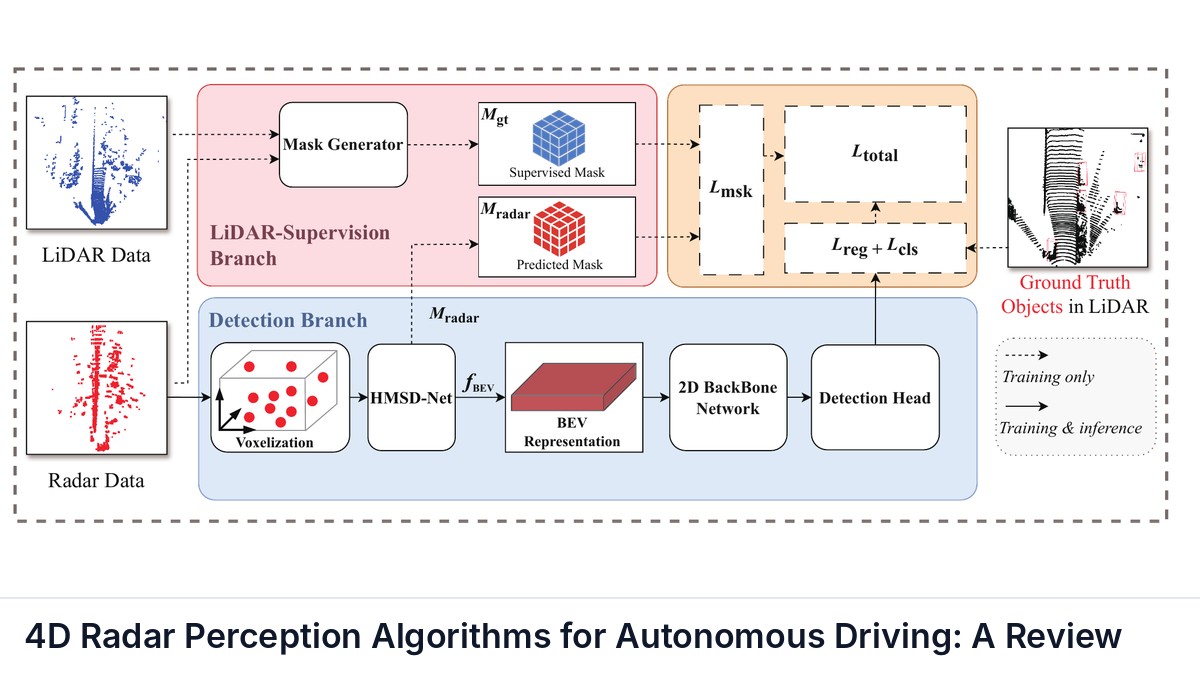
Research on 4D millimeter-wave radar perception algorithms has flourished in recent years, extending from signal processing and object detection to semantic segmentation, motion estimation, occupancy prediction, and dynamic scene reconstruction.
A Browser-Native Digital Test Range for Benchmarking 4D Ocean-Glider Planning Algorithms
Edward Holmberg, Elias Ioup, Mahdi Abdelguerfi
Repeated in-situ evaluation of ocean-glider planners requires scarce vehicles, operators, deployment and recovery resources, and ocean conditions that cannot be reset for competing algorithms.
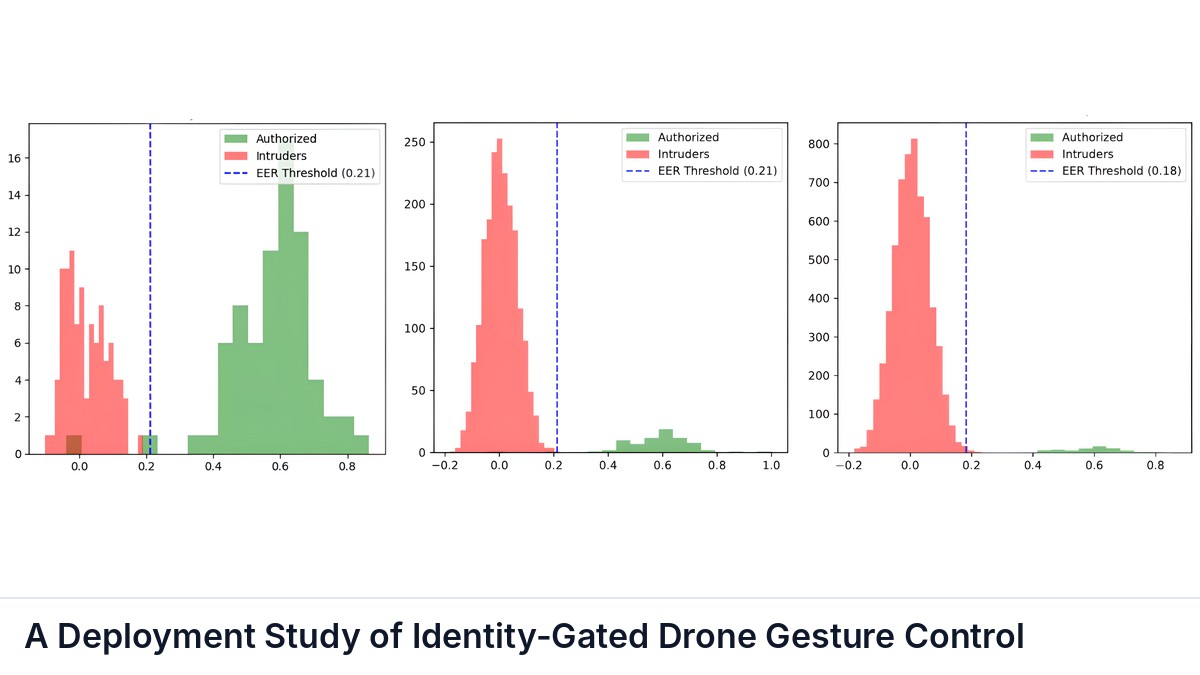
A Deployment Study of Identity-Gated Drone Gesture Control
Diyari Mohammed Salih, Ilyes Chaabeni, Naima Ait Oufroukh
Vision-based gesture control accepts commands from any hand in the camera field of view, which is unsafe in shared indoor spaces.