
Robot Manipulation with GPT-6-Astra: Body Knowledge, Experience Reuse, Emergent Skills, and Sim2Real Transfer
Sida He, Lingxi Xie, Yunning Cao, Pengfei Chen, Kaiwen Duan, Jiannan Ge, Xinyue Huo, Jiacheng Shao, Qi Tian · N/A · 2026
Framework
N/A
License
N/A
Stars
N/A
Summary
General-purpose multimodal agents can write robot-control programs, but repeated exploration and model-mediated action selection can make execution slow.
Abstract Summary
Key Points
- General-purpose multimodal agents can write robot-control programs, but repeated exploration and model-mediated action selection can make execution slow.
- We study how external body knowledge, successful experience, and executable skills improve an XLeRobot controlled by GPT-6-Astra in a simulated and a physical elevator-button task.
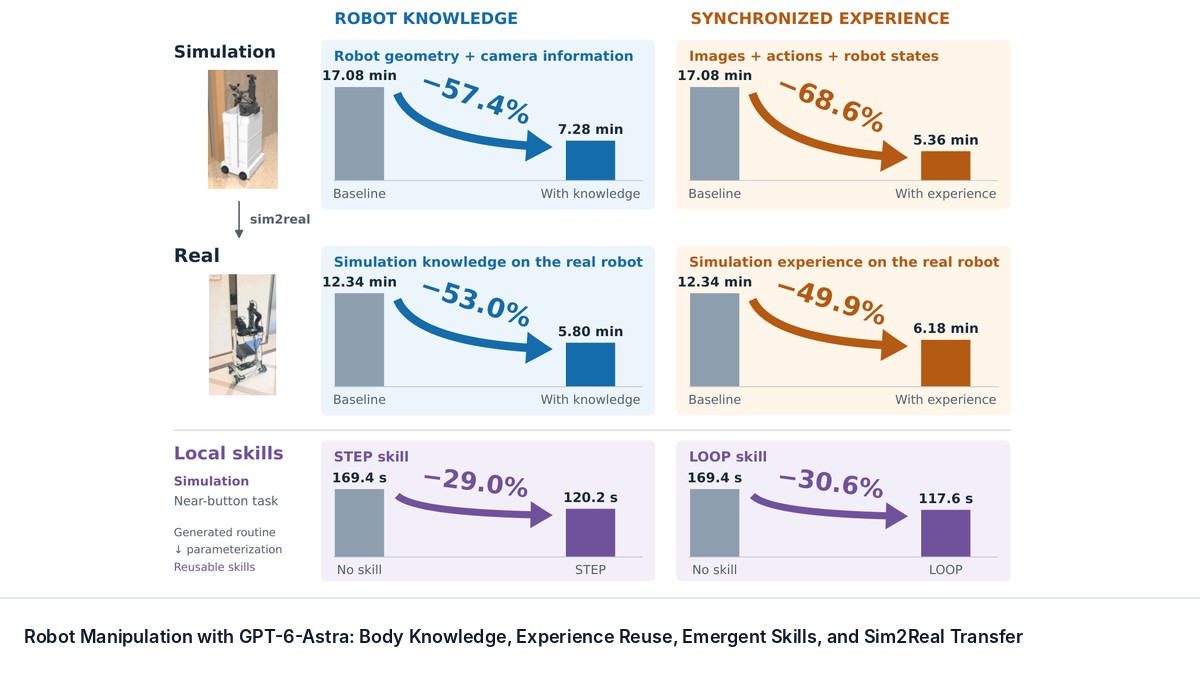
- In 30 fixed-start simulation trials, complete robot geometry and camera information reduce mean completion time by 57.4% relative to a baseline with only the common control interface and no prior experience; images with synchronized action and state records reduce it by 68.6% without additional body assets.
- In nine paired comparisons (18 trials) at starts displaced by 10-100 cm, experience recorded at the original start reduces mean time by 58-63% relative to no experience, demonstrating generalization to the tested new starting positions.
- During experience experiments, GPT-6-Astra spontaneously generates a short visual-feedback program
System and Experimental Protocol
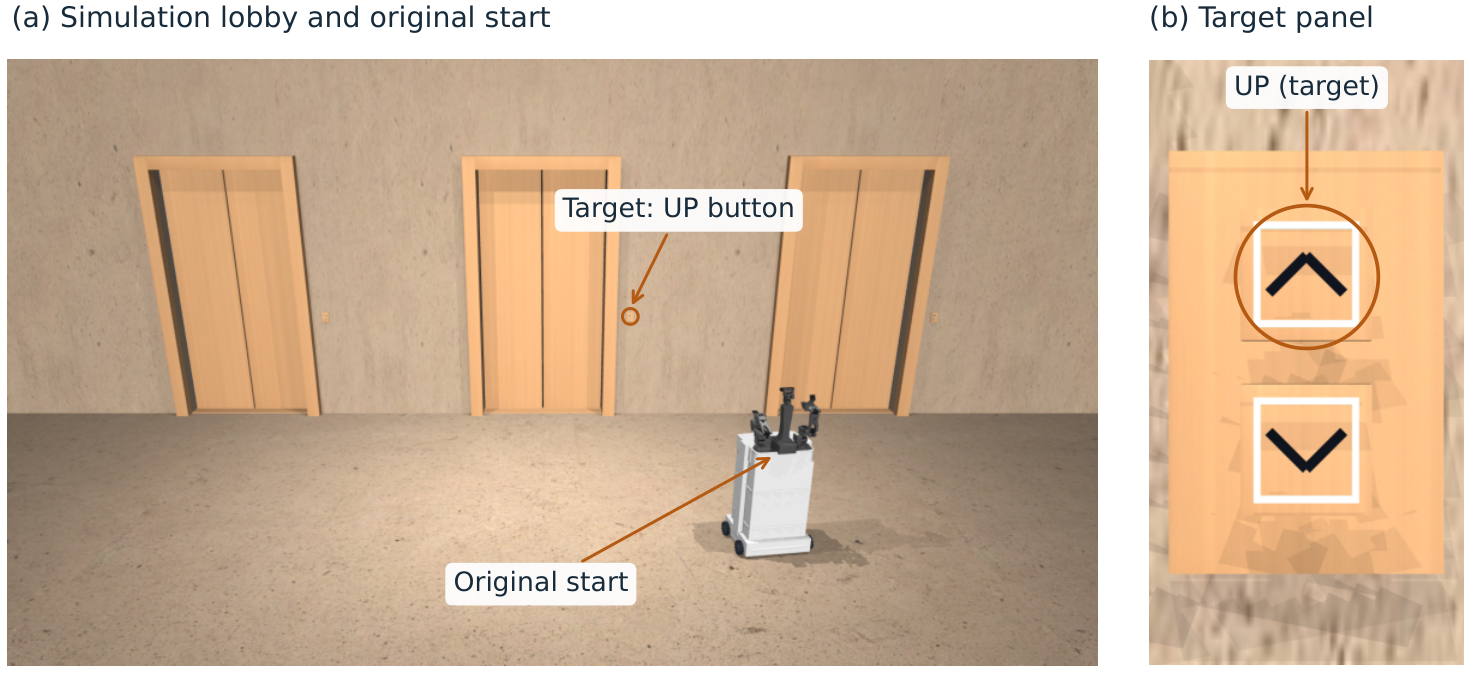
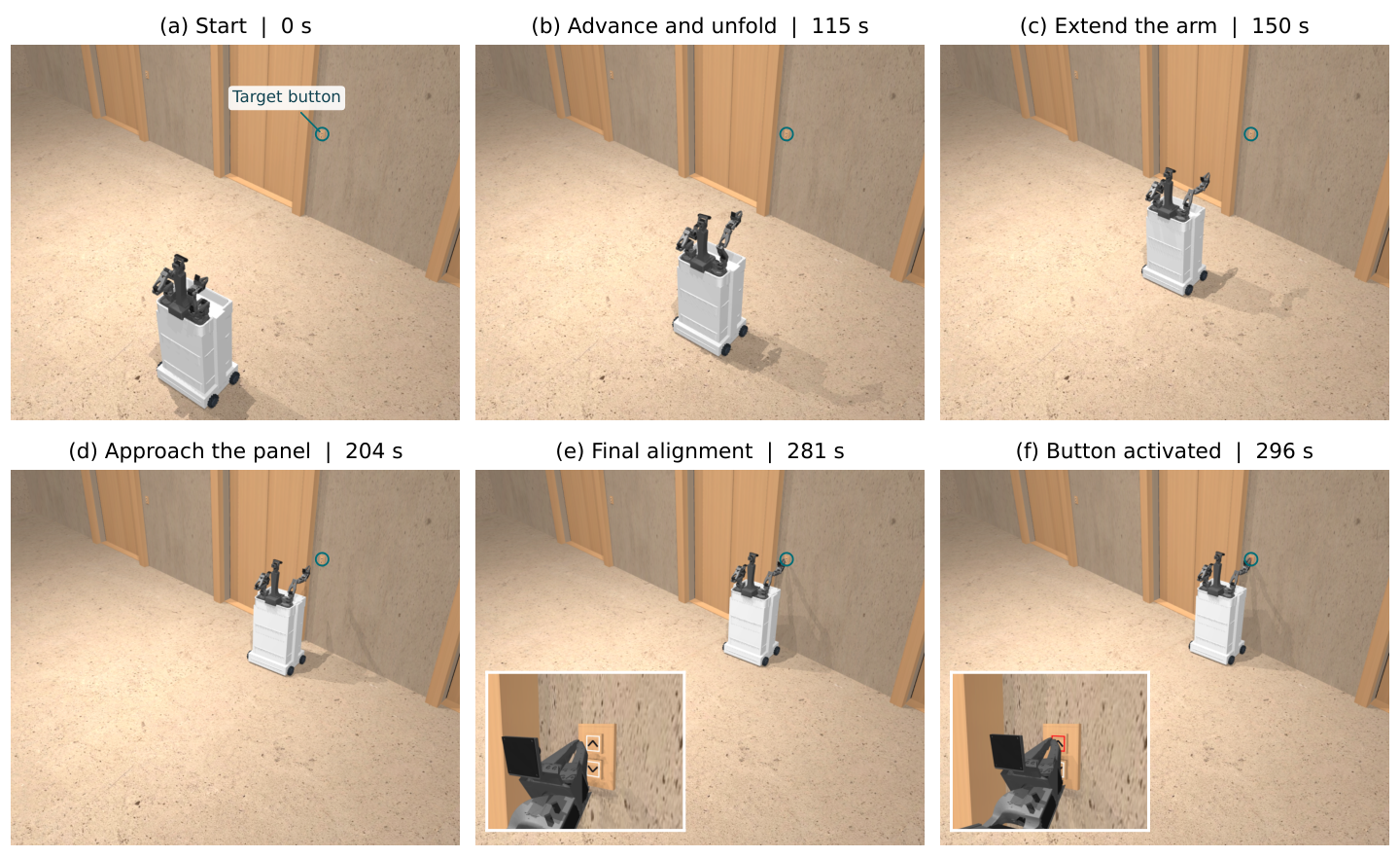
The simulated and physical platforms are based on XLeRobot [ 18 ] , with two six-channel arms, a pan–tilt head, and three onboard cameras. We modified the original platform to use a four-wheel mecanum base, enabling forward, lateral, and rotational motion. The MuJoCo [ 19 ] environment reproduces the modified robot’s geometry and control channels in an elevator lobby (Figure 3 ).
Body Knowledge and Experience in Simulation
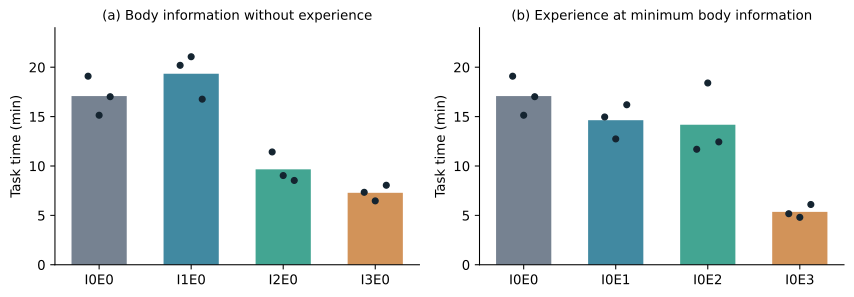
All 30 fixed-start trials succeed. Without historical experience, mean task times for I0, I1, I2, and I3 are 1024.9, 1160.4, 579.8, and 437.1 s (Figure 4 (a)). Thus mechanical assets alone reduce mean time by 43.4%, and complete geometry with camera information reduces it by 57.4% relative to I0.
The qualitative I1 condition is not faster, demonstrating that adding information does not automatically reduce execution cost. At I0, mean times for E0, E1, E2, and E3 are 1024.9, 878.1, 850.7, and 321.4 s (Figure 4 (b)).
From Emergent Behavior to Reusable Skills
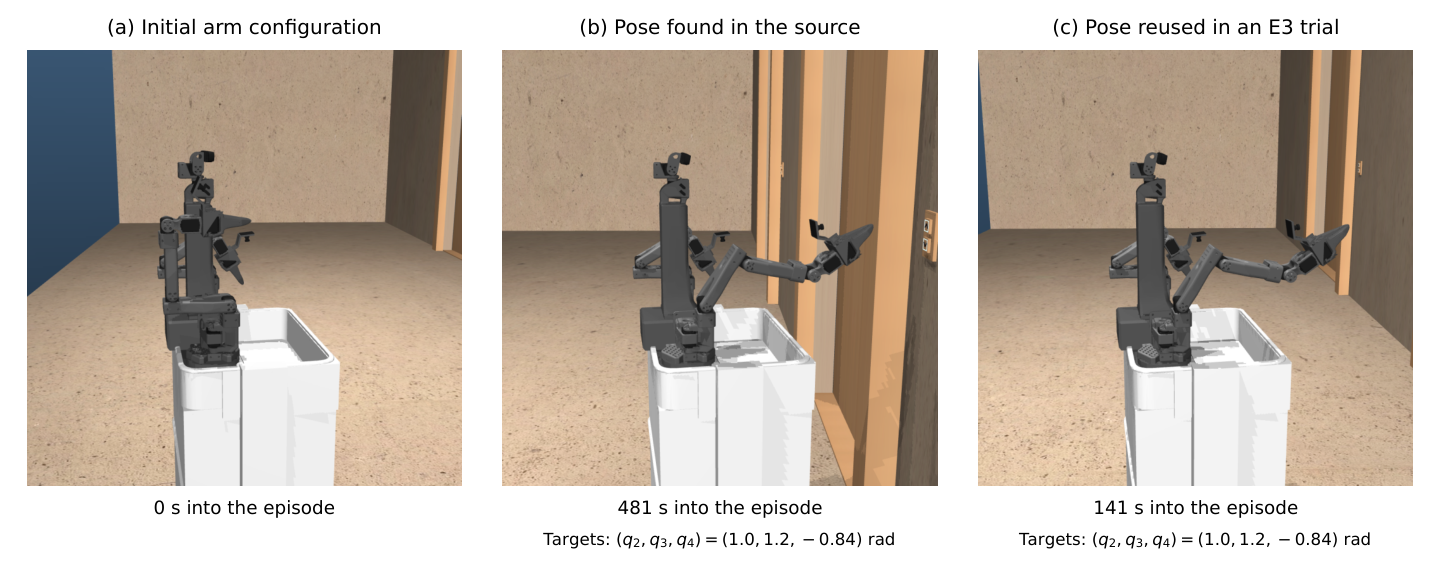
During a supplementary simulation study comparing experience packages (Appendix C.3 ), Astra writes a program that advances briefly, captures images, checks red pixels within selected regions for button activation, and repeats until a threshold is reached or the step budget is exhausted.
The program permits at most five iterations; the observed episode executes four, taking about 4.6 s locally, followed by Astra’s visual confirmation.
Sim2Real and Real-Experience Transfer
We evaluate the physical XLeRobot in a real elevator lobby after the calibration and interface preparation described in Section 3 . Hardware calibration expresses joint targets in the same XML reference as simulation, and both APIs use body-frame base velocities. The task changes from the middle elevator’s UP button to the opposite-side DOWN button, with success determined by operator-confirmed gripper-tip contact.
The controller allows velocity updates during continuous base motion and stops when a command expires or a stop is requested.
Sources and Demonstrations
Figures are reproduced from He et al. See the full paper for experimental details and the project page, when the paper links one, for demonstrations and videos.
Related Papers

A Sim-to-Real Integration Pipeline for Training and Deployment of Chunk-Based VLA Manipulation Policies
Mathilde Kappel, Clémence Grislain, Mohamed Chetouani et al.
Vision-Language-Action (VLA) models have become a prominent paradigm for mapping multimodal inputs, including semantic instructions, visual observations of the scene, and proprioceptive observations, to robot actions.
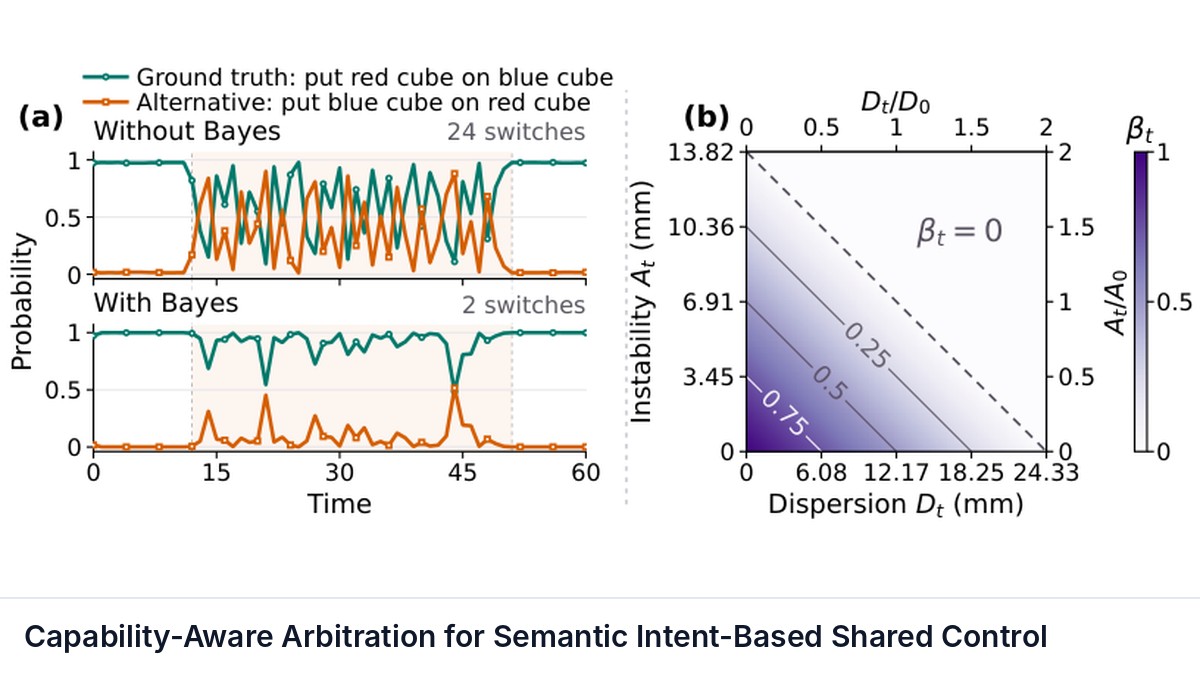
Capability-Aware Arbitration for Semantic Intent-Based Shared Control
Zhaoda Du, Michael Bowman, Xiaoli Zhang
Shared control often allocates robot authority based on confidence in inferred human intent, assuming reliable autonomous execution. When this assumption fails, high intent confidence can cause over-helping.
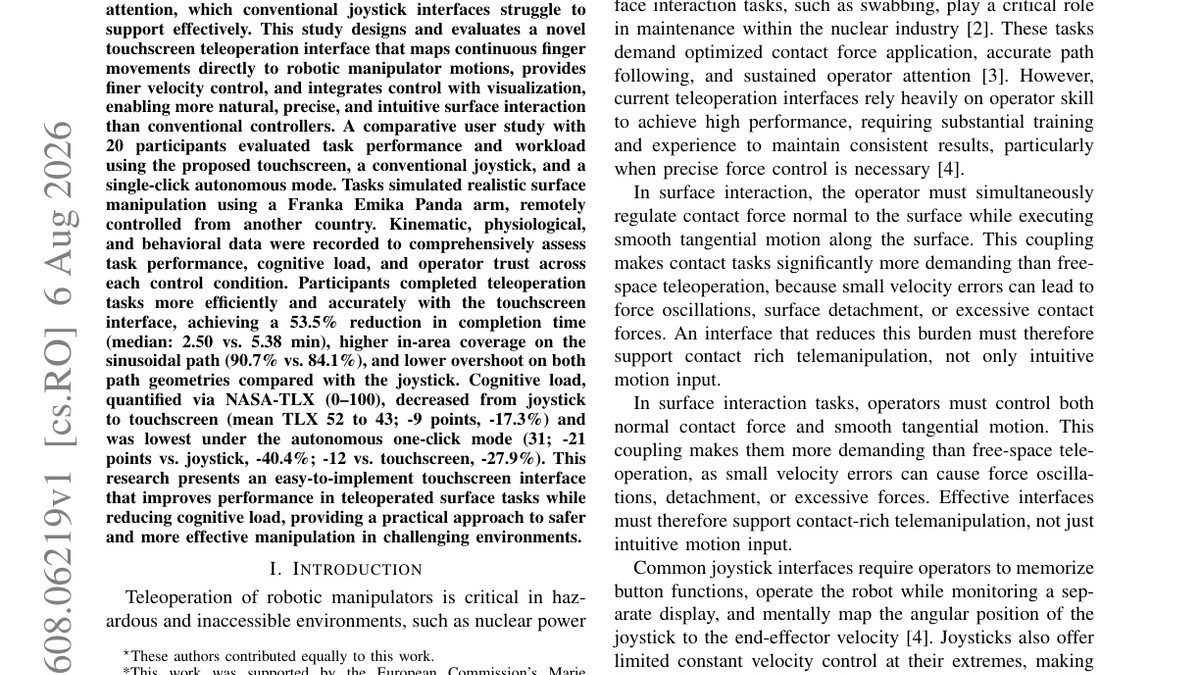
Design and Evaluation of a Touchscreen-Based Teleoperation Interface for Robotic Manipulators
Juan José García Cárdenas, Alperen Kenan, Hamidreza Raei et al.
Intuitive teleoperation interfaces are crucial for the safe and effective operation of robotic manipulators in challenging environments.
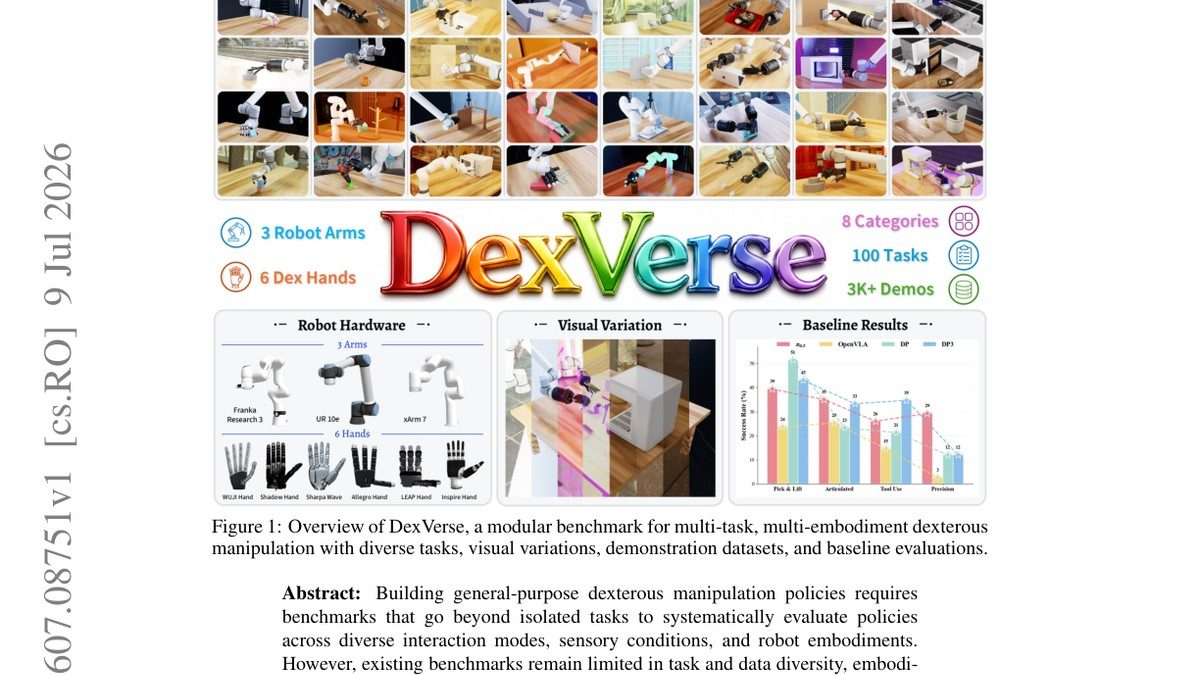
DexVerse: A Modular Benchmark for Multi-Task, Multi-Embodiment Dexterous Manipulation
Yunchao Yao, Zhuxiu Xu, Tianqi Zhang et al.
Building general-purpose dexterous manipulation policies requires benchmarks that go beyond isolated tasks to systematically evaluate policies across diverse interaction modes, sensory conditions, and robot embodiments.