
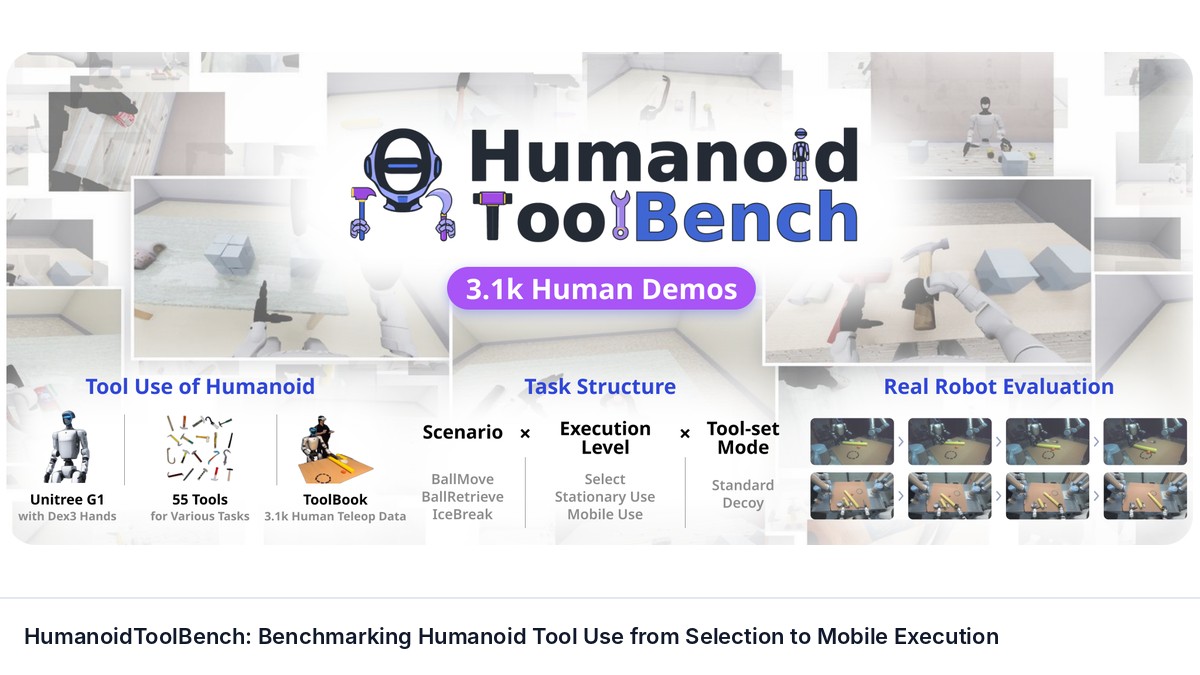
HumanoidToolBench: Benchmarking Humanoid Tool Use from Selection to Mobile Execution
Kyochul Jang, Seohyeon Park, Ohchul Kwon, Sangjun Park, Junhyeok Choi, Seungyeop Yi, Chaeyun Kim, Sangkyu Lee, Idan Szpektor, Avi Caciularu, Jongmin Park, Youngjae Yu · N/A · 2026
Framework
N/A
License
N/A
Stars
N/A
Summary
As robotic hardware and learning methods advance, humanoids need tools to perform tasks beyond their inherent physical limits. Successful tool use requires selecting a suitable tool and coordinating manipulation and, when needed, locomotion to complete the task.
Abstract Summary
Key Points
- As robotic hardware and learning methods advance, humanoids need tools to perform tasks beyond their inherent physical limits.
- Successful tool use requires selecting a suitable tool and coordinating manipulation and, when needed, locomotion to complete the task.
- Existing benchmarks do not jointly evaluate these capabilities on a humanoid
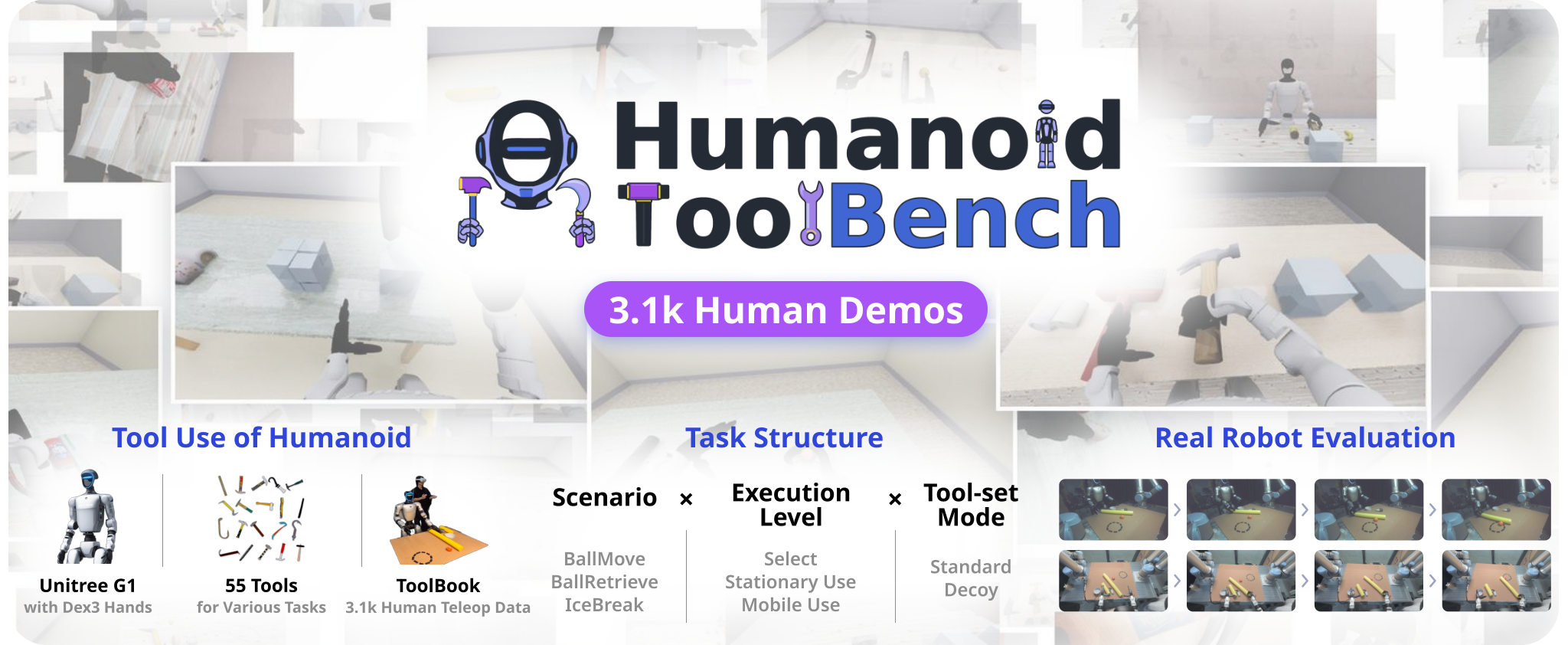
- We introduce HumanoidToolBench, an 18-task benchmark spanning three scenarios, three execution levels, and two tool-set modes, together with ToolBook, a dataset of 3.1k demonstrations collected in simulation and on a real Unitree G1.
- Evaluation of seven policies in simulation and three on the real robot reveals substantial gaps between selecting a suitable tool and completing the task.
HumanoidToolBench
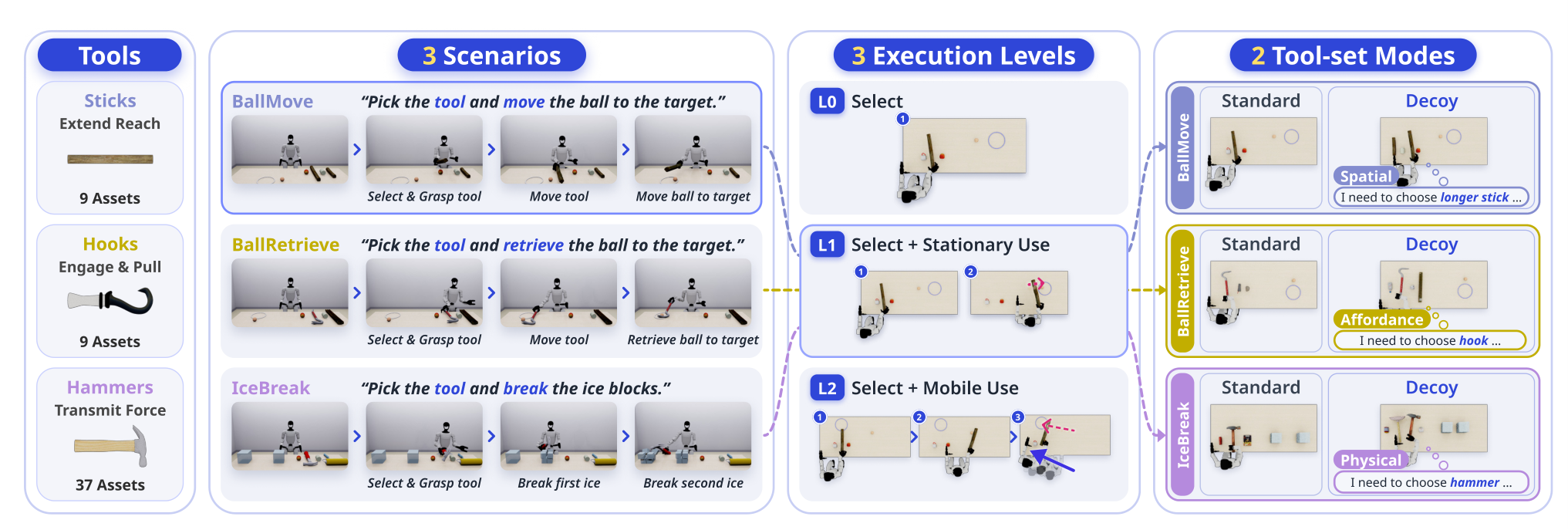
HumanoidToolBench evaluates whether humanoid policies select tools suited to the environment and the user’s instruction, then use them to complete the requested task ( HumanoidToolBench: Benchmarking Humanoid Tool Use from Selection to Mobile Execution ). We instantiate the hierarchical levels in Table I as execution levels , which increase the demands of tool use.
Each task is a combination of scenario, execution level, and tool-set mode, yielding 18 tasks from three scenarios, three execution levels, and two modes.
Experiments
We are continuing to improve HTML versions of papers, and your feedback helps enhance accessibility and mobile support. To report errors in the HTML that will help us improve conversion and rendering, choose any of the methods listed below: ) button, located in the page header. Tip: You can select the relevant text first, to include it in your report. Our team has already identified the following issues .
We appreciate your time reviewing and reporting rendering errors we may not have found yet.
Sources and Demonstrations
Figures are reproduced from Jang et al. See the full paper for experimental details and the project page, when the paper links one, for demonstrations and videos.
Related Papers
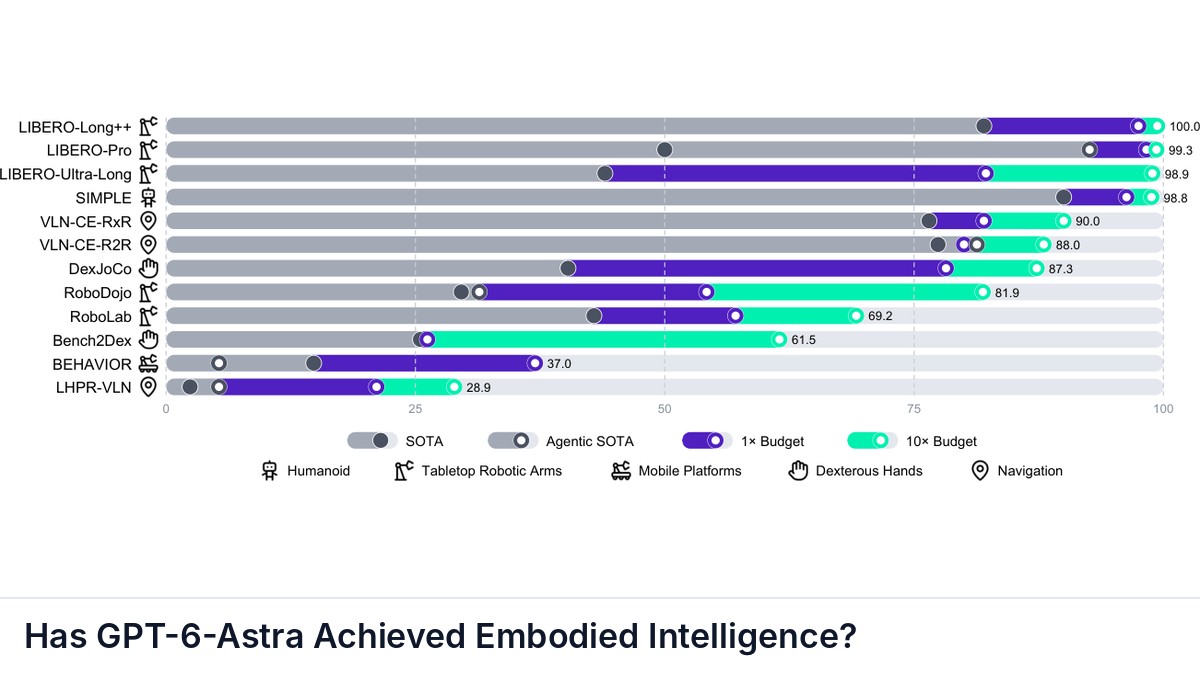
Has GPT-6-Astra Achieved Embodied Intelligence?
SenseNova, Joint Research Team, : et al.
GPT-6-Astra demonstrates a level of competence in robotic manipulation and navigation that challenges the conventional paradigm of building specialized models for individual tasks and embodiments.
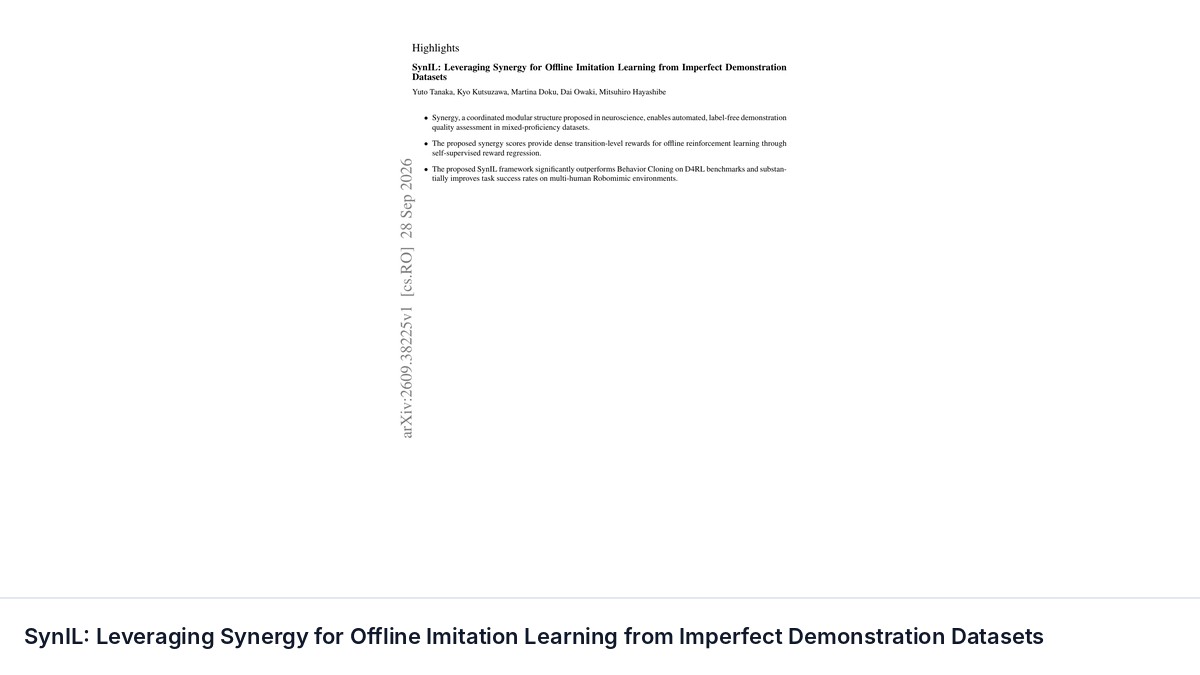
SynIL: Leveraging Synergy for Offline Imitation Learning from Imperfect Demonstration Datasets
Yuto Tanaka, Kyo Kutsuzawa, Martina Doku et al.
Imitation learning enables robots to acquire complex skills directly from massive demonstration datasets, but its performance degrades severely when datasets are contaminated with suboptimal or noisy demonstrations.
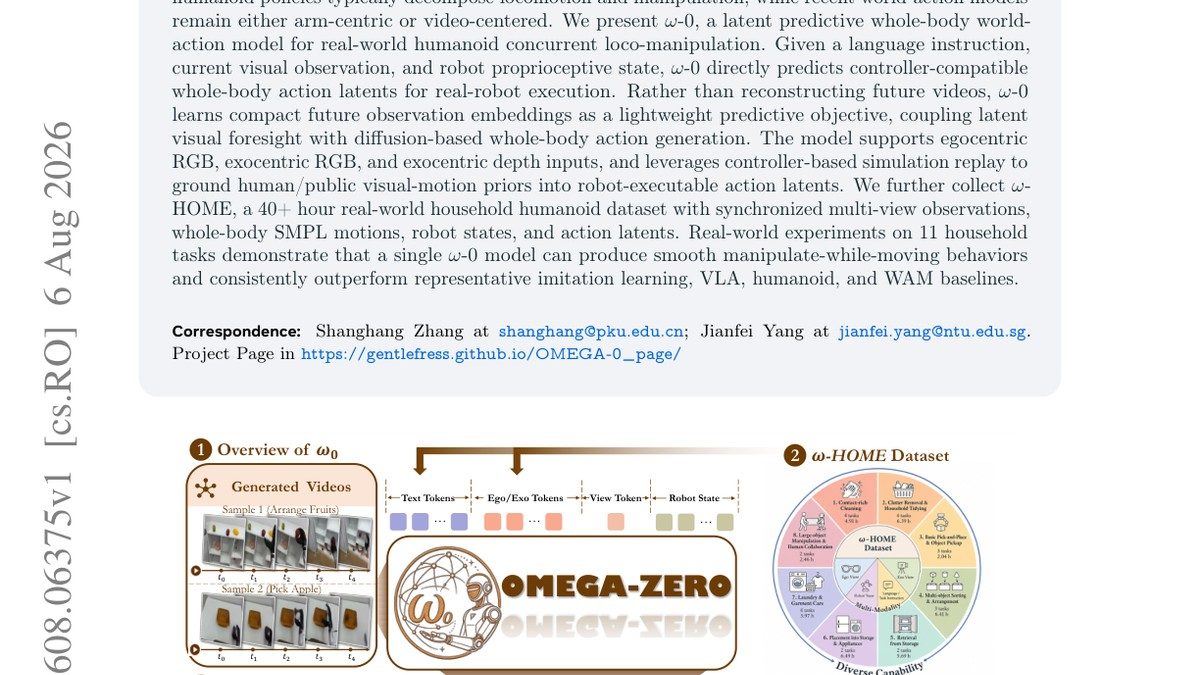
$ω$-0: A Latent Predictive World Action Model for Concurrent Humanoid Loco-Manipulation
Zhe Li, Zhenzhe Zhang, Yangyang Wei et al.
Humanoid household tasks often require concurrent loco-manipulation, where the robot must move, adjust posture, maintain balance, and manipulate objects as a single coordinated behavior.
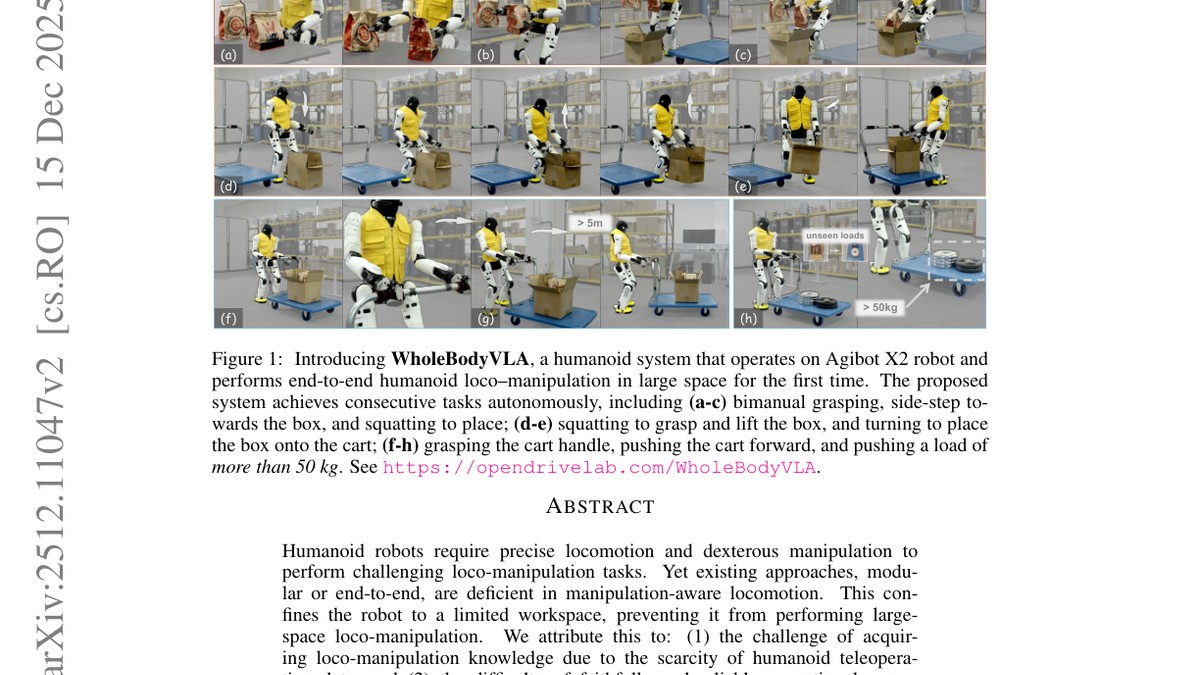
WholeBodyVLA: Towards Unified Latent VLA for Whole-Body Loco-Manipulation Control
Haoran Jiang, Jin Chen, Qingwen Bu et al.
Humanoid robots require precise locomotion and dexterous manipulation to perform challenging loco-manipulation tasks. Yet existing approaches, modular or end-to-end, are deficient in manipulation-aware locomotion.