
Clarity-Driven Adaptive Mission Planning for a Solar-Powered Autonomous Surface Vessel
Kavin M. Govindarajan, Kaleb Ben Naveed, David Li, Devansh R. Agrawal, Mary Maceda, Matthew Bryant, Dimitra Panagou, Chris Vermillion · N/A · 2026
Framework
N/A
License
N/A
Stars
N/A
Summary
This paper presents a comprehensive methodology, backed by simulation and experimental results, for an adaptive mission planning strategy that is mathematically grounded in the maximization of the information-driven quantity of clarity.
Abstract Summary
Key Points
- This paper presents a comprehensive methodology, backed by simulation and experimental results, for an adaptive mission planning strategy that is mathematically grounded in the maximization of the information-driven quantity of clarity.
- In particular, the methodology introduced in this work addresses the use of sustainably powered autonomous surface vessels (ASVs) to perform scientific missions that prioritize locations of maximum interest.
- Because these locations of maximum interest are not known a priori but are rather identified based on in-situ measurements, online adaptation is essential for mission planning.
- Furthermore, the reliance on a limited-power renewable resource requires an adaptation strategy that maximizes information gathering subject to mobility restrictions imposed by the renewable resource.
- Our approach addresses these challenges through a clarity-driven ergodic search, where clarity represents a mathematical quantity that has been rigorously linked to differential (information) entropy.
Energy & Information (Clarity) Modeling
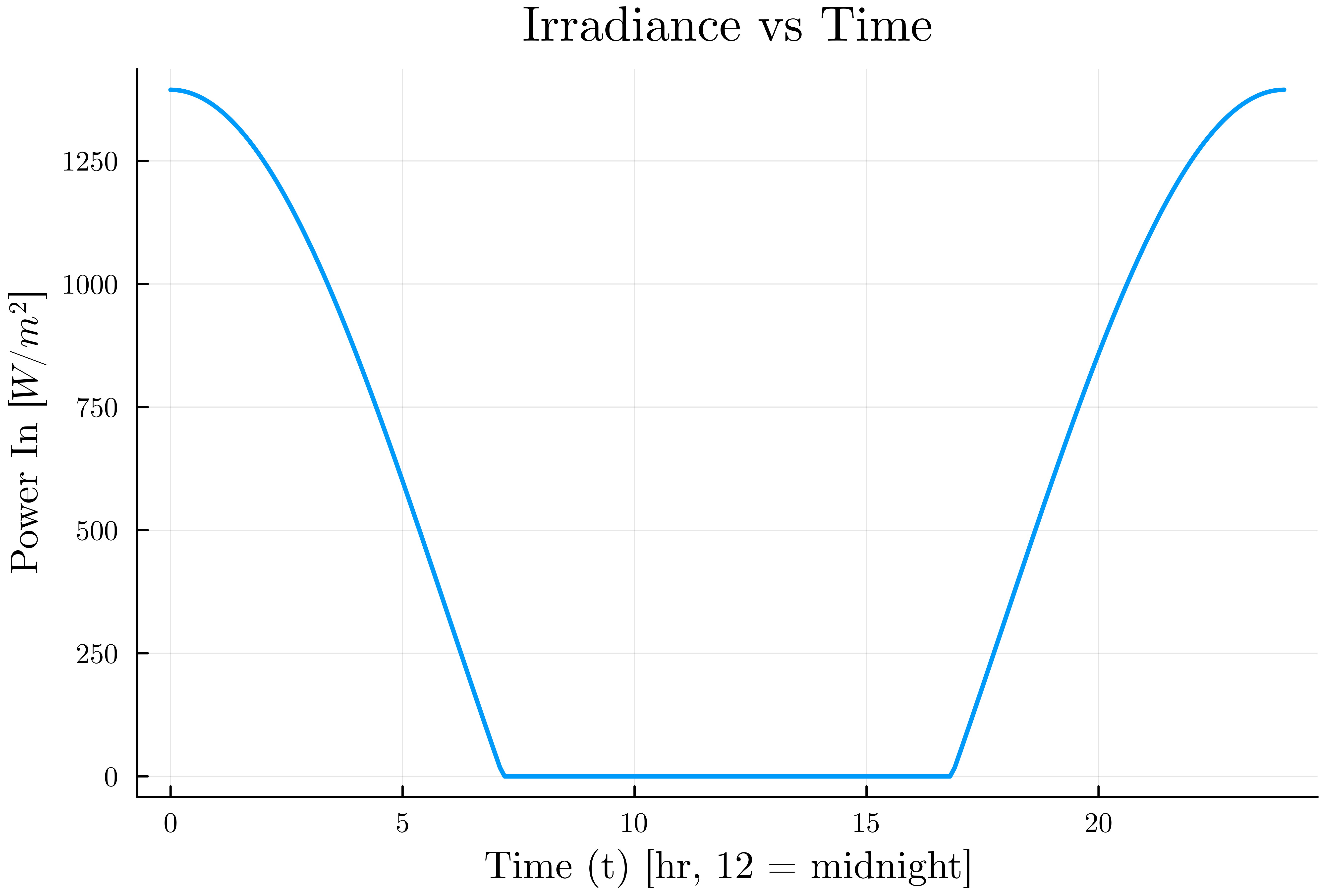
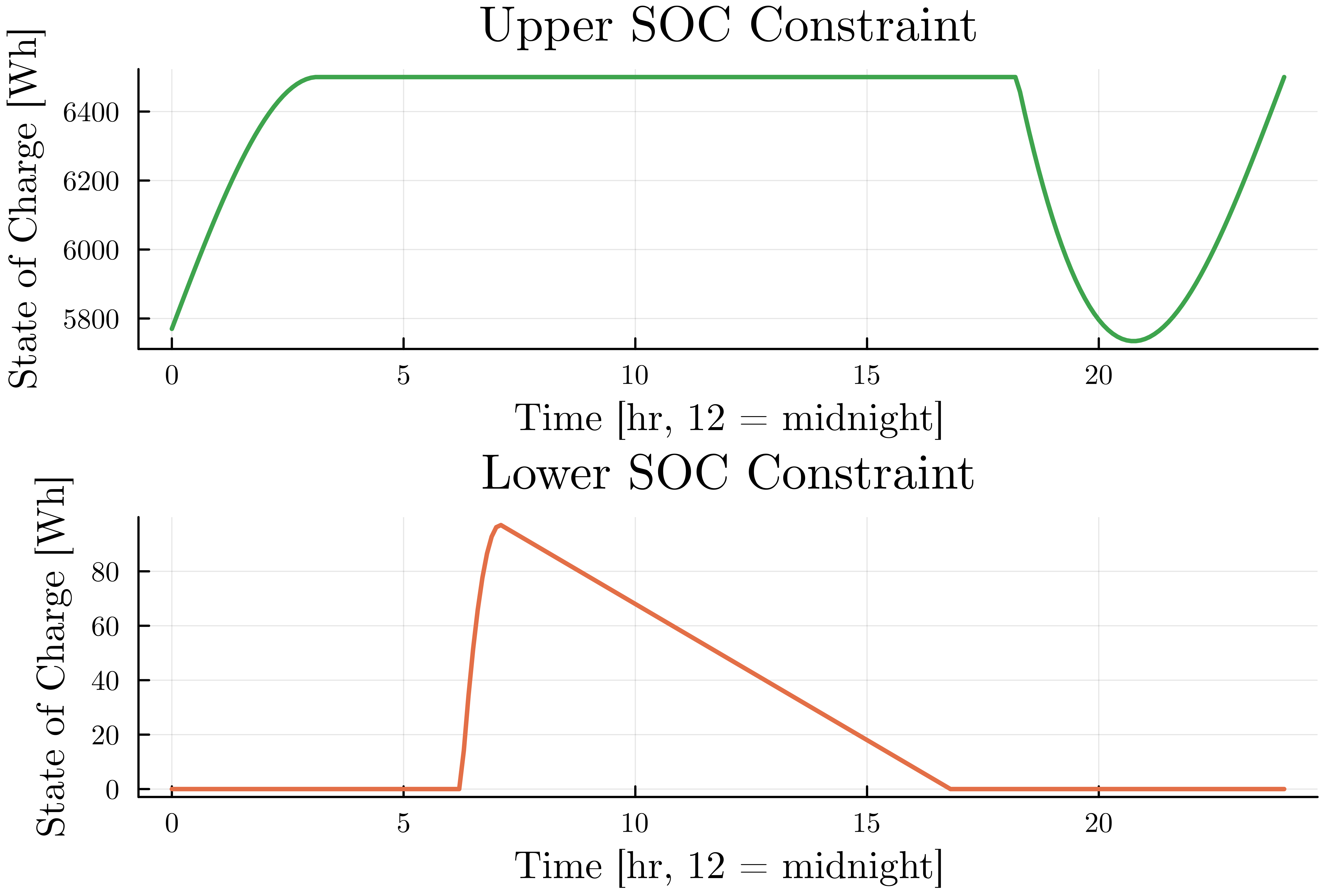
The ultimate goal of this work is to present a process for maximizing the collection of useful scientific information under a limited energy resource. Therefore, it is critical to establish underlying models that describe how both energy and information (to be modeled using clarity) evolve over time. Those models are presented in this section. We first consider the energy dynamics of the ASV.
In particular, we consider an ASV with on-board battery storage, rendering its speed adjustable in real-time.
Adaptive Mission Planning Methodology
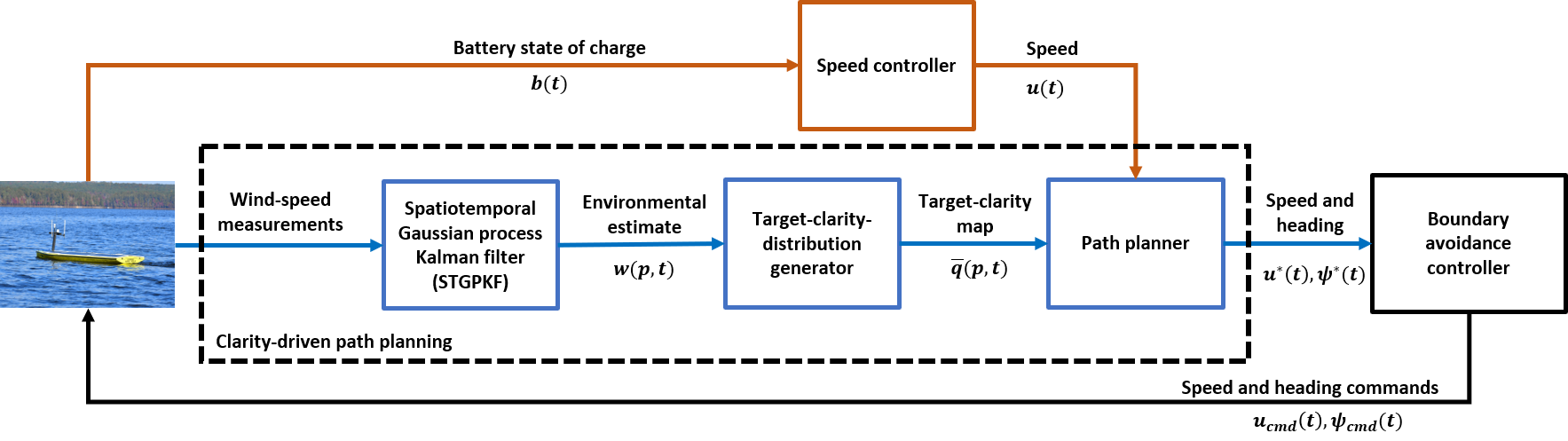
We consider the problem of exploring a mission domain $\mathcal{D}\subset\mathbb{R}^{2}$ using a solar-powered autonomous surface vehicle (ASV) tasked with characterizing a spatiotemporally varying wind field. The objective is to allocate sensing effort toward regions where the wind speed $w(p,t)$ is close to a desired rated value $w_{\mathrm{rated}}$, while respecting energetic and operational constraints.
To achieve this, we propose the integrated control framework shown in Fig. 3 .
Simulation Study
In this section, we use simulation studies to examine the effects of target adaptation and the low-level path planner on sampling behavior, field reconstruction, and clarity deficit. We first isolate these effects in two diagnostic environments and then evaluate their sensitivity to the spatiotemporal correlation scales of the wind field through a Monte Carlo study.
Experimental Results
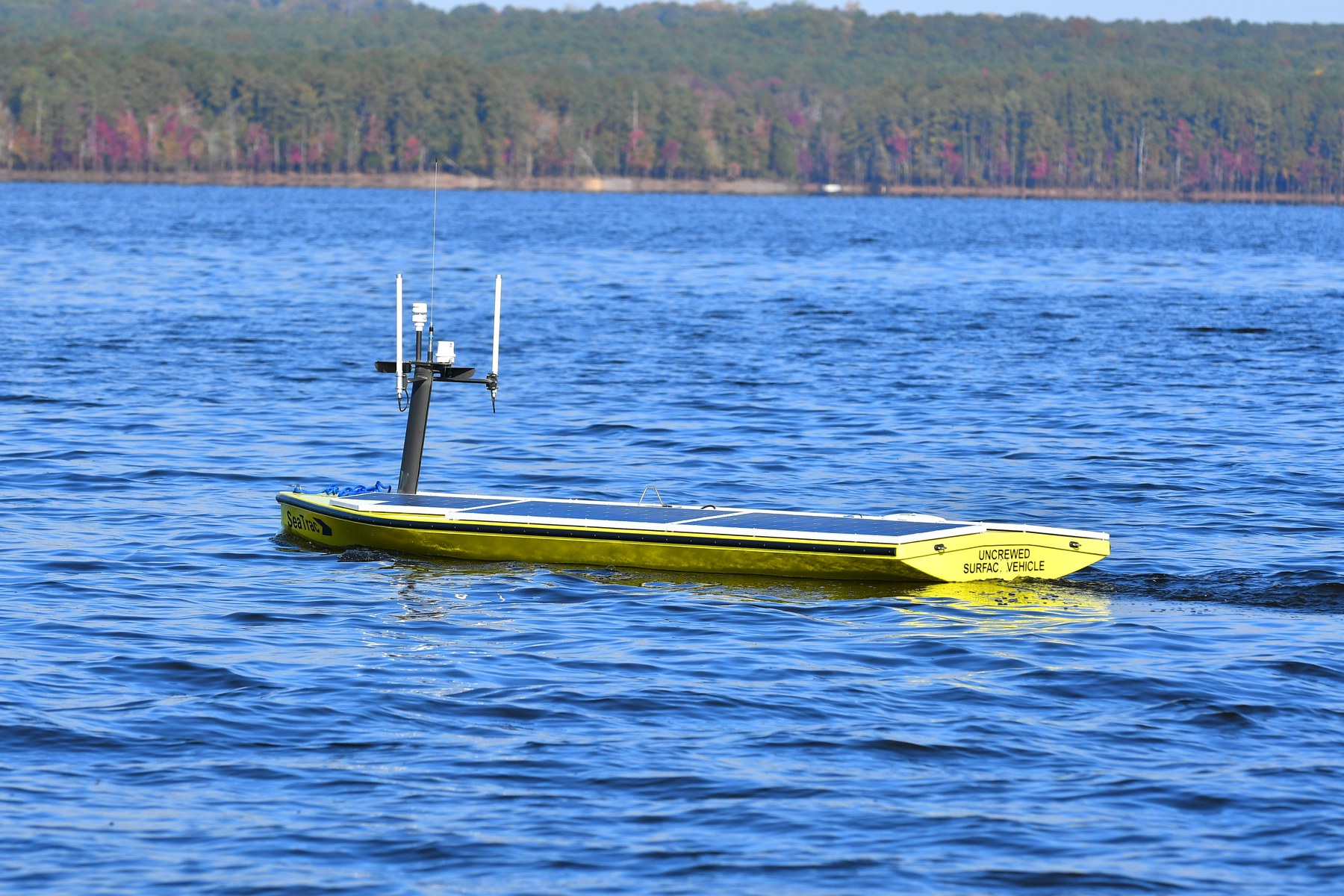
This section evaluates the framework on the SeaTrac ASV. We consider three mission profiles: 90-minute missions at constant speed, 90-minute missions with closed-loop SOC control, and 3-hour missions with closed-loop SOC control. The first comparison examines targeted sampling without speed adaptation; the latter two examine operation of the planner and energy controller together.
Experiments were based on the SeaTrac SP-48 ASV, with the goal of tracking a target wind speed during each experimental run (same as in the simulation studies).
Sources and Demonstrations
Figures are reproduced from Govindarajan et al. See the full paper for experimental details and the project page, when the paper links one, for demonstrations and videos.
Related Papers
A Browser-Native Digital Test Range for Benchmarking 4D Ocean-Glider Planning Algorithms
Edward Holmberg, Elias Ioup, Mahdi Abdelguerfi
Repeated in-situ evaluation of ocean-glider planners requires scarce vehicles, operators, deployment and recovery resources, and ocean conditions that cannot be reset for competing algorithms.
A Low-Cost, Open Platform for End-to-End Autonomous Driving on a Miniature Ackermann Vehicle
Gustavo Claudio Karl Couto, Eric Aislan Antonelo, Gabriel George Zipperer
This paper presents a low-cost, open experimental platform for research in end-to-end autonomous driving with miniature Ackermann vehicles.
A Physics-Informed Collision Learning Framework for Collaborative Robot Motion Generation
Chen Cai, Steven Liu
Close-proximity multi-arm manipulation requires collision models that are both geometrically accurate and differentiable enough for real-time optimization.
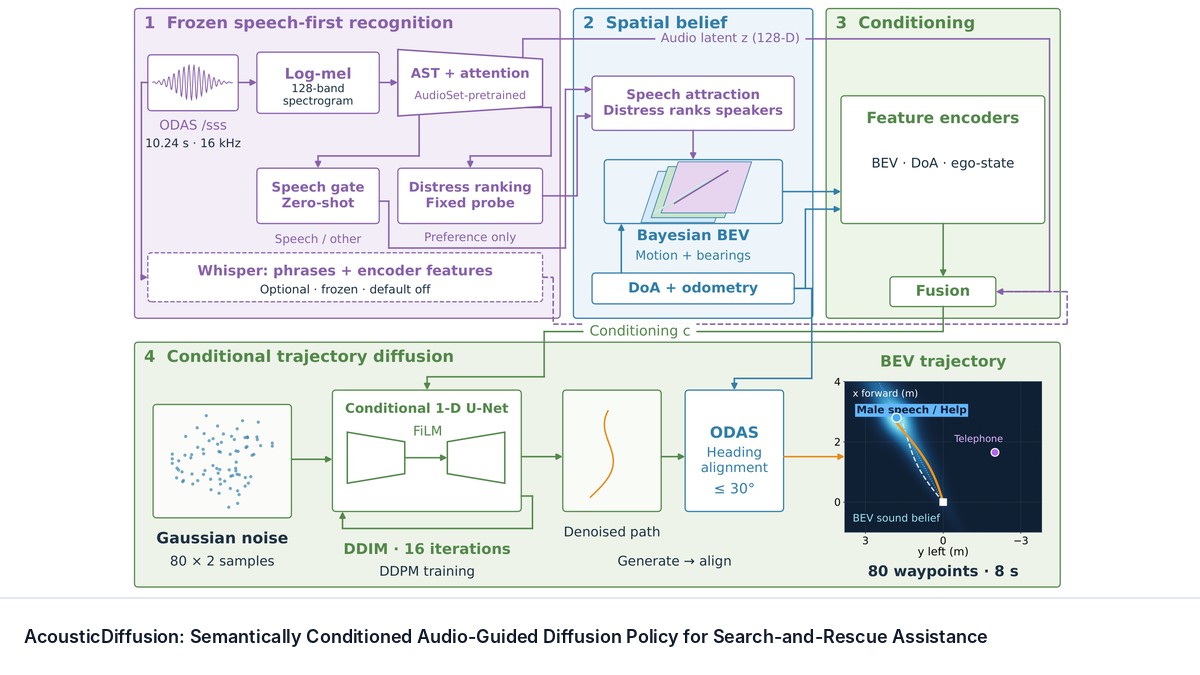
AcousticDiffusion: Semantically Conditioned Audio-Guided Diffusion Policy for Search-and-Rescue Assistance
Iana Zhura, Didar Seyidov, Dmitrii Plotnikov et al.
Navigating toward human callers is an important capability for rescue robots operating where visual contact is degraded or occluded. We present AcousticDiffusion, a semantically conditioned, audio-guided diffusion policy for human-directed navigation.