
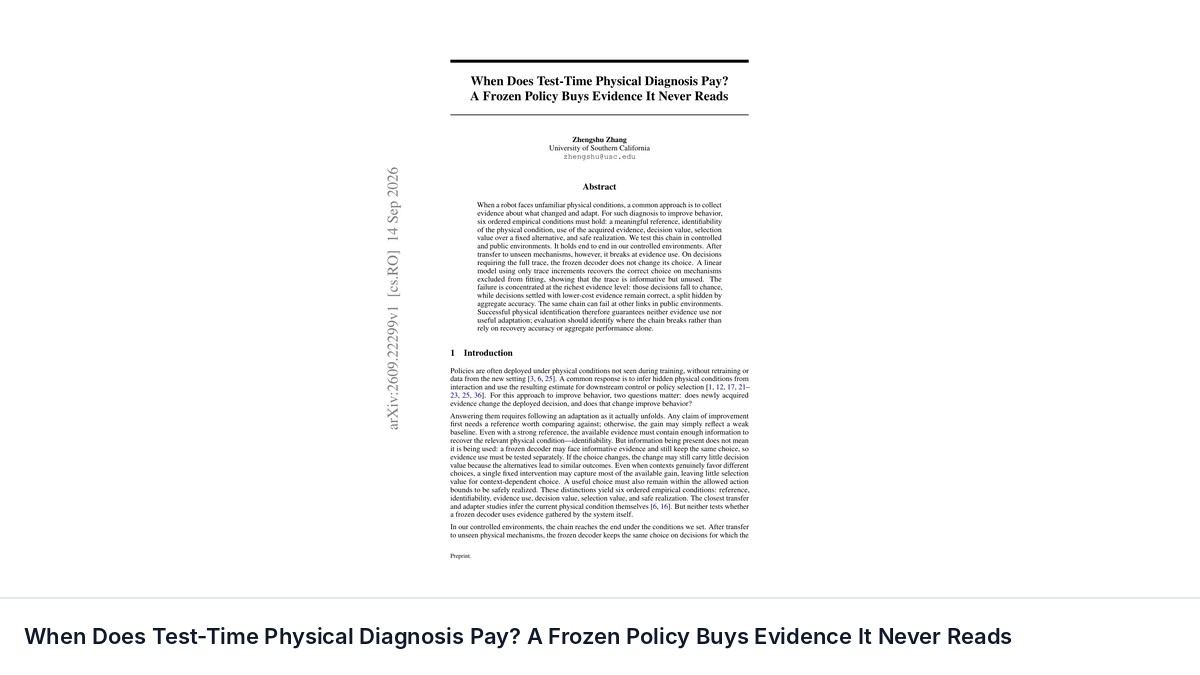
When Does Test-Time Physical Diagnosis Pay? A Frozen Policy Buys Evidence It Never Reads
Zhengshu Zhang · N/A · 2026
Framework
N/A
License
N/A
Stars
N/A
Summary
When a robot faces unfamiliar physical conditions, a common approach is to collect evidence about what changed and adapt.
Abstract Summary
Key Points
- When a robot faces unfamiliar physical conditions, a common approach is to collect evidence about what changed and adapt.
- For such diagnosis to improve behavior, six ordered empirical conditions must hold: a meaningful reference, identifiability of the physical condition, use of the acquired evidence, decision value, selection value over a fixed alternative, and safe realization.
- We test this chain in controlled and public environments
- It holds end to end in our controlled environments
- After transfer to unseen mechanisms, however, it breaks at evidence use
What Must Hold for Physical Diagnosis to Pay?
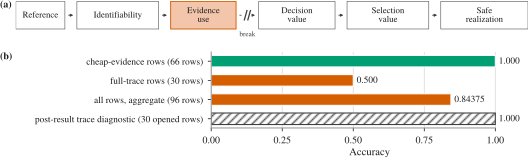
Diagnosis pays only if a chain of conditions holds end to end. Between “the system found out what changed” and “the system did better for knowing it” sit six conditions, ordered as a single decision passes through them (Figure 1 a); a break at any link ends the case for diagnosis however well the earlier ones went.
A failed condition ends the case for diagnosis and blocks downstream development, although diagnostics already available from the same panel may expose later failures.
Evaluation Protocol: Isolating the Failed Link
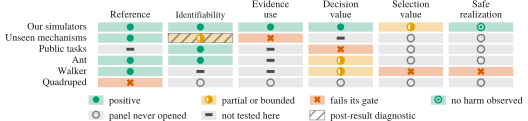
Every threshold below was set before the run it judges, so where a result lands close to its threshold the verdict is not a judgement made after seeing the number. A system that chooses how much evidence to buy can also beat a fixed rule by buying more, so the fixed rule receives the same purchases: whatever the adaptive system bought on a given decision, the comparator gets too, leaving only allocation to compare.
Findings
We first check that the evaluation registers success. In two simulators we built, every decision chooses between two action strategies, and which wins depends on a physical condition the system cannot see: whether contact slips, whether the actuator has margin, whether the button breaks.
Before acting it buys evidence about that condition at one of four prices, paid in bytes serialized: nothing, a single bit saying whether the situation is resolvable, a telemetry summary, or the full trace.
Sources and Demonstrations
Figures are reproduced from Zhang See the full paper for experimental details and the project page, when the paper links one, for demonstrations and videos.
Related Papers
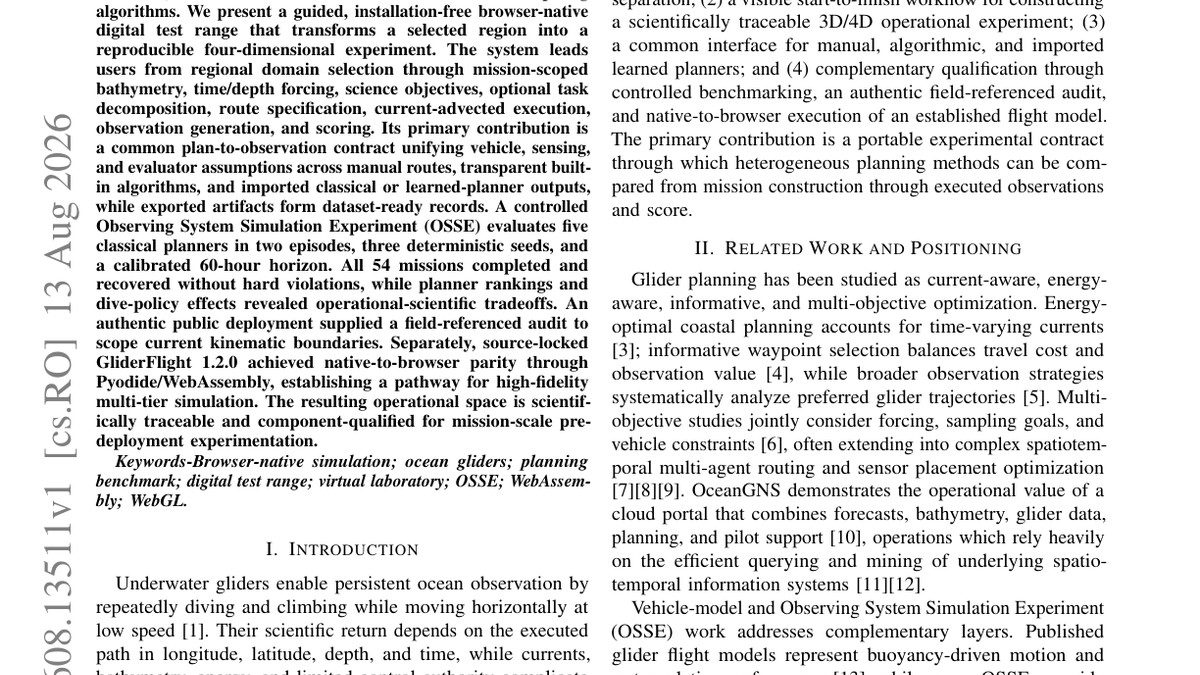
A Browser-Native Digital Test Range for Benchmarking 4D Ocean-Glider Planning Algorithms
Edward Holmberg, Elias Ioup, Mahdi Abdelguerfi
Repeated in-situ evaluation of ocean-glider planners requires scarce vehicles, operators, deployment and recovery resources, and ocean conditions that cannot be reset for competing algorithms.
A Mode-Unified, Continuous, and Biomimetic Control Strategy of a Robotic Lower Limb Prosthesis
Hanjun Kim, Sixu Zhou, John Shim et al.
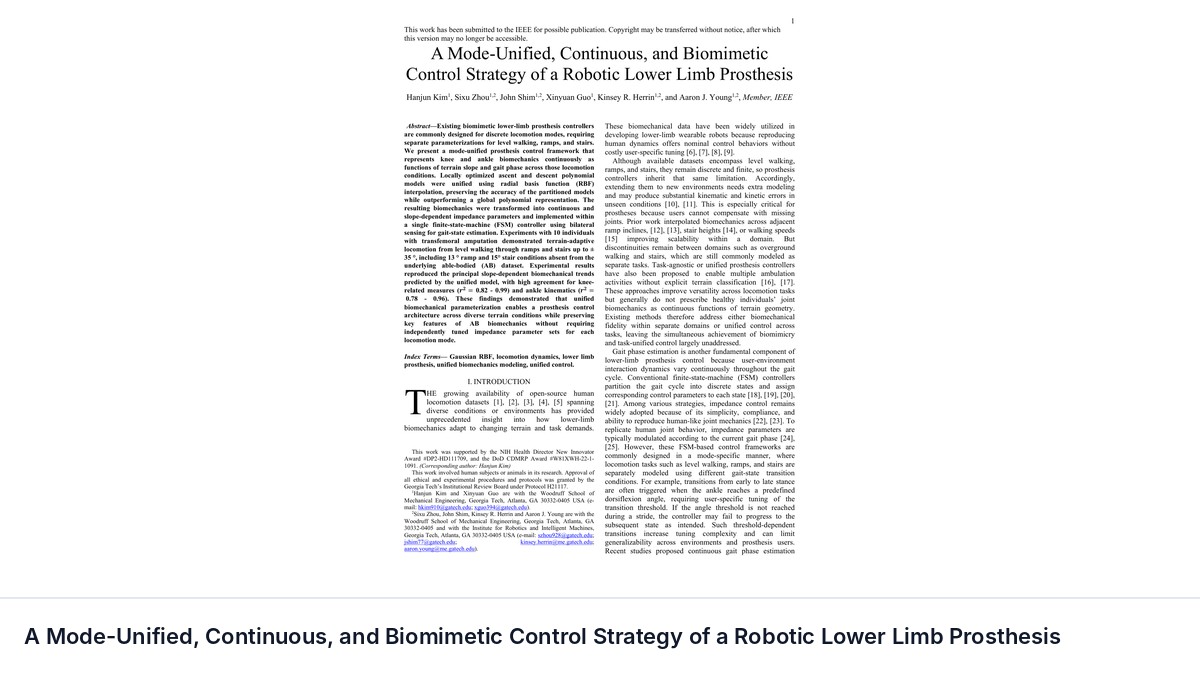
Existing biomimetic lower-limb prosthesis controllers are commonly designed for discrete locomotion modes, requiring separate parameterizations for level walking, ramps, and stairs.

A Sim-to-Real Integration Pipeline for Training and Deployment of Chunk-Based VLA Manipulation Policies
Mathilde Kappel, Clémence Grislain, Mohamed Chetouani et al.
Vision-Language-Action (VLA) models have become a prominent paradigm for mapping multimodal inputs, including semantic instructions, visual observations of the scene, and proprioceptive observations, to robot actions.
A Unified Kinematic Representation Enables Reusable Biological Joint Moment Estimation
Jinwoo Hwang, Ilseung Park, Changseob Song et al.
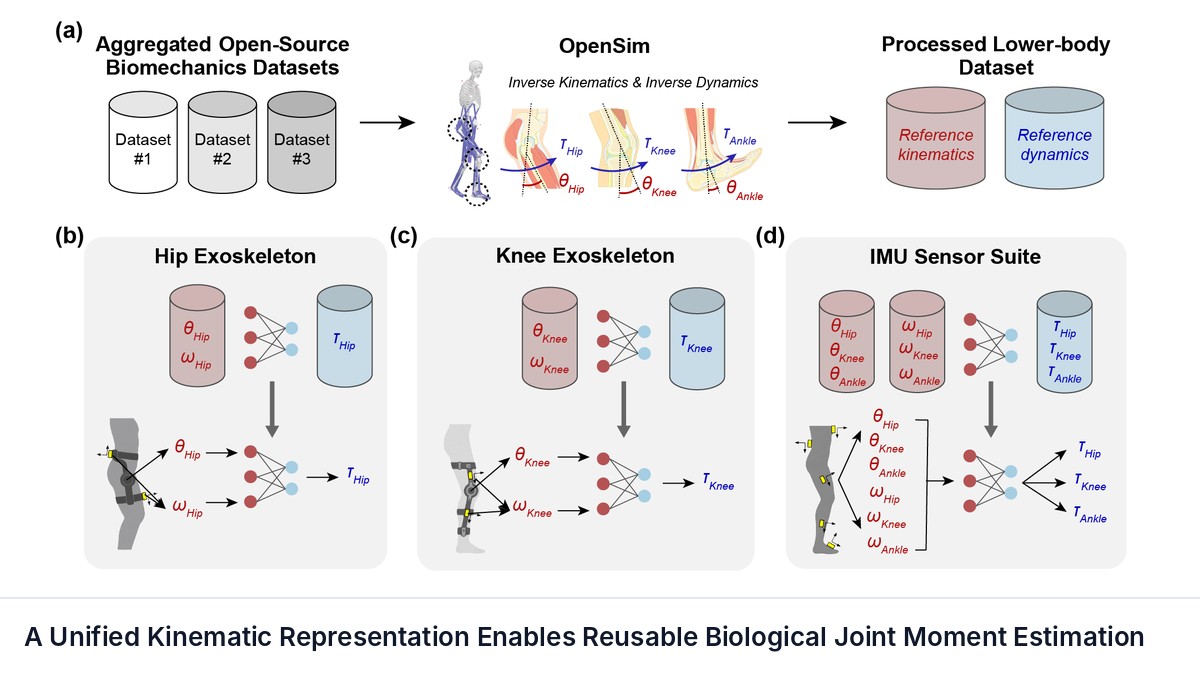
Objective: Data-driven models that estimate physiological states, particularly biological joint moments, are widely used in exoskeleton control.