
Grasp, Handover, Rotate: Bimanual Object Reorientation via Compositional Diffusion and Energy-Based Optimization
Wun Lam Yeung, Wenjun Liu, Yui Cheung Yu, Zhengyan Lambo Qin, Qijin She, Heng Li, Ziqi Wang, Ping Tan · N/A · 2026
Framework
N/A
License
N/A
Stars
N/A
Summary
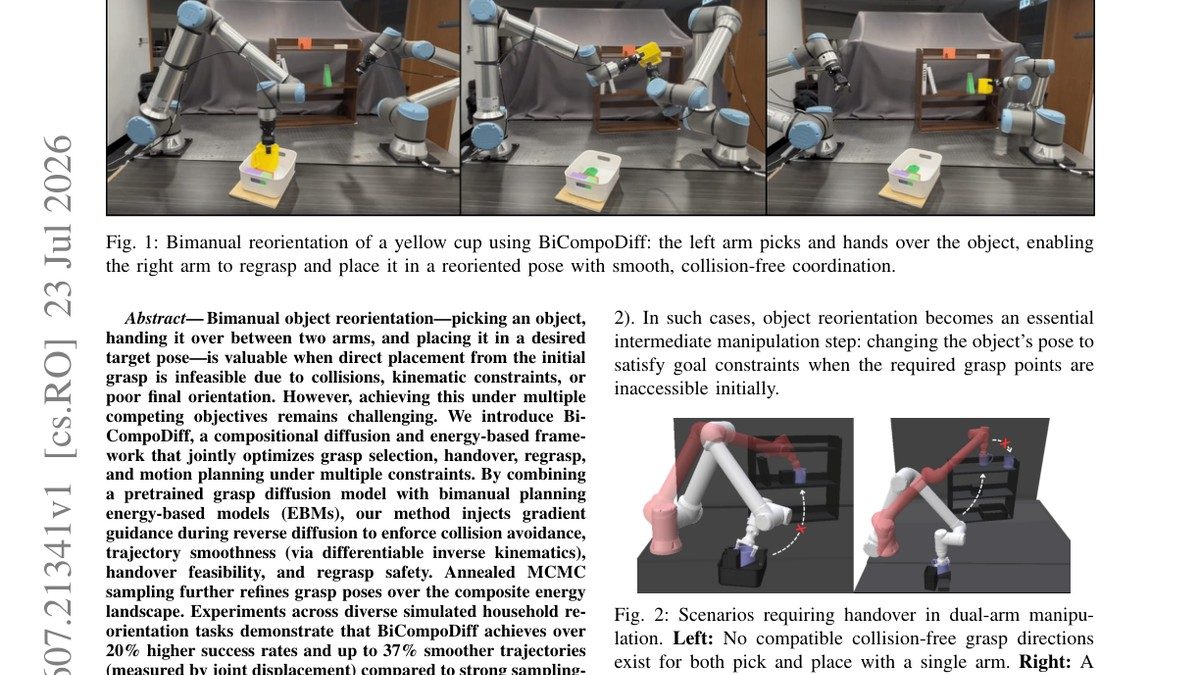
Bimanual object reorientation - picking an object, handing it over between two arms, and placing it in a desired target pose - is valuable when direct placement from the initial grasp is infeasible due to collisions, kinematic constraints, or poor final orientation.
Abstract Summary
Key Points
- Bimanual object reorientation - picking an object, handing it over between two arms, and placing it in a desired target pose - is valuable when direct placement from the initial grasp is infeasible due to collisions, kinematic constraints, or poor final orientation.
- However, achieving this under multiple competing objectives remains challenging
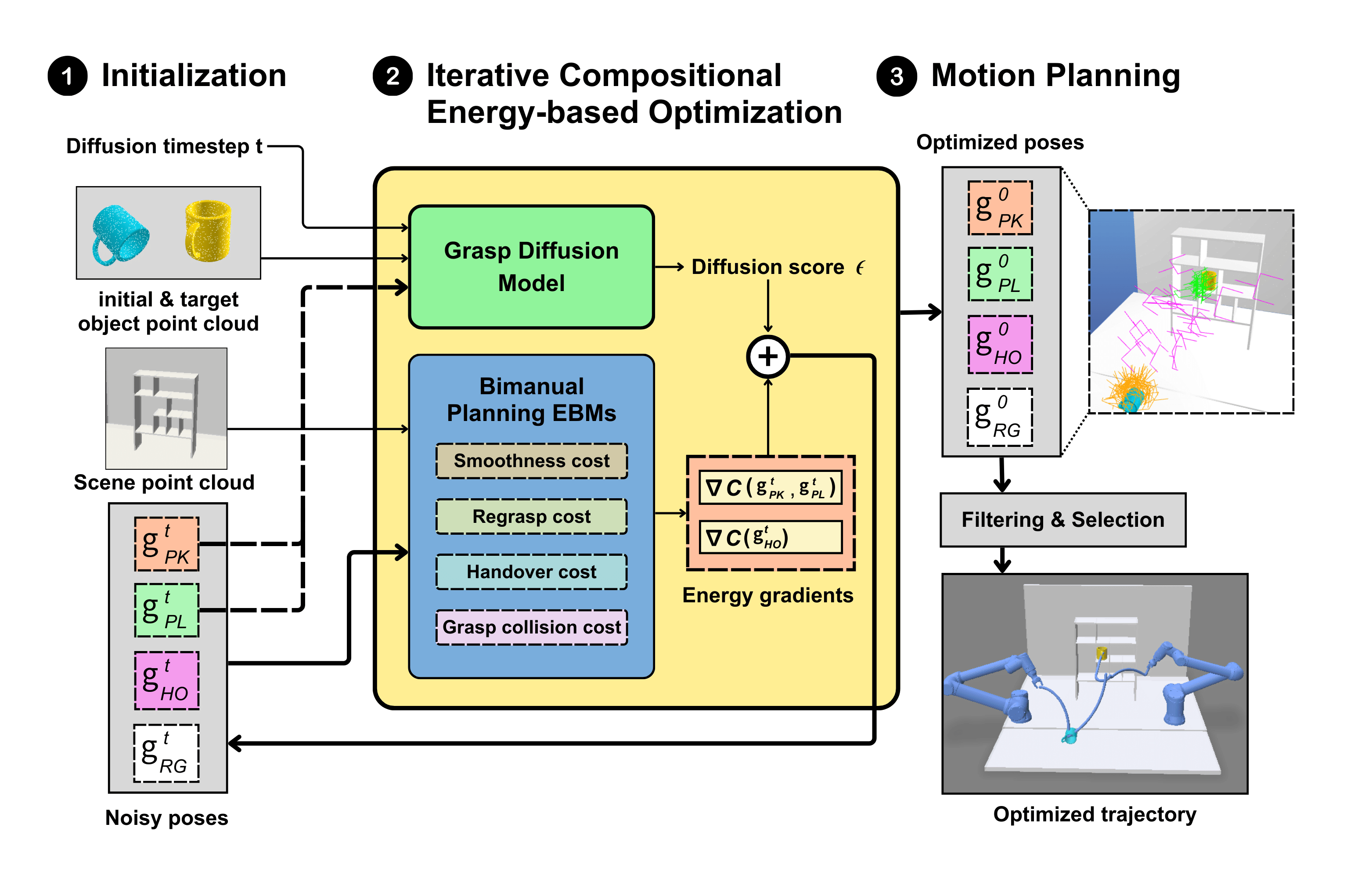
- We introduce BiCompoDiff, a compositional diffusion and energy-based framework that jointly optimizes grasp selection, handover, regrasp, and motion planning under multiple constraints.
- By combining a pretrained grasp diffusion model with bimanual planning energy-based models (EBMs), our method injects gradient guidance during reverse diffusion to enforce collision avoidance, trajectory smoothness (via differentiable inverse kinematics), handover feasibility, and regrasp safety.
- Annealed MCMC sampling further refines grasp poses over the composite energy landscape
PRELIMINARIES
In this work, we leverage diffusion models as the core generative component for grasp candidate initialization and subsequent joint refinement with motion planning. Diffusion models are particularly well-suited for this setup due to their close connection to energy-based models (EBMs) and their ability to support compositional optimization in high-dimensional, multi-modal spaces [ 6 , 20 ] .
METHODS
We study coordinated dual-arm pick-and-place in clutter using two UR12e 6-DoF robots. The robot must optimize a full reorientation sequence: pick with one arm, handover, regrasp with the other arm, and place at the target.
Experiments
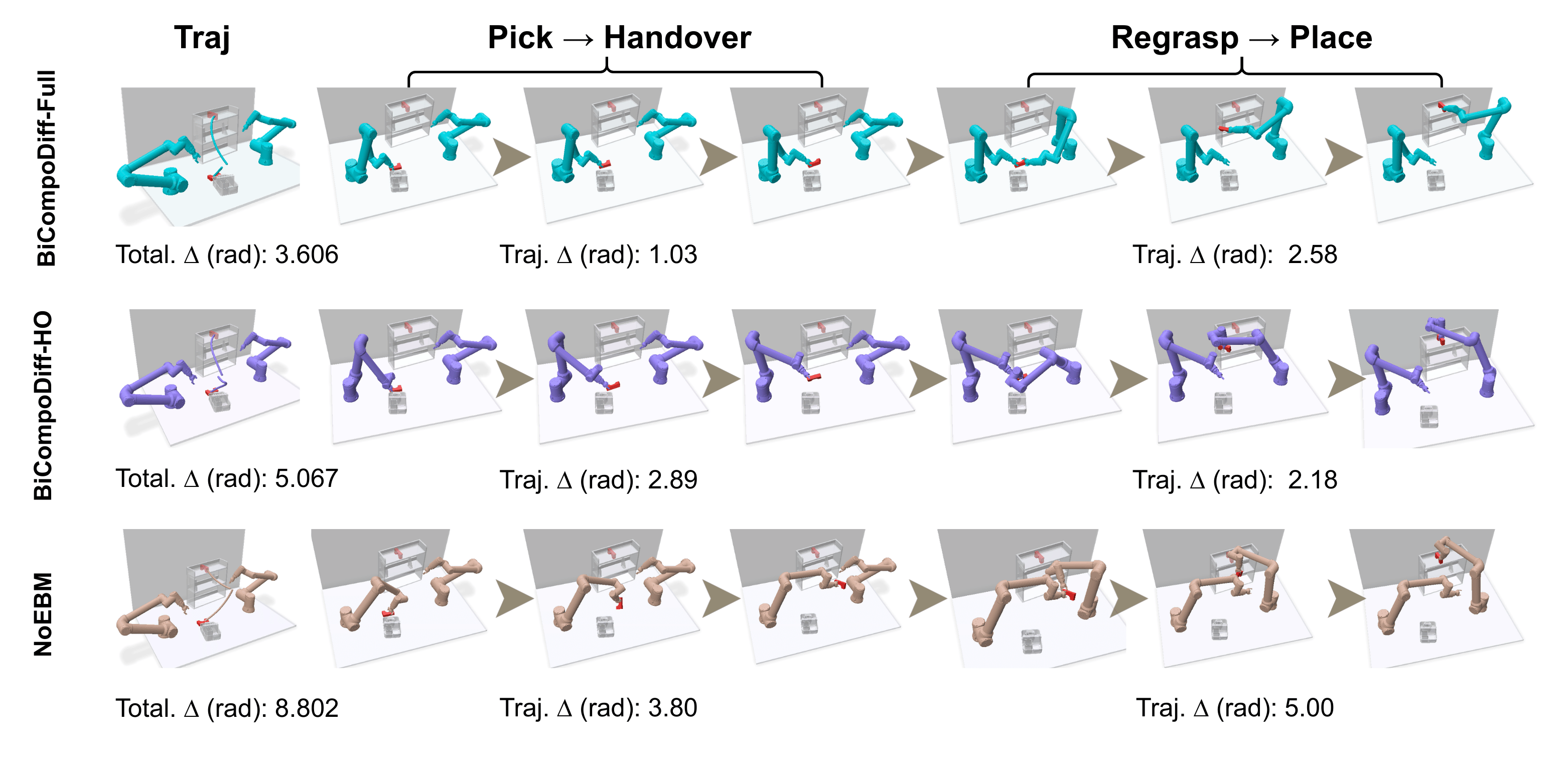
We evaluate BiCompoDiff on collaborative bimanual manipulation tasks involving pick, place, handover, and regrasp actions for object reorientation. All experiments are conducted in simulation unless otherwise stated, with real-world validation. Experiments are conducted in a modular simulation pipeline that couples a high-level task specification front-end with a motion planning back-end.
The environment includes: Task Sandbox: Defines scene geometry, initial/target object poses, and planner interface.
Sources and Demonstrations
Figures are reproduced from Yeung et al. See the full paper for experimental details and the project page, when the paper links one, for demonstrations and videos.
Related Papers
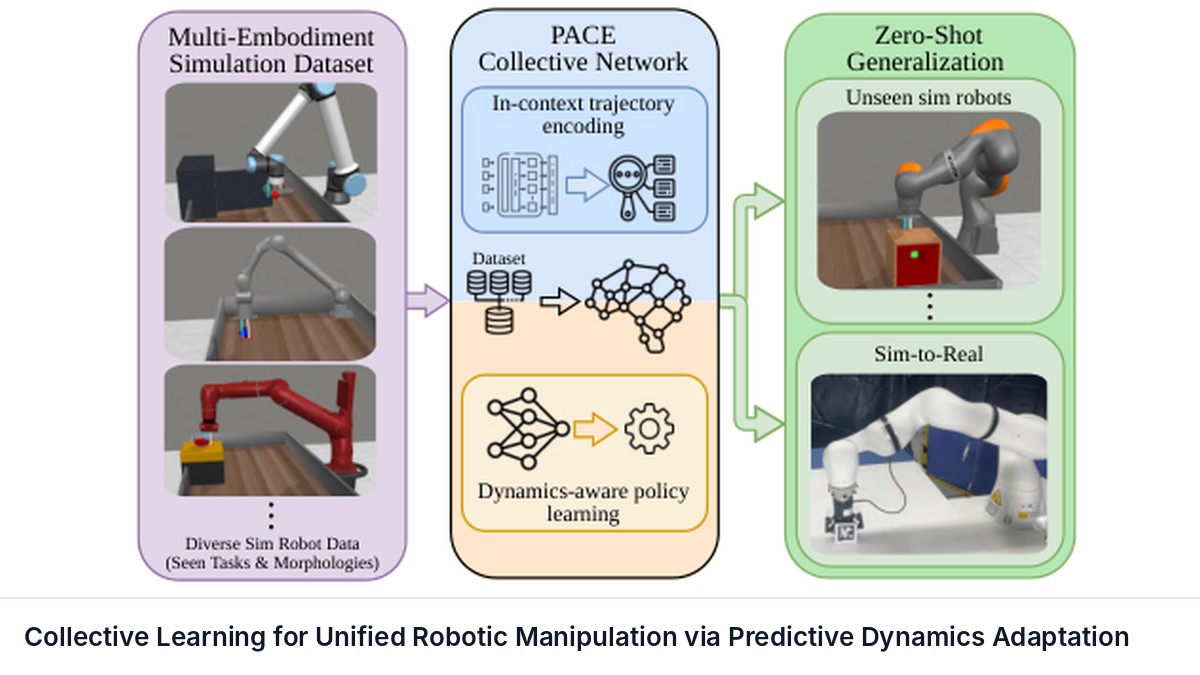
Collective Learning for Unified Robotic Manipulation via Predictive Dynamics Adaptation
Shaocheng Liu, Yuan Meng, Zhenshan Bing et al.
Learning a collective policy for state-based Cartesian manipulation across diverse robotic embodiments presents a fundamental challenge due to embodiment-dependent transition dynamics.
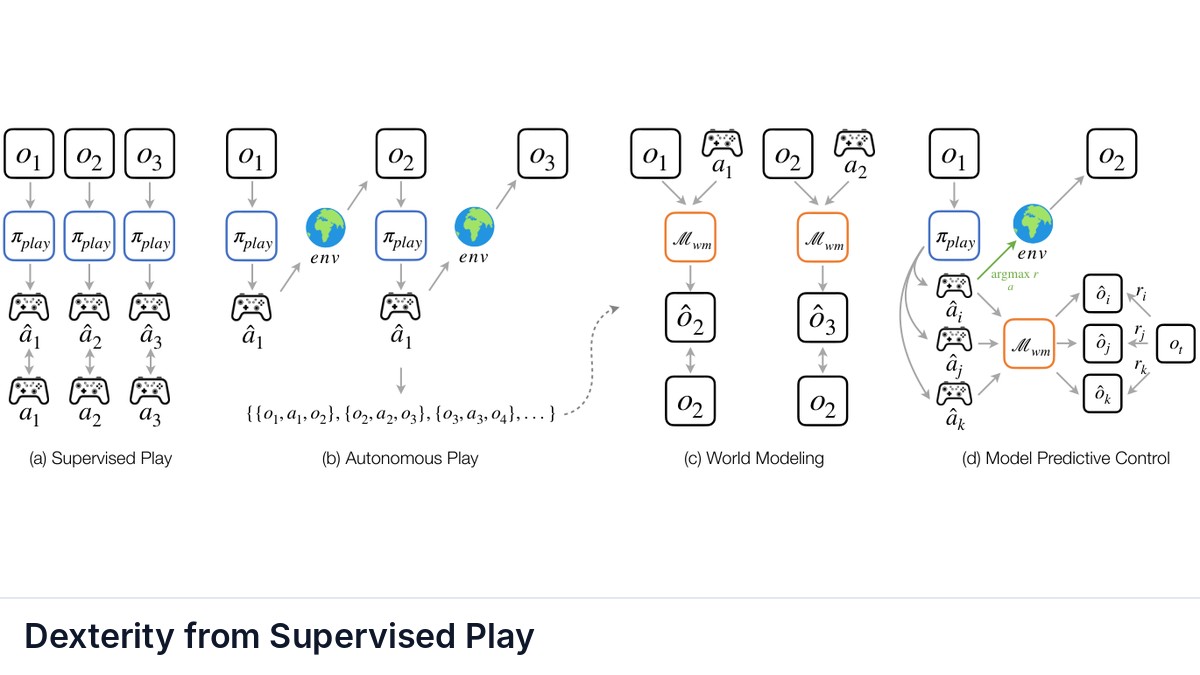
Dexterity from Supervised Play
Botao He, Yiming Dou, Yiannis Aloimonos et al.
How can robots autonomously collect the contact-rich experience needed to learn dexterous manipulation?
3DThinkVLA: Endowing Vision-Language-Action Models with Latent 3D Priors via 3D-Thinking-Guided Co-training
Jiaxin Shi, Xidong Zhang, Fucai Zhu et al.
We propose a 3D-thinking-guided co-training framework that enables vision-language-action (VLA) models to perform 3D spatial reasoning implicitly during action prediction.
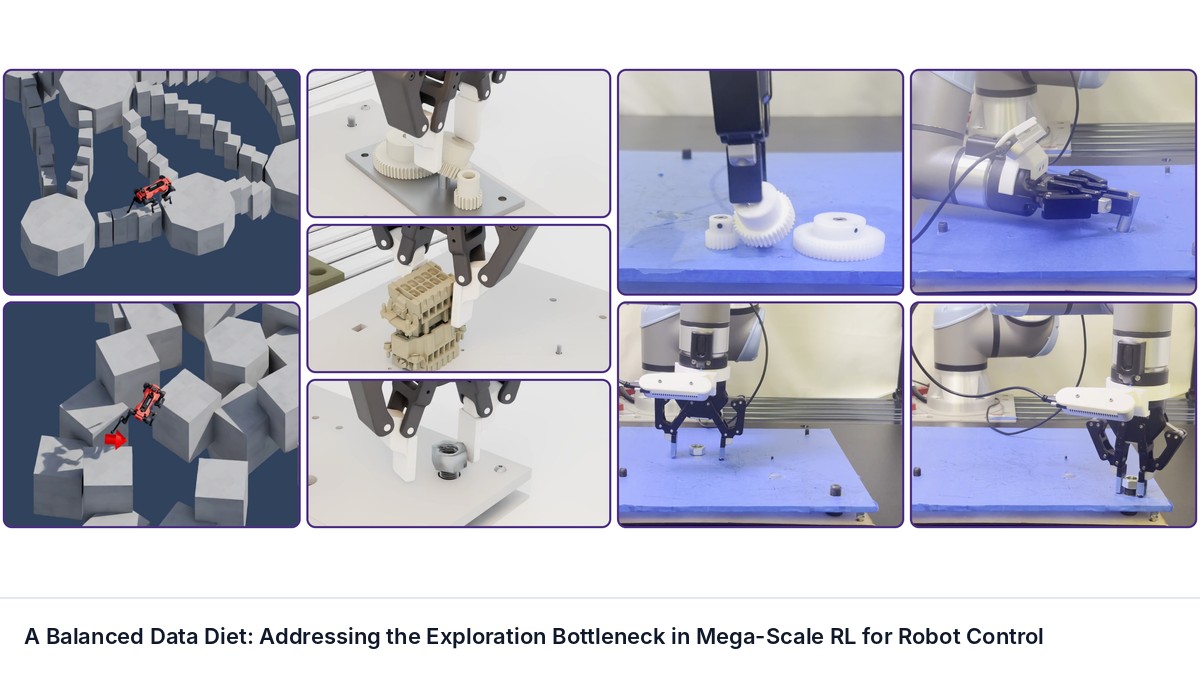
A Balanced Data Diet: Addressing the Exploration Bottleneck in Mega-Scale RL for Robot Control
Octi Zhang, Mateo Guaman Castro, Patrick Yin et al.
General-purpose robots must perform a wide range of tasks from agile locomotion to dexterous manipulation.