
Optimize, Learn, Refine: Whole-Body Grasping and Pick-and-Throw with a Spiral Soft Robot
Marwah Basuhai, Tingcong Liu, Ibrahim Alsarraj, Yuhao Wang, Ke Wu · N/A · 2026
Framework
N/A
License
N/A
Stars
N/A
Summary
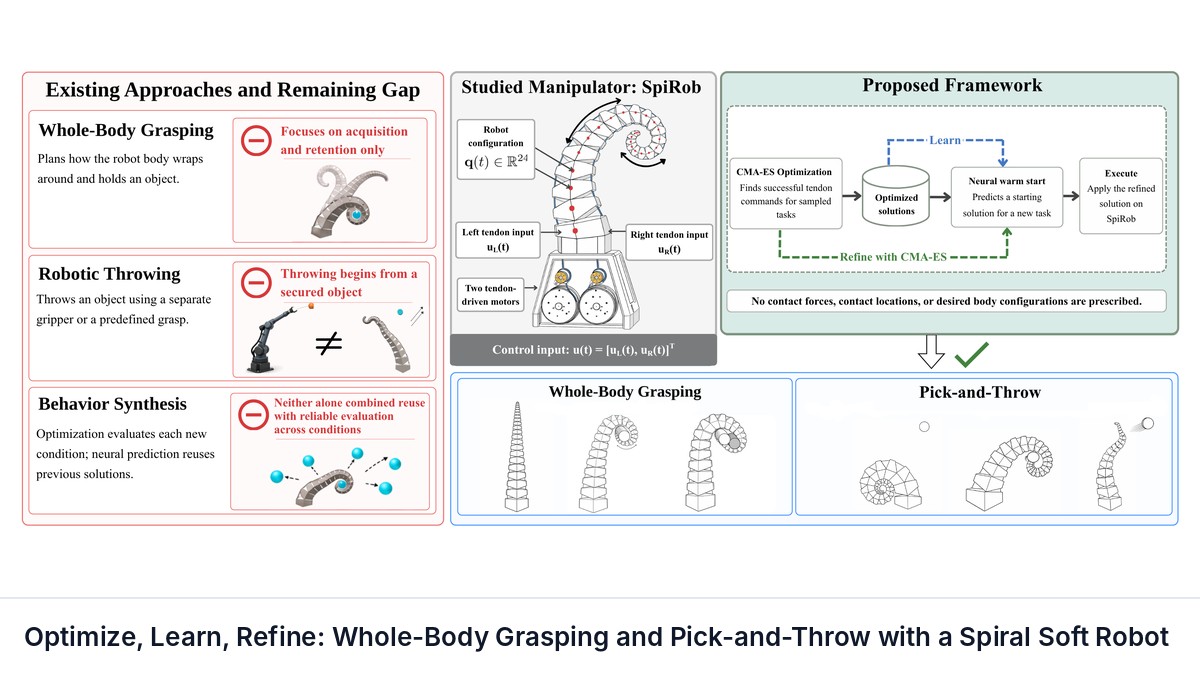
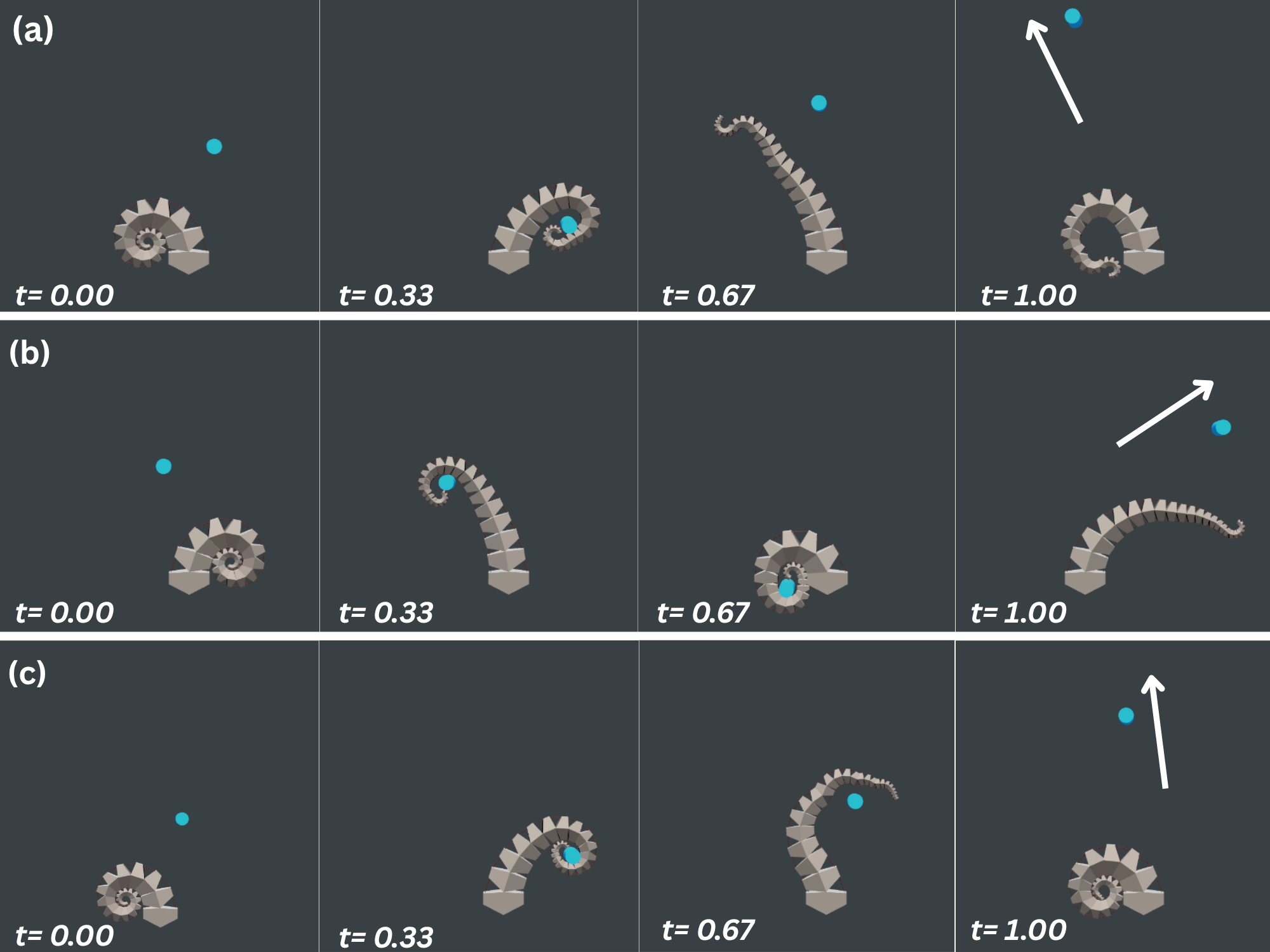
Soft continuum robots can exploit distributed compliance for whole-body manipulation, but synthesizing behavior through changing contacts remains difficult. We address whole-body grasping and pick-and-throw from an initially ungrasped state through outcome-based actuation-space optimization.
Abstract Summary
Key Points
- Soft continuum robots can exploit distributed compliance for whole-body manipulation, but synthesizing behavior through changing contacts remains difficult.
- We address whole-body grasping and pick-and-throw from an initially ungrasped state through outcome-based actuation-space optimization.
- Grasping is quantified by tip angular sweep and body-object enclosure, while throwing further incorporates release-direction alignment and minimum release speed.
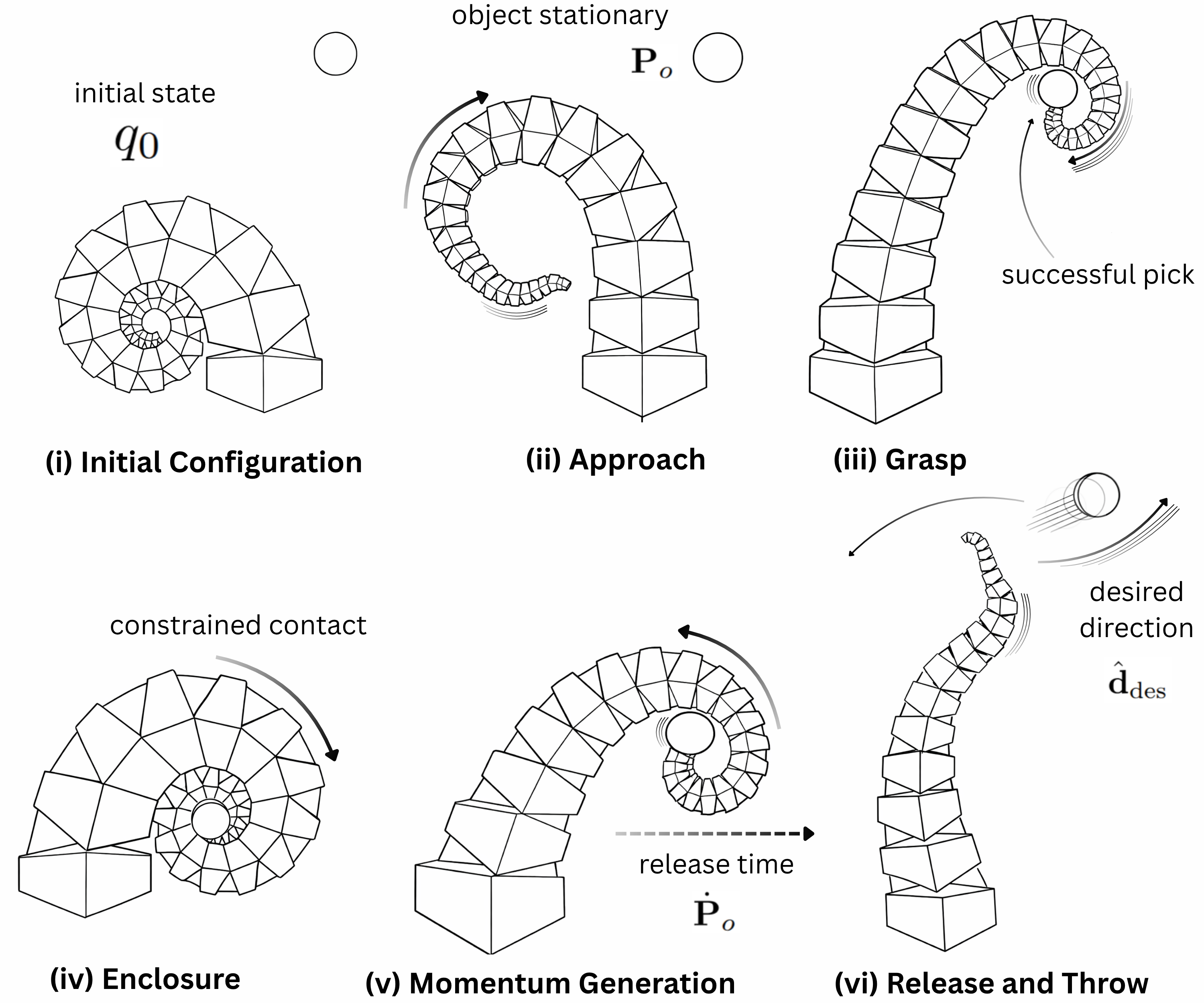
- These objectives allow grasping, acceleration, and release to emerge from compliant interaction without prescribing contact forces, contact locations, or body configurations.
- Because the resulting actuation-to-outcome mapping is nonsmooth, we utilize derivative-free CMA-ES within an optimize-learn-refine framework.
Problem Statement
This section defines the grasping and pick-and-throw tasks considered in this work and introduces the tendon-driven soft robot SpiRob. We use SpiRob, the spiral-inspired tendon-driven soft robot shown in the central panel of Fig. 1 , as the experimental platform [ 18 ] .
Fabricated from flexible polymers through additive manufacturing, SpiRob has a logarithmic-spiral-inspired backbone whose curvature and stiffness vary continuously from a relatively rigid base to a highly compliant tip.
Methodology
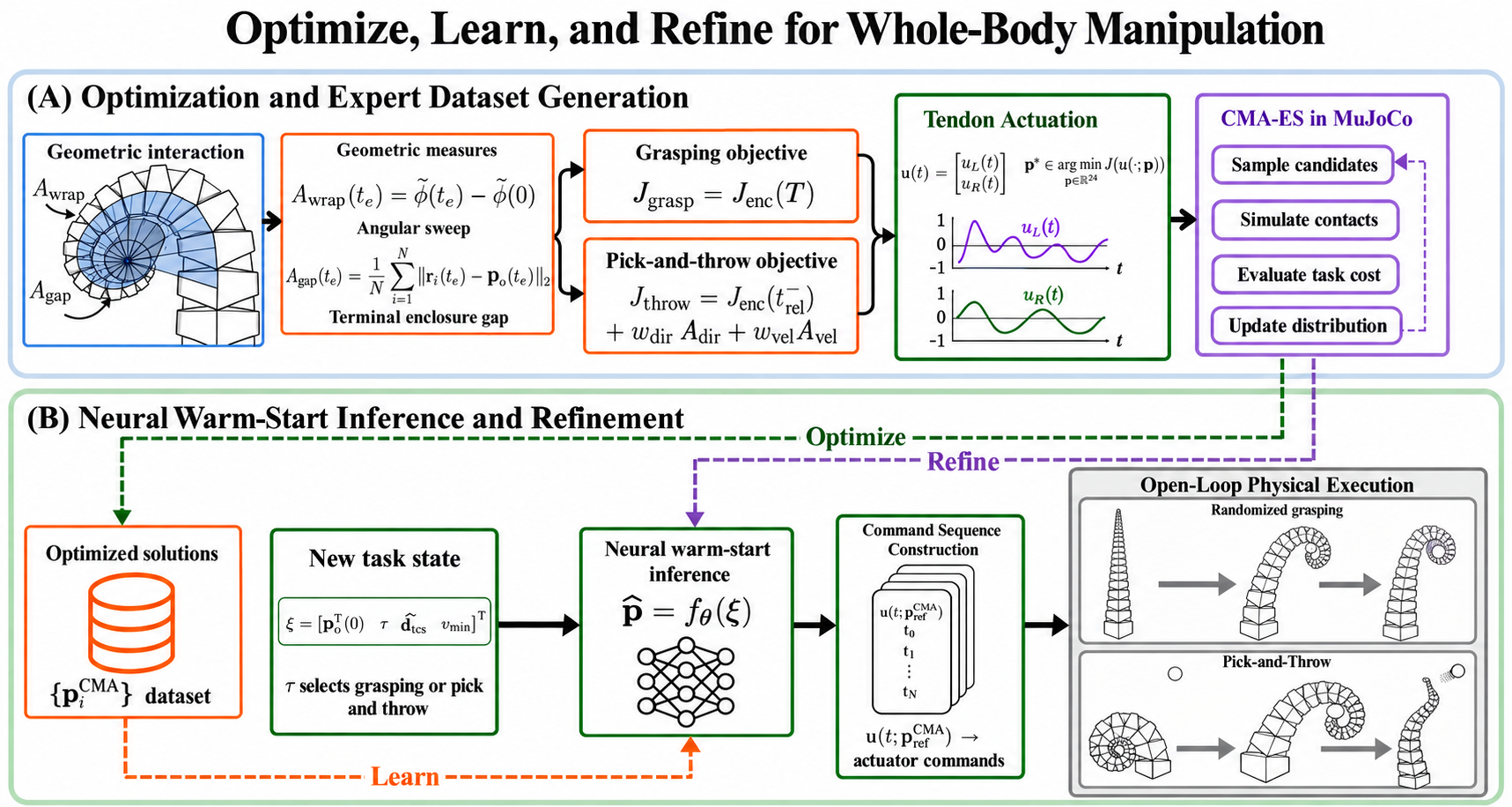
As shown in Fig. 2 , the proposed methodology specifies the three components needed to solve the actuation-space problem in Eq. ( 2 ). First, we define the task-dependent outcome cost $J$ for whole-body grasping and pick-and-throw. Second, we represent the continuous tendon-command trajectory $\mathbf{u}(\cdot)$ with a finite-dimensional parameter vector for numerical search.
Finally, we solve the parameterized problem through an optimize–learn–refine strategy that reuses prior solutions across task conditions.
Optimization and Learning in Simulation
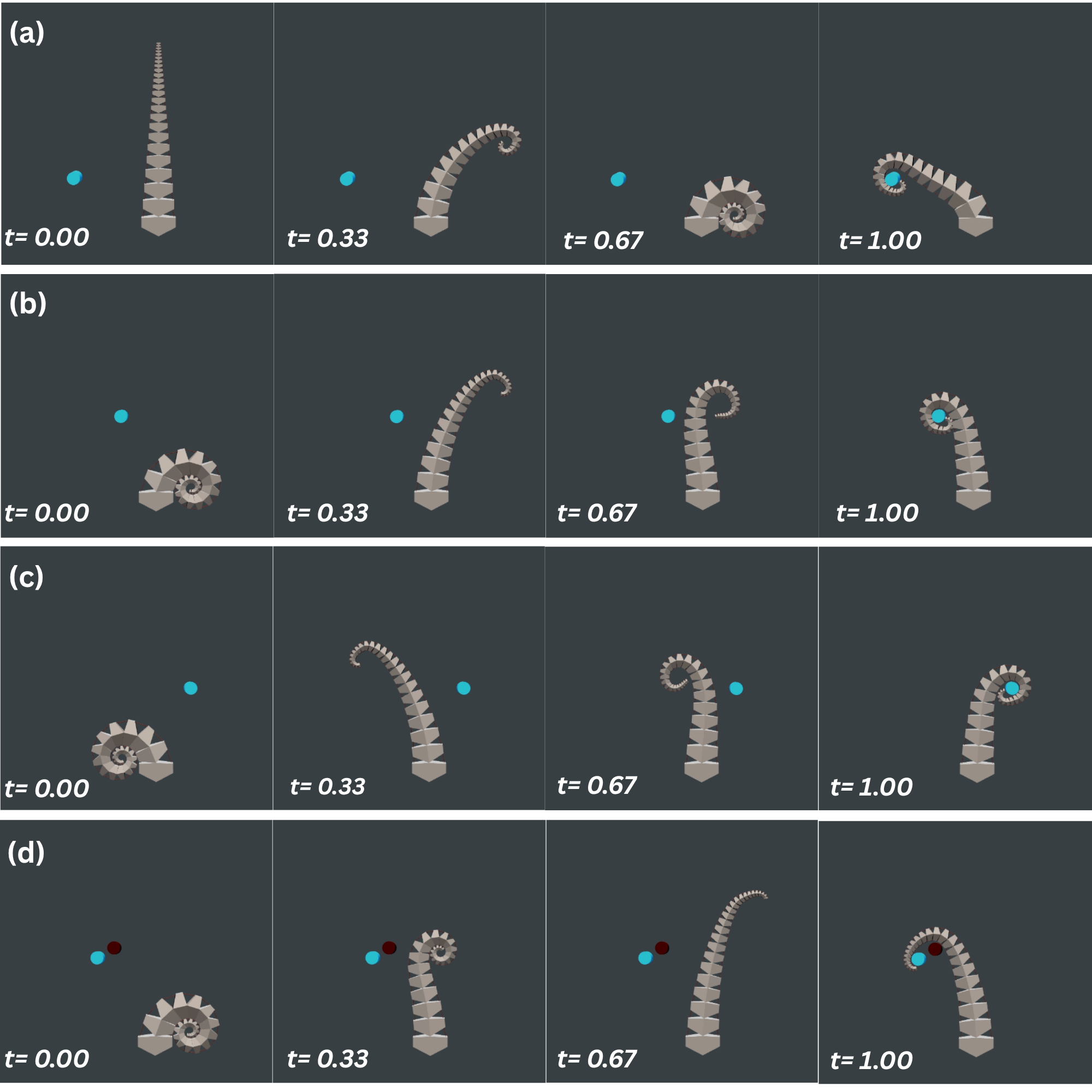
The framework was evaluated in MuJoCo for randomized whole-body grasping and pick-and-throw. The grasping task used Eq. ( 7 ), whereas pick-and-throw used Eq. ( 10 ). All simulation rollouts used a $3.5~\mathrm{s}$ control horizon. For whole-body grasping, the 84 training positions and 500 test positions were sampled from the same robot-centered workspace shown in Fig.
5 , spanning For each training position, CMA–ES generated an optimized condition–parameter pair $(\boldsymbol{\xi}_{i},\mathbf{p}_{i}^{\mathrm{CMA}})$ for neural training.
Experimental Validation
The SpiRob platform described in Section II-A was used for the hardware experiments and mounted above a planar workspace with two displacement-controlled tendon motors. An overhead camera recorded the robot–object interaction for offline evaluation without providing online feedback.
The refined tendon commands were sent to the motors at $100~\mathrm{Hz}$, with the tendon displacement rate limited to $80~\mathrm{mm\,s^{-1}}$.
Sources and Demonstrations
Figures are reproduced from Basuhai et al. See the full paper for experimental details and the project page, when the paper links one, for demonstrations and videos.
Related Papers
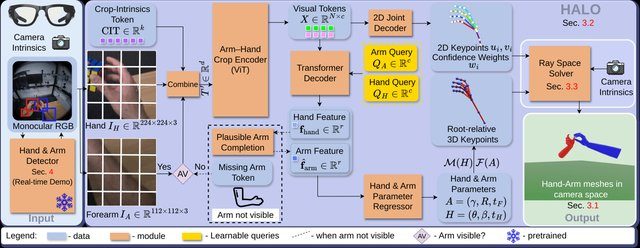
EgoForce: Forearm-Guided Camera-Space 3D Hand Pose from a Monocular Egocentric Camera
Christen Millerdurai, Shaoxiang Wang, Yaxu Xie et al.
Reconstructing the absolute 3D pose and shape of the hands from the user's viewpoint using a single head-mounted camera is crucial for practical egocentric interaction in AR/VR, telepresence, and hand-centric manipulation tasks, where sensing must remain compact and unobtrusive.
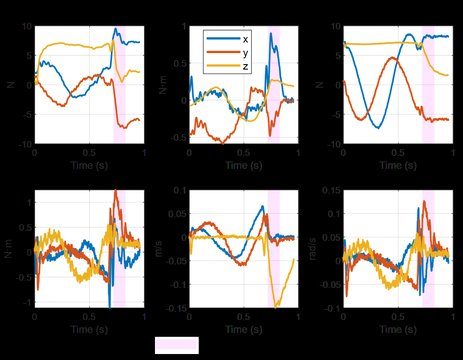
SI-Diff: A Framework for Learning Search and High-Precision Insertion with a Force-Domain Diffusion Policy
Yibo Liu, Stanko Oparnica, Simon Shewchun-Jakaitis et al.
Contact-rich manipulation is fundamental in robotics but poses significant challenges due to uncertainties in relative poses, such as misalignments and small clearances in peg-in-hole tasks.
3DThinkVLA: Endowing Vision-Language-Action Models with Latent 3D Priors via 3D-Thinking-Guided Co-training
Jiaxin Shi, Xidong Zhang, Fucai Zhu et al.
We propose a 3D-thinking-guided co-training framework that enables vision-language-action (VLA) models to perform 3D spatial reasoning implicitly during action prediction.
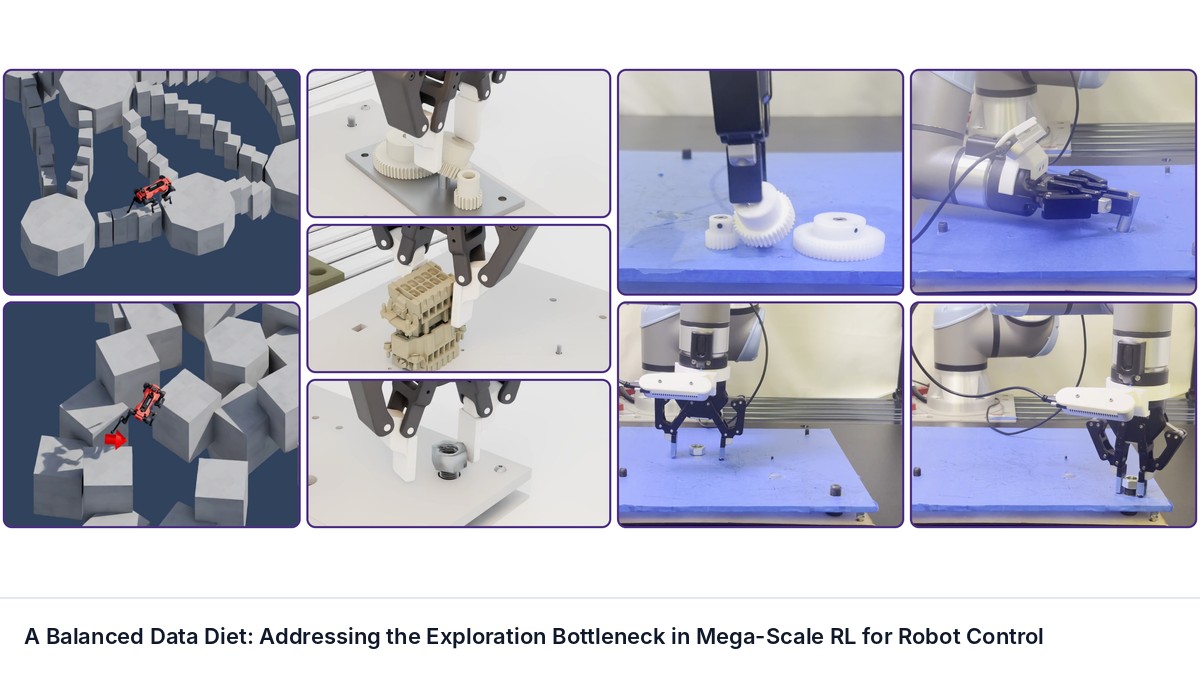
A Balanced Data Diet: Addressing the Exploration Bottleneck in Mega-Scale RL for Robot Control
Octi Zhang, Mateo Guaman Castro, Patrick Yin et al.
General-purpose robots must perform a wide range of tasks from agile locomotion to dexterous manipulation.