
FERPO: Forward Entropy-Regularized Policy Optimization
Sebastian Sanokowski, Alireza Sarmadi, Majid Khadiv · N/A · 2026
Framework
N/A
License
N/A
Stars
N/A
Summary
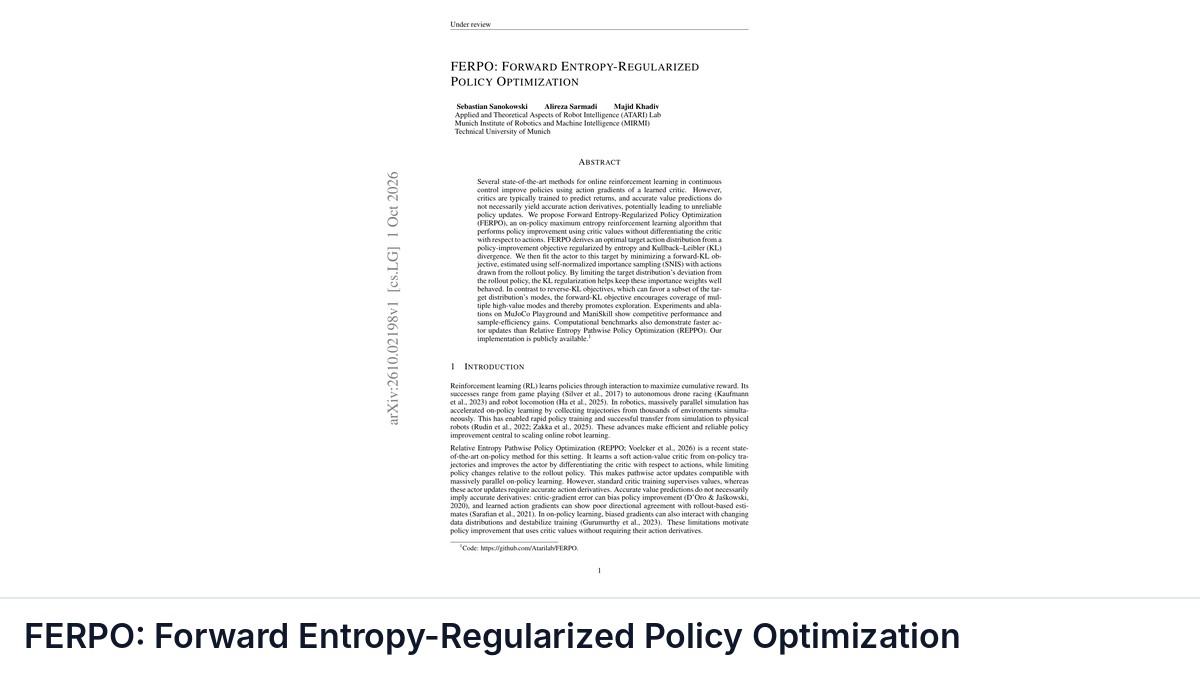
Several state-of-the-art methods for online reinforcement learning in continuous control improve policies using action gradients of a learned critic.
Abstract Summary
Key Points
- Several state-of-the-art methods for online reinforcement learning in continuous control improve policies using action gradients of a learned critic.
- However, critics are typically trained to predict returns, and accurate value predictions do not necessarily yield accurate action derivatives, potentially leading to unreliable policy updates.
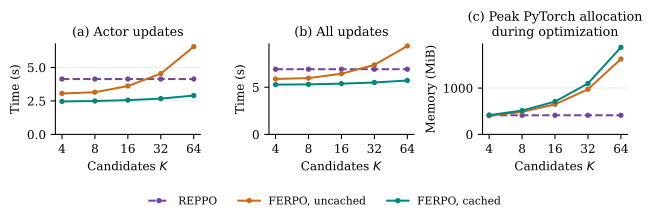
- We propose Forward Entropy-Regularized Policy Optimization (FERPO), an on-policy maximum entropy reinforcement learning algorithm that performs policy improvement using critic values without differentiating the critic with respect to actions.
- FERPO derives an optimal target action distribution from a policy-improvement objective regularized by entropy and Kullback-Leibler (KL) divergence.
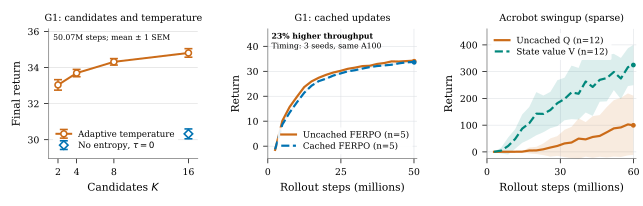
- We then fit the actor to this target by minimizing a forward-KL objective, estimated using self-normalized importance sampling (SNIS) with actions drawn from the rollout policy.
Problem Description
Maximum-entropy reinforcement learning. We consider a discounted Markov decision process with continuous state space $\mathcal{S}$, bounded continuous action space $\mathcal{A}$, initial-state density $\rho_{0}$, transition density $P(s^{\prime}\mid s,a)$, reward $r(s,a)$, and discount factor $\gamma\in[0,1)$.
For a policy $\pi$, let $\rho_{t}^{\pi}$ denote the state distribution at time $t$, generated by $s_{0}\sim\rho_{0}$, $a_{t}\sim\pi(\cdot\mid s_{t})$, and $s_{t+1}\sim P(\cdot\mid s_{t},a_{t})$.
Method: FERPO
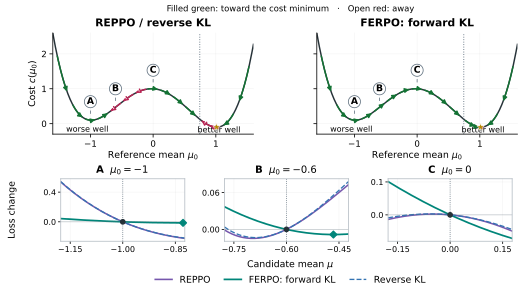
Pathwise actor updates require accurate critic action derivatives, although standard critic learning supervises values. Value accuracy alone does not ensure derivative accuracy ( ?? ). This motivates an actor update that uses critic values without requiring $\nabla_{a}Q_{\phi}(s,a)$. We introduce Forward Entropy-Regularized Policy Optimization ( FERPO ). FERPO first minimizes the Lagrangian in Eq.
Experiments
We compare actor updates on the bimodal cost $c(a)=(a^{2}-1)^{2}-0.1a$, whose right well is better. We use an exact critic $Q=-c$ and Gaussian policies $\pi_{\mu}=\mathcal{N}(\mu,\sigma^{2})$, with fixed $\sigma=0.4$, $\tau=0.1$, $\lambda=0.05$, and $T=\tau+\lambda$. Forward fitting changes the update direction. Let $\nu$ denote the candidate mean and $m_{*}:=\mathbb{E}_{q_{\mu}^{*}}[a]$.
We differentiate with respect to $\nu$, holding the reference $\pi_{\mu}$ and target $q_{\mu}^{*}$ fixed.
Sources and Demonstrations
Figures are reproduced from Sanokowski et al. See the full paper for experimental details and the project page, when the paper links one, for demonstrations and videos.
Related Papers
A Browser-Native Digital Test Range for Benchmarking 4D Ocean-Glider Planning Algorithms
Edward Holmberg, Elias Ioup, Mahdi Abdelguerfi
Repeated in-situ evaluation of ocean-glider planners requires scarce vehicles, operators, deployment and recovery resources, and ocean conditions that cannot be reset for competing algorithms.
A Mode-Unified, Continuous, and Biomimetic Control Strategy of a Robotic Lower Limb Prosthesis
Hanjun Kim, Sixu Zhou, John Shim et al.
Existing biomimetic lower-limb prosthesis controllers are commonly designed for discrete locomotion modes, requiring separate parameterizations for level walking, ramps, and stairs.

A Sim-to-Real Integration Pipeline for Training and Deployment of Chunk-Based VLA Manipulation Policies
Mathilde Kappel, Clémence Grislain, Mohamed Chetouani et al.
Vision-Language-Action (VLA) models have become a prominent paradigm for mapping multimodal inputs, including semantic instructions, visual observations of the scene, and proprioceptive observations, to robot actions.
A Unified Kinematic Representation Enables Reusable Biological Joint Moment Estimation
Jinwoo Hwang, Ilseung Park, Changseob Song et al.
Objective: Data-driven models that estimate physiological states, particularly biological joint moments, are widely used in exoskeleton control.