
Beyond Binary: Sim-to-Real Dexterous Manipulation with Physics-Grounded Contact Representation
FeaturedJiahe Pan, Stelian Coros, Jitendra Malik, Toru Lin · · 2026
Framework
N/A
License
N/A
Stars
0
Summary
A primary bottleneck in contact-rich manipulation is the difficulty of collecting real-world data. Sim-to-real reinforcement learning offers a scalable alternative, but the simulation-reality gap prev
Abstract Summary
Key Points
- Proposes Center-of-Pressure (CoP) tactile representation for sim-to-real contact-rich manipulation.
- CoP preserves dense contact information while remaining robust across simulation-reality gap.
- Sensor calibration via differentiable dynamics estimates taxel orientations without ground-truth force.
- Achieves zero-shot sim-to-real transfer on multi-fingered hand for peg-in-hole and ball balancing.
- Outperforms binary-contact and raw-taxel baselines.
Methodology
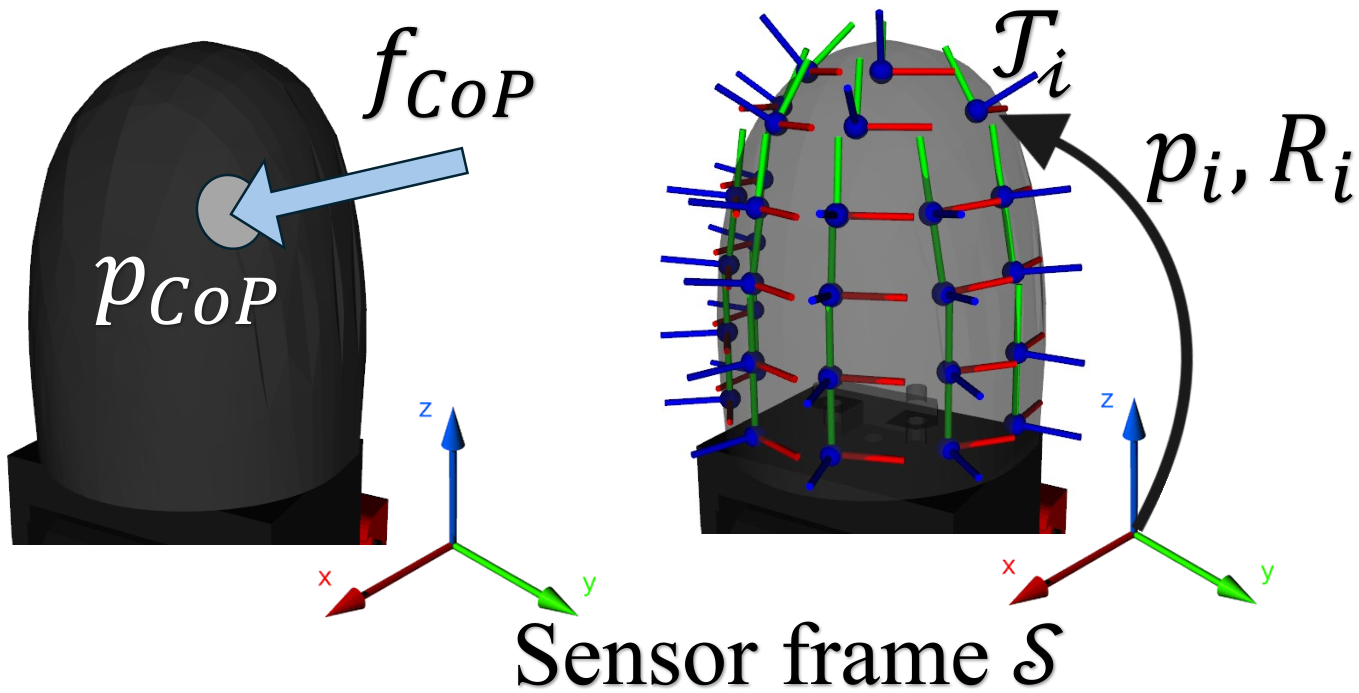
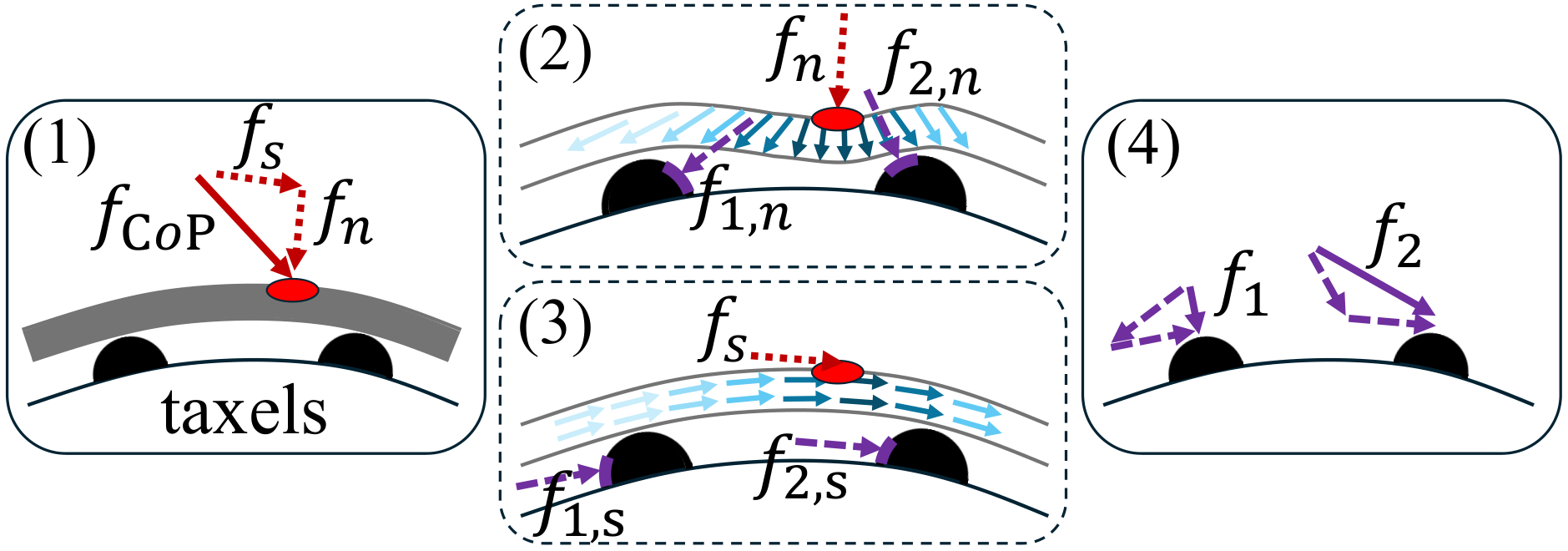
We propose Center-of-Pressure (CoP) 1 1 1 We use the term CoP to denote the resultant contact wrench reduced to a single force vector applied at a centroidal contact point; this approximation is intended as a compact local contact descriptor, rather than a complete representation of arbitrary multi-contact pressure distributions. as a physics-aware contact representation. On a round fingertip of a robot hand (Fig.
Experiments
Tasks. We use a 16-DOF Allegro hand equipped with XELA uSkin sensors covering the fingertips, phalanges, and palm of the hand. We evaluate on two challenging contact-rich manipulation tasks: peg-in-hole insertion and ball-balancing . For both tasks, we train a blind policy conditioned only on proprioception (current and commanded joint angles) and contact observations.
Sources and Demonstrations
Figures are reproduced from Pan et al. See the full paper for experimental details and the project page, when the paper links one, for demonstrations and videos.
Related Papers
SI-Diff: A Framework for Learning Search and High-Precision Insertion with a Force-Domain Diffusion Policy
Yibo Liu, Stanko Oparnica, Simon Shewchun-Jakaitis et al.
Contact-rich manipulation is fundamental in robotics but poses significant challenges due to uncertainties in relative poses, such as misalignments and small clearances in peg-in-hole tasks.
3DThinkVLA: Endowing Vision-Language-Action Models with Latent 3D Priors via 3D-Thinking-Guided Co-training
Jiaxin Shi, Xidong Zhang, Fucai Zhu et al.
We propose a 3D-thinking-guided co-training framework that enables vision-language-action (VLA) models to perform 3D spatial reasoning implicitly during action prediction.
A Balanced Data Diet: Addressing the Exploration Bottleneck in Mega-Scale RL for Robot Control
Octi Zhang, Mateo Guaman Castro, Patrick Yin et al.
General-purpose robots must perform a wide range of tasks from agile locomotion to dexterous manipulation.

A Sim-to-Real Integration Pipeline for Training and Deployment of Chunk-Based VLA Manipulation Policies
Mathilde Kappel, Clémence Grislain, Mohamed Chetouani et al.
Vision-Language-Action (VLA) models have become a prominent paradigm for mapping multimodal inputs, including semantic instructions, visual observations of the scene, and proprioceptive observations, to robot actions.