
One Future, Every Robot: Label-Efficient Collective-State Prediction with Decentralized JEPA
Alan-Barsag Gazzaev, Alexey Garvilov, Sergey Muravyov · N/A · 2026
Framework
N/A
License
N/A
Stars
N/A
Summary
Can every robot in a swarm predict the same future collective state from only local observations and bandwidth-limited messages?
Abstract Summary
Key Points
- Can every robot in a swarm predict the same future collective state from only local observations and bandwidth-limited messages?
- We formulate this as decentralized shared-state prediction and introduce Collective-State JEPA (CS-JEPA), a recurrent joint-embedding predictive architecture whose output at every robot represents one common future token field.
- At deployment, each robot uses a 16-frame local history and one 64-float recurrent message per directed edge; there is no global pooling, target encoder, episode clock, or recorded future action.
- After pretraining without downstream collective labels, frozen representations are evaluated with ridge probes fitted on 6, 12, or 24 globally labeled episodes.
- Against raw-future reconstruction with the same receiver anchor and deployment capacity but 9,607 additional training-only parameters, a prospectively registered five-seed follow-up improves prediction-error and inter-robot-agreement label-budget AUC on in-distribution, ring, mutual-kNN, and unseen-size families up to 108 robots.
Problem Formulation
At time $t$, the active swarm is a dynamic graph $\mathcal{G}_{t}=(\mathcal{V}_{t},\mathcal{E}_{t})$. Robot $i$ observes a receiver-indexed local view $o_{t}^{i}$ and receives messages only from $\mathcal{N}_{t}(i)$. Its allowed information is Here $o_{t}^{i}$ contains only robot $i$’s normalized world position, velocity, two-dimensional task vector, and active bit, all in a shared normalized world frame.
Collective-State JEPA
A frozen local encoder maps robot $i$’s self observation to $e_{t}^{i}\in\mathbb{R}^{64}$. At every history step, each active robot broadcasts only its previous recurrent state. Receiver $i$ computes We set $\bar{h}_{t-1}^{,i}=0$ when $\mathcal{N}_{t}(i)=\varnothing$, matching the masked-mean implementation.
Updates are synchronous, use one message round per environment step, and send 64 float32 values (256 bytes) per directed edge. With 16 frames, the measured warm-up is 15 message steps.
Experimental Protocol
For the target-isolation follow-up, we froze the protocol and generated a new data family only afterward. It contains three tasks (flocking, formation, coverage), 200-step episodes, process noise 0.02, and no observation noise. Training and ID use bounded-small-world graphs with $N\in\{10,18\}$ and maximum degree four. Table II shows the splits.
Ring and mutual-$k$NN are topology shifts; the size split uses $N\in\{36,72,108\}$, unseen and up to $6\times$ the largest training swarm.
Results
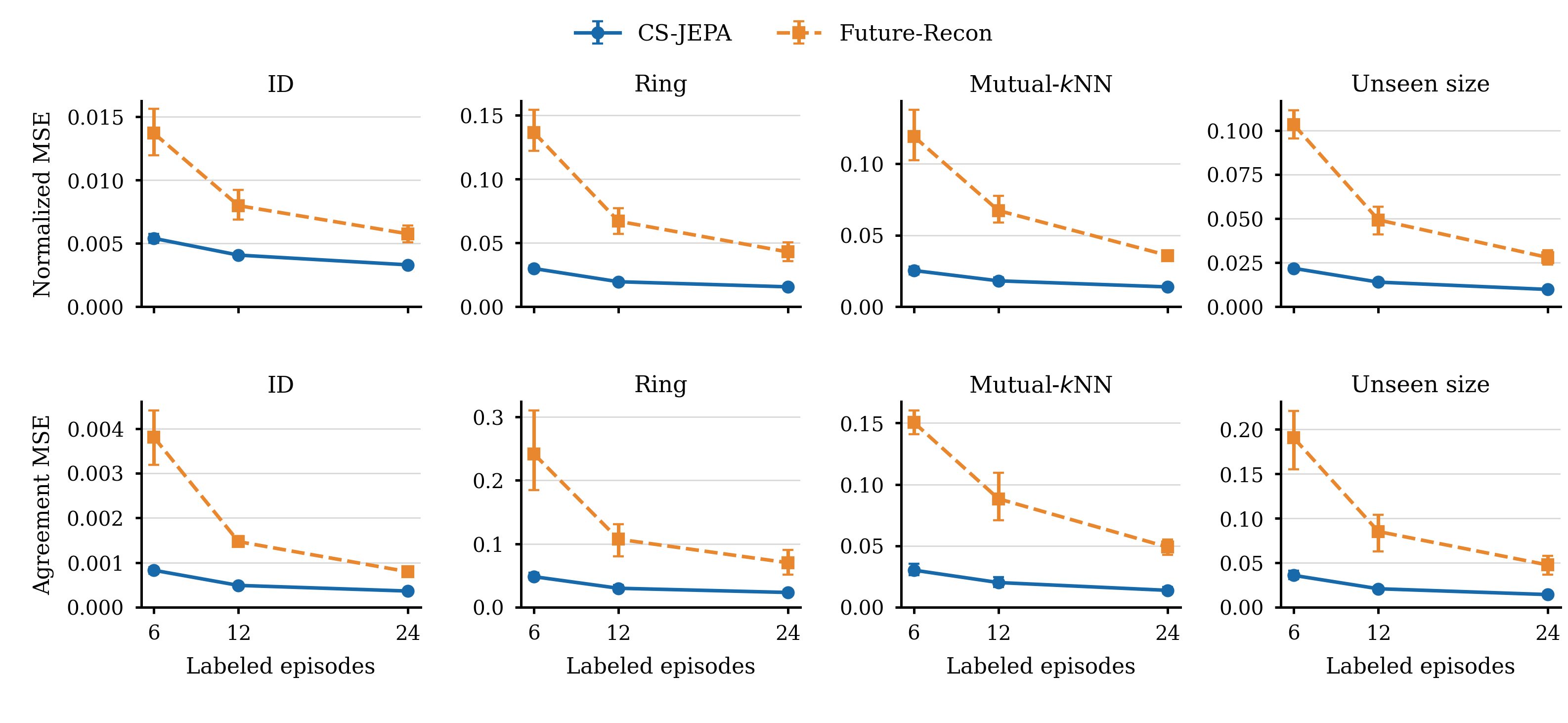
All four registered comparisons satisfy the prespecified joint criterion (Table III ). Every accuracy and agreement effect is positive in 5/5 outer seeds, and every lower confidence bound is above zero. The smallest effect is ID agreement (0.001342); the largest effects are 0.057156 accuracy and 0.098817 agreement, both on ring. Figure 3 exposes every seed rather than treating episodes as independent replications.
Sources and Demonstrations
Figures are reproduced from Gazzaev et al. See the full paper for experimental details and the project page, when the paper links one, for demonstrations and videos.
Related Papers
A Browser-Native Digital Test Range for Benchmarking 4D Ocean-Glider Planning Algorithms
Edward Holmberg, Elias Ioup, Mahdi Abdelguerfi
Repeated in-situ evaluation of ocean-glider planners requires scarce vehicles, operators, deployment and recovery resources, and ocean conditions that cannot be reset for competing algorithms.
A Low-Cost, Open Platform for End-to-End Autonomous Driving on a Miniature Ackermann Vehicle
Gustavo Claudio Karl Couto, Eric Aislan Antonelo, Gabriel George Zipperer
This paper presents a low-cost, open experimental platform for research in end-to-end autonomous driving with miniature Ackermann vehicles.
AcousticDiffusion: Semantically Conditioned Audio-Guided Diffusion Policy for Search-and-Rescue Assistance
Iana Zhura, Didar Seyidov, Dmitrii Plotnikov et al.
Navigating toward human callers is an important capability for rescue robots operating where visual contact is degraded or occluded. We present AcousticDiffusion, a semantically conditioned, audio-guided diffusion policy for human-directed navigation.
Actively Resolving Contextual Uncertainty for Underspecified Tasks in Natural Language
Zachary Ravichandran, Jonathan Diller, Fernando Cladera et al.
Foundation models provide robots with the ability to interpret natural language and reason about environmental context, yet most language-conditioned policies assume that goals are well-specified and that task-relevant information is provided upfront via a prior map.