
Reflex-Informed Neuromuscular Reinforcement Learning for Muscle-Driven Locomotion
Jian Zhou, Xingyu Zhang, Rui Ma, Yu Cao, Shane Xie, Zhi-qiang Zhang · N/A · 2026
Framework
N/A
License
N/A
Stars
N/A
Summary
Muscle-driven locomotion provides a physically grounded approach to generating realistic human movement. However, achieving both physiological plausibility and adaptability to changes in musculoskeletal capacity and external disturbances remains a fundamental challenge.
Abstract Summary
Key Points
- Muscle-driven locomotion provides a physically grounded approach to generating realistic human movement.
- However, achieving both physiological plausibility and adaptability to changes in musculoskeletal capacity and external disturbances remains a fundamental challenge.
- To address this limitation, we propose a Reflex-Informed Neuromuscular Reinforcement Learning framework for muscle-driven locomotion.
- Within this framework, a fixed phase-dependent reflex controller serves as the underlying neuromuscular control mechanism, while the reinforcement learning policy produces four biomechanically meaningful residual parameters to modulate key reflex gains and thresholds associated with hip swing, knee support, and ankle propulsion according to the current state.
- Experimental results demonstrate that the proposed framework generates physiologically plausible locomotion with improved kinematic accuracy and dynamic consistency, as well as better bilateral symmetry and stride-to-stride consistency under nominal walking conditions.
Method
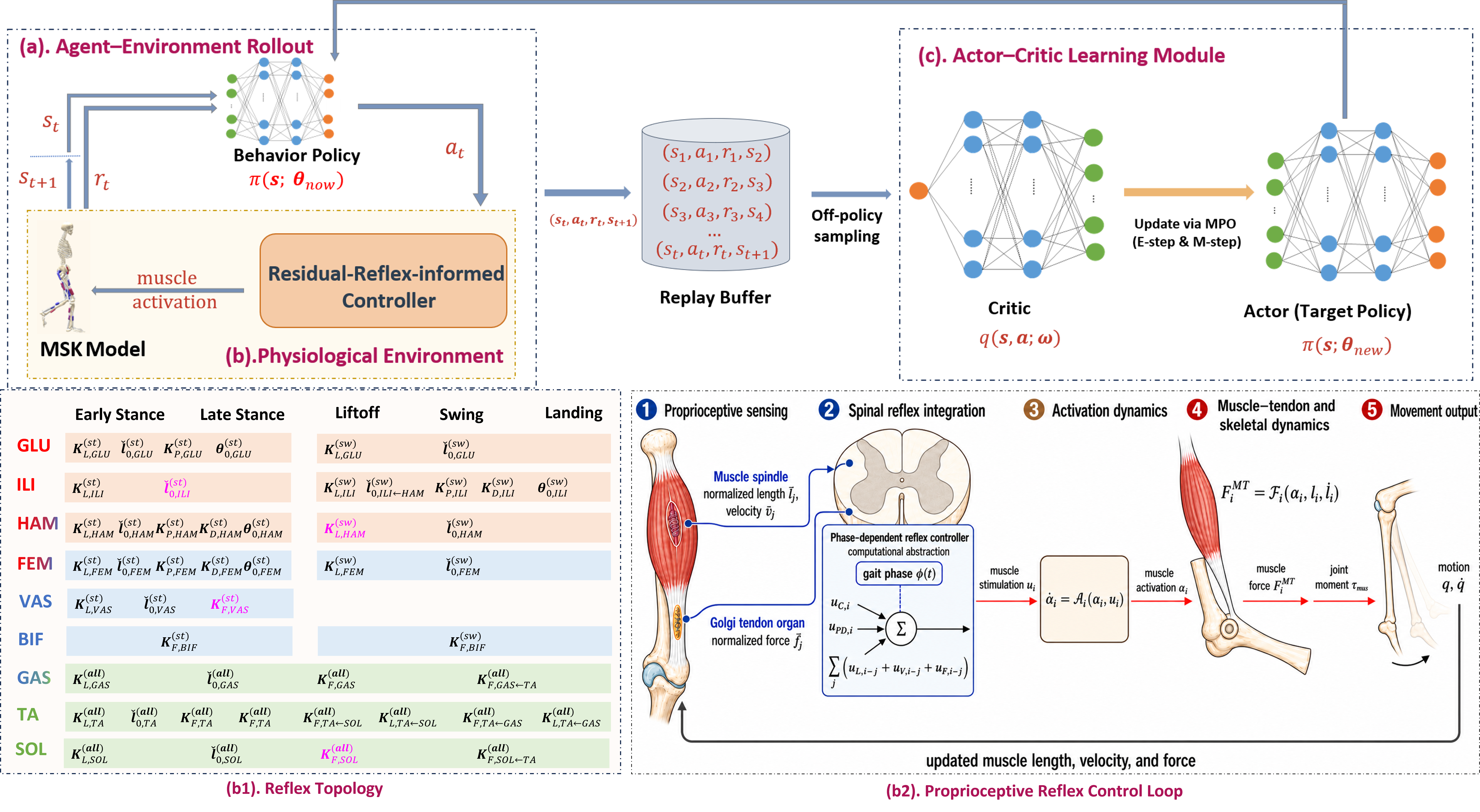
Figure 1 illustrates the proposed Reflex-Informed Neuromuscular Reinforcement Learning framework. A fixed phase-dependent reflex controller provides the underlying neuromuscular control mechanism, while the reinforcement learning policy generates four-dimensional residual actions that regulate selected reflex parameters according to the current musculoskeletal state.
The resulting muscle stimulation drives the musculoskeletal simulation, which produces the next state and reward.
Evaluation
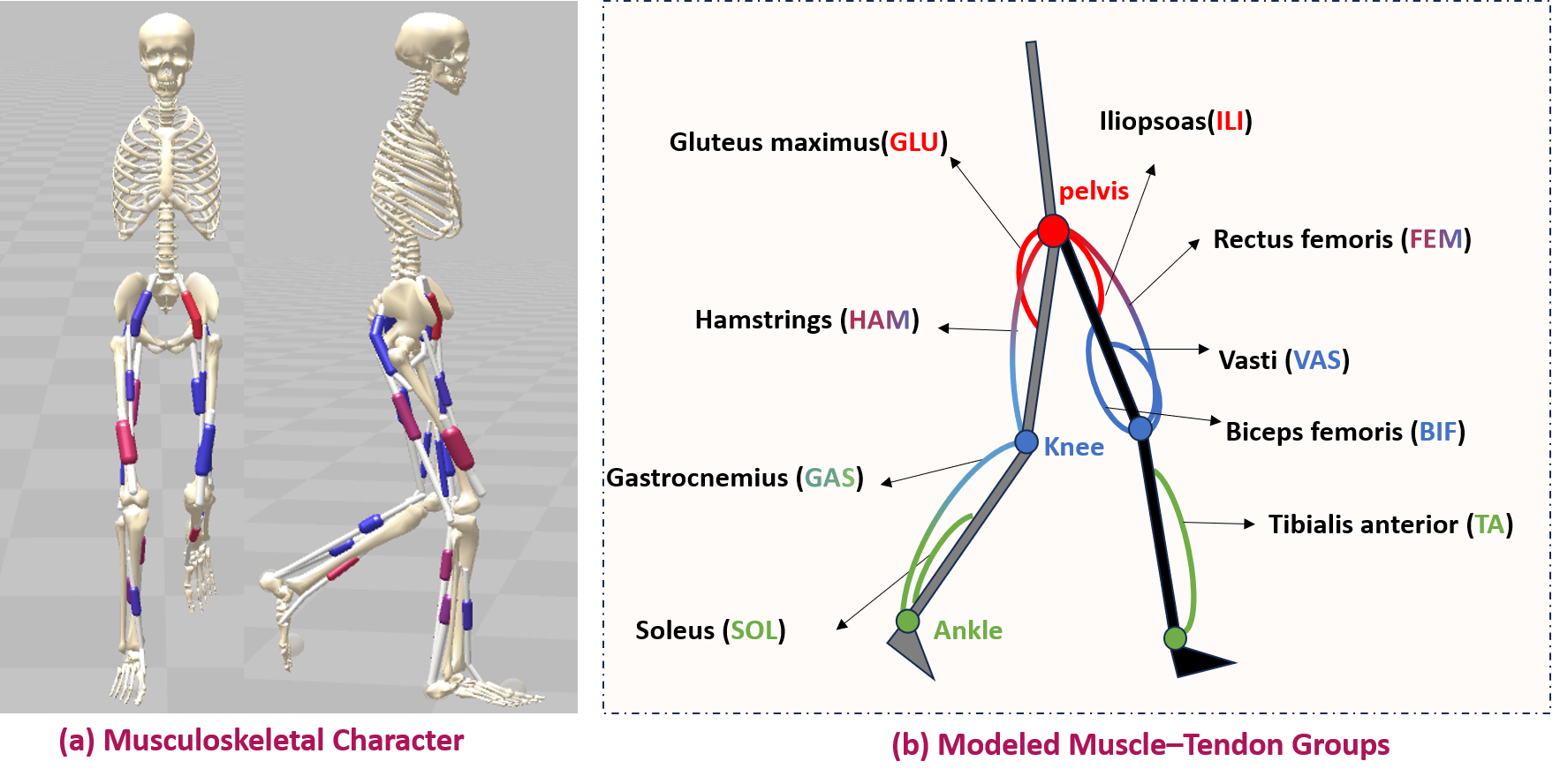
The simulator, musculoskeletal character, muscle-driven dynamics, and foot–ground contact model are described in Sec. 3.2 . The same character and simulation settings were used for all controllers unless a plantarflexor weakness condition was explicitly introduced. The evaluation includes four control approaches: two direct muscle-control reinforcement learning methods, E2E-RL Weng et al.
(2021) ; de Vree and Carloni (2021) ; Ogum et al. (2024) and DEP-RL Schumacher et al.
Sources and Demonstrations
Figures are reproduced from Zhou et al. See the full paper for experimental details and the project page, when the paper links one, for demonstrations and videos.
Related Papers
A Balanced Data Diet: Addressing the Exploration Bottleneck in Mega-Scale RL for Robot Control
Octi Zhang, Mateo Guaman Castro, Patrick Yin et al.
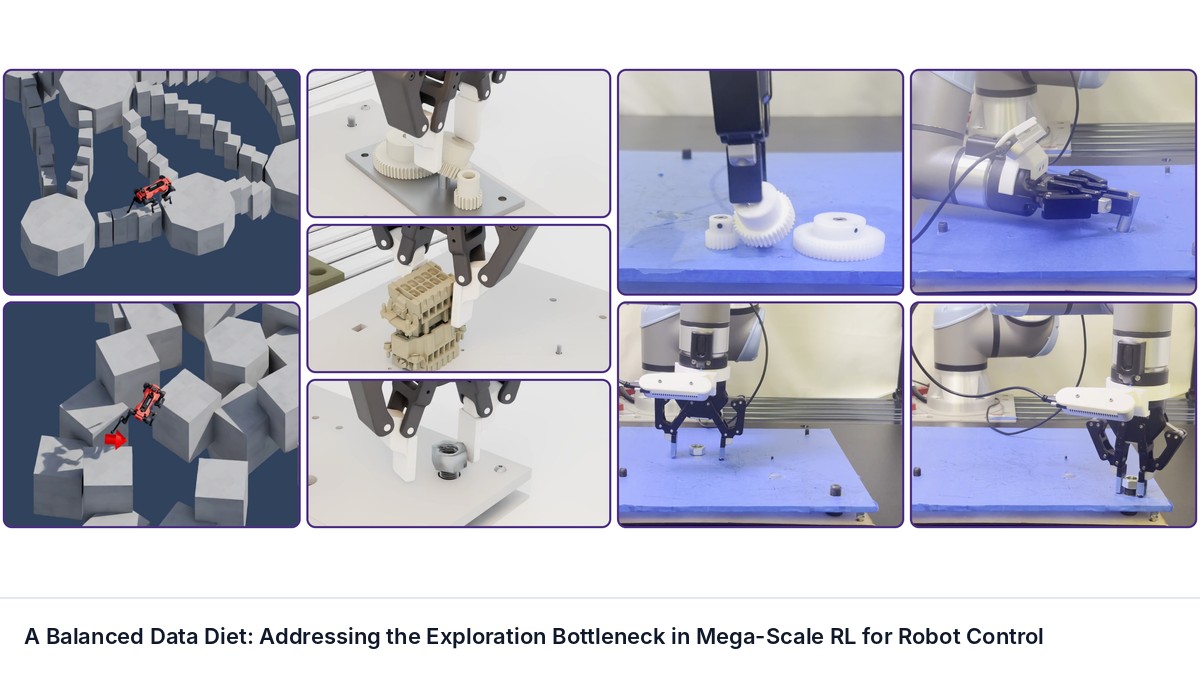
General-purpose robots must perform a wide range of tasks from agile locomotion to dexterous manipulation.
A Mode-Unified, Continuous, and Biomimetic Control Strategy of a Robotic Lower Limb Prosthesis
Hanjun Kim, Sixu Zhou, John Shim et al.
Existing biomimetic lower-limb prosthesis controllers are commonly designed for discrete locomotion modes, requiring separate parameterizations for level walking, ramps, and stairs.
A Unified Kinematic Representation Enables Reusable Biological Joint Moment Estimation
Jinwoo Hwang, Ilseung Park, Changseob Song et al.
Objective: Data-driven models that estimate physiological states, particularly biological joint moments, are widely used in exoskeleton control.
Adaptive Rejection of Unknown Hybrid Sinusoidal Disturbances with Application to Humanoid Walking under Unknown Ground Motion
I-Chia Chang, Jacob Stewart, Petros A. Ioannou et al.
Legged robot control is not yet practical in non-inertial environments, where the ground and surroundings accelerate in the inertial Earth frame, mainly because of the unknown, time-varying, persistent perturbations caused by environmental motion, compounded by the associated hybrid robotic dynamics.