
M3GD: Multi-Modal Multi-View Geometric Diffusion for Camera--LiDAR Novel View Synthesis
Yang Zhou, Jiuhong Xiao, Shizhao Ye, Long Quang, Carlos Nieto-Granda, Giuseppe Loianno · N/A · 2026
Framework
N/A
License
N/A
Stars
N/A
Summary
Robotic novel view synthesis (NVS) must recover both visual appearance and metric 3D structure, yet most generative NVS methods rely only on images, overlooking LiDAR, a complementary sensor common on robotic platforms.
Abstract Summary
Key Points
- Robotic novel view synthesis (NVS) must recover both visual appearance and metric 3D structure, yet most generative NVS methods rely only on images, overlooking LiDAR, a complementary sensor common on robotic platforms.
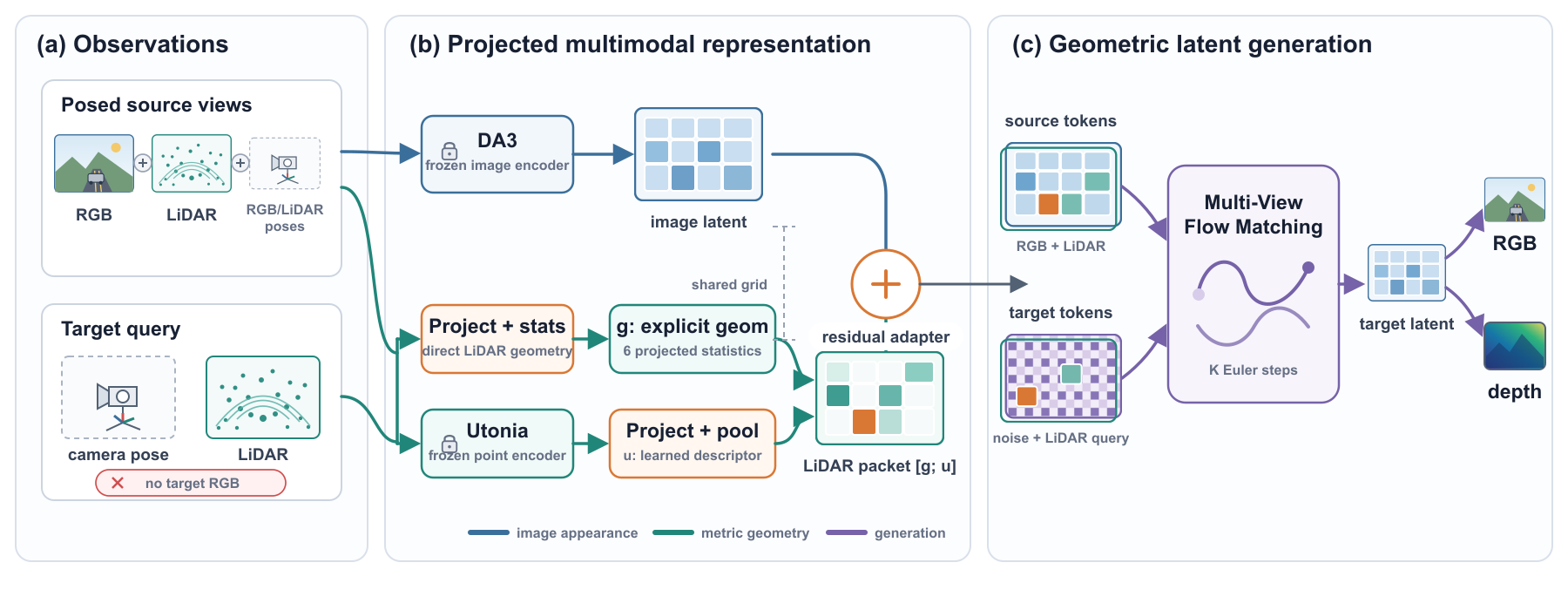
- We present M3GD, a Camera--LiDAR multimodal representation for generative NVS that composes independently pretrained 2D image and 3D point-cloud foundation models without separately pretraining a cross-modal translator.
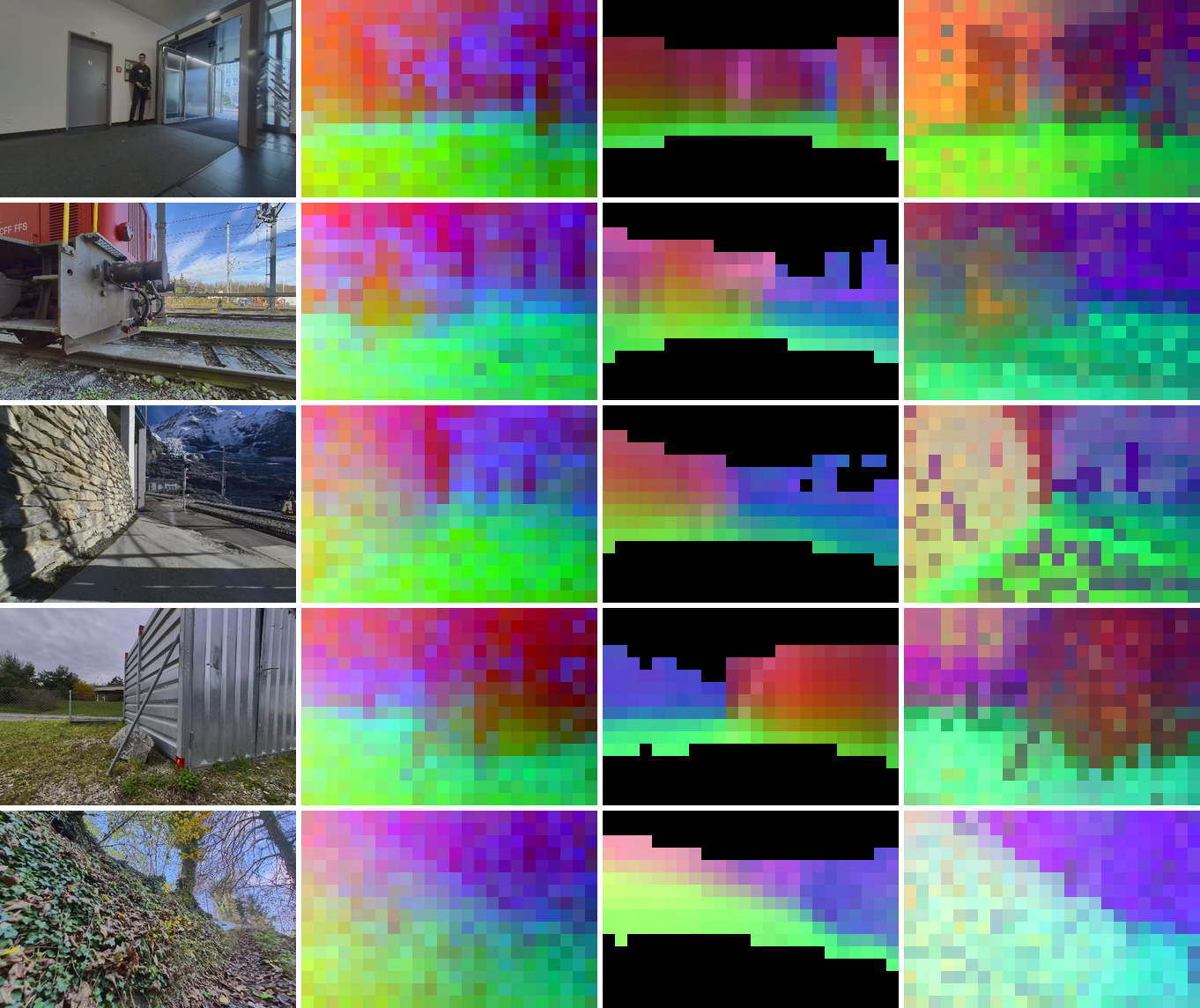
- We show that, after camera projection, frozen LiDAR and image features exhibit substantial shared spatial structure, providing a natural cross-modal representation.
- M3GD conditions generation on LiDAR through this structure: it combines explicit geometry statistics with learned point-cloud descriptors into view-aligned packets on the image-latent grid, injected through a lightweight residual adapter into a multi-view flow-matching generator whose latent space, decoders, and training objective remain intact.
- On the GrandTour dataset, M3GD improves target-view RGB and depth synthesis over an image-only version of the same backbone.
Problem Statement and Preliminaries
To ground the projected Camera–LiDAR conditioning used by M3GD, we first state the NVS problem, subsequently introduce the diffusion and flow-matching machinery used by our backbone, and finally summarize the 2D and 3D foundation representations composed by M3GD.
Methodology
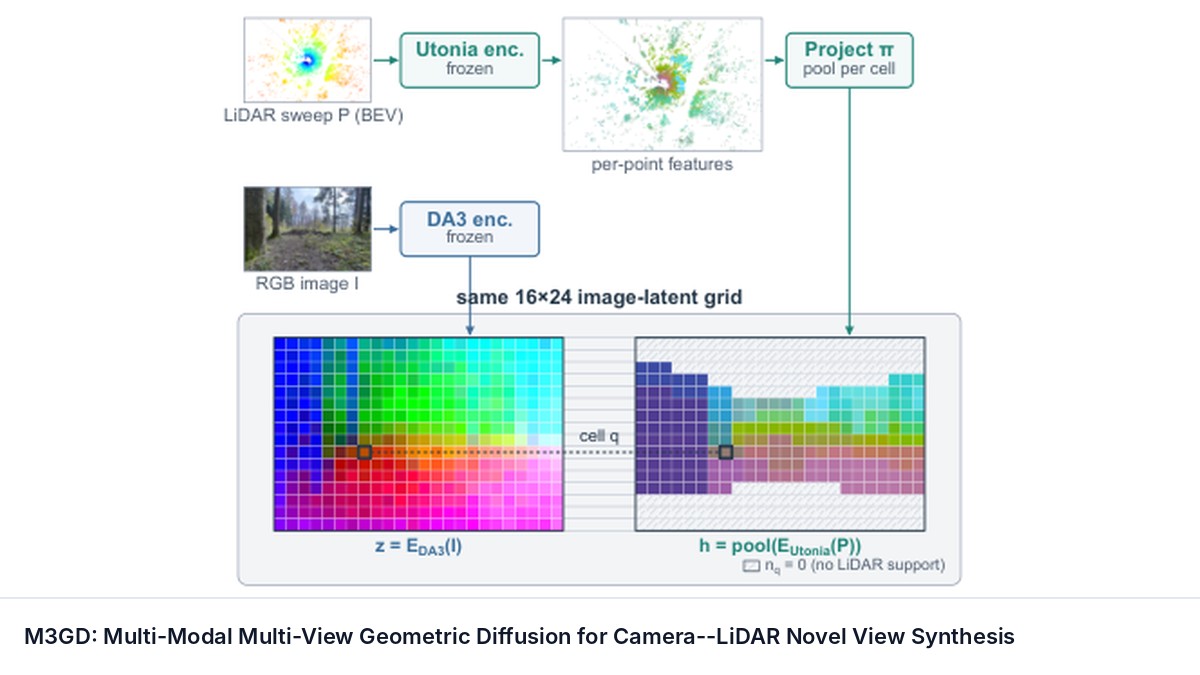
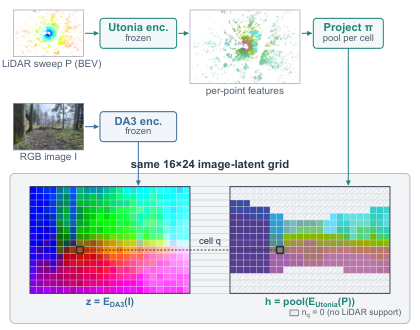
M3GD composes 2D and 3D representations through a projected RGB–LiDAR conditioning pathway (Fig. 1 ). The frozen DA3 encoder maps the RGB image $I$ to an $H{\times}W$ latent grid $z$, the space in which the inherited GLD backbone generates novel views.
In parallel, the frozen Utonia encoder assigns a descriptor to every point of the LiDAR sweep $P$, and the camera projection $\pi$ pools these descriptors into the cells of a second grid $h$ with the same layout.
Experimental Setup
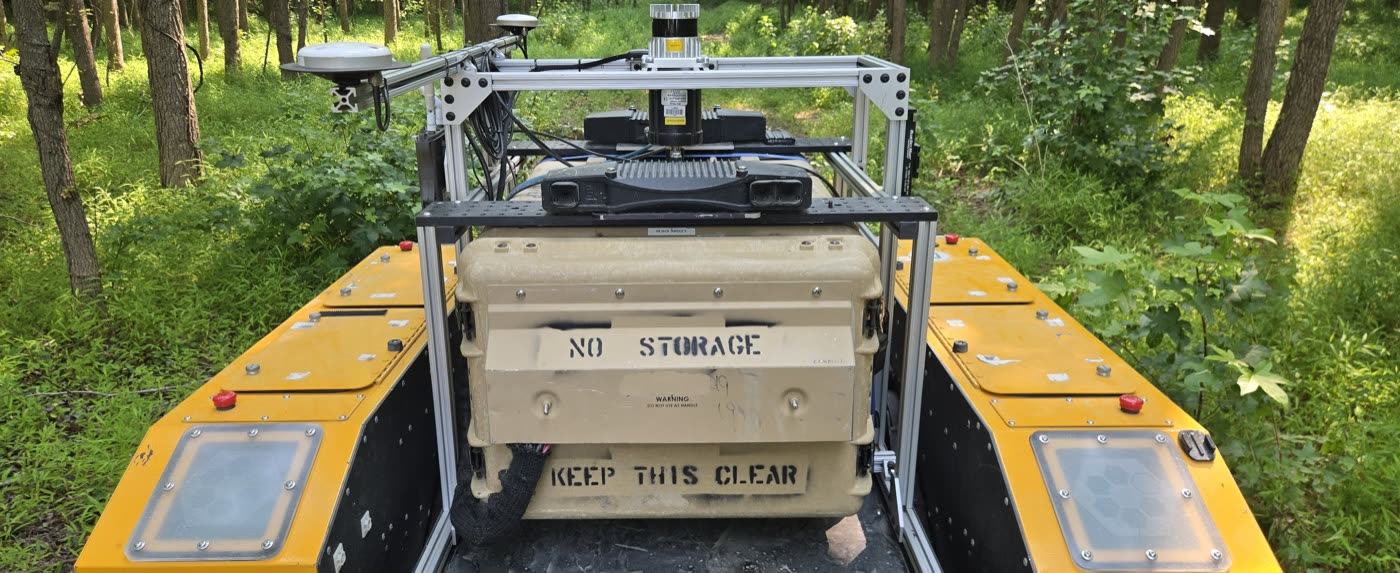
This section fixes the protocol shared by all experiments in Section VI : implementation (Section V-A ), dataset and metrics (Section V-B ), baselines (Section V-C ), and the real-robot platform (Section V-D ). Backbones. We leverage the released GLD checkpoint [ 8 ] , whose frozen encoder and decoders are described in Section IV-B .
Each DA3 feature level synthesized by the diffusion model is a $1536$-channel map ($C{=}1536$) on the image patch grid.
Results
Under the protocol of Section V , we first test the representation-level premise of M3GD (Section VI-A ). We then present the baseline comparison and mechanism ablations (Sections VI-B and VI-D ), qualitative analysis (Section VI-C ), and the deployment-recipe, real-robot, and runtime results (Sections VI-E – VI-G ).
Sources and Demonstrations
Figures are reproduced from Zhou et al. See the full paper for experimental details and the project page, when the paper links one, for demonstrations and videos.
Related Papers

A Sim-to-Real Integration Pipeline for Training and Deployment of Chunk-Based VLA Manipulation Policies
Mathilde Kappel, Clémence Grislain, Mohamed Chetouani et al.
Vision-Language-Action (VLA) models have become a prominent paradigm for mapping multimodal inputs, including semantic instructions, visual observations of the scene, and proprioceptive observations, to robot actions.
Aim Short to Reach Far: Your Frozen World Model Can Plan Better Than You Think
Xvyuan Liu, Jianjie Fang, Chen Gao et al.
Planners built on visual world models commonly score each predicted outcome by its distance to the encoded goal image. We show that this target can limit control even with exact dynamics and globally optimal short-horizon search: reaching a goal may require actions that initially move away from it.
Beyond Reconstruction: What Matters in Action Tokenization for Robot Policies?
Haoran Chen, Jingtian Ji, Samuel Wheeler et al.
Autoregressive action-token policies such as vision-language-action models require action tokenizers to translate discrete token sequences into precise control actions in continuous space. Many action tokenizers learn the mapping between tokens and actions via a reconstruction objective.

Capability-Aware Arbitration for Semantic Intent-Based Shared Control
Zhaoda Du, Michael Bowman, Xiaoli Zhang
Shared control often allocates robot authority based on confidence in inferred human intent, assuming reliable autonomous execution. When this assumption fails, high intent confidence can cause over-helping.