
EVPeriscope: Extended Perception across Aerial and Ground Vehicles with Event-based Propeller Tracking
Dexter Ong, Vijay Kumar, Pratik Chaudhari · N/A · 2026
Framework
N/A
License
N/A
Stars
N/A
Summary
Reliable relative localization between aerial and ground robots is a key requirement for tightly coordinated heterogeneous teams.
Abstract Summary
Key Points
- Reliable relative localization between aerial and ground robots is a key requirement for tightly coordinated heterogeneous teams.
- This can be difficult to do using conventional frame-based cameras and fiducial markers because they are sensitive to motion blur, lighting variations, and payload constraints.
- This paper presents EVPeriscope, an event-based perception system that enables detection, localization and control of a quadrotor using an upward-facing event camera on a ground robot by detecting the high-frequency visual signature of its propellers.
- This system allows the quadrotor to function as an extended perception system for the ground robot when onboard sensors exhibit degradation or occlusion.
- We demonstrate the capabilities of this marsupial ground-aerial system via experiments in challenging field conditions with wind speeds of up to 15 mph, in both daylight and at night.
Method
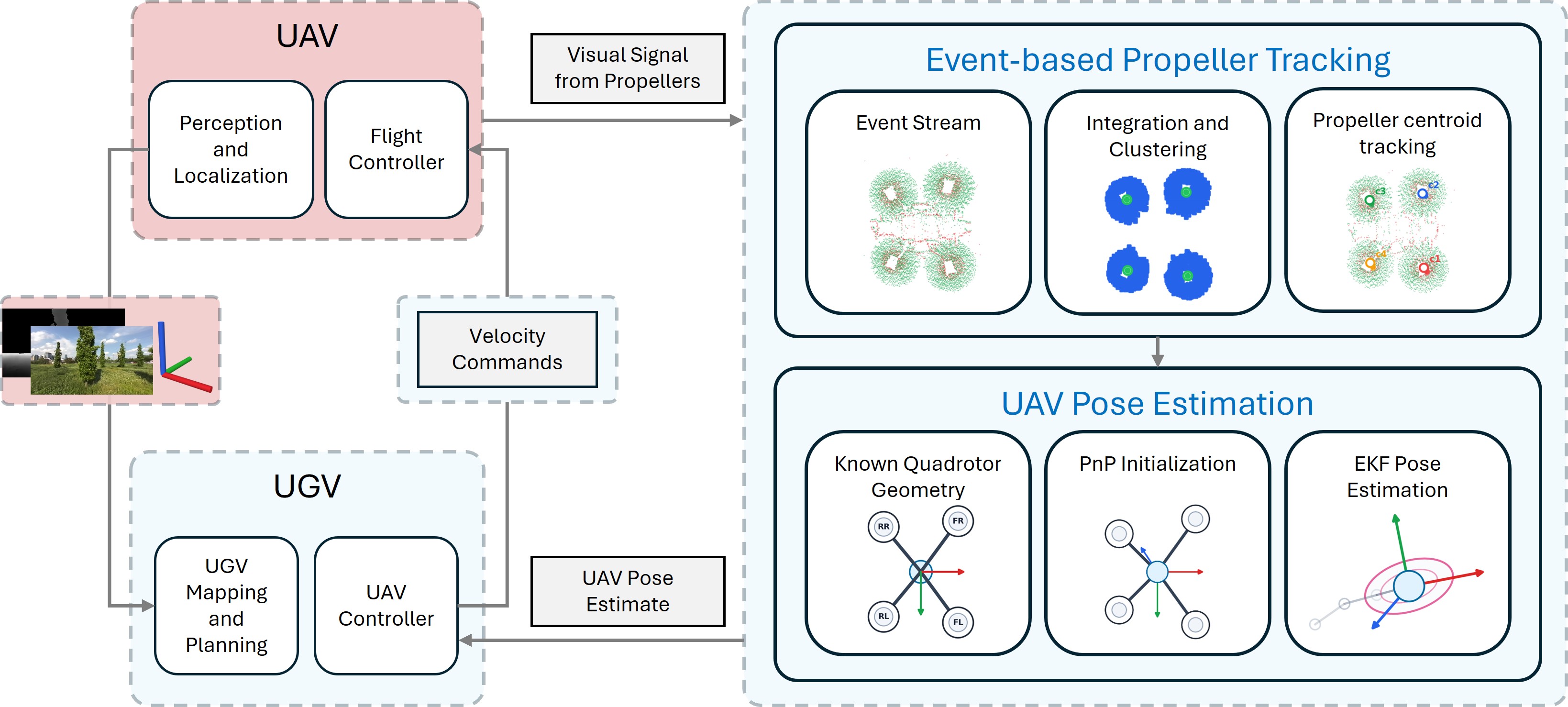
The EVPeriscope system consists of an event-based propeller detection and tracking pipeline, quadrotor pose estimation module and UAV controller. The system diagram is shown in Fig. 2 . Event cameras produce sparse, high-temporal-resolution measurements that are inherently asynchronous and noisy, making instantaneous frame-based detection unreliable.
Experiments
Altitude Position (m ) / Attitude (deg) Error X Y Z Roll Pitch Yaw 0.5 0.014 $\pm$ 0.006 0.027 $\pm$ 0.007 0.017 $\pm$ 0.005 1.975 $\pm$ 0.915 1.894 $\pm$ 1.137 1.342$\pm$ 0.103 1.0 0.065 $\pm$ 0.029 0.086 $\pm$ 0.015 0.023 $\pm$ 0.014 2.250 $\pm$ 1.856 1.970 $\pm$ 1.522 1.611 $\pm$ 0.155 2.0 0.084 $\pm$ 0.015 0.125 $\pm$ 0.024 0.129 $\pm$ 0.019 2.744 $\pm$ 2.419 5.162 $\pm$ 3.645 1.944 $\pm$ 0.320 4.0 0.142 $\pm$ 0.040 0.434 $\pm$ 0.035 0.493 $\pm$ 0.032 4.248 $\pm$ 3.131 9.432 $\pm$ 9.344 4.752 $\pm$ 0.576 6.0 0.364 $\pm$ 0.084 0.546 $\pm$ 0....
Sources and Demonstrations
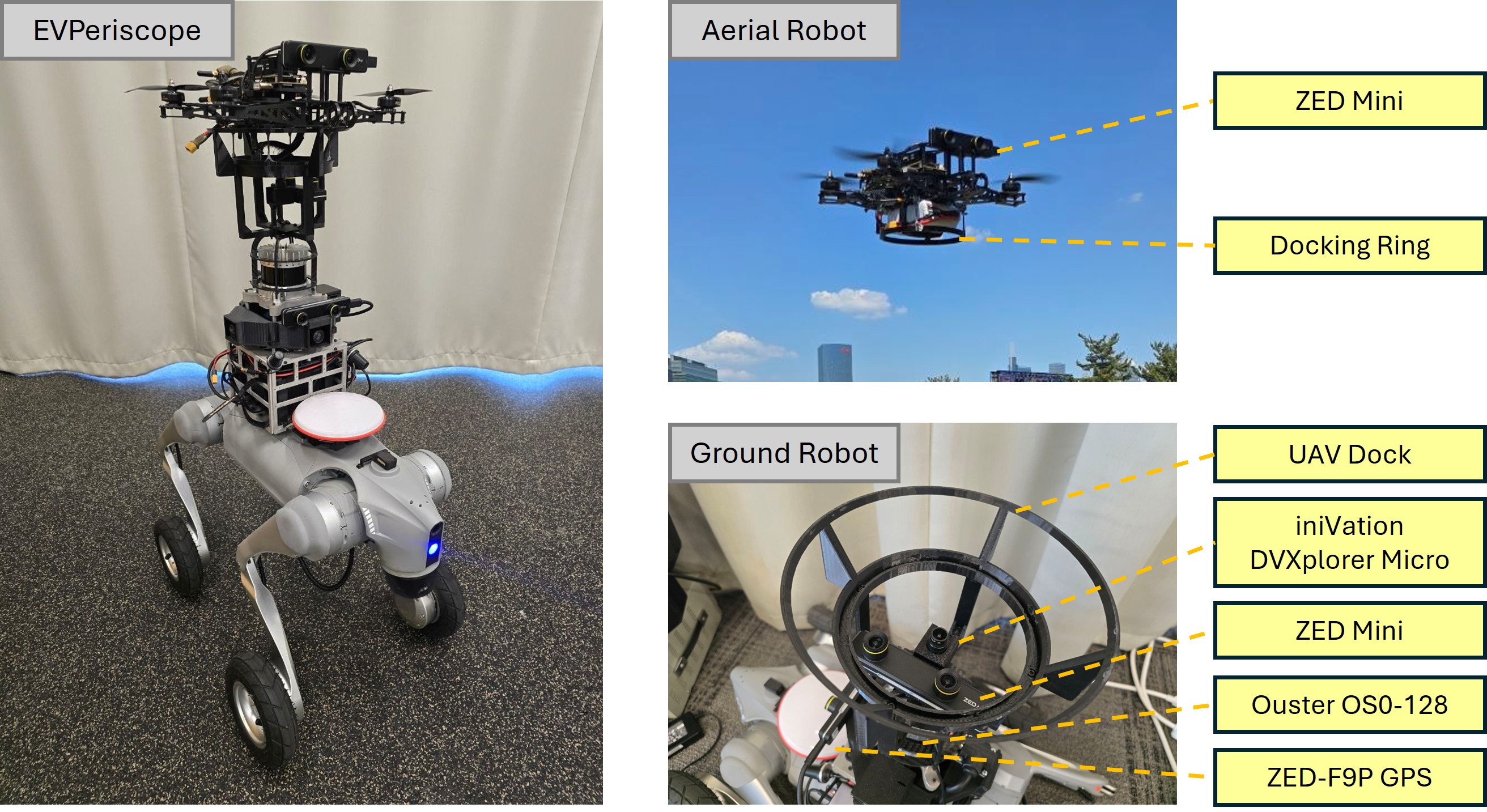
Figures are reproduced from Ong et al. See the full paper for experimental details and the project page, when the paper links one, for demonstrations and videos.
Related Papers
A Low-Cost, Open Platform for End-to-End Autonomous Driving on a Miniature Ackermann Vehicle
Gustavo Claudio Karl Couto, Eric Aislan Antonelo, Gabriel George Zipperer
This paper presents a low-cost, open experimental platform for research in end-to-end autonomous driving with miniature Ackermann vehicles.
Aim Short to Reach Far: Your Frozen World Model Can Plan Better Than You Think
Xvyuan Liu, Jianjie Fang, Chen Gao et al.
Planners built on visual world models commonly score each predicted outcome by its distance to the encoded goal image. We show that this target can limit control even with exact dynamics and globally optimal short-horizon search: reaching a goal may require actions that initially move away from it.
Autonomous Droplet Navigation via Model-Based Reinforcement Learning: Zero-Shot Transfer and Emergent Dynamics
Rajneesh Anand, Mayuresh V. Kothare
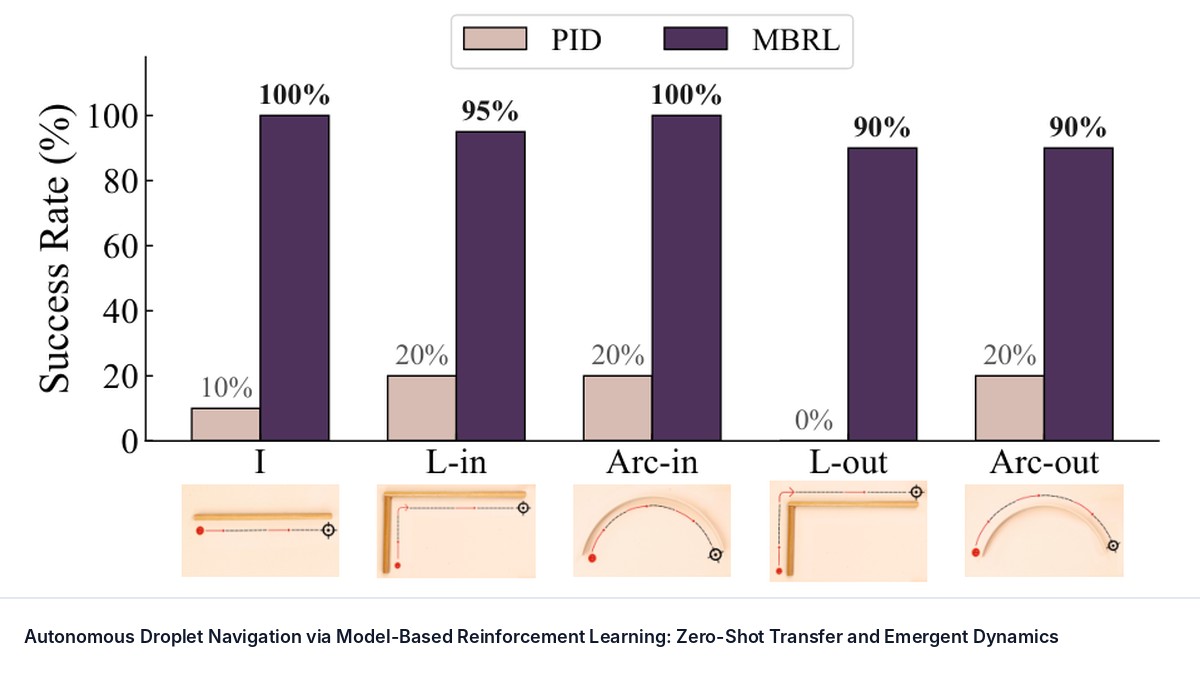
Self-driving laboratories (SDLs) are transforming chemical and materials discovery through closed-loop automation, yet automated infrastructure for physical manipulation of soft, deformable matter remains beyond current robotic platforms.
Autoware in Construction: Gap Analysis and LiDAR Perception Toward Off-Road Autonomous Driving
Yu Otsuki, Teja Emmey, Sena Matsushita et al.
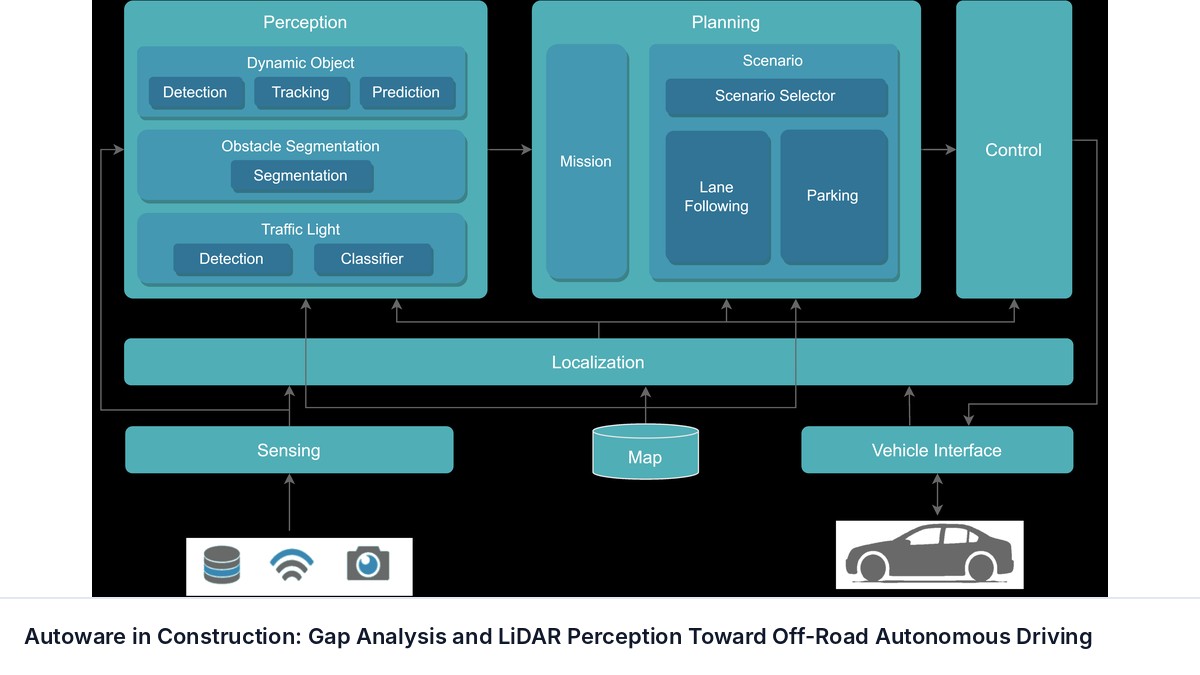
Autoware is an open-source autonomous driving software platform widely adopted by researchers and industry developers.