
MIND: Instruction-Conditioned Incremental Grounding for Robots
Mohamed Abouagour, Junhyun Nam, Wonse Jo, Byung-Cheol Min · N/A · 2026
Framework
N/A
License
N/A
Stars
N/A
Summary
Robots following persistent language instructions must decide which cached room judgments remain valid as their environment changes.
Abstract Summary
Key Points
- Robots following persistent language instructions must decide which cached room judgments remain valid as their environment changes.
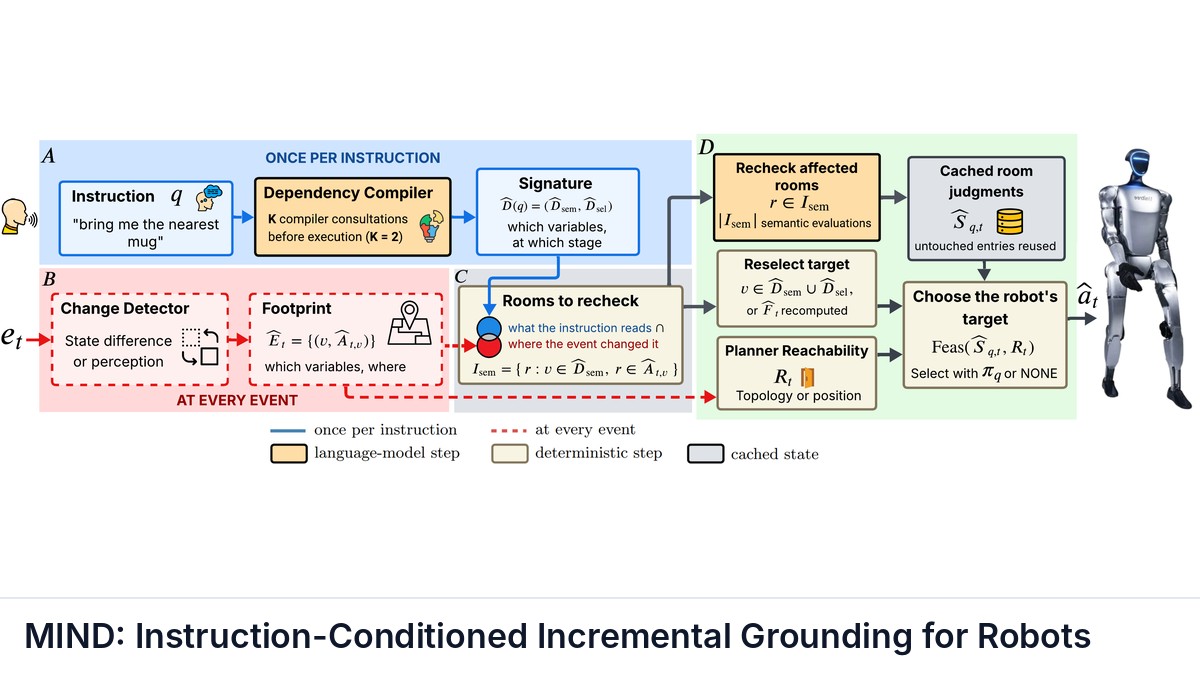
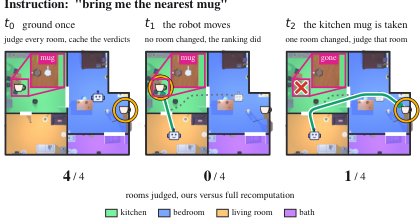
- We present MIND (Maintenance via INstruction-conditioned Dependencies), a framework for maintaining target-room decisions without re-evaluating every room after each event.
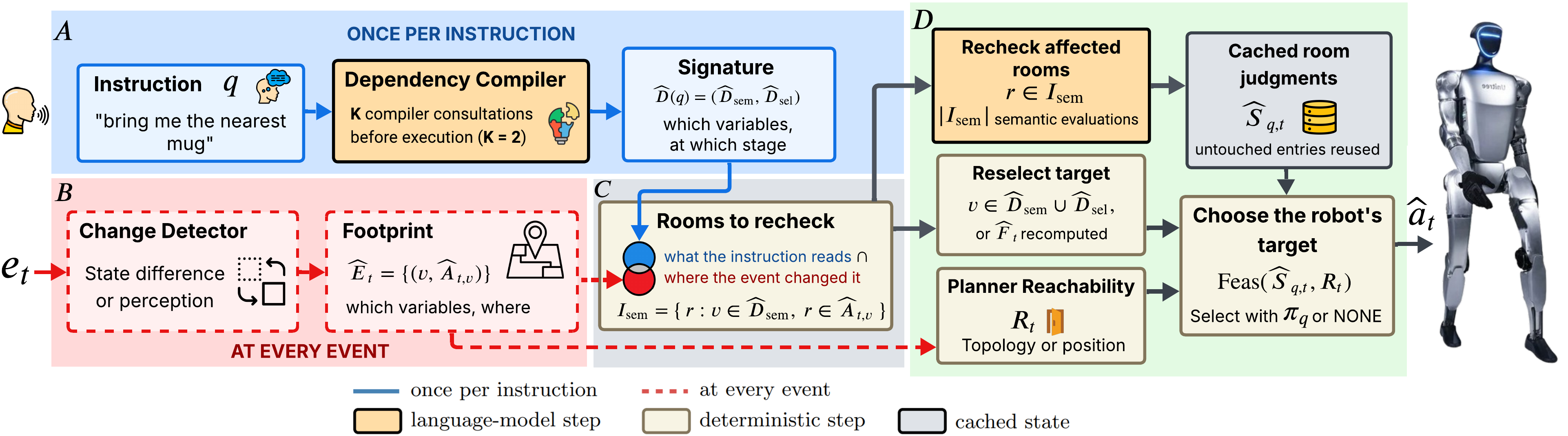
- A language model compiles each instruction into dependencies for semantic qualification and target selection.
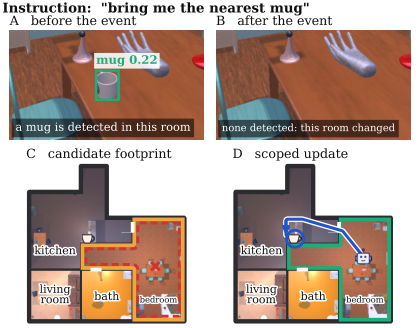
- The controller intersects semantic dependencies with event footprints, refreshes affected judgments, and updates reachability and selection separately.
- For fixed deterministic evaluation, planning, and selection, conservative dependency and footprint coverage preserves the decisions of full recomputation.
Problem Formulation
System and event stream. An episode fixes a natural-language instruction $q$ and a building with regions $\mathcal{R}$; in our indoor experiments each region is one room. The episode then evolves through events $e_{1:T}$. Event $e_{t}$ changes the world from $X_{t-1}$ to $X_{t}$, where $X_{t}$ holds region inventories, semantic region labels, the robot’s region, interaction history, and the region-adjacency graph.
We denote these state categories by We instantiate $\mathcal{V}$ with five state categories common to indoor grounding.
Methodology
MIND compiles dependencies once per instruction and uses event footprints to maintain cached room judgments, reachability, and target selection (see Fig. 2 ). The compiler (Fig. 2 ) maps $q$ to The true read sets are defined counterfactually for the fixed semantic function $s_{q}$ and selector $\pi_{q}$ used in the comparison.
A variable $v$ belongs to $D^{*}_{\mathrm{sem}}(q)$ if changing only state category $v$ can change $s_{q}(r;X)$ for some candidate region.
Benchmarks and Experimental Setup
The six-family dependency and request benchmarks use automatically checked manifests frozen by hash before model evaluation.
A dependency manifest is refused if a sequence has no verdict-changing event or abstains throughout, a history sequence is not moved by its use event, a move or door event changes a verdict for a nearest request, or no event exposes the inventory-only rule; a request manifest is refused if families are unbalanced or share a signature, a minimal pair adds an edge other than the one claimed, a held-out template leaks into d...
Results
Every number below is measured on the frozen evaluation units of Section V with the metrics defined there. Semantic-evaluation counts are reported per five-event sequence. Table I reports episode-accuracy proportions with $95\%$ Wilson intervals and semantic-evaluation means with standard deviations.
Decision-agreement rates are descriptive proportions over the evaluated decisions; the observation-derived footprint experiment reports a one-sided Clopper–Pearson bound. Conservative coverage and update scope.
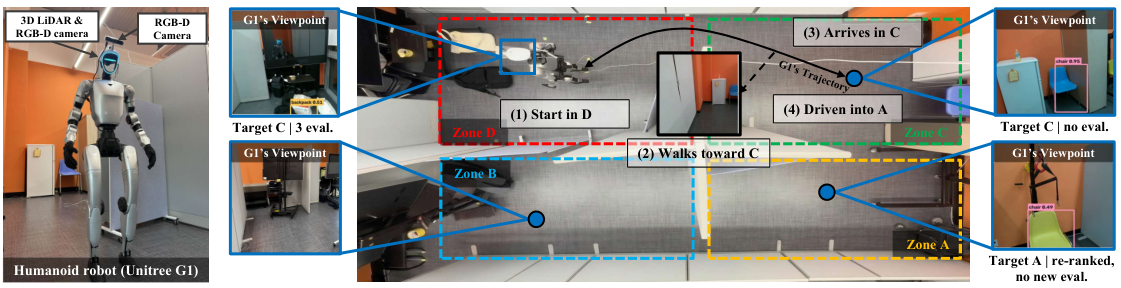
Sources and Demonstrations
Figures are reproduced from Abouagour et al. See the full paper for experimental details and the project page, when the paper links one, for demonstrations and videos.
Related Papers
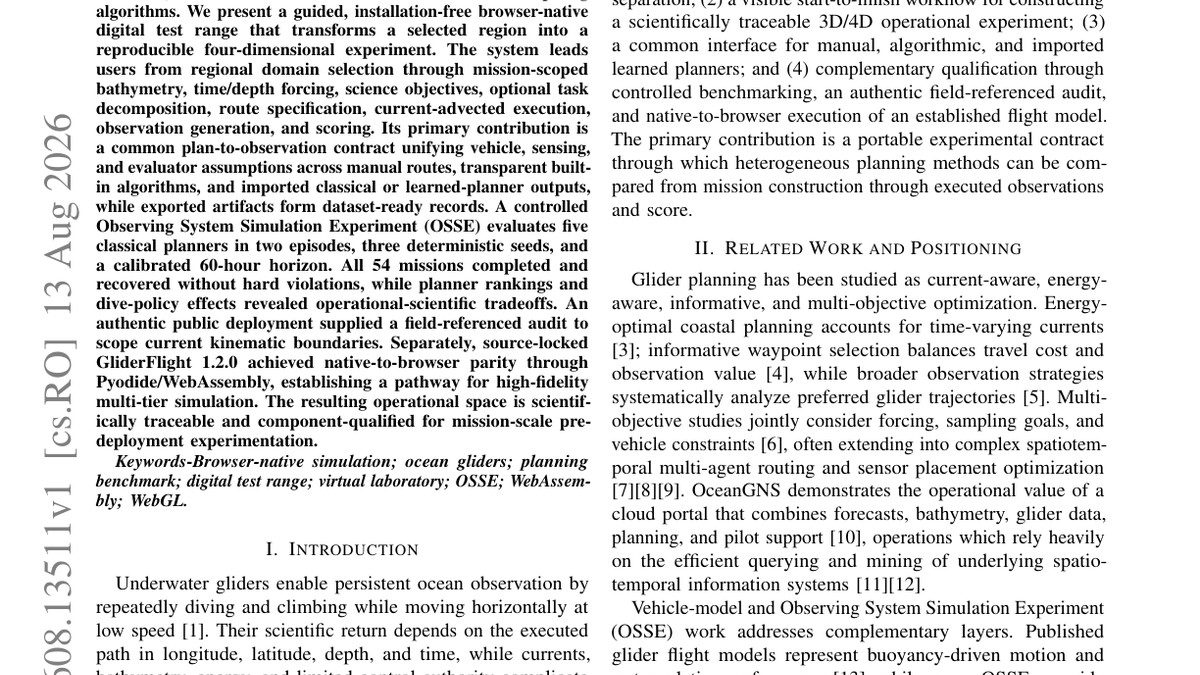
A Browser-Native Digital Test Range for Benchmarking 4D Ocean-Glider Planning Algorithms
Edward Holmberg, Elias Ioup, Mahdi Abdelguerfi
Repeated in-situ evaluation of ocean-glider planners requires scarce vehicles, operators, deployment and recovery resources, and ocean conditions that cannot be reset for competing algorithms.
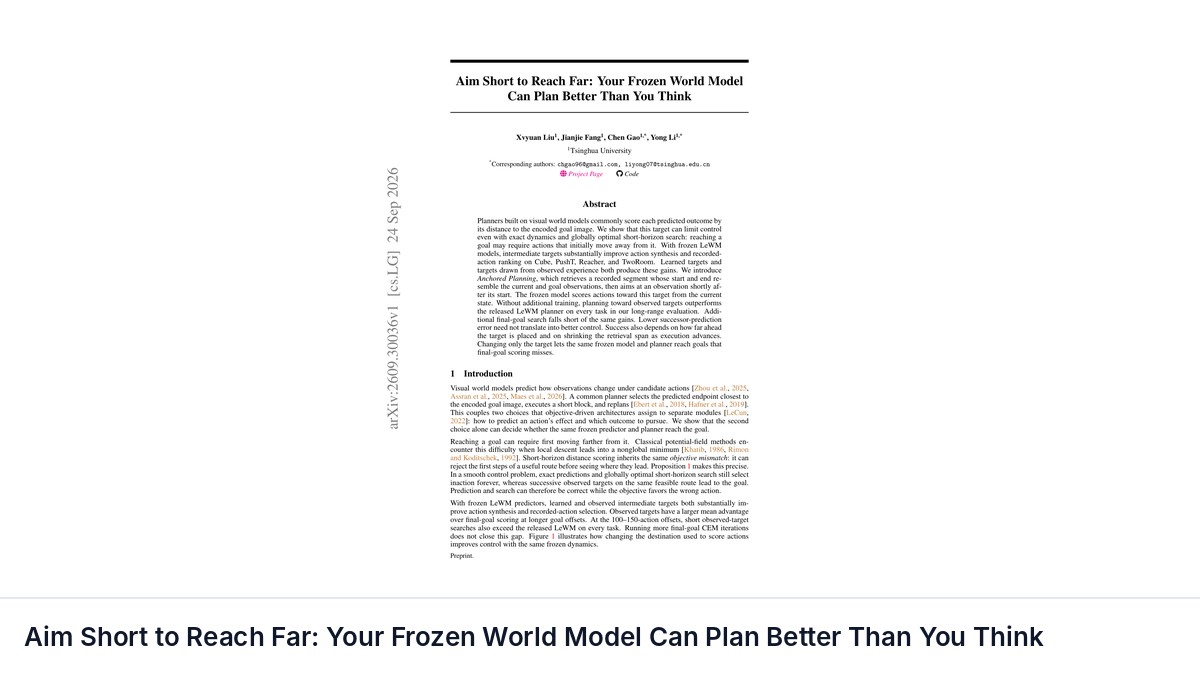
Aim Short to Reach Far: Your Frozen World Model Can Plan Better Than You Think
Xvyuan Liu, Jianjie Fang, Chen Gao et al.
Planners built on visual world models commonly score each predicted outcome by its distance to the encoded goal image. We show that this target can limit control even with exact dynamics and globally optimal short-horizon search: reaching a goal may require actions that initially move away from it.
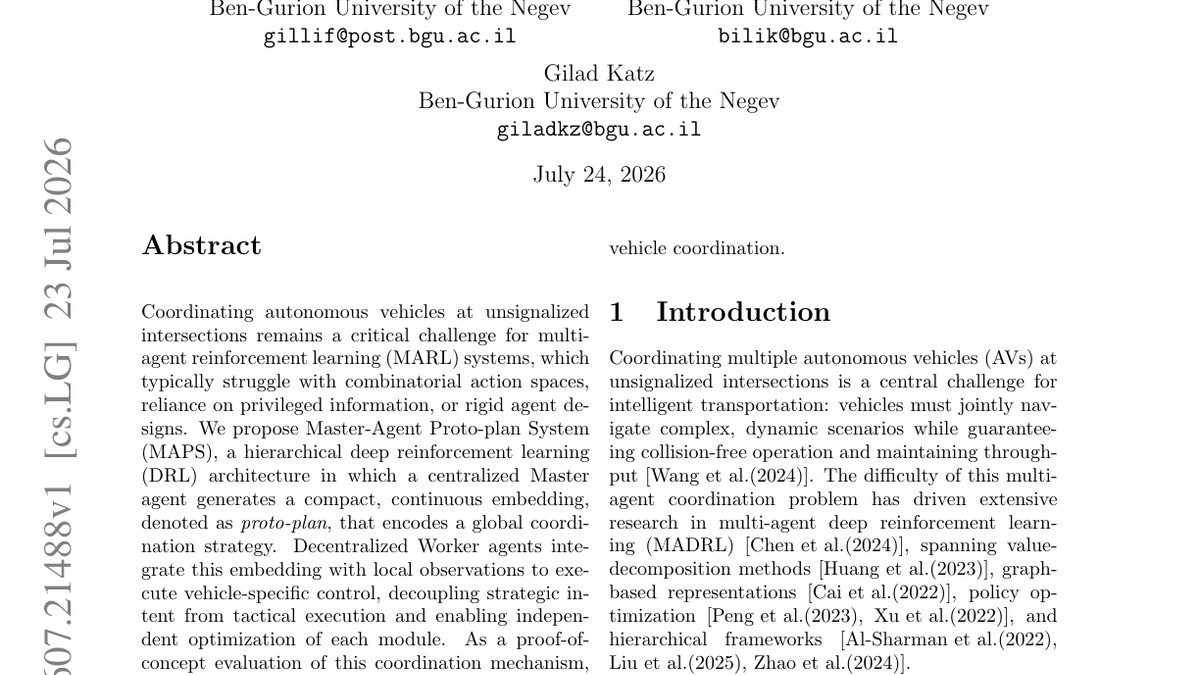
Compact Latent Coordination for Autonomous Vehicles at Unsignalized Intersections
Gil Lifshits, Igal Bilik, Gilad Katz
Coordinating autonomous vehicles at unsignalized intersections remains a critical challenge for multi-agent reinforcement learning (MARL) systems, which typically struggle with combinatorial action spaces, reliance on privileged information, or rigid agent designs.
D3DWA: Adaptive Weight and Prediction-Horizon for Dynamic Window Approach via Dueling Double Deep Q-Network
Zahra Jooyandeh, Masato Kobayashi, Yuki Uranishi
The Dynamic Window Approach (DWA) is widely used for local navigation, but its performance depends strongly on parameters that are typically fixed before navigation.