
Advancing Omnimodal Embodied Agents from Isolated Skills to Everyday Physical Autonomy
FeaturedJunhao Shi, Zezheng Huai, Siyin Wang, Jia Chen, Yubang Wang, Zhaoye Fei, Hechang Chen, Jingjing Gong, Xipeng Qiu, Yu-Gang Jiang · · 2026
Framework
Python
License
N/A
Stars
1
Summary
Building persistent embodied agents in unstructured environments demands unified orchestration of heterogeneous tools spanning both cyber (APIs, IoT) and physical (manipulation, navigation) domains, coupled with autonomous recovery from physical failures that inevitably arise over extended operation.
Abstract Summary
Key Points
- Building persistent embodied agents in unstructured environments demands unified orchestration of heterogeneous tools spanning both cyber (APIs, IoT) and physical (manipulation, navigation) domains, coupled with autonomous recovery from physical failures that inevitably arise over extended operation.
Abstract
Building persistent embodied agents in unstructured environments demands unified orchestration of heterogeneous tools spanning both cyber (APIs, IoT) and physical (manipulation, navigation) domains, coupled with autonomous recovery from physical failures that inevitably arise over extended operation. Existing systems treat these as separate problems: VLM-based planners lack a unified cyber-physical action space, agent frameworks accumulate unbounded context that degrades temporal coherence, and VLA policies execute open-loop without detecting their own failures. We argue that persistent autonomy requires not a monolithic model but a hierarchical asynchronous architecture with explicit separation of planning, memory, and verification. To this end, we present OmniAct, a framework integrating a multimodal semantic planner for skill routing across unified action spaces, an adaptive hierarchical memory with event-boundary-driven compression for sub-linear context growth, and an asynchronous visual preemption engine that closes the semantic loop during physical execution. Across 40 real-world long-horizon tasks on two robotic platforms coordinating four IoT devices, OmniAct achieves consistent improvements in end-to-end success across all complexity levels, maintains near-flat token consumption over under 100k+ accumulated interaction tokens, and elevates mid-scale open-weight models to proprietary-level performance.
Links
- Paper (PDF): 2606.27251v1
- arXiv: 2606.27251v1
- Project Page: https://huaizz-shawen.github.io/OmniAct
Related Papers

Scalable Behavior Cloning with Open Data, Training, and Evaluation
Arthur Allshire, Himanshu Gaurav Singh, Ritvik Singh et al.
We introduce ABC, a fully open-source stack for manipulation with behavior cloning. At its core is ABC-130K: the largest open-source teleoperation dataset to date, featuring 3,500 hours of data spanning over 130K episodes across 195 diverse tasks.

E-TTS: A New Embodied Test-Time Scaling Framework for Robotic Manipulation
Wen Ye, Peiyan Li, Tingyu Yuan et al.
Recently, a few works have made early attempts to study test-time scaling for embodied tasks.
HumanoidUMI: Bridging Robot-Free Demonstrations and Humanoid Whole-Body Manipulation
Hongwu Wang, Chenhao Yu, Youhao Hu et al.
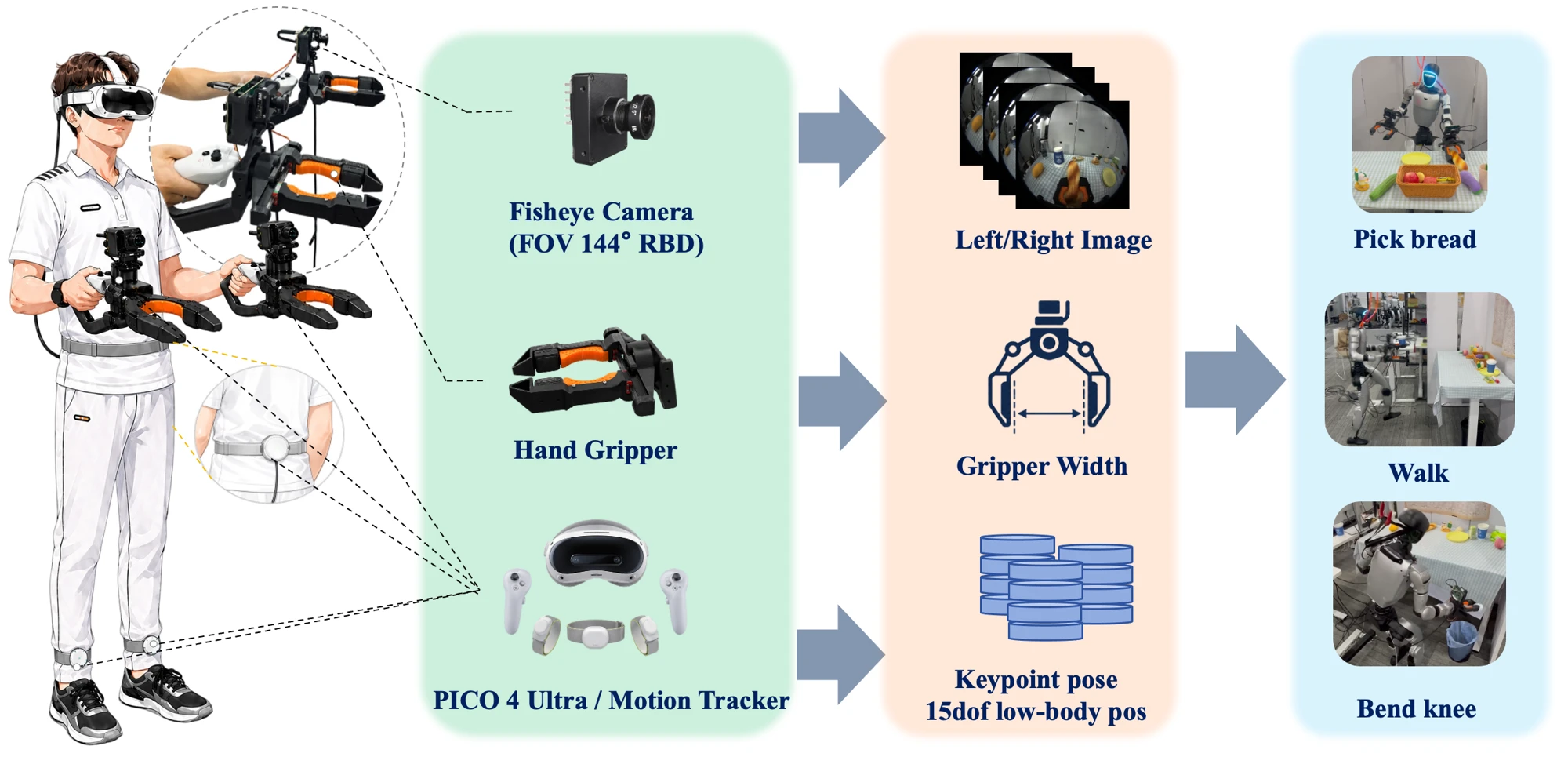
HumanoidUMI moves demonstration collection off the robot, then translates human motion into executable humanoid skills.

LA4VLA: Learning to Act without Seeing via Language-Action Pretraining
Tao Lin, Yuxin Du, Yiran Mao et al.
Vision-Language-Action (VLA) models are commonly pretrained on robot demonstrations by jointly mapping visual observations and language instructions to actions. However, dense visual-action supervision can dominate the comparatively sparse language-action signal.