
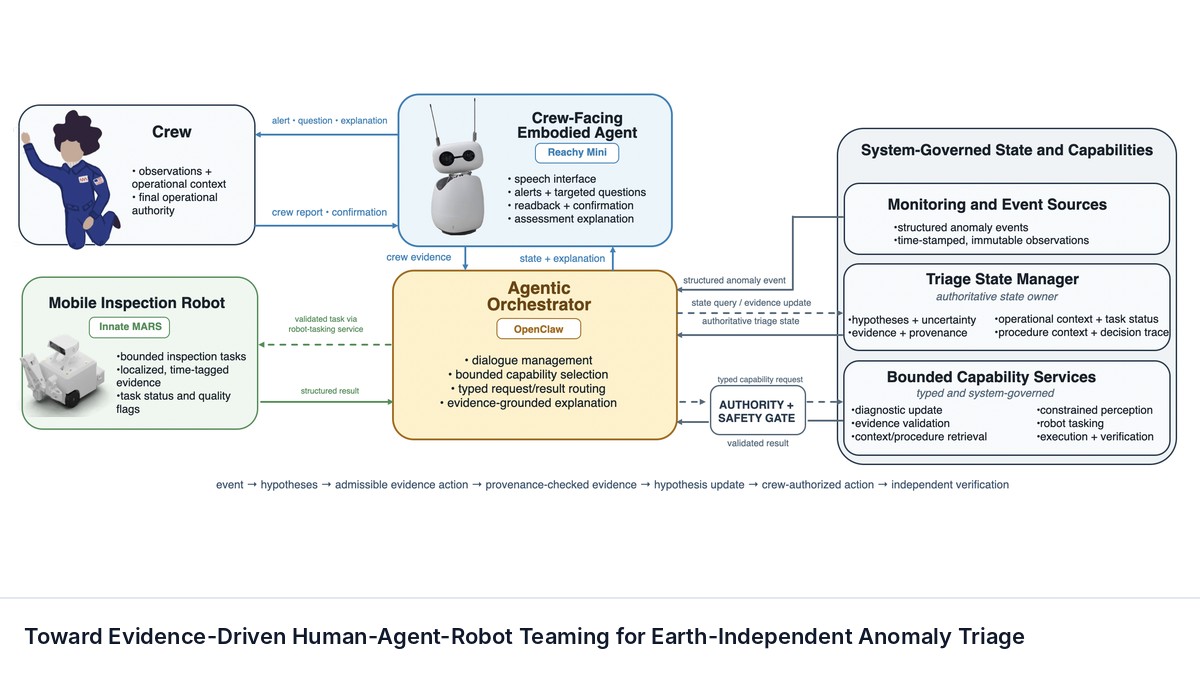
Toward Evidence-Driven Human-Agent-Robot Teaming for Earth-Independent Anomaly Triage
Ignacio G Lopez-Francos, Alexis Gallagher, Samira Shalal · N/A · 2026
Framework
N/A
License
N/A
Stars
N/A
Summary
Deep-space crews cannot rely on real-time ground support for urgent off-nominal events. Initial alerts may underdetermine cause, while discriminating evidence may reside in crew observations or at locations that are unsafe, costly, or unavailable for crew inspection.
Abstract Summary
Key Points
- Deep-space crews cannot rely on real-time ground support for urgent off-nominal events
- Initial alerts may underdetermine cause, while discriminating evidence may reside in crew observations or at locations that are unsafe, costly, or unavailable for crew inspection.
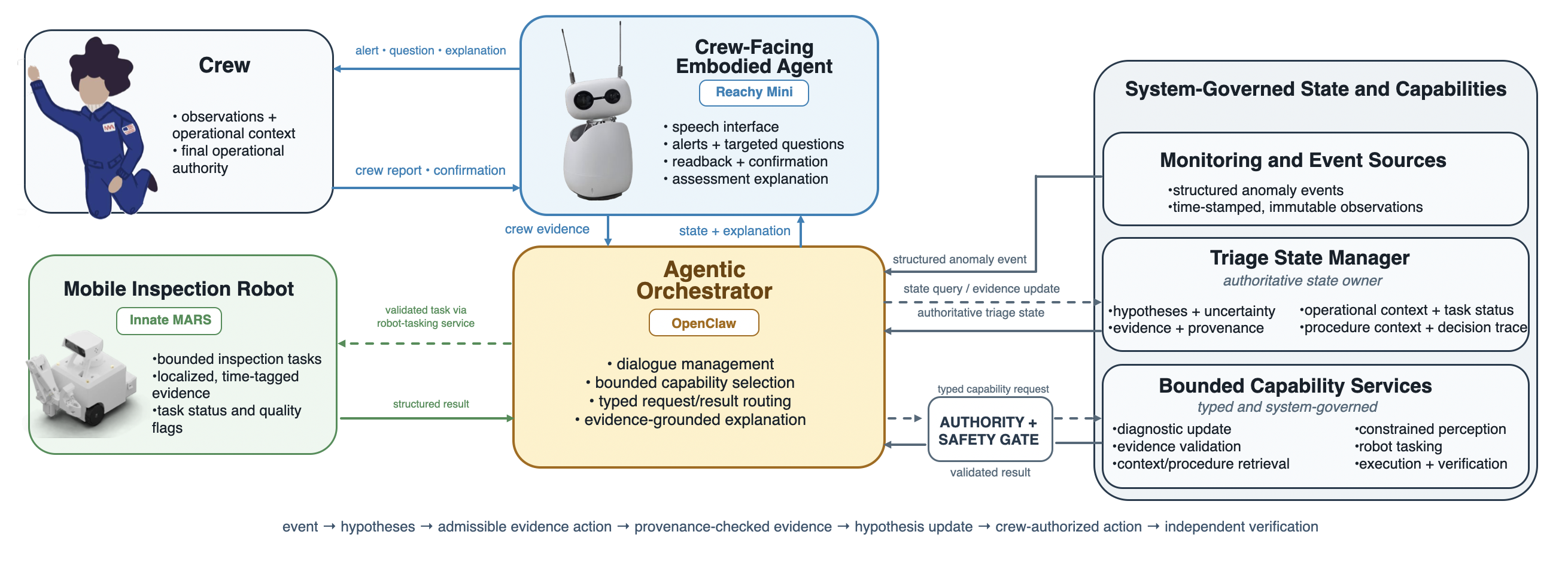
- We present an evidence-driven architecture for human-agent-robot teaming in Earth-independent anomaly triage.
- Agentic AI is treated as a stateful coordinator over bounded, inspectable services rather than as a fully autonomous vehicle controller.
- A triage state manager maintains hypotheses, evidence provenance, uncertainty, operational context, and tool status; a crew-facing embodied agent elicits observations and explains assessment changes; and a mobile robot acquires targeted, localized evidence.
Evidence-Driven Agentic Architecture
The architecture continuously receives structured events from caution-and-warning systems, conventional fault detection, isolation, and recovery (FDIR), anomaly detectors, and crew reports. An off-nominal event initiates triage; independently designed automated safing may act in parallel when delay is unacceptable.
The architecture then supports situation assessment and early response, when additional evidence can distinguish plausible causes and guide the next safe action.
Illustrative Use Cases
This scenario uses an actual ISS event to examine how a similar anomaly could be handled aboard a crewed vehicle in transit to Mars, where communication delay prevents real-time support from Mission Control. On January 14, 2015, the ISS annunciated TOXIC ATMOSPHERE Node 2 LTL IFHX NH3 Leak Detected , indicating possible ammonia ingress through the Node 2 Low Temperature Loop Interface Heat Exchanger (IFHX).
Software inhibited ventilation, and the crew isolated in the Russian Segment.
Proof-of-Concept Implementation and Demonstration
We implemented the Section II architecture on an NVIDIA DGX Spark for the Section III-A ammonia scenario. An OpenClaw-based orchestrator routes high-level workflow messages among Reachy Mini as the crew-facing interface, an authoritative triage state manager and bounded backend services, and Innate MARS through a ROS2 robot-tasking service [ 12 , 13 ] .
Local models provide dialogue and tool use ( Gemma-4-26B-A4B-it ), speech recognition and synthesis ( Parakeet-TDT-0.6B-v2 , Kokoro-82M ), and visual interpretation ( Qwen3-VL-8B-Instruct ).
Sources and Demonstrations
Figures are reproduced from Lopez-Francos et al. See the full paper for experimental details and the project page, when the paper links one, for demonstrations and videos.
Related Papers
A Balanced Data Diet: Addressing the Exploration Bottleneck in Mega-Scale RL for Robot Control
Octi Zhang, Mateo Guaman Castro, Patrick Yin et al.
General-purpose robots must perform a wide range of tasks from agile locomotion to dexterous manipulation.
A Browser-Native Digital Test Range for Benchmarking 4D Ocean-Glider Planning Algorithms
Edward Holmberg, Elias Ioup, Mahdi Abdelguerfi
Repeated in-situ evaluation of ocean-glider planners requires scarce vehicles, operators, deployment and recovery resources, and ocean conditions that cannot be reset for competing algorithms.
A Low-Cost, Open Platform for End-to-End Autonomous Driving on a Miniature Ackermann Vehicle
Gustavo Claudio Karl Couto, Eric Aislan Antonelo, Gabriel George Zipperer
This paper presents a low-cost, open experimental platform for research in end-to-end autonomous driving with miniature Ackermann vehicles.
A Mode-Unified, Continuous, and Biomimetic Control Strategy of a Robotic Lower Limb Prosthesis
Hanjun Kim, Sixu Zhou, John Shim et al.
Existing biomimetic lower-limb prosthesis controllers are commonly designed for discrete locomotion modes, requiring separate parameterizations for level walking, ramps, and stairs.