
One Demonstration Is Enough for Real-World Robotic Reinforcement Learning
FeaturedYuwan Liu, Hongze Yu, Song Liu, Yuhan Wang, Junge Zhang, Yaodong Yang, Yuanpei Chen, Ceyao Zhang · · 2026
Framework
N/A
License
N/A
Stars
N/A
Summary
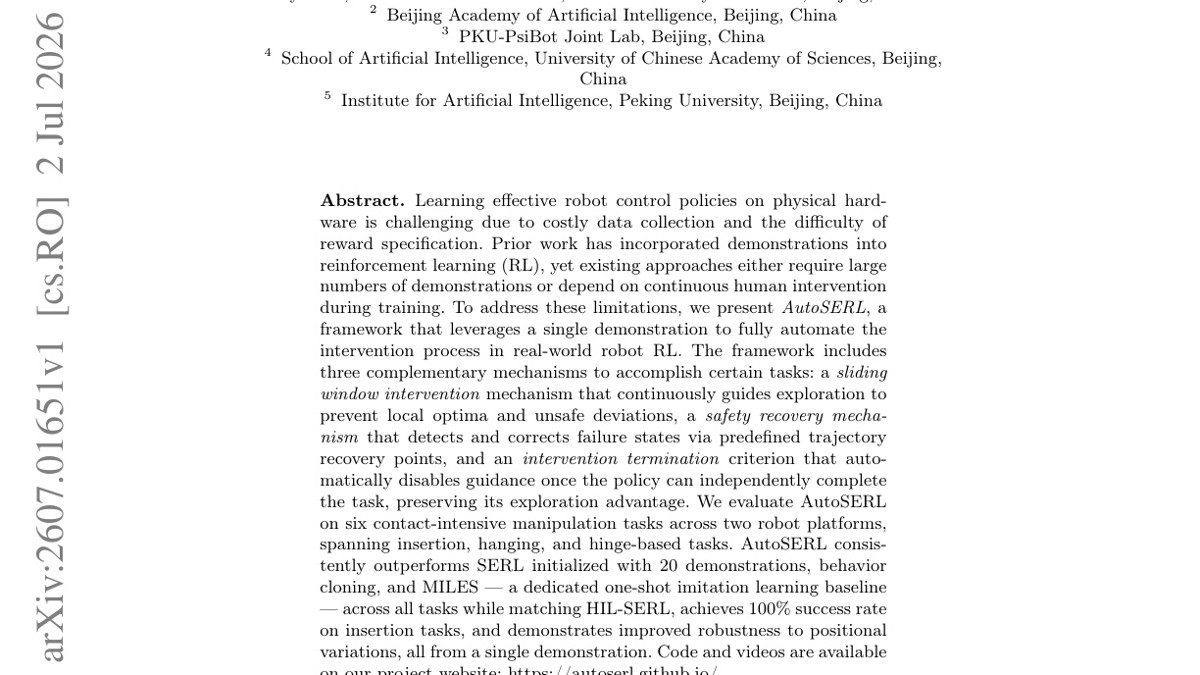
Learning effective robot control policies on physical hardware is challenging due to costly data collection and the difficulty of reward specification.
Abstract Summary
Key Points
- Proposes One Demonstration Is Enough for Real-World Robotic Reinforce for robotics.
- Evaluated on real or simulated robotic tasks.
- Primary contribution in ar-vr.
Method
Reinforcement learning (RL) tasks can be modeled as a Markov Decision Process $\mathcal{M}=\left(\mathcal{S},\mathcal{A},\rho,P,r,\gamma\right)$, where $\mathcal{S}$ is the state space, $\mathcal{A}$ is the action space, $\rho(s_{0})$ is the initial state distribution, $P$ is the state transition probability, $r$ is the reward function, and $\gamma$ is the discount factor.
The learning objective is to maximize the expected cumulative reward. Our method is built upon SERL [ 14 ] .
Experiments
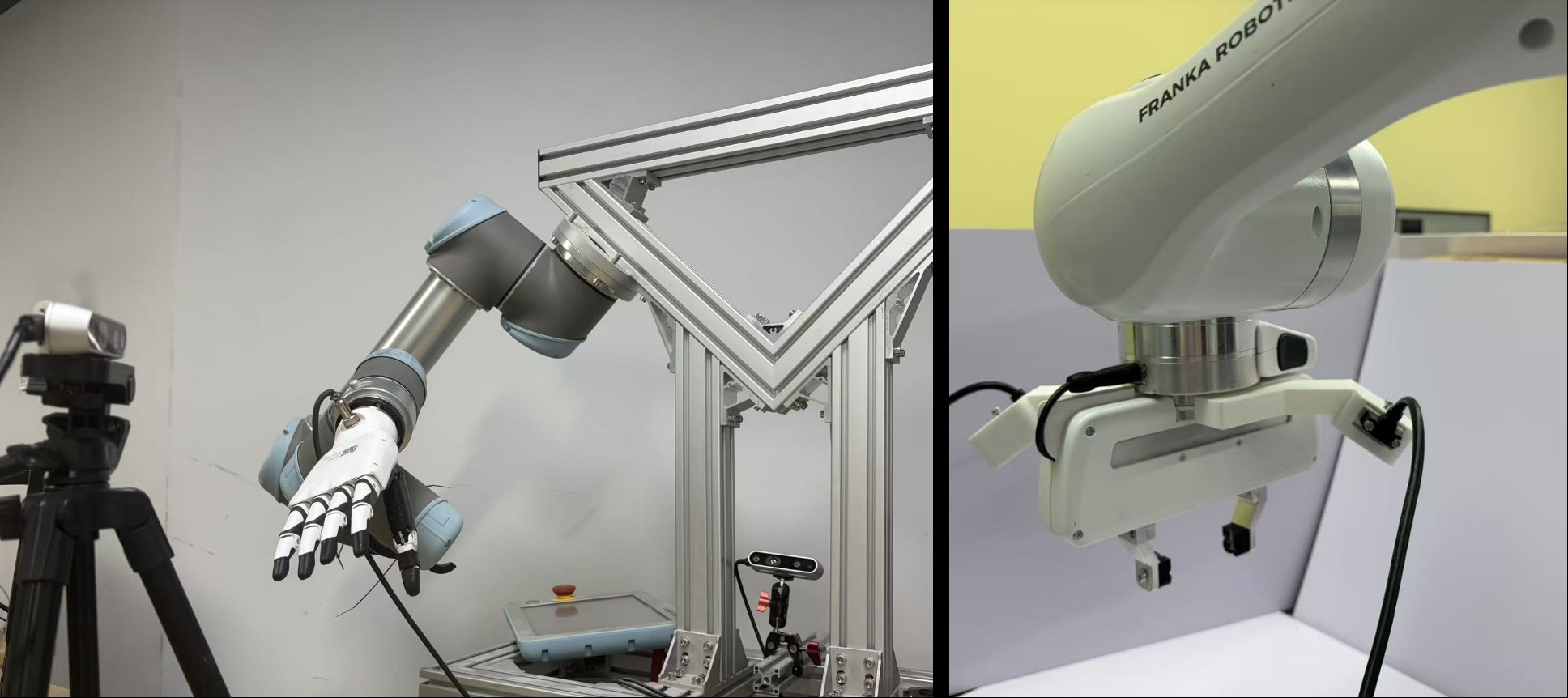
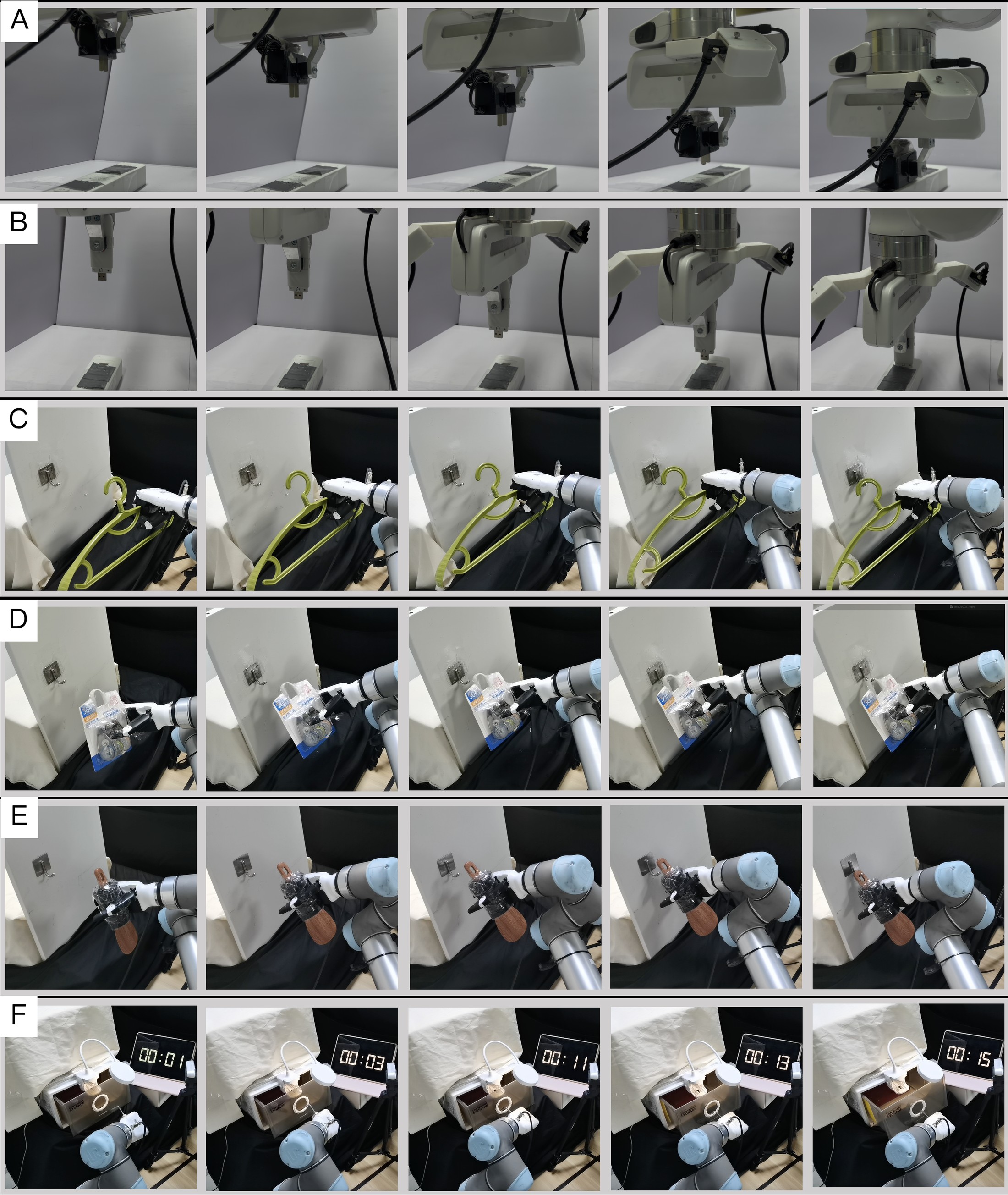
We conduct real-world experiments to evaluate the effectiveness of AutoSERL, aiming to address the following questions: (1) Does AutoSERL achieve higher training efficiency than existing baselines? (2) How robust is AutoSERL across different seeds and under positional variations? (3) How do different heuristic hyperparameter settings affect the performance of AutoSERL?
(4) What are the respective contributions of the individual components of AutoSERL to its overall performance? (5) Does AutoSERL merely imitate the demonstration trajectory, or c...
Sources and Demonstrations
Figures are reproduced from Liu et al. See the full paper for experimental details and the project page, when the paper links one, for demonstrations and videos.
Related Papers
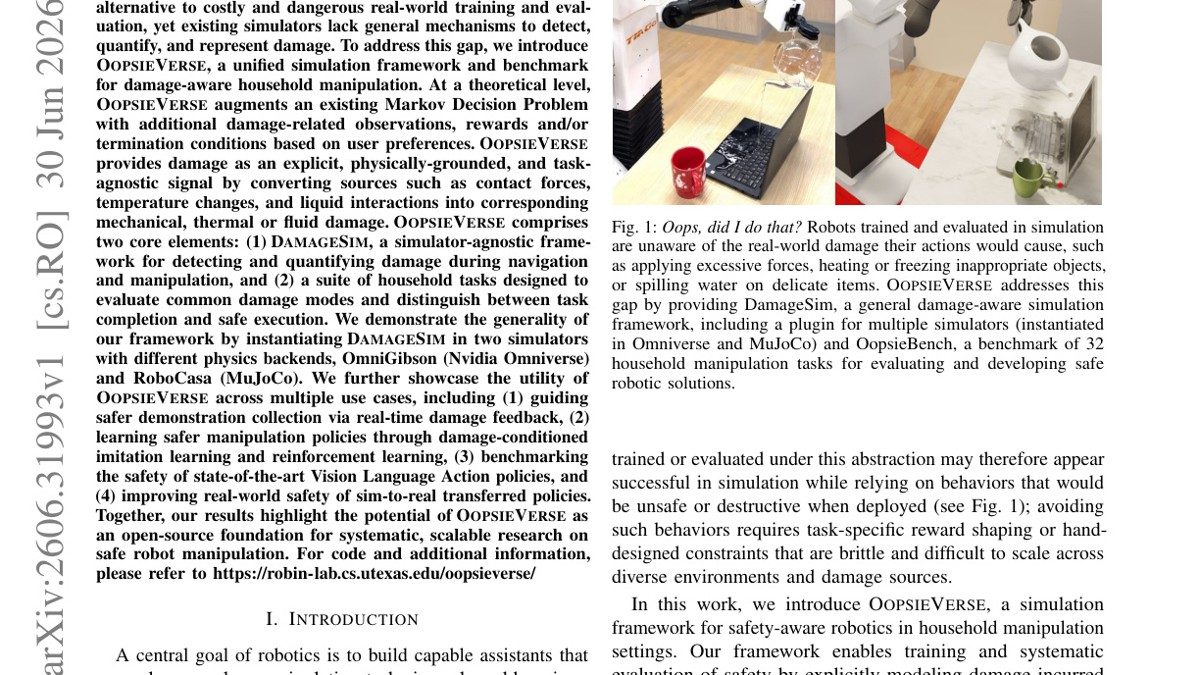
OopsieVerse: A Safety Benchmark with Damage-Aware Simulation for Robot Manipulation
Arnav Balaji, Arpit Bahety, Sriniket Ambatipudi et al.
While robotic manipulation capabilities have advanced rapidly, physical safety remains a major barrier to deploying household robots: task success is insufficient if the robot damages itself or its surroundings.

WorldSample: Closed-loop Real-robot RL with World Modelling
Yuquan Xue, Le Xu, Zeyi Liu et al.
Reinforcement learning (RL) can overcome the demonstration-coverage limitation of imitation learning (IL) by allowing robots to improve through trial-and-error interaction beyond the states observed in demonstrations.
Diffusion Policy: Visuomotor Policy Learning via Action Diffusion
Cheng Chi, Siyuan Feng, Yilun Du et al.
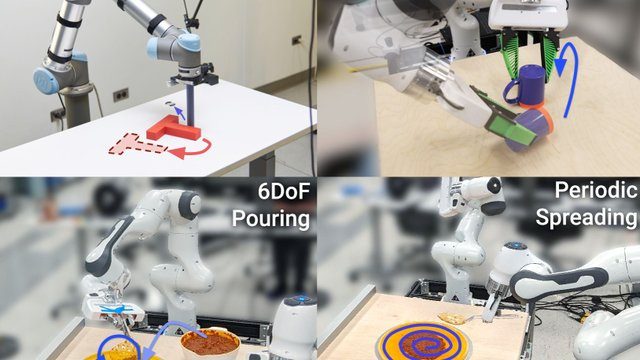
A behavior cloning approach that models robot policies as conditional diffusion processes, enabling multimodal action distributions and smooth action sequences.
Actuator Reality Shaping for Zero-Shot Sim-to-Real Robot Learning
Satoshi Yamamori, Koji Ishihara, Kentaro Minamikawa et al.
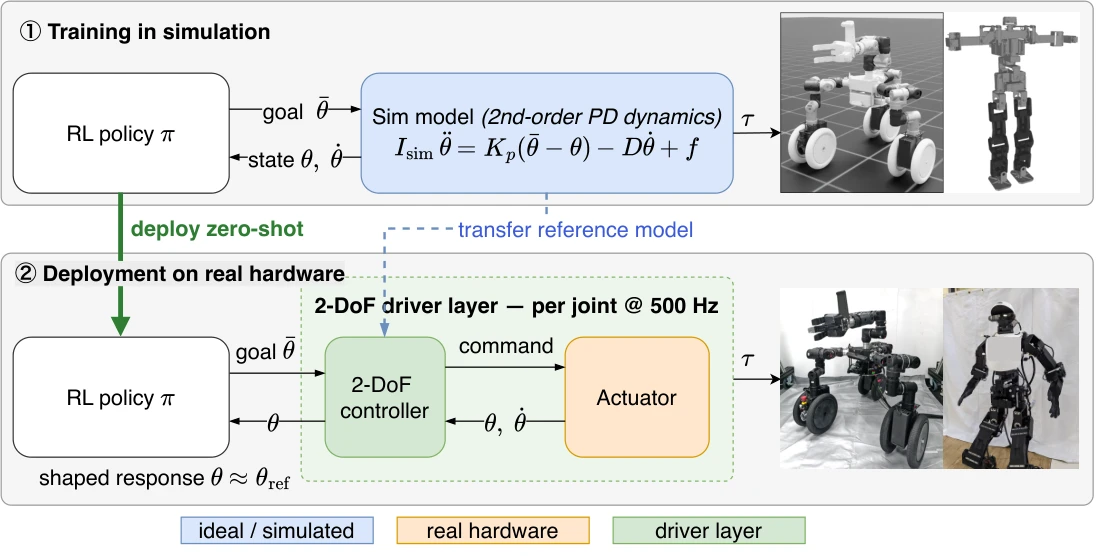
Instead of making simulation imitate every motor imperfection, this work shapes the physical actuator to follow the simulated reference.