
Reward-DAgger: Robot-Gated Interactive Imitation Learning with General-Purpose Progress-Based Reward Models
Ryan Li, Yigit Korkmaz, Erdem B{\i}y{\i}k · N/A · 2026
Framework
N/A
License
N/A
Stars
N/A
Summary
Recent advances in robot learning have enabled generalist control policies capable of completing a wide range of tasks. However, their performance degrades when deployed in unseen environments, making it critical to detect failures and teach recovery behaviors.
Abstract Summary
Key Points
- Recent advances in robot learning have enabled generalist control policies capable of completing a wide range of tasks.
- However, their performance degrades when deployed in unseen environments, making it critical to detect failures and teach recovery behaviors.
- Existing runtime monitoring methods often require task- and policy-specific training or hyperparameter tuning, limiting cross-task deployment and introducing additional overhead during iterative policy updates.
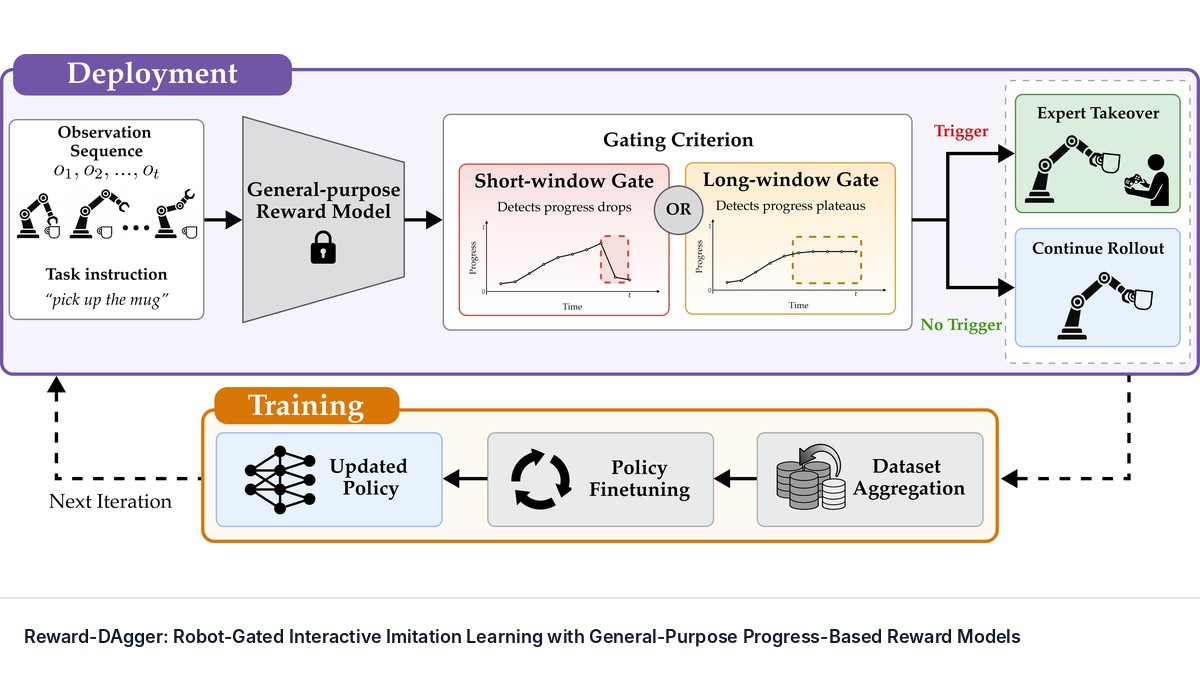
- We present Reward-DAgger, a robot-gated interactive imitation learning framework that uses dense progress signals from a general-purpose reward model to determine when human intervention is needed.
- Our approach is agnostic to the underlying policy architecture, requires no access to policy internals, and can be applied across tasks without retuning the gating mechanism.
Method
Reward-DAgger leverages dense progress signals obtained from general-purpose reward models to determine when a robot policy should transfer control to the expert. In this section, we first introduce how we construct a gating criterion from general-purpose reward models, and then discuss how we incorporate the criterion into an interactive imitation learning pipeline for fine-tuning the base policy.
A general-purpose reward model is typically constructed by prompting or fine-tuning a VLM to produce dense progress signals.
Experiments
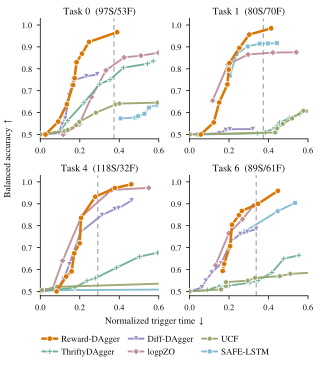
Our experiments evaluate the effectiveness of Reward-DAgger as a robot-gated interactive imitation learning framework across different tasks and policy architectures. Specifically, we seek to answer the following research questions: Does the gating mechanism of Reward-DAgger accurately detect failures with low detection latency?
Does the gating configuration of Reward-DAgger transfer across tasks without additional calibration? Does Reward-DAgger efficiently improve downstream policy performance while minimizing human burden? Baselines.
Sources and Demonstrations
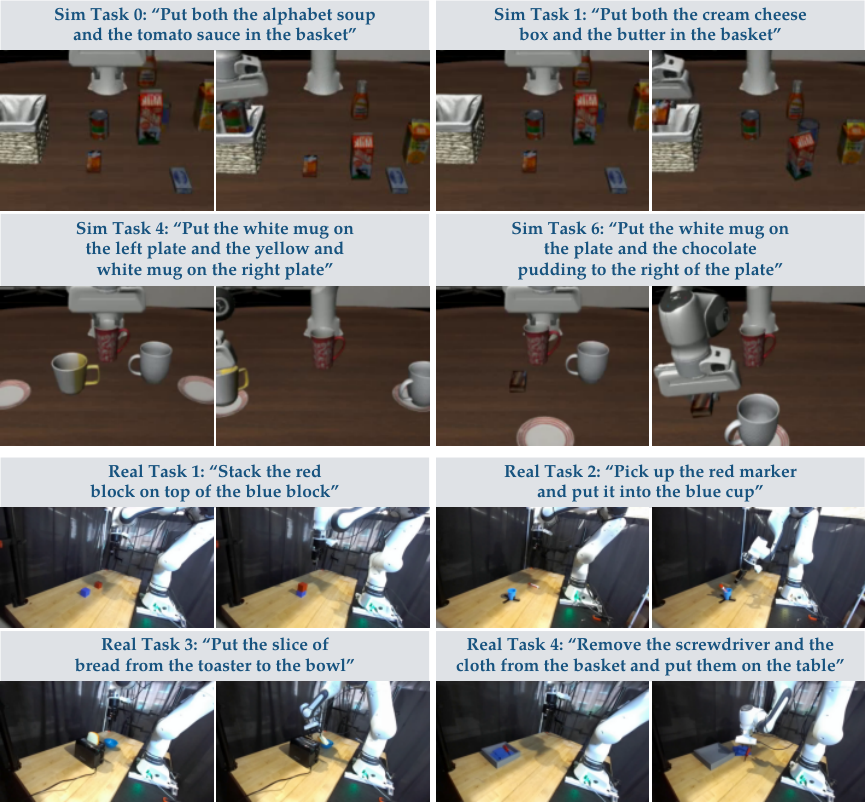
Figures are reproduced from Li et al. See the full paper for experimental details and the project page, when the paper links one, for demonstrations and videos.
Related Papers
A Low-Cost, Open Platform for End-to-End Autonomous Driving on a Miniature Ackermann Vehicle
Gustavo Claudio Karl Couto, Eric Aislan Antonelo, Gabriel George Zipperer
This paper presents a low-cost, open experimental platform for research in end-to-end autonomous driving with miniature Ackermann vehicles.

A Sim-to-Real Integration Pipeline for Training and Deployment of Chunk-Based VLA Manipulation Policies
Mathilde Kappel, Clémence Grislain, Mohamed Chetouani et al.
Vision-Language-Action (VLA) models have become a prominent paradigm for mapping multimodal inputs, including semantic instructions, visual observations of the scene, and proprioceptive observations, to robot actions.
Can People Distinguish Human and AI Agency in Humanoid Teleoperation? A Preliminary Study of Agency Perception
Xiang Li, Koya Dendo, Keigo Minamida et al.
Can people distinguish between human and AI agency in humanoid teleoperation?

Capability-Aware Arbitration for Semantic Intent-Based Shared Control
Zhaoda Du, Michael Bowman, Xiaoli Zhang
Shared control often allocates robot authority based on confidence in inferred human intent, assuming reliable autonomous execution. When this assumption fails, high intent confidence can cause over-helping.