
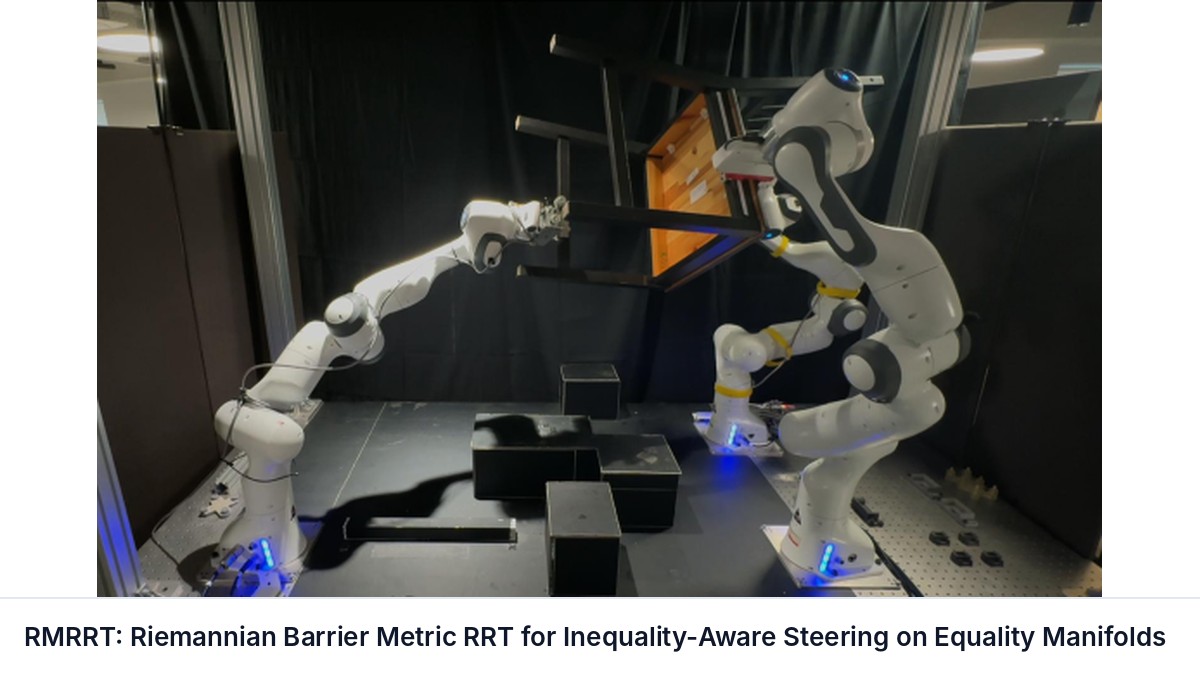
RMRRT: Riemannian Barrier Metric RRT for Inequality-Aware Steering on Equality Manifolds
Minhyeong Kang, Sanghyun Kim · N/A · 2026
Framework
N/A
License
N/A
Stars
N/A
Summary
This paper presents a motion planning framework that unifies equality and inequality constraints within a single geometric formulation for sampling-based planning in high-dimensional robotic systems.
Abstract Summary
Key Points
- This paper presents a motion planning framework that unifies equality and inequality constraints within a single geometric formulation for sampling-based planning in high-dimensional robotic systems.
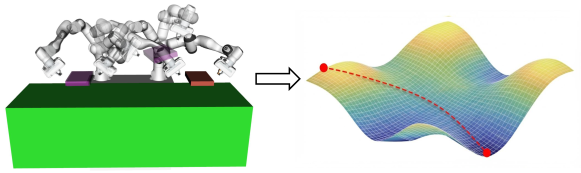
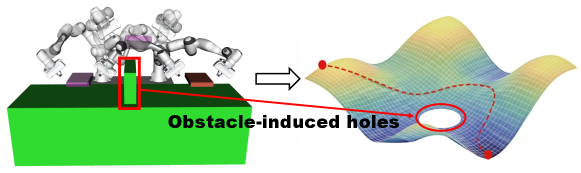
- In conventional sampling-based planners, equality constraints are typically enforced through projection, whereas inequality constraints are handled separately through binary validity checks such as collision testing, often leading to inefficient exploration.
- To address this limitation, we propose Riemannian Barrier Metric RRT (RMRRT), which constructs a unified local geometry for planning on equality-constrained manifolds.
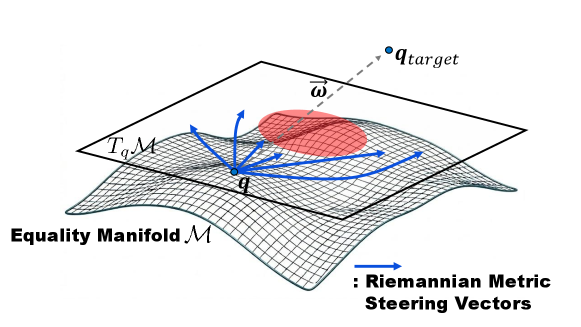
- RMRRT first builds an ambient barrier metric from inequality-sensitive barrier terms and then induces a tangent-space metric via a (G)-orthogonal projection associated with the equality constraints.
- The resulting tangent-space metric is used consistently in both steering and nearest-neighbor selection, biasing exploration away from nearby inequality boundaries while preserving first-order equality consistency.
Preliminaries
This section introduces the notation and geometric preliminaries used throughout the paper. Specifically, we formulate the motion planning problem under equality and inequality constraints, review equality-constrained manifolds and their tangent spaces, and summarize barrier-based representations of inequality constraints used in the metric construction of Section III . Notation.
Riemannian Barrier Metric RRT
In this section, we present Riemannian Barrier Metric RRT (RMRRT), a sampling-based planner that combines equality-manifold admissibility with inequality-aware local geometry. We first construct an ambient barrier metric and the induced tangent-space metric, and then show how the resulting geometry is used consistently in steering, nearest-neighbor selection, and manifold correction.
Experiments
This section evaluates RMRRT under coupled equality and inequality constraints in terms of reliability, efficiency, and practical applicability. Consistent with the scope clarified in Section III , the metric incorporates only distance- and proximity-based geometric inequalities, instantiated primarily from robot–obstacle proximity.
Other feasibility constraints, including joint limits, self-collision, and task-specific validity conditions, are enforced separately through standard state- and edge-validity checks.
Sources and Demonstrations
Figures are reproduced from Kang et al. See the full paper for experimental details and the project page, when the paper links one, for demonstrations and videos.
Related Papers
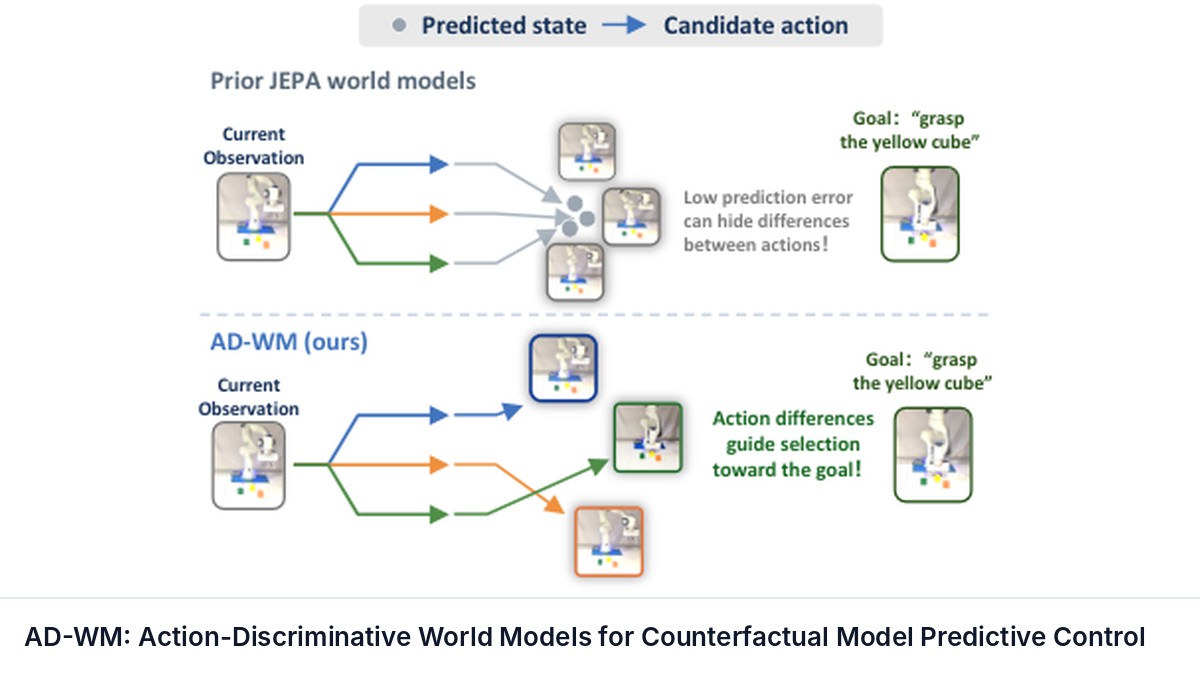
AD-WM: Action-Discriminative World Models for Counterfactual Model Predictive Control
Jiabin Qiu, Zixuan Chen, Hongye Cao et al.
Latent world models are typically trained to predict factual transitions, whereas model predictive control (MPC) must compare alternative actions from the same state. A model can therefore achieve low factual prediction error yet poorly distinguish candidate actions.
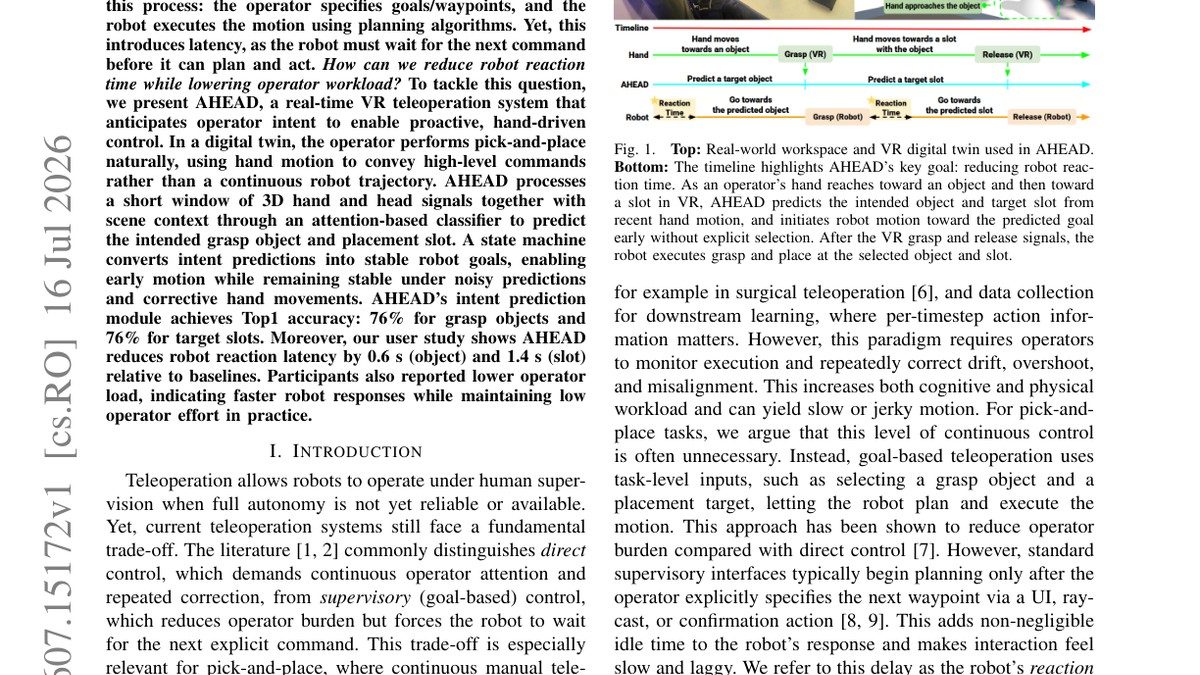
AHEAD: Anticipatory Hand-Driven Teleoperation via Human Intent Prediction
Seok Joon Kim, Junho Lee, Federica Spinola et al.
Direct hand-driven teleoperation maps an operator's hand motion to robot end-effector commands at every frame, enabling precise control, but it requires constant monitoring and correction during approach, grasp, and placement, which can be slow and fatiguing.
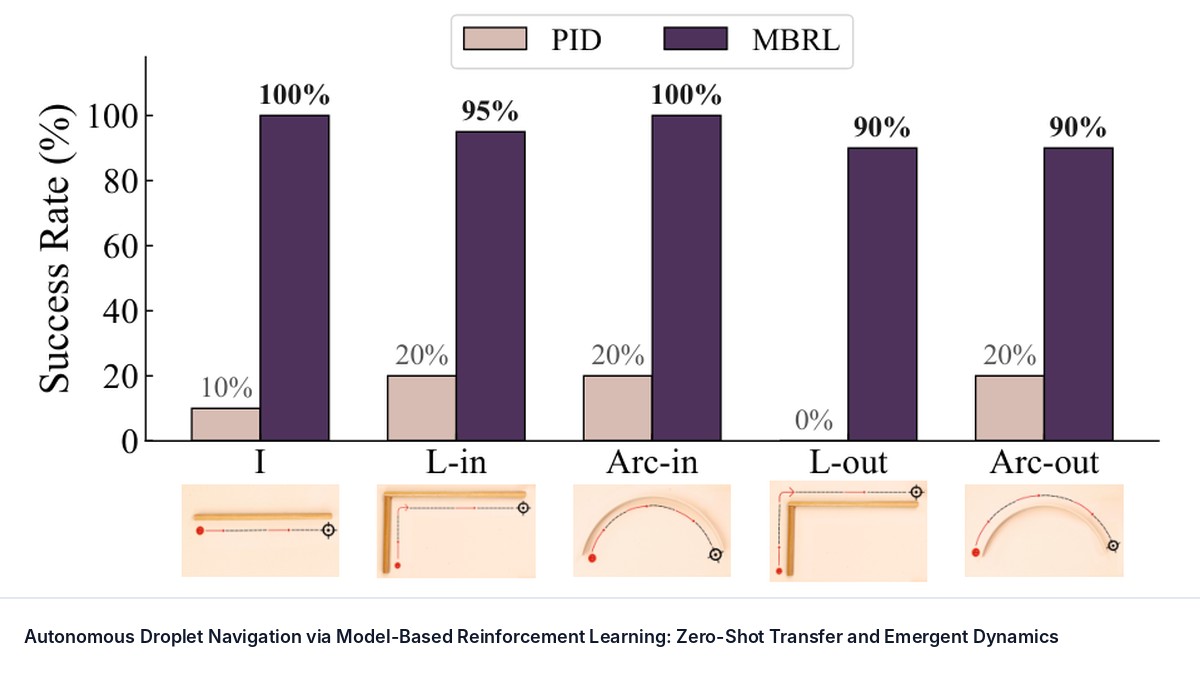
Autonomous Droplet Navigation via Model-Based Reinforcement Learning: Zero-Shot Transfer and Emergent Dynamics
Rajneesh Anand, Mayuresh V. Kothare
Self-driving laboratories (SDLs) are transforming chemical and materials discovery through closed-loop automation, yet automated infrastructure for physical manipulation of soft, deformable matter remains beyond current robotic platforms.
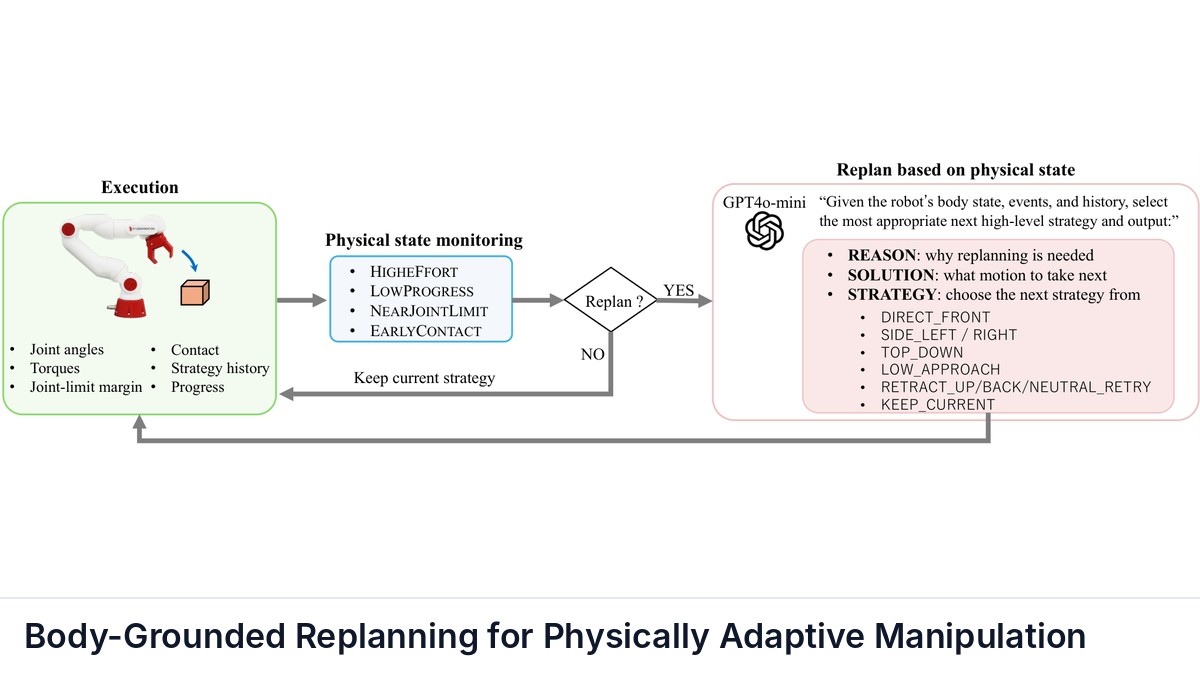
Body-Grounded Replanning for Physically Adaptive Manipulation
Namiko Saito, Hiroshi Kera
Manipulation requires not only reasoning about the external environment, but also about the robot's physical condition.