
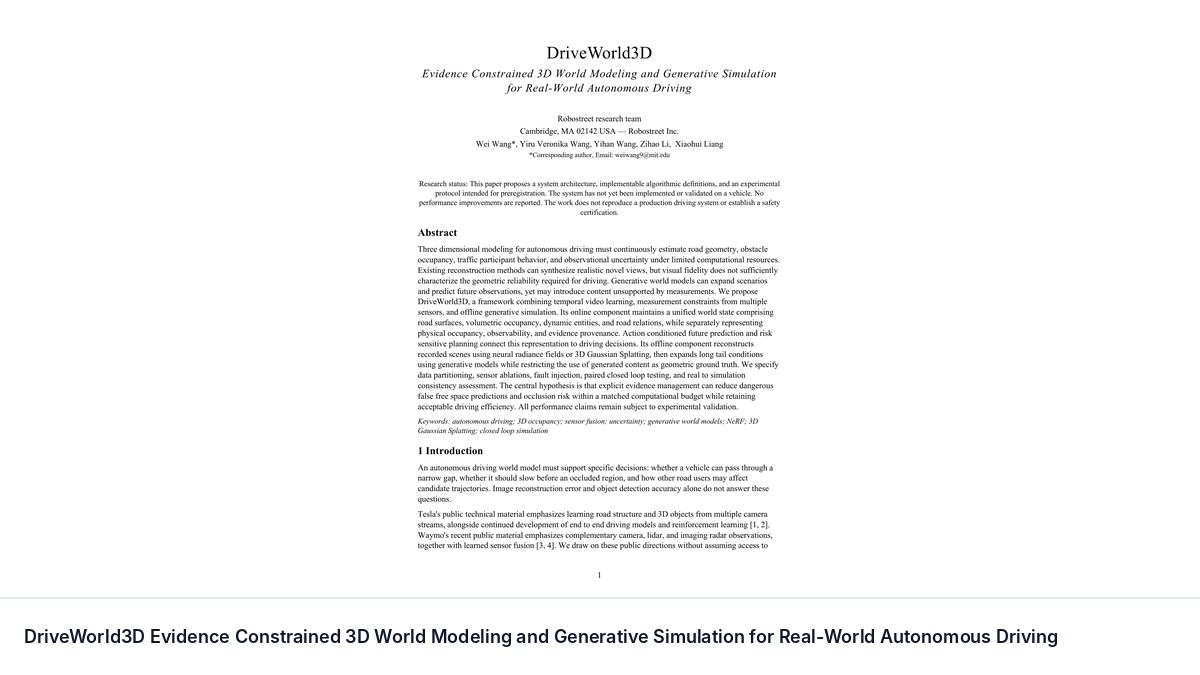
DriveWorld3D Evidence Constrained 3D World Modeling and Generative Simulation for Real-World Autonomous Driving
Wei Wang (Robostreet research team Cambridge, MA, USA), Yiru Veronika Wang (Robostreet research team Cambridge, MA, USA), Yihan Wang (Robostreet research team Cambridge, MA, USA), Zihao Li (Robostreet research team Cambridge, MA, USA), Xiaohui Liang (Robostreet research team Cambridge, MA, USA) · N/A · 2026
Framework
N/A
License
N/A
Stars
N/A
Summary
Three dimensional modeling for autonomous driving must continuously estimate road geometry, obstacle occupancy, traffic participant behavior, and observational uncertainty under limited computational resources.
Abstract Summary
Key Points
- Three dimensional modeling for autonomous driving must continuously estimate road geometry, obstacle occupancy, traffic participant behavior, and observational uncertainty under limited computational resources.
- Existing reconstruction methods can synthesize realistic novel views, but visual fidelity does not sufficiently characterize the geometric reliability required for driving.
- Generative world models can expand scenarios and predict future observations, yet may introduce content unsupported by measurements.
- We propose DriveWorld3D, a framework combining temporal video learning, measurement constraints from multiple sensors, and offline generative simulation.
- Its online component maintains a unified world state comprising road surfaces, volumetric occupancy, dynamic entities, and road relations, while separately representing physical occupancy, observability, and evidence provenance.
DriveWorld3D Evidence Constrained 3D World Modeling and Generative Simulation for Real-World Autonomous Driving
|Authors: Wei Wang (Robostreet research team Cambridge, MA, USA), Yiru Veronika Wang (Robostreet research team Cambridge, MA, USA), Yihan Wang (Robostreet research team Cambridge, MA, USA), Zihao Li (Robostreet research team Cambridge, MA, USA), Xiaohui Liang (Robostreet research team Cambridge, MA, USA)
|Venue: arXiv preprint | Year: 2026
|arXiv: 2610.22450
Abstract
Three dimensional modeling for autonomous driving must continuously estimate road geometry, obstacle occupancy, traffic participant behavior, and observational uncertainty under limited computational resources. Existing reconstruction methods can synthesize realistic novel views, but visual fidelity does not sufficiently characterize the geometric reliability required for driving. Generative world models can expand scenarios and predict future observations, yet may introduce content unsupported by measurements. We propose DriveWorld3D, a framework combining temporal video learning, measurement constraints from multiple sensors, and offline generative simulation. Its online component maintains a unified world state comprising road surfaces, volumetric occupancy, dynamic entities, and road relations, while separately representing physical occupancy, observability, and evidence provenance. Action conditioned future prediction and risk sensitive planning connect this representation to driving decisions. Its offline component reconstructs recorded scenes using neural radiance fields or 3D Gaussian Splatting, then expands long tail conditions using generative models while restricting the use of generated content as geometric ground truth. We specify data partitioning, sensor ablations, fault injection, paired closed loop testing, and real to simulation consistency assessment. The central hypothesis is that explicit evidence management can reduce dangerous false free space predictions and occlusion risk within a matched computational budget while retaining acceptable driving efficiency. All performance claims remain subject to experimental validation. Keywords: autonomous driving; 3D occupancy; sensor fusion; uncertainty; generative world models; NeRF; 3D Gaussian Splatting; closed loop simulation
Key Contributions
- Three dimensional modeling for autonomous driving must continuously estimate road geometry, obsta…
- Existing reconstruction methods can synthesize realistic novel views, but visual fidelity does no…
- Generative world models can expand scenarios and predict future observations, yet may introduce c…
- We propose DriveWorld3D, a framework combining temporal video learning, measurement constraints f…
- Its online component maintains a unified world state comprising road surfaces, volumetric occupan…
Topics
- vision
- reinforcement-learning
- planning
Code & Data
No code repository linked in paper metadata.
BibTeX
@article{Cambridge2026_261022450,
  title     = {DriveWorld3D Evidence Constrained 3D World Modeling and Generative Simulation for Real-World Autonomous Driving},
  author    = {Wei Wang (Robostreet research team Cambridge and MA and USA) and Yiru Veronika Wang (Robostreet research team Cambridge and MA and USA) and Yihan Wang (Robostreet research team Cambridge and MA and USA) and Zihao Li (Robostreet research team Cambridge and MA and USA) and Xiaohui Liang (Robostreet research team Cambridge and MA and USA)},
  year      = {2026},
  eprint    = {2610.22450},
  archivePrefix = {arXiv},
  primaryClass  = {cs.RO},
  url       = {https://arxiv.org/abs/2610.22450}
}
Related Papers
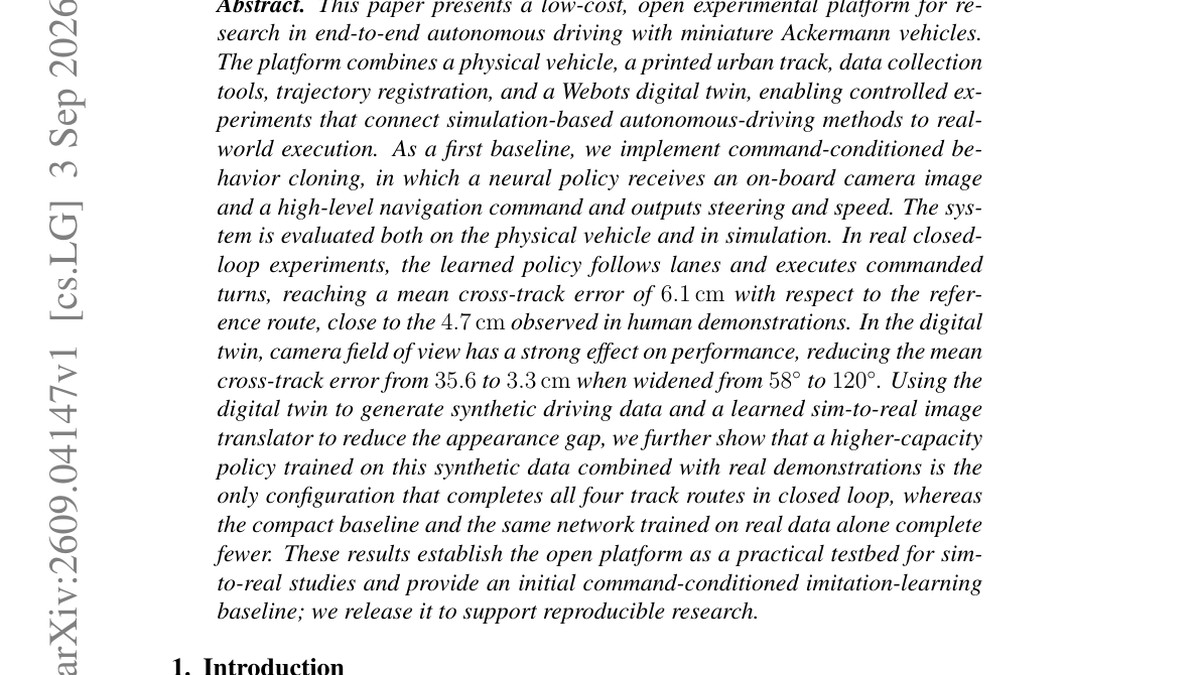
A Low-Cost, Open Platform for End-to-End Autonomous Driving on a Miniature Ackermann Vehicle
Gustavo Claudio Karl Couto, Eric Aislan Antonelo, Gabriel George Zipperer
This paper presents a low-cost, open experimental platform for research in end-to-end autonomous driving with miniature Ackermann vehicles.
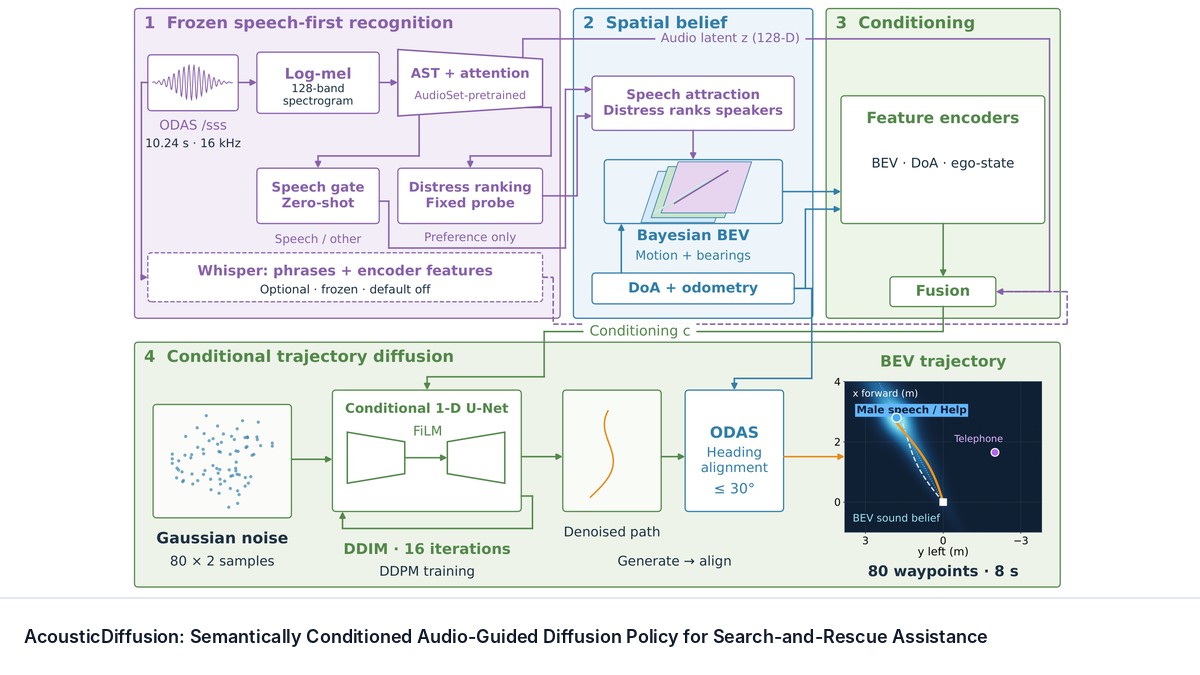
AcousticDiffusion: Semantically Conditioned Audio-Guided Diffusion Policy for Search-and-Rescue Assistance
Iana Zhura, Didar Seyidov, Dmitrii Plotnikov et al.
Navigating toward human callers is an important capability for rescue robots operating where visual contact is degraded or occluded. We present AcousticDiffusion, a semantically conditioned, audio-guided diffusion policy for human-directed navigation.
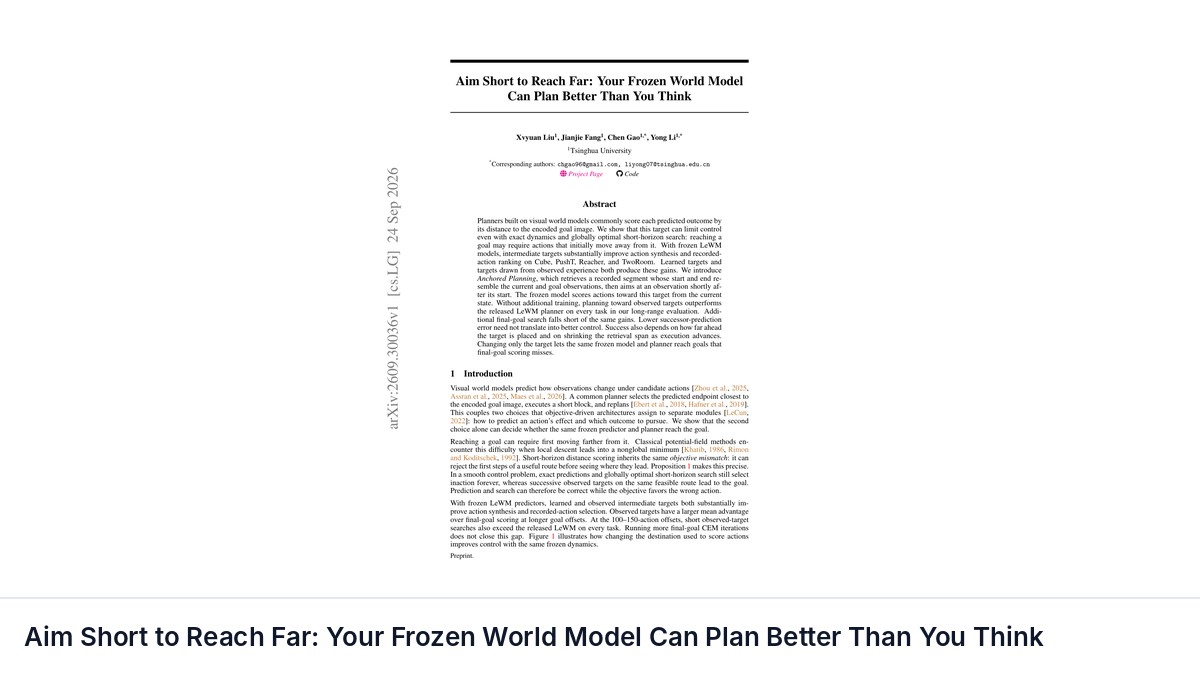
Aim Short to Reach Far: Your Frozen World Model Can Plan Better Than You Think
Xvyuan Liu, Jianjie Fang, Chen Gao et al.
Planners built on visual world models commonly score each predicted outcome by its distance to the encoded goal image. We show that this target can limit control even with exact dynamics and globally optimal short-horizon search: reaching a goal may require actions that initially move away from it.
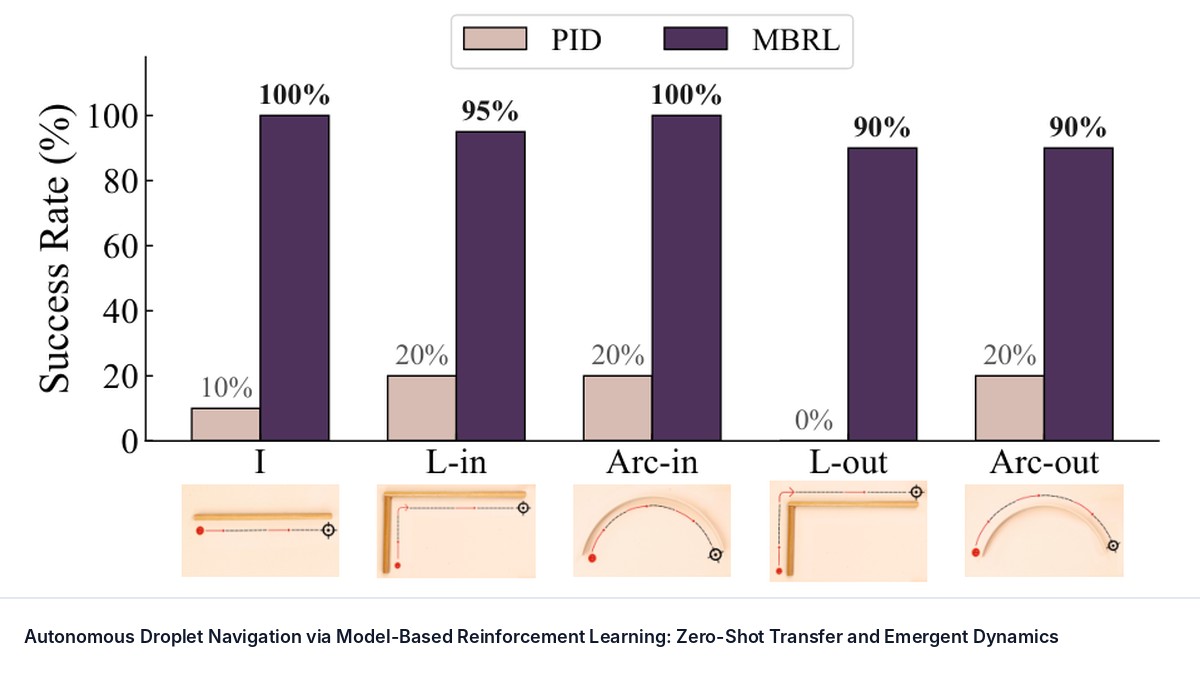
Autonomous Droplet Navigation via Model-Based Reinforcement Learning: Zero-Shot Transfer and Emergent Dynamics
Rajneesh Anand, Mayuresh V. Kothare
Self-driving laboratories (SDLs) are transforming chemical and materials discovery through closed-loop automation, yet automated infrastructure for physical manipulation of soft, deformable matter remains beyond current robotic platforms.