
BLT*: Informed Belief Localization Trees for Uncertainty-Aware Planning on Digital Twins
Elliot Preston-Krebs, Abhishek Goudar, Timothy D. Barfoot · N/A · 2026
Framework
N/A
License
N/A
Stars
N/A
Summary
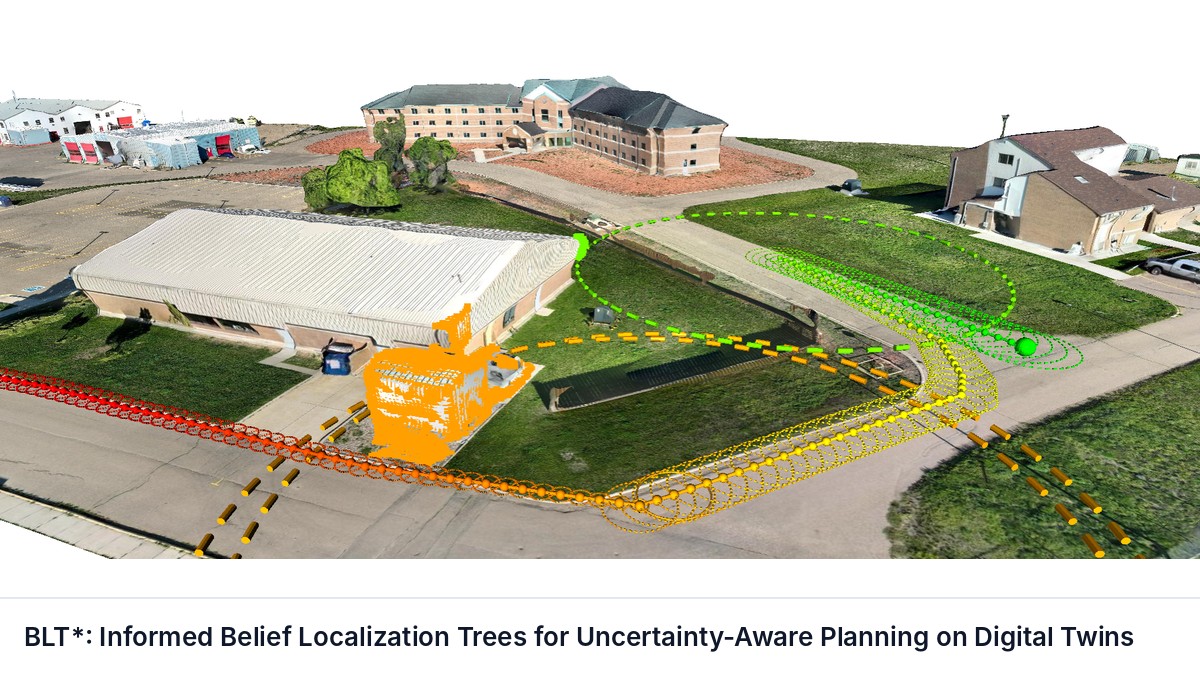
We present Informed Belief Localization Trees* (Informed BLT*), a sampling-based belief space planning (BSP) algorithm that scales to large outdoor digital twins with point-cloud observations. We adapt RRT* and Informed RRT* to belief space using the $2$-Wasserstein ($W_2$) metric.
Abstract Summary
Key Points
- We present Informed Belief Localization Trees* (Informed BLT*), a sampling-based belief space planning (BSP) algorithm that scales to large outdoor digital twins with point-cloud observations.
- We adapt RRT* and Informed RRT* to belief space using the $2$-Wasserstein ($W_2$) metric
- Assuming isotropic Gaussian beliefs, sampled belief states can be connected efficiently while accounting for available information and probabilistic collision constraints.
- This enables steering and rewiring without repeatedly propagating observations, and allows previously computed measurement information to be reused.
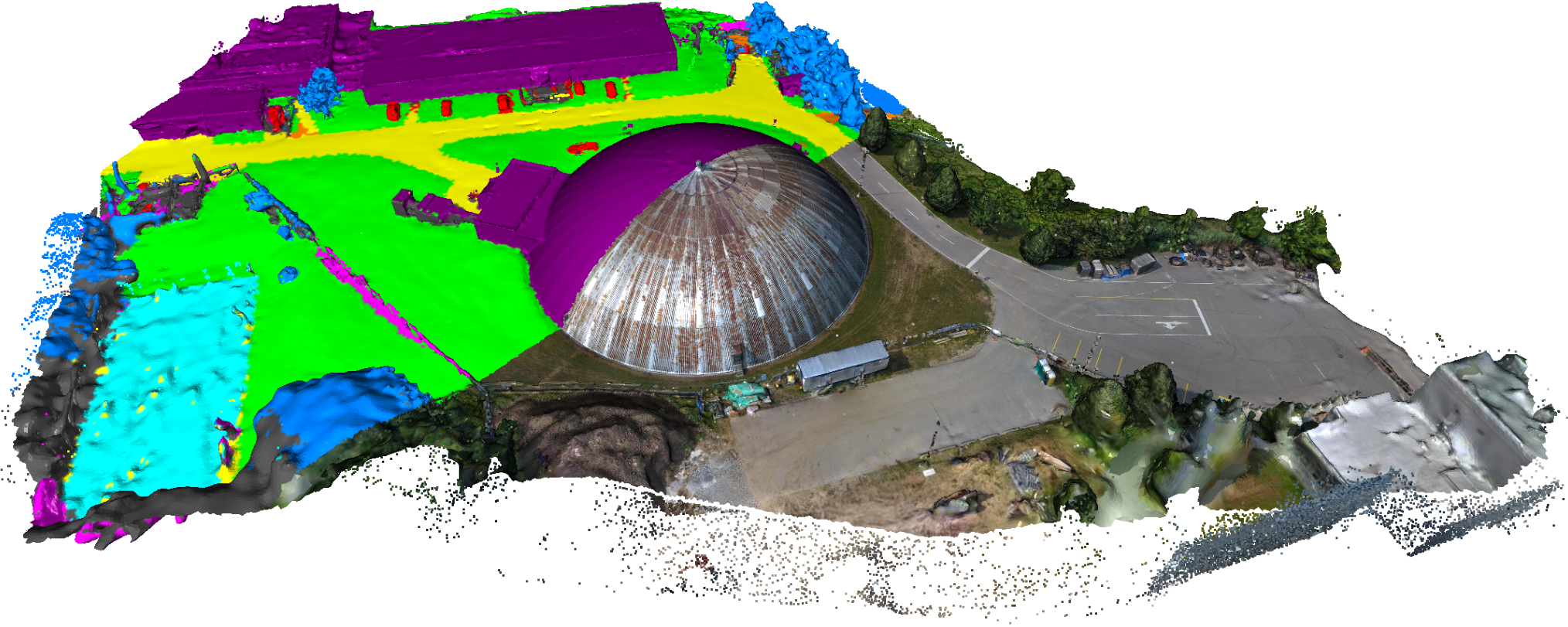
- We present a framework to generate semantically labelled digital twins for planning in real-world environments with point-cloud-based localization.
Preliminaries
We use bold lowercase letters to denote vectors, e.g., $\mathbf{x}\in\mathbb{R}^{d}$, and bold uppercase letters for matrices, e.g., $\mathbf{A}\in\mathbb{R}^{d\times d}$. The space of $d\times d$ positive semidefinite matrices is denoted $\mathbb{S}^{d}_{+}$.
We denote the configuration space by $X\subseteq\mathbb{R}^{d}$; the obstacle space by $X_{\text{obs}}\subset X$; and the free space by $X_{\text{free}}=\operatorname{cl}(X\setminus X_{\text{obs}})$, where $\operatorname{cl}(\cdot)$ denotes closure.
Problem Formulation
Consider the state space $X$, the belief space $\mathcal{B}^{d}$, the obstacle space $X_{\mathrm{obs}}$, and the goal region $X_{\mathrm{goal}}$ as defined in Section III . Let $P_{\mathrm{inter}}\in(0,1)$ denote a prescribed probability threshold for goal attainment and collision avoidance.
Methodology
In this section, we outline the evolution of belief states under our motion and observation models. We use the Kalman filter notation from [ 20 ] , where $\check{(\cdot)}$ and $\hat{(\cdot)}$ denote prior and posterior quantities, respectively.
The prediction step under the motion model ( 5 ) is Assuming the maximum-likelihood observation, the innovation is zero and the correction step is expressed in information form as where $\bm{\Omega}_{k}=\mathbf{R}_{k}^{-1}$ is the information matrix in ( 6 ).
Validation
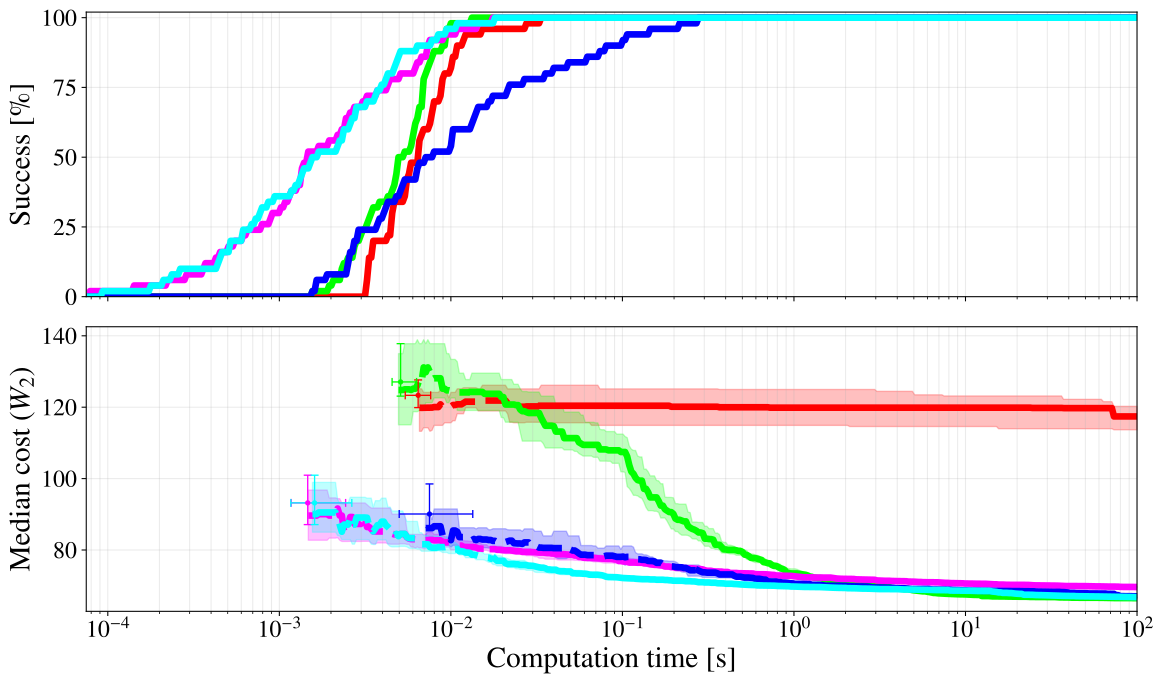
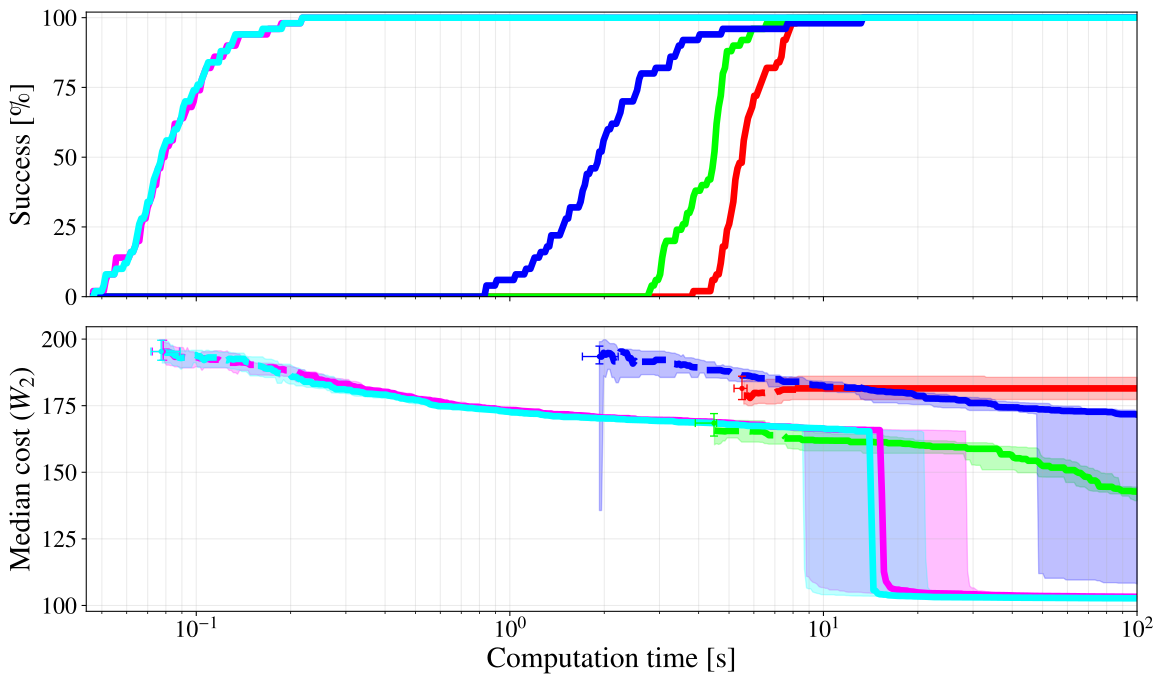
For each map from the previous section, we conducted 50 trials using pseudorandom seeds, with the same seed used across all five planners in each trial. Each planner was run for $100\,\mathrm{s}$ under the $\ell_{2}$ and $W_{2}$ objectives separately. The objective value was sampled every $1\,\mathrm{ms}$ by a separate monitoring thread, and the time to the first solution was recorded with sub-millisecond resolution.
Sources and Demonstrations
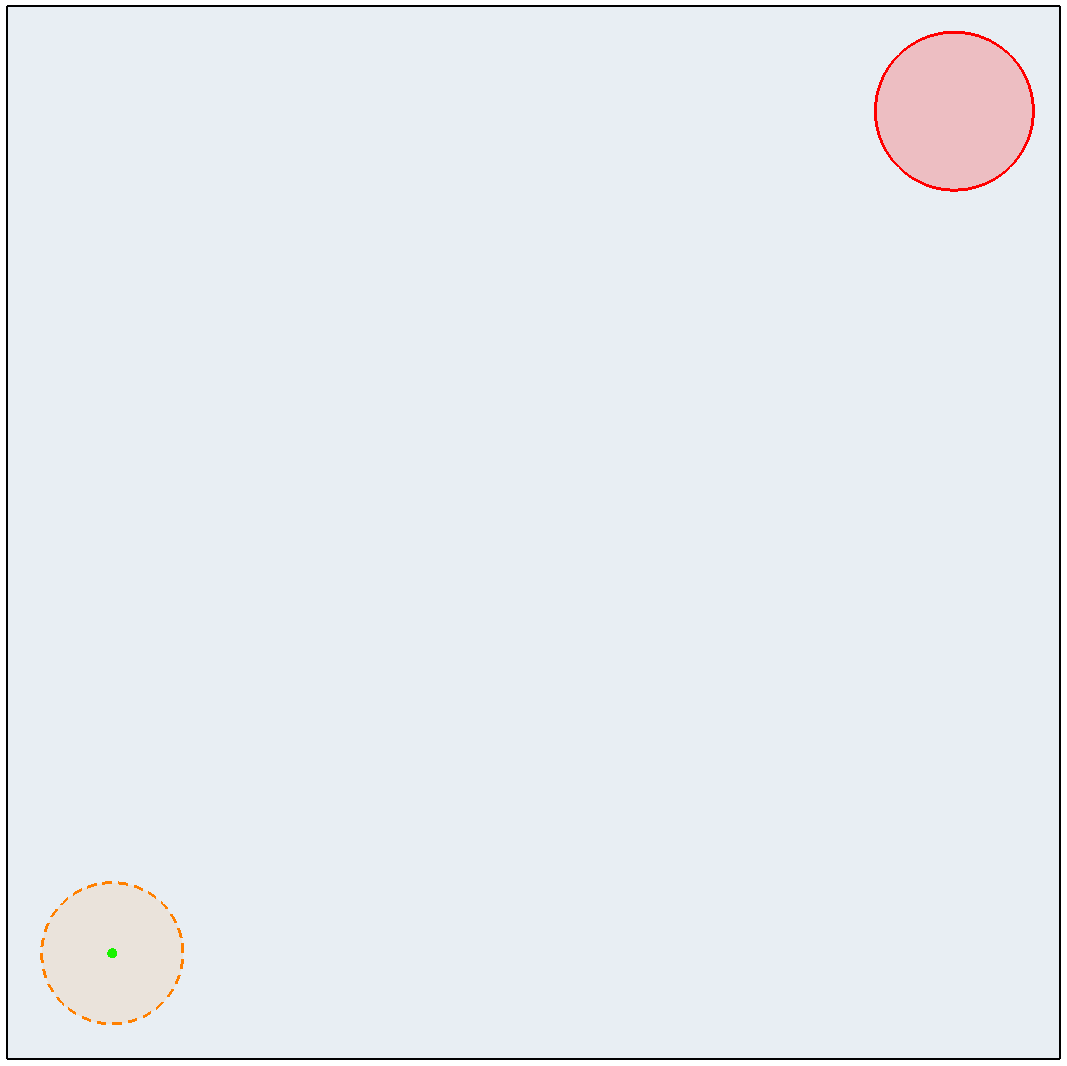
Figures are reproduced from Preston-Krebs et al. See the full paper for experimental details and the project page, when the paper links one, for demonstrations and videos.
Related Papers
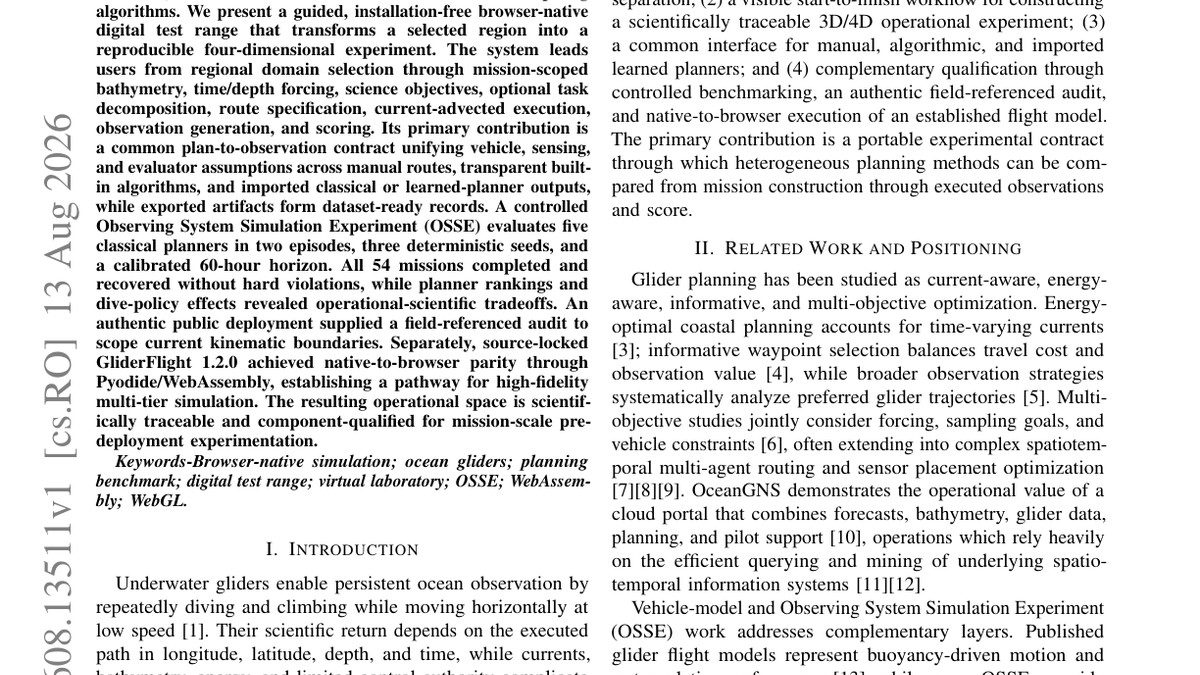
A Browser-Native Digital Test Range for Benchmarking 4D Ocean-Glider Planning Algorithms
Edward Holmberg, Elias Ioup, Mahdi Abdelguerfi
Repeated in-situ evaluation of ocean-glider planners requires scarce vehicles, operators, deployment and recovery resources, and ocean conditions that cannot be reset for competing algorithms.
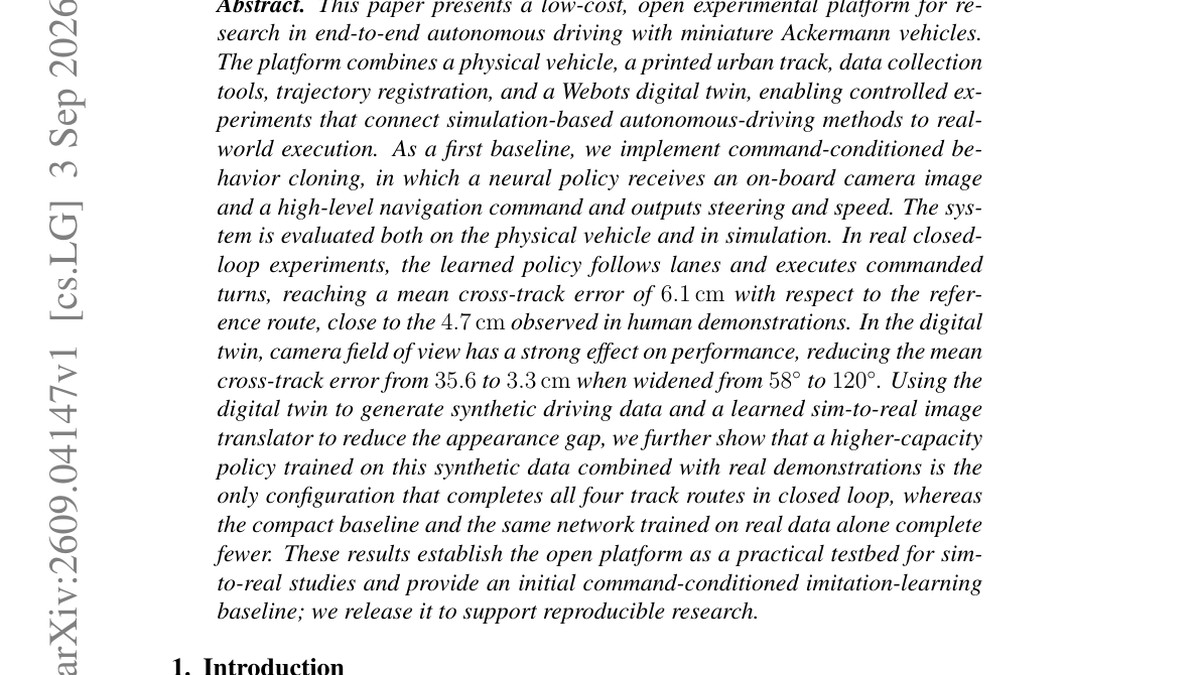
A Low-Cost, Open Platform for End-to-End Autonomous Driving on a Miniature Ackermann Vehicle
Gustavo Claudio Karl Couto, Eric Aislan Antonelo, Gabriel George Zipperer
This paper presents a low-cost, open experimental platform for research in end-to-end autonomous driving with miniature Ackermann vehicles.
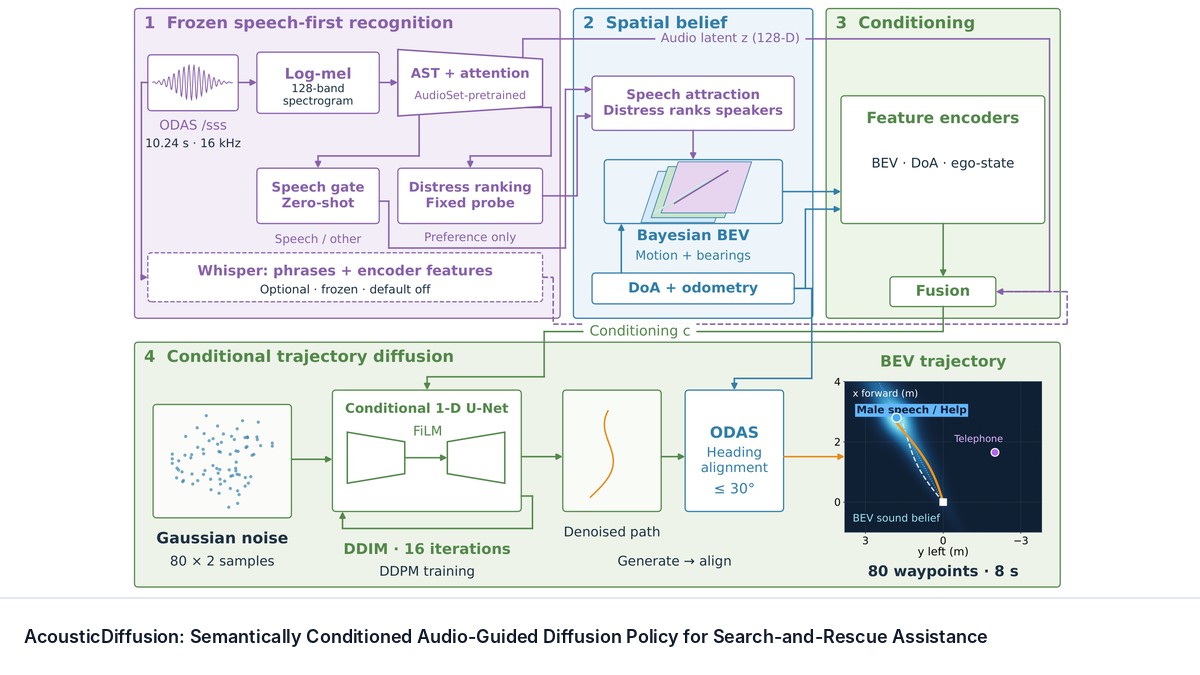
AcousticDiffusion: Semantically Conditioned Audio-Guided Diffusion Policy for Search-and-Rescue Assistance
Iana Zhura, Didar Seyidov, Dmitrii Plotnikov et al.
Navigating toward human callers is an important capability for rescue robots operating where visual contact is degraded or occluded. We present AcousticDiffusion, a semantically conditioned, audio-guided diffusion policy for human-directed navigation.
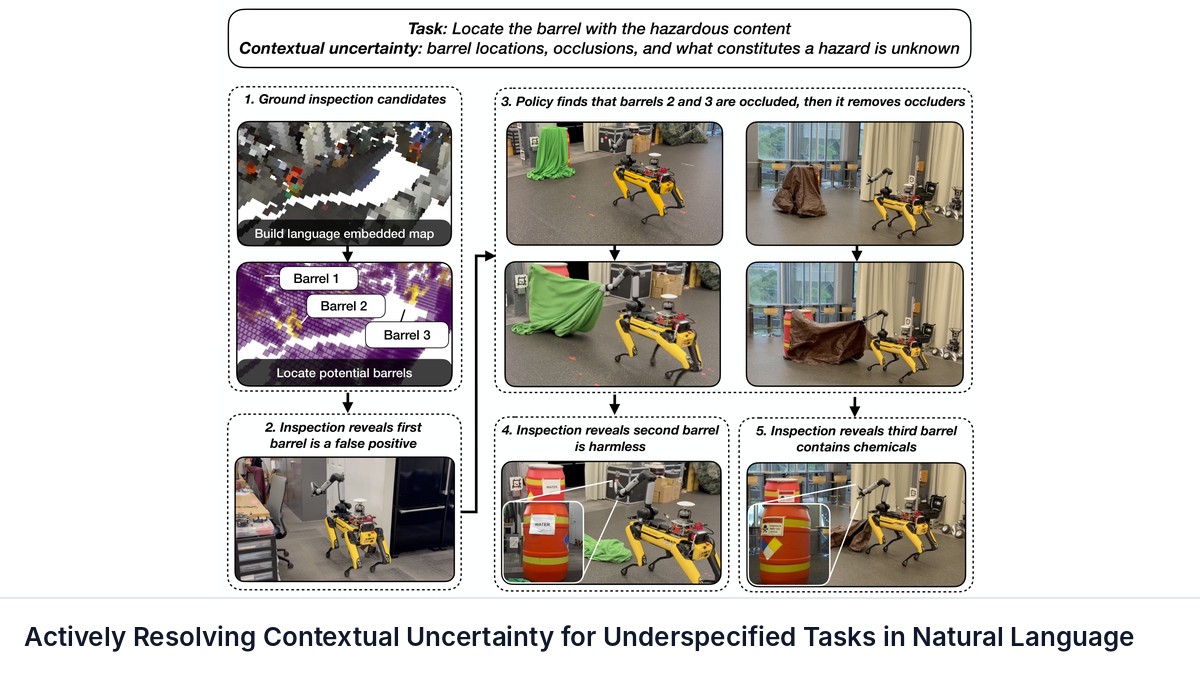
Actively Resolving Contextual Uncertainty for Underspecified Tasks in Natural Language
Zachary Ravichandran, Jonathan Diller, Fernando Cladera et al.
Foundation models provide robots with the ability to interpret natural language and reason about environmental context, yet most language-conditioned policies assume that goals are well-specified and that task-relevant information is provided upfront via a prior map.