
At a glance
- Problem: most labeling systems cover only one annotation type, and general-purpose frontier models are expensive at robot-dataset scale. Source
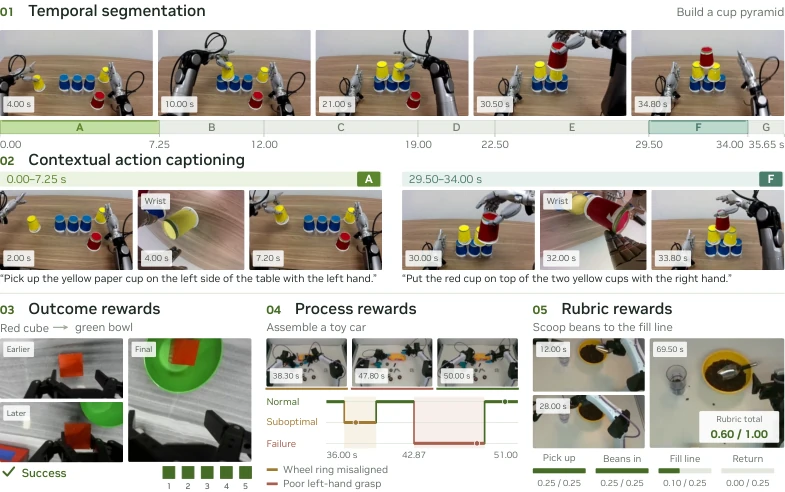
- Idea: stitch overlapping segmentation windows into event intervals, caption each interval with neighboring context, and use one reward model for dense, outcome or rubric labels. Source
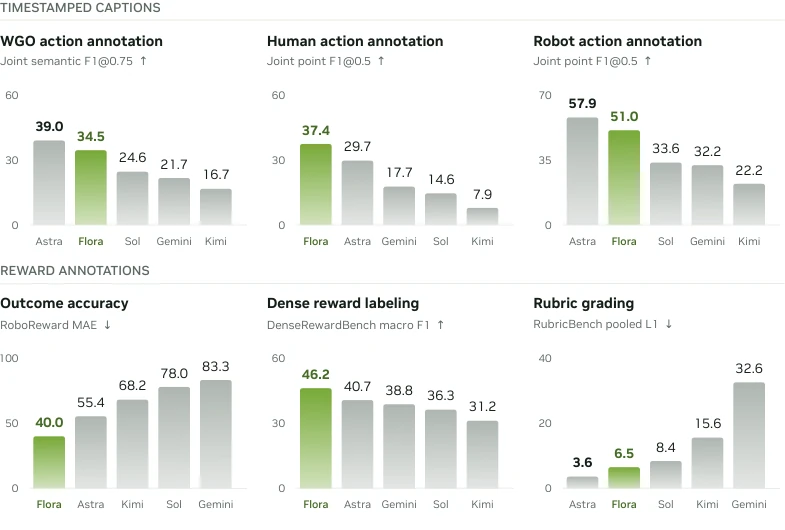
- Evidence: on RoboRewardBench the reward model's outcome error (MAE, multiplied by 100) is 40.0, versus 55.4 for GPT-6 Astra and 66.5 for the specialized RoboReward model. Source
Evaluation scope Reward results combine two public and two internal benchmarks; numbers for specialized reward models are taken from their own publications under their original protocols. Source
How it works
- The segmentation model predicts window-relative start and end times with continuation flags; fragments are converted to episode time and joined using temporal overlap and those flags. Source
- The captioning model writes one imperative instruction per interval from the target frames plus labeled before and after context, and failed attempts keep their intended goal without implying success. Source
- Flora-Rewarder labels each 0.5-second step as failure, suboptimal or normal, and the labels are retrospective: a later recovery does not improve an earlier step. Source
- The segmenter is fine-tuned from Qwen3.5-9B with LoRA and a frozen visual encoder, while the captioner and reward model start from Qwen3.5-27B. Source
- The supervised segmenter is further trained with GRPO using a verifiable reward built from temporal F1, precision and endpoint accuracy. Source
Evidence & results
- On DenseRewardBench (40 held-out bimanual episodes) Flora-Rewarder recalls 53.3% of failure steps while no baseline exceeds 11.7%, but it also labels about 11% of normal steps as failures. Evidence
- On the authors' DenseCaptionBench, Flora leads all three metrics on Human100 (37.4% joint F1) but ranks second to GPT-6 Astra on Robot200 (51.0% versus 57.9% joint F1). Evidence
- On WGO-Bench pipelines, Flora improves mean segmentation F1 by 16.9 points and joint F1 by 7.3 points over Refiner, with similar caption accuracy (64.7% vs. 64.3%). Evidence
Limitations & boundaries
- On the in-house rubric benchmark GPT-6 Astra is more accurate, with a pooled L1 of 3.6 versus Flora-Rewarder's 6.5; the authors call these system-level comparisons. Source
- Caption scores are judged by GPT-6 Astra, which is also an evaluated system, so the authors flag generator–judge self-preference as a limitation. Source
- Dense labels use later frames as evidence, so the authors intend these retrospective annotations for offline labeling. Source
Takeaway
Our reading: Flora's strongest case is labeling cost, since on a 50-episode subset it scores 57.1% quality versus 53.7% for GPT-6 Astra at an estimated $0.72 rather than $88.49 per hour of video, an estimate based on the authors' own GPU deployment assumptions. Source
Resources
Figures: the paper's authors. Editorial source and image review: 2026-10-26. Findings are author-reported, not independently reproduced by Robotics Research Hub.
Original abstract
The life-cycle of robotics foundation models crucially depends on data labels. Outcome reward labels are needed for monitoring real-world deployments. Process reward labels are needed during RL post-training. Timestamped captions are needed for filtering and balancing pretraining data. We present Flora, an industrial-quality data engine used for training GR00T models, that simultaneously covers these capabilities. Flora achieves SOTA scores on the captioning benchmark WGO-Bench and reward benchmarks RoboReward and Robometer. On internal benchmarks it is competitive with GPT-6 Astra while beating other frontier models. The model is substantially cheaper than API-based alternatives, roughly 125 times cheaper than GPT-6 Astra. Florais battle tested at scale, labeling 200,000 hours of data per day across 512 GB300s. By open-sourcing our data engine, we enable researchers to scale custom robotics datasets and explore emerging applications such as physical auto-research and human-to-robot transfer.
Citation
@article{Leng2026_261031779,
  title     = {FLORA: An Open Model Suite for Scaling Robotics Data Engines},
  author    = {Sicong Leng and Yunze Man and Zhiqi Li and Jing Wang and Yuhe Zhang and Ryan Punamiya and Siddharth Patki and Kaiyuan Zheng and Zi-ang Cao and Zhiding Yu and Sifei Liu and Danfei Xu and Ben Levin and Jan Kautz and Yuke Zhu and Johan Bjorck and Linxi "Jim" Fan},
  year      = {2026},
  eprint    = {2610.31779},
  archivePrefix = {arXiv},
  primaryClass  = {cs.RO},
  url       = {https://arxiv.org/abs/2610.31779}
}