
DGT-Map: Directional Global Traversability Mapping Utilizing Multi-Task Learning for Heterogeneous Vehicles
Jaskrit Singh, Kashif K. Noori, Jing Xiao, Constantinos Chamzas · N/A · 2026
Framework
N/A
License
N/A
Stars
N/A
Summary
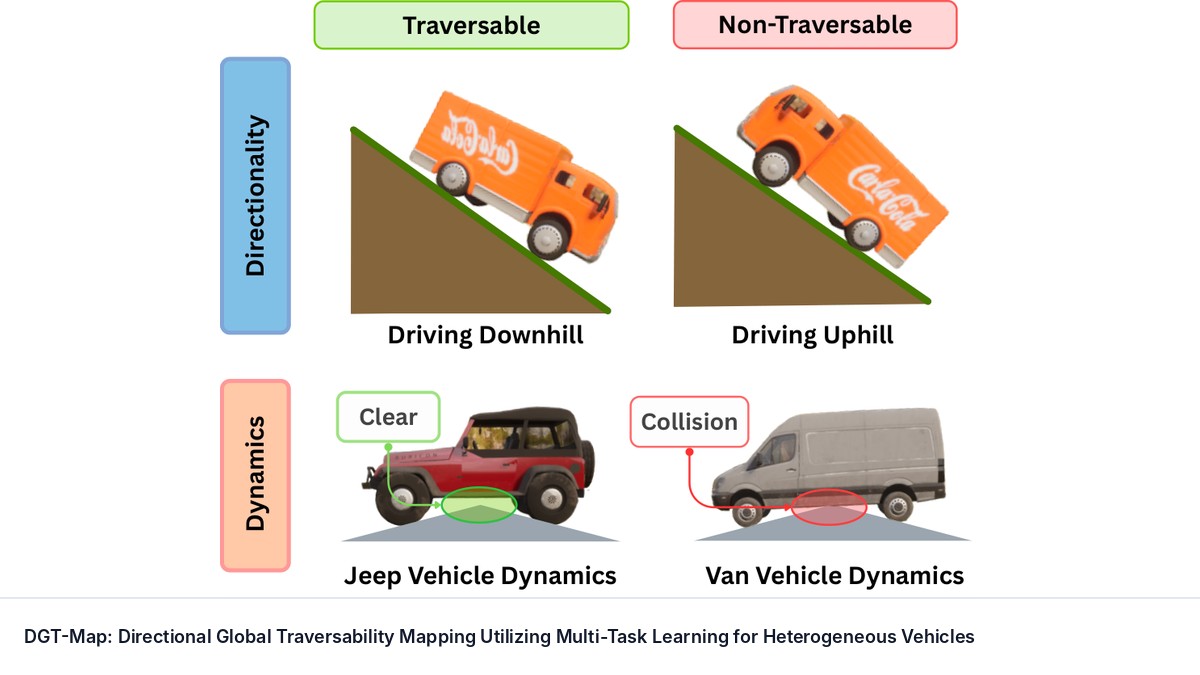
Off-road traversability is direction-dependent and vehicle specific, yet most global maps assign a single isotropic cost to each location.
Abstract Summary
Key Points
- Off-road traversability is direction-dependent and vehicle specific, yet most global maps assign a single isotropic cost to each location.
- Existing learned estimators are also commonly trained independently for each vehicle; this preserves vehicle-specific behavior but prevents vehicles from sharing common terrain representations.
- DGT-MAP addresses both limitations through a self-supervised framework that learns global, directional, and vehicle-conditioned traversability costmaps from RGB-D observations and locomotion signals.
- A shared multi-task backbone learns common terrain features across training vehicles while vehicle-specific prediction heads preserve platform-dependent responses.
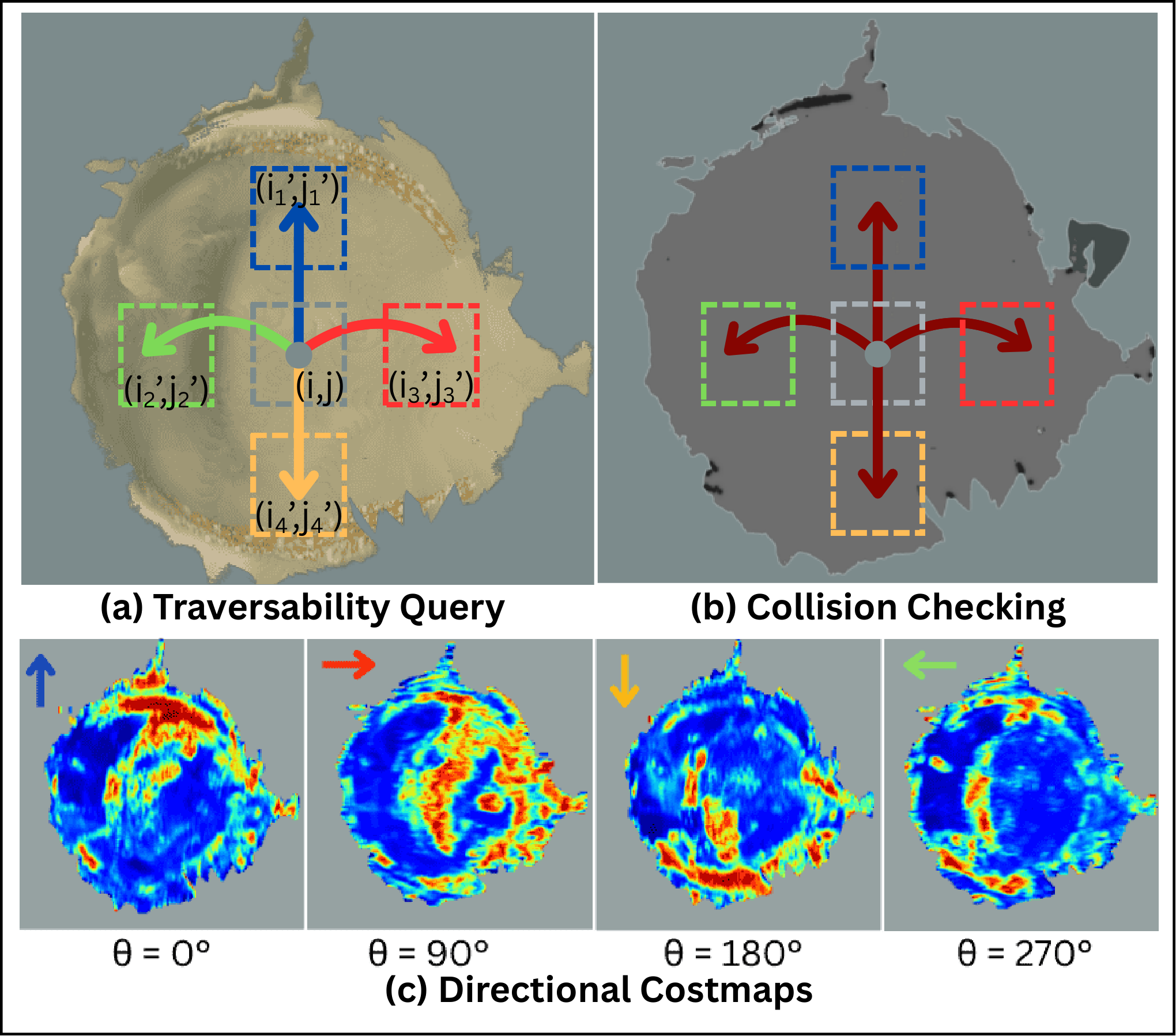
- At inference, DGT-MAP produces a heading-indexed costmap that can be used by a direction-aware planner.
Problem Statement
We consider the problem of learning a global, directional, vehicle-conditioned traversability map for off-road navigation using self-supervised data. Given $N$ vehicles equipped with RGB-D cameras and IMUs operating in an unknown off-road environment, our goal is to estimate terrain-induced traversal cost as a function of spatial location, direction of travel, and vehicle platform.
Methodology
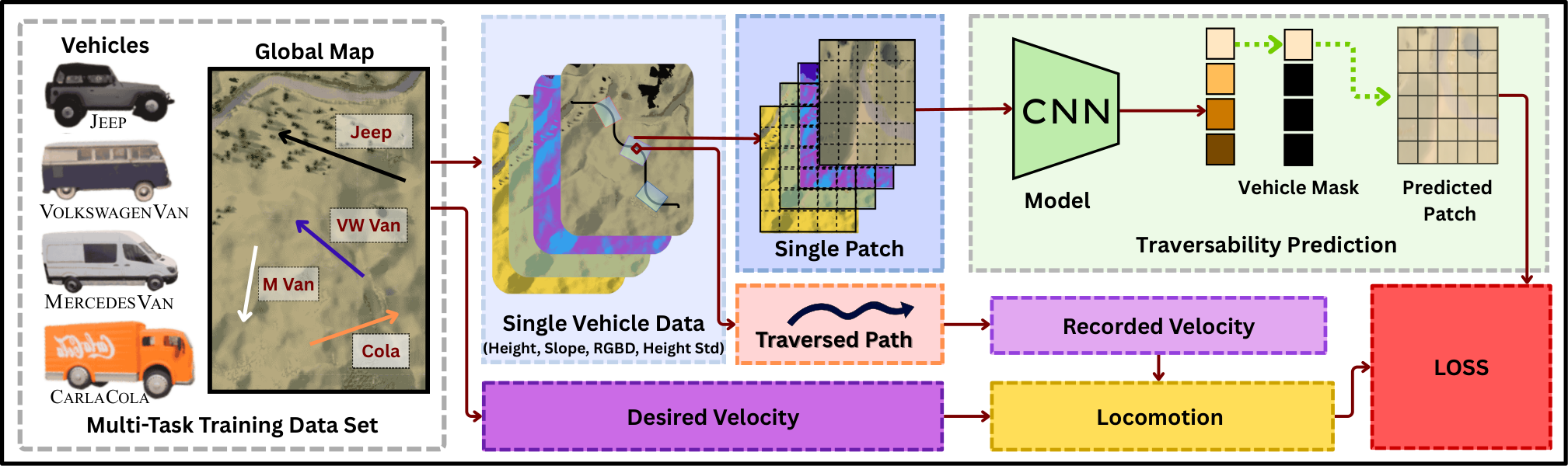
Our approach learns the traversability function defined in Sec. III through self-supervision: rather than manually labeling terrain, we use the discrepancy between commanded and actual vehicle motion as a natural measure of traversal difficulty ( Sec. IV-A ).
We then use a multi-task CNN with a shared terrain backbone and vehicle-specific prediction heads, allowing terrain features to be shared across vehicles while preserving vehicle-dependent responses ( Sec. IV-B ).
Experiments
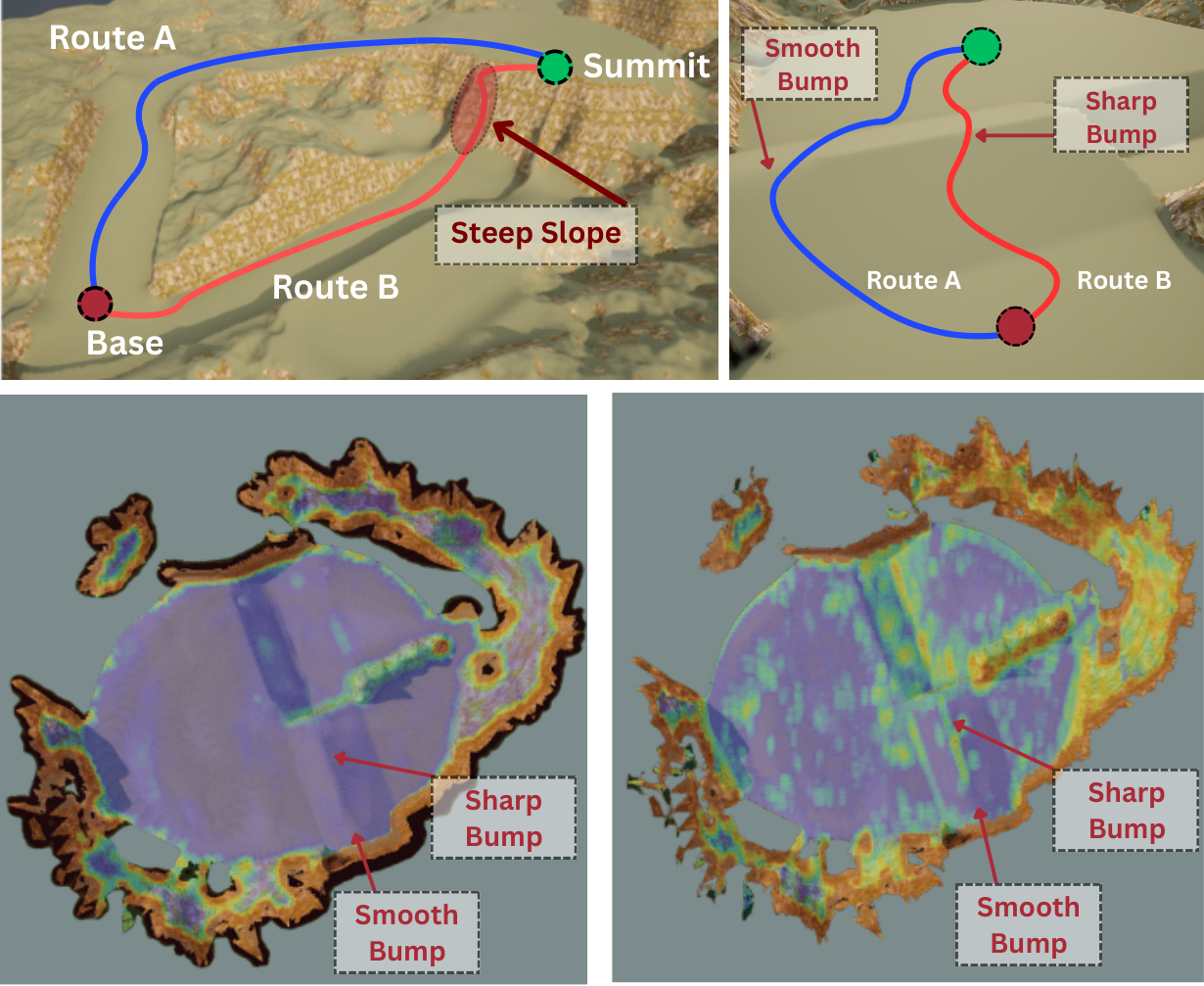
In this section, we empirically evaluate four central claims of our method: dgt-map captures global, directional traversability information not captured by direction-agnostic methods. dgt-map captures vehicle-specific nuances in traversability. dgt-map captures features beyond basic geometric slope cues.
Multi-task training improves performance compared to single-task training with the same amount of vehicle-specific data, especially in cases where vehicle-specific data is limited.
Sources and Demonstrations
Figures are reproduced from Singh et al. See the full paper for experimental details and the project page, when the paper links one, for demonstrations and videos.
Related Papers
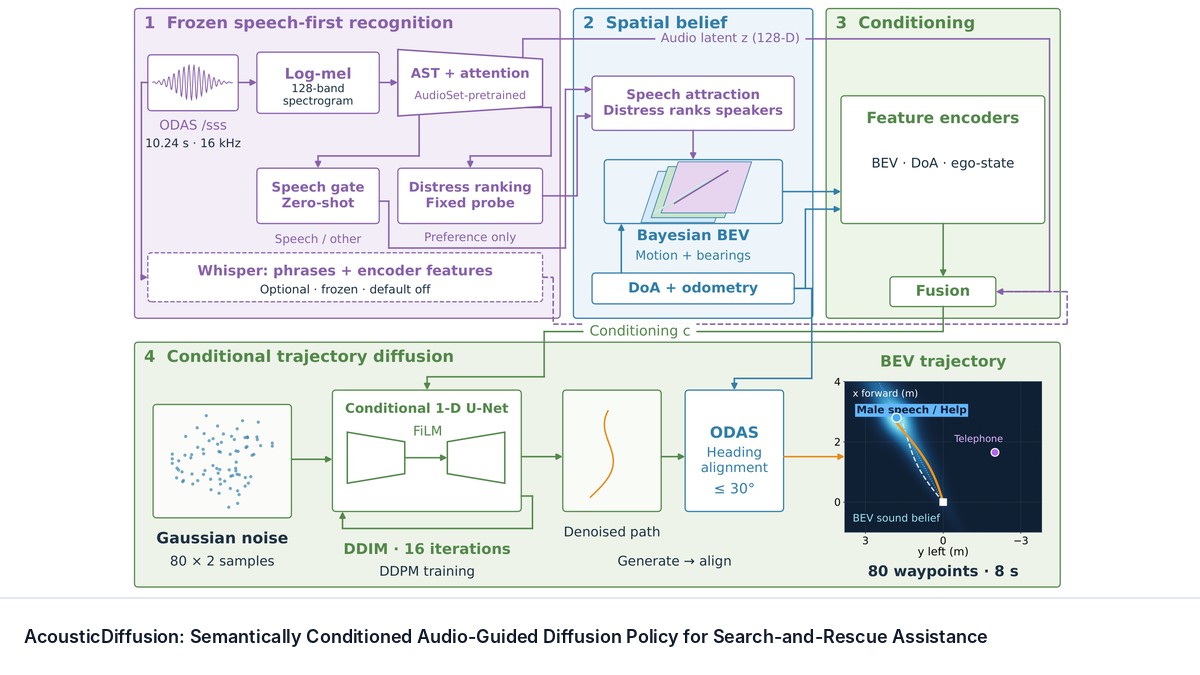
AcousticDiffusion: Semantically Conditioned Audio-Guided Diffusion Policy for Search-and-Rescue Assistance
Iana Zhura, Didar Seyidov, Dmitrii Plotnikov et al.
Navigating toward human callers is an important capability for rescue robots operating where visual contact is degraded or occluded. We present AcousticDiffusion, a semantically conditioned, audio-guided diffusion policy for human-directed navigation.
Contact-Rich Motion Planning via GPU-Parallel Mode Evaluation
Jiayun Li, Georgia Chalvatzaki
Contact-rich motion planning (CRMP) is essential for robotic manipulation and locomotion, yet remains computationally challenging due to combinatorial contact decisions.
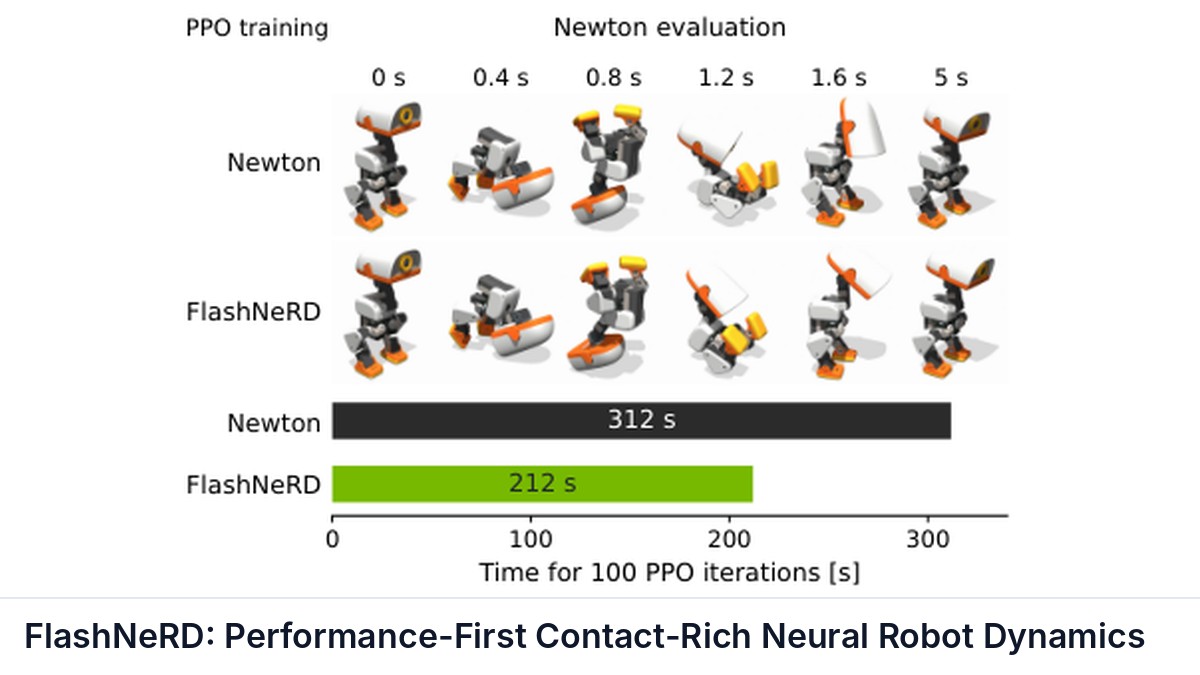
FlashNeRD: Performance-First Contact-Rich Neural Robot Dynamics
Mohammadmehdi Ataei, Mohammad Amin Nabian, Jie Xu et al.
Compared with analytical physics, learned dynamics models promise robot simulation that is faster, inherently differentiable, and easily adaptable to real data.
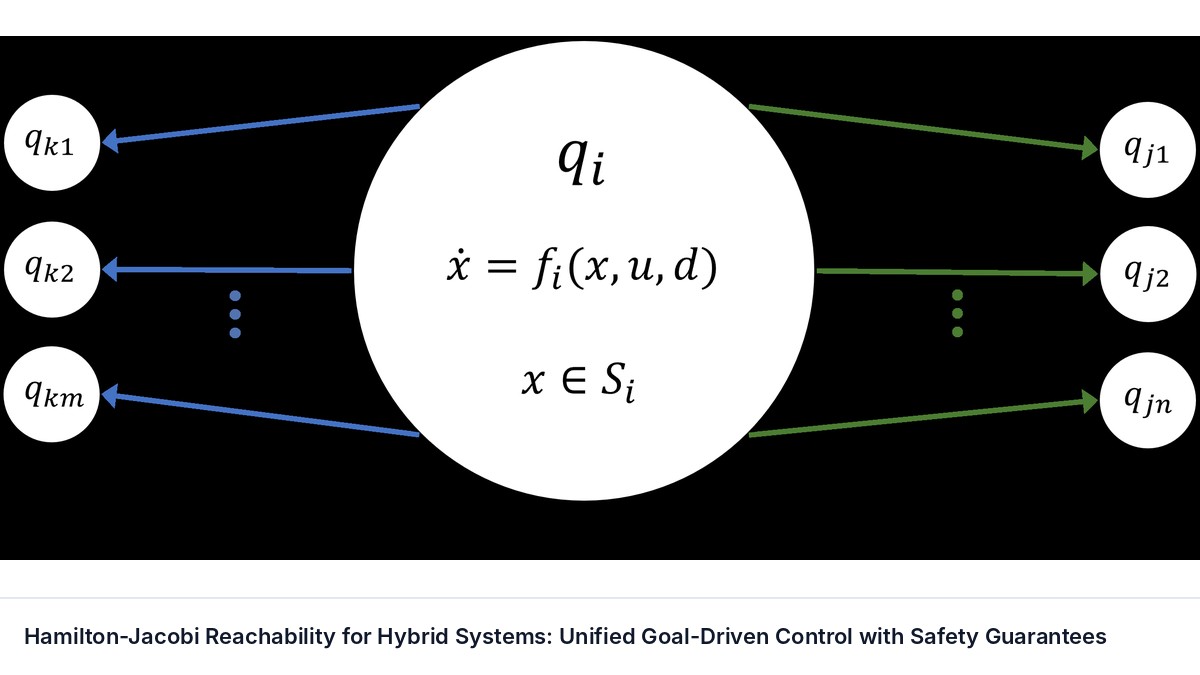
Hamilton-Jacobi Reachability for Hybrid Systems: Unified Goal-Driven Control with Safety Guarantees
Javier Borquez, Shuang Peng, Somil Bansal
Hybrid dynamical systems provide a powerful modeling framework for robotic systems, particularly in contact-rich environments. However, ensuring safety and performance in such systems remains challenging due to the intricate coupling between continuous dynamics and discrete mode transitions.