
Recording Hand-Held Laparoscopic Instrument Motion in the Operating Room: Magnetometer-Free Fusion of Inertial, Range and Visual Sensing
Jiyul Lee, Dongho Yee, Juahn Oh, Jinseok Lee, Yechan Seo, Seong Jeong, Minsung Kim, Seonho Shim, Younghoon Noh, Hyuk Choi, Youngbin Kong, Hyoun-Joong Kong · N/A · 2026
Framework
N/A
License
N/A
Stars
N/A
Summary
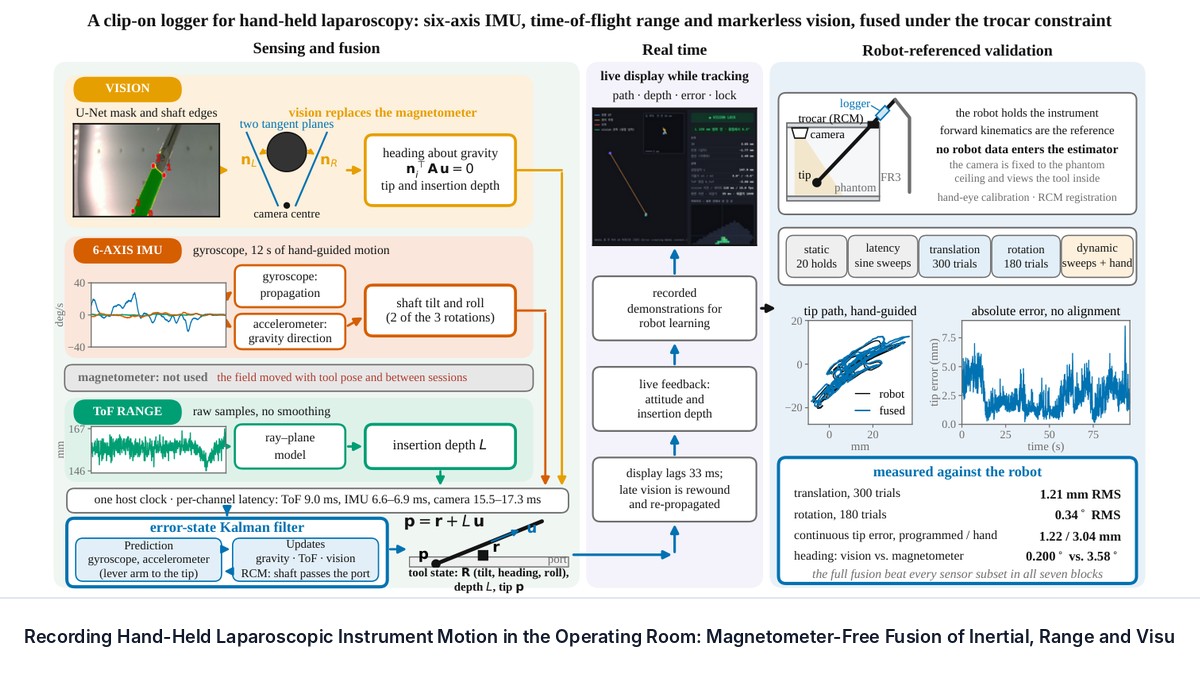
Most minimally invasive procedures are still performed with hand-held laparoscopic instruments, yet only the endoscopic video is retained; the instrument motion that expresses surgical skill, and that could support skill assessment and robot learning, is lost.
Abstract Summary
Key Points
- Most minimally invasive procedures are still performed with hand-held laparoscopic instruments, yet only the endoscopic video is retained; the instrument motion that expresses surgical skill, and that could support skill assessment and robot learning, is lost.
- Pose from video alone remains millimeters to centimeters off, and an instrument-mounted inertial measurement unit (IMU) cannot rely on its magnetometer, whose field changed with tool pose and between sessions in our measurements.
- We present a surgical instrument-state logger that clips onto a conventional instrument without modifying the part that enters the patient and fuses a six-axis IMU and a time-of-flight (ToF) rangefinder with a markerless camera in an error-state Kalman filter under the remote center of motion (RCM) of the trocar.
- Heading comes from the shaft silhouette, segmented by a U-Net, in place of the magnetometer: the rotation-angle error is 0.200{\deg}, against 3.58{\deg} from the accelerometer and magnetometer alone.
- Against a Franka Research 3 manipulator, and without alignment to it, the displacement error over 300 translation trials was 1.21mm RMS and the relative-rotation error over 180 rotation trials 0.34{\deg} RMS.
Methods
This section covers the device and the trocar geometry, the preliminary study that rules the magnetometer out, the vision and range models, and the filter that fuses them. Table II lists which sensor fixes which degree of freedom. Their weaknesses are complementary: the gyroscope drifts, gravity is corrupted by motion, vision is intermittent and late, and ToF must be interpreted through the orientation.
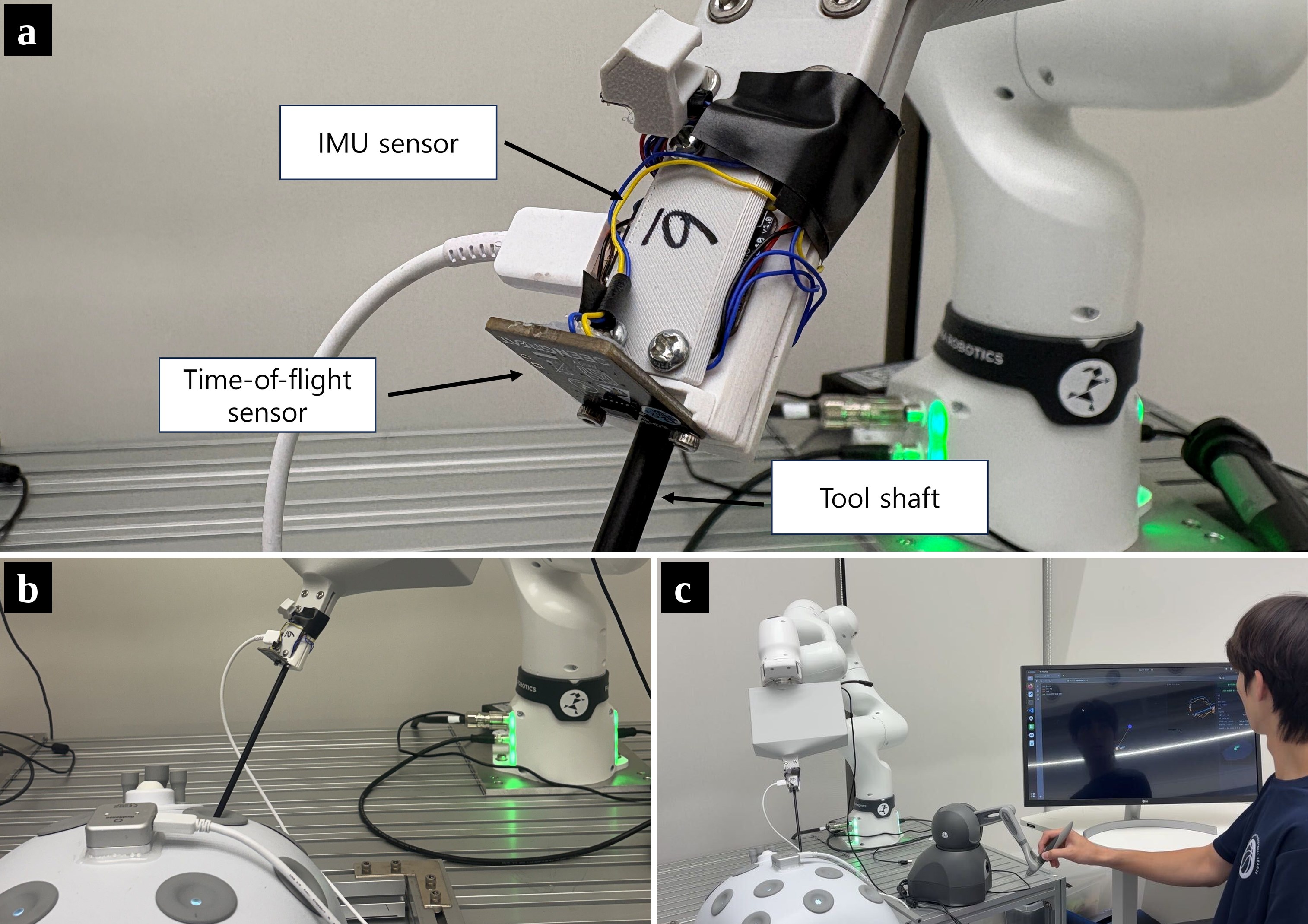
The module clamps to the handle side of a standard laparoscopic instrument of 5.18 mm shaft diameter (Fig. 2 a).
Experiments
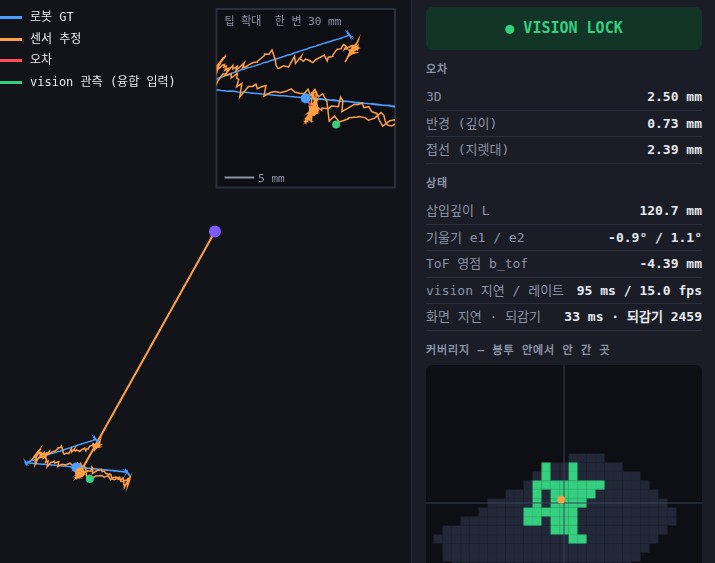
All experiments are referenced to an FR3 that holds the instrument through the trocar of the phantom (Fig. 2 b), and none of them lets robot data into the estimator: we evaluate static stability, observation latency, translation, rotation and continuous tracking, with sensor ablations throughout. Motions are commanded as minimum-jerk profiles about the RCM.
Sources and Demonstrations
Figures are reproduced from Lee et al. See the full paper for experimental details and the project page, when the paper links one, for demonstrations and videos.
Related Papers
3DThinkVLA: Endowing Vision-Language-Action Models with Latent 3D Priors via 3D-Thinking-Guided Co-training
Jiaxin Shi, Xidong Zhang, Fucai Zhu et al.
We propose a 3D-thinking-guided co-training framework that enables vision-language-action (VLA) models to perform 3D spatial reasoning implicitly during action prediction.
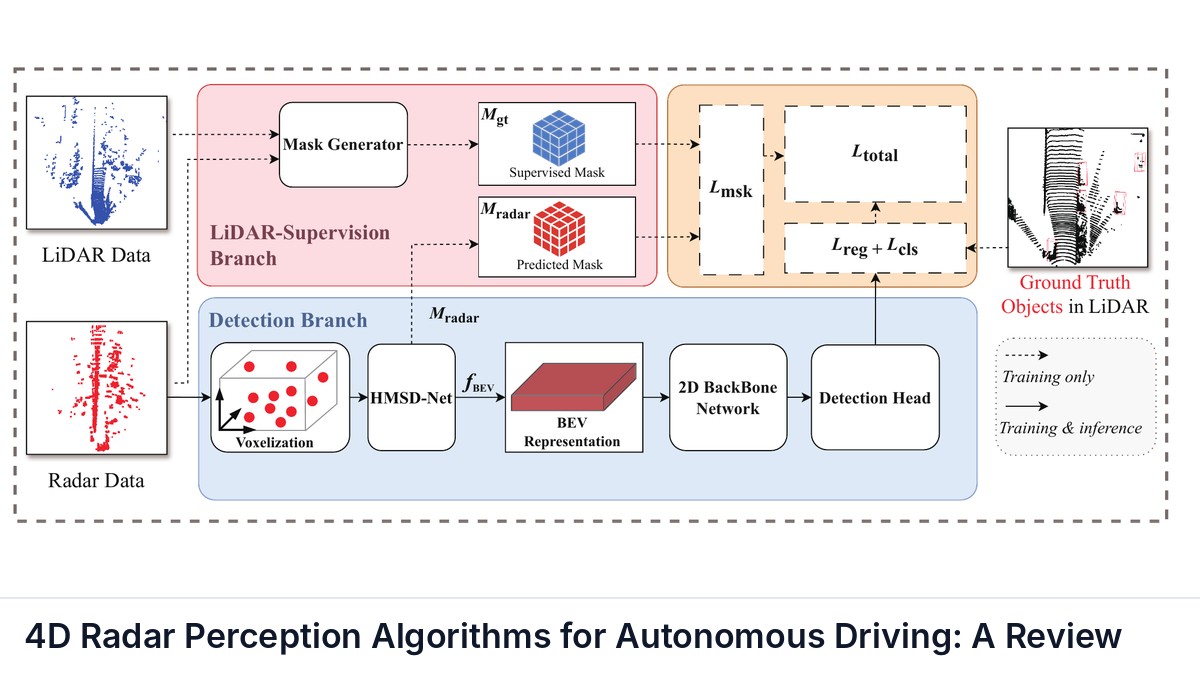
4D Radar Perception Algorithms for Autonomous Driving: A Review
Xumin Wu, Jun Zhou, Jilin Mei et al.
Research on 4D millimeter-wave radar perception algorithms has flourished in recent years, extending from signal processing and object detection to semantic segmentation, motion estimation, occupancy prediction, and dynamic scene reconstruction.
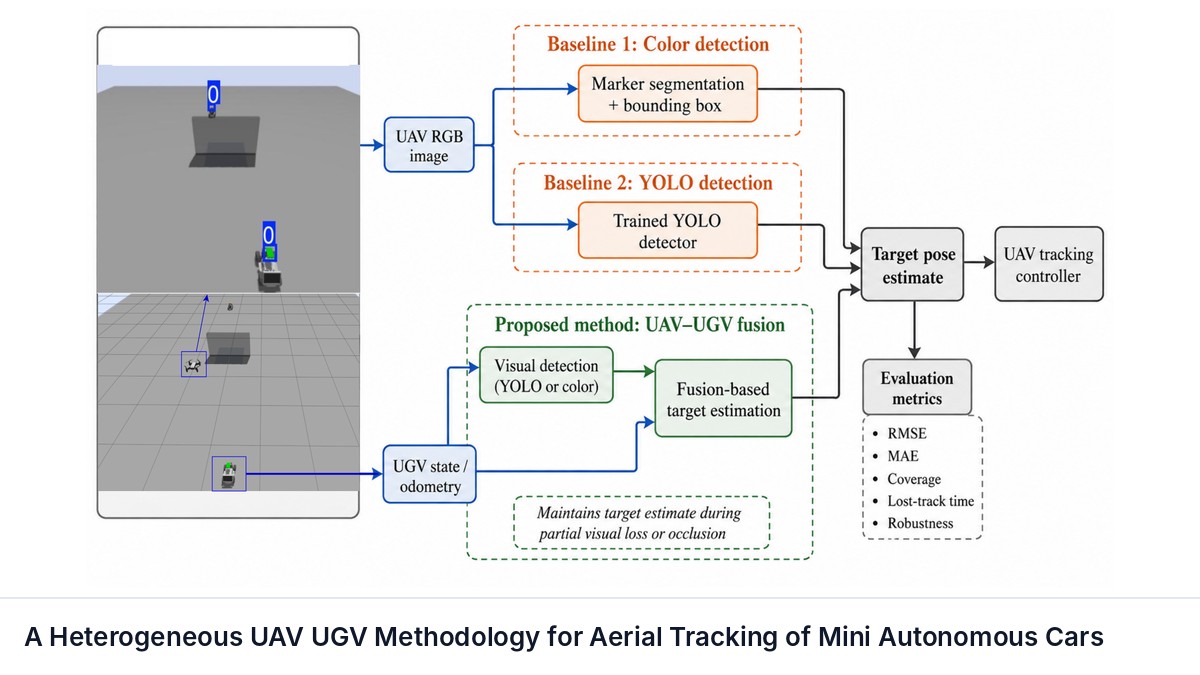
A Heterogeneous UAV UGV Methodology for Aerial Tracking of Mini Autonomous Cars
Santiago Fernandez, Angel da Silva, Hiago Sodre et al.
Aerial tracking of autonomous ground vehicles can provide useful situational awareness in environments where fixed external perception infrastructure is unavailable.
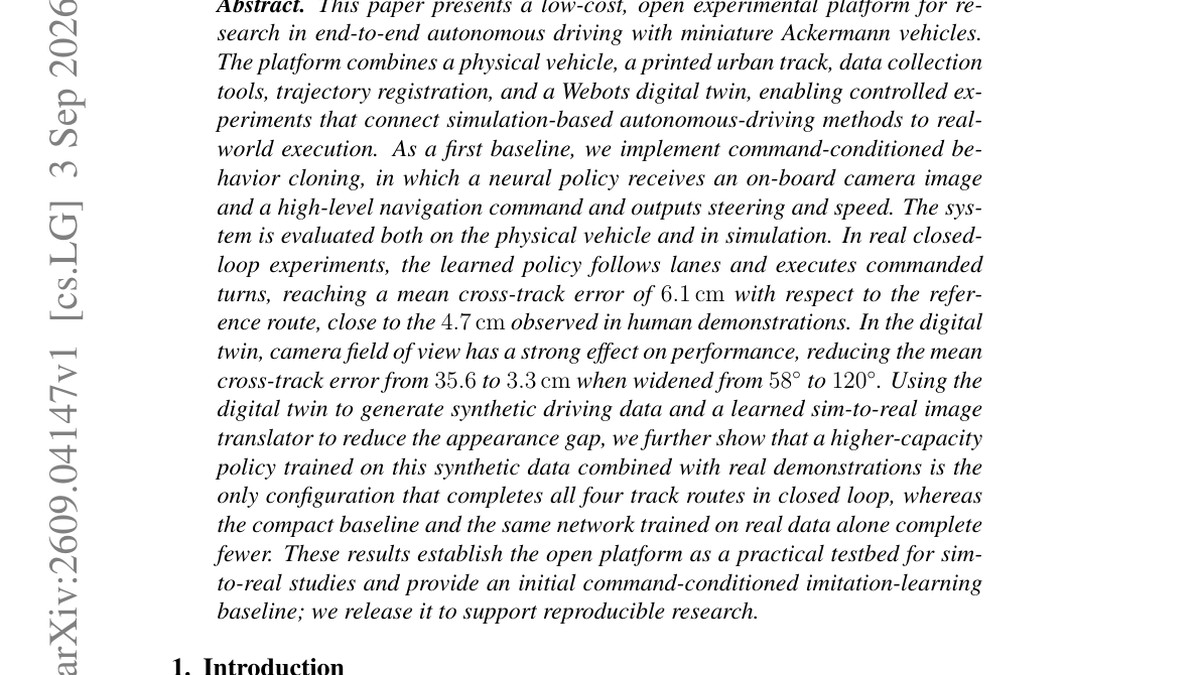
A Low-Cost, Open Platform for End-to-End Autonomous Driving on a Miniature Ackermann Vehicle
Gustavo Claudio Karl Couto, Eric Aislan Antonelo, Gabriel George Zipperer
This paper presents a low-cost, open experimental platform for research in end-to-end autonomous driving with miniature Ackermann vehicles.