

Learning Terrain-Adaptive Humanoid Locomotion on Granular Terrain
Junnosuke Kamohara, Feiyang Wu, Andy Ningan Zong, Daniel I. Goldman, Yashwanth Nakka, Seth Hutchinson, Ye Zhao · N/A · 2026
Framework
N/A
License
N/A
Stars
N/A
Summary
Humanoid locomotion on granular terrain remains a significant challenge due to its complex foot-terrain interaction dynamics that are difficult to model. Existing approaches either ignore granular contact dynamics or incorporate simplified normal force models with heuristic tangential components.
Abstract Summary
Key Points
- Humanoid locomotion on granular terrain remains a significant challenge due to its complex foot-terrain interaction dynamics that are difficult to model.
- Existing approaches either ignore granular contact dynamics or incorporate simplified normal force models with heuristic tangential components.
- In this work, we present a physics-grounded granular contact model based on three-dimensional resistive force theory (3D RFT) and efficiently simulate granular terrain for reinforcement learning (RL) training.
- Unlike traditional rigid contact models and simplified granular contact models with ad-hoc heuristics, our contact solver produces physically accurate granular intrusion dynamics without resorting to heuristics.
- It captures realistic penetration and tangential drag during training, enabling the policy to learn behaviors that transfer reliably to real-world granular terrain where rigid contact models fail.
Preliminaries
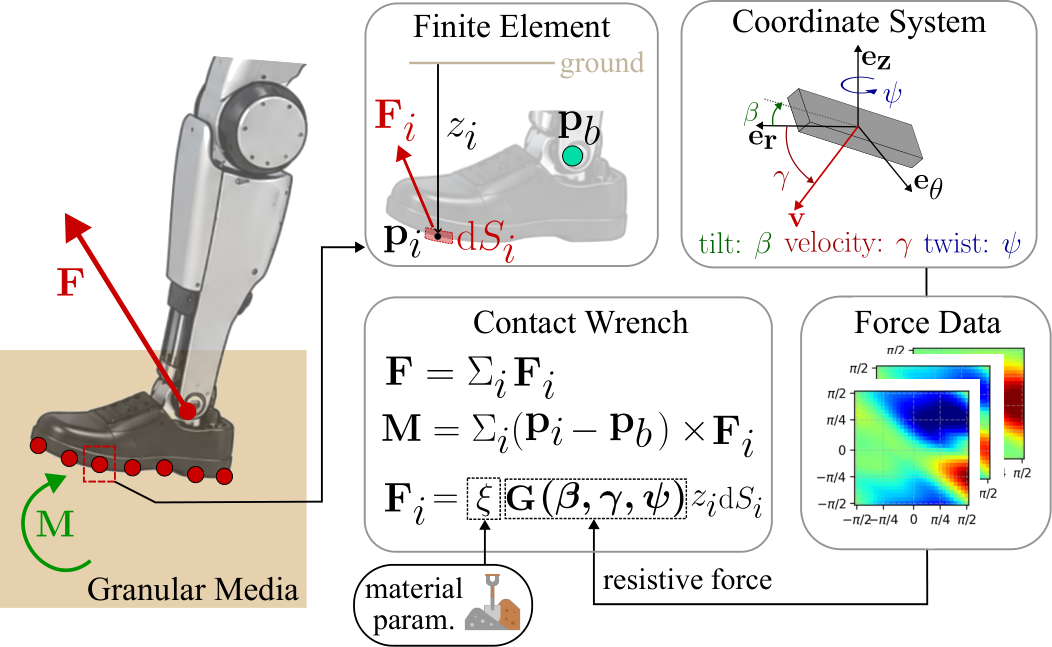
We utilize 3D RFT [ 13 ] to model the contact forces between the humanoid foot and the granular terrain. RFT assumes that the contact force on an intruding body is the sum of forces per area per depth $\bm{\alpha}$ acting on infinitesimal elements: $\mathbf{F}=\int_{S}\bm{\alpha}/z/\mathds{1}_{z 2 . Thus, we first derive the contact force and moment acting on each finite element.
Method
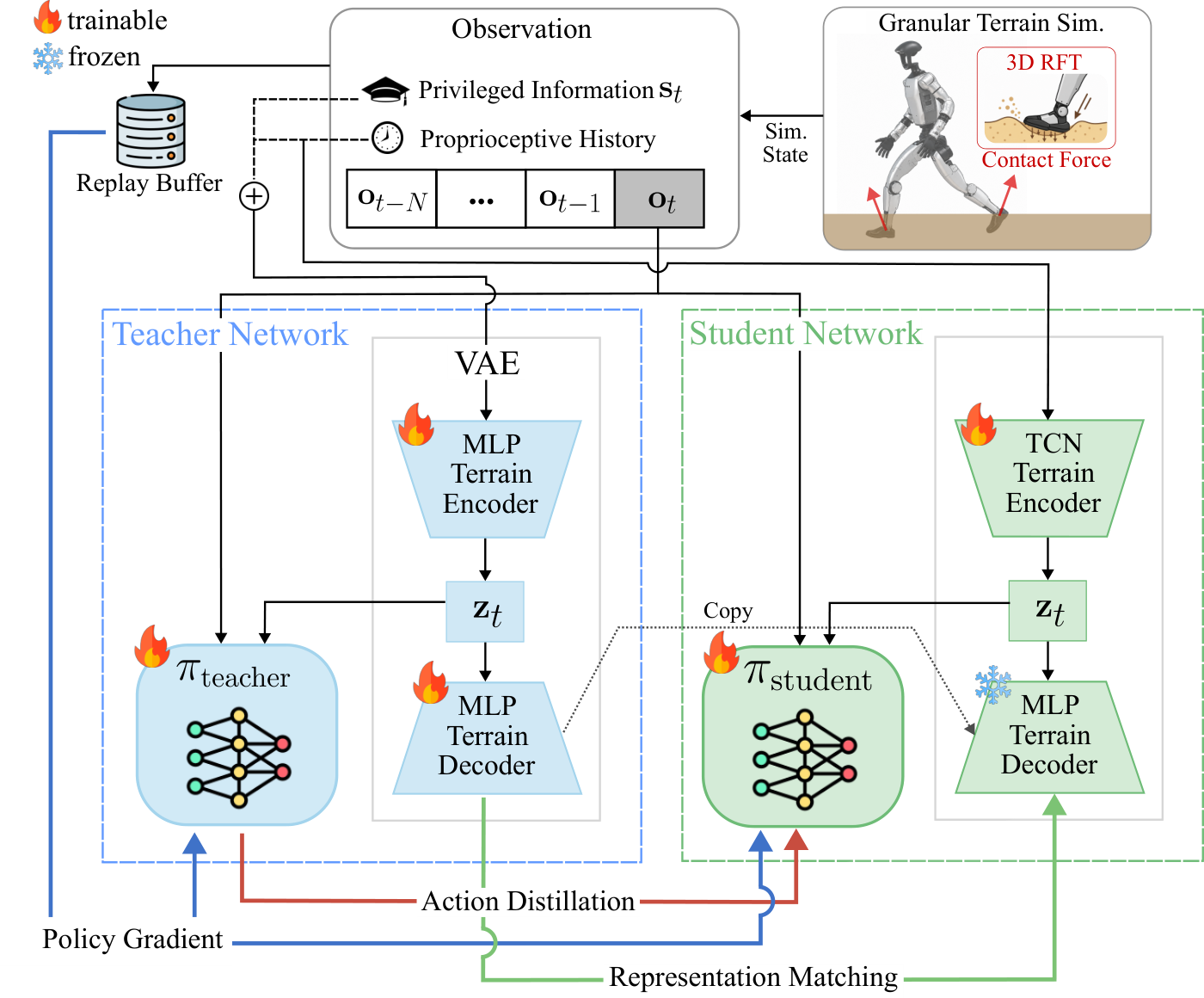
This section details our terrain-adaptive RL framework, which builds on the granular contact model introduced above. We formulate the velocity-tracking task for humanoid locomotion as a Markov Decision Process (MDP).
At each timestep $t$, the agent receives the observation $\mathbf{o}_{t}$, performs an action $\mathbf{a}_{t}$ according to its current policy $\pi(\cdot/\mathbf{o}_{t})$, and obtains a scalar reward $R_{t}$.
Results
We evaluate the performance of the proposed control system for robust walking and running on different types of granular terrain in both simulation and real-world experiments. We first evaluate the fidelity of our contact model in isolation through a single rigid body intrusion experiment, comparing horizontal travel distance, ground penetration, and ground reaction forces against the material point method (MPM).

Sources and Demonstrations
Figures are reproduced from Kamohara et al. See the full paper for experimental details and the project page, when the paper links one, for demonstrations and videos.
Related Papers
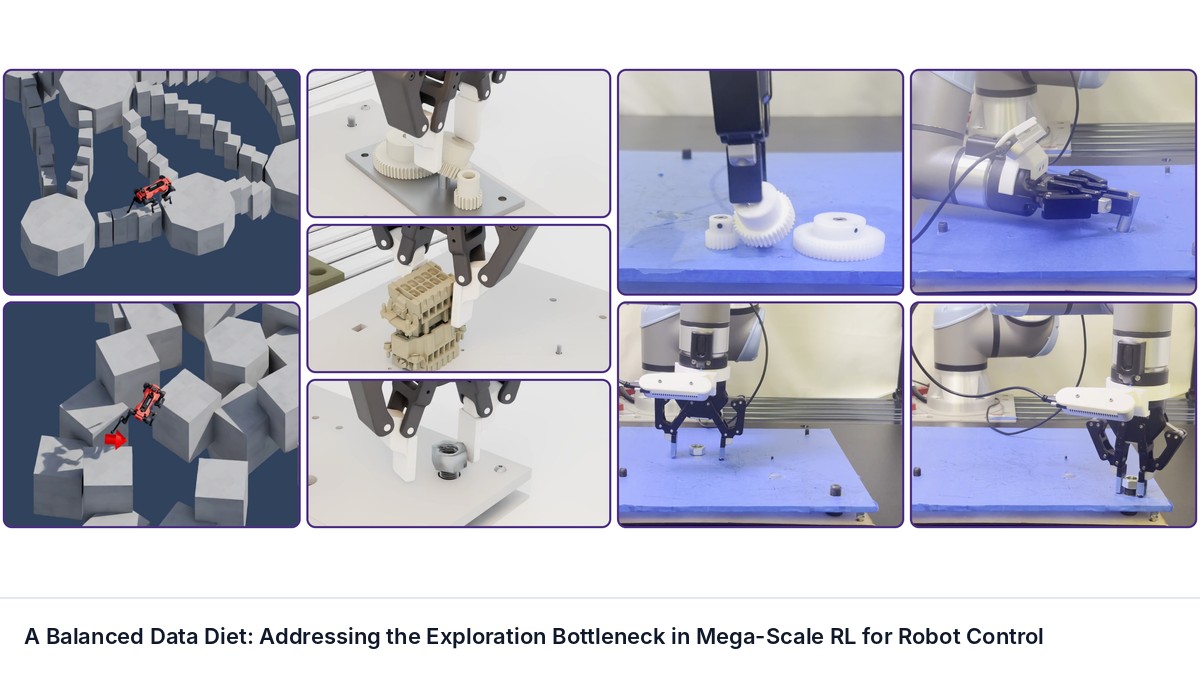
A Balanced Data Diet: Addressing the Exploration Bottleneck in Mega-Scale RL for Robot Control
Octi Zhang, Mateo Guaman Castro, Patrick Yin et al.
General-purpose robots must perform a wide range of tasks from agile locomotion to dexterous manipulation.
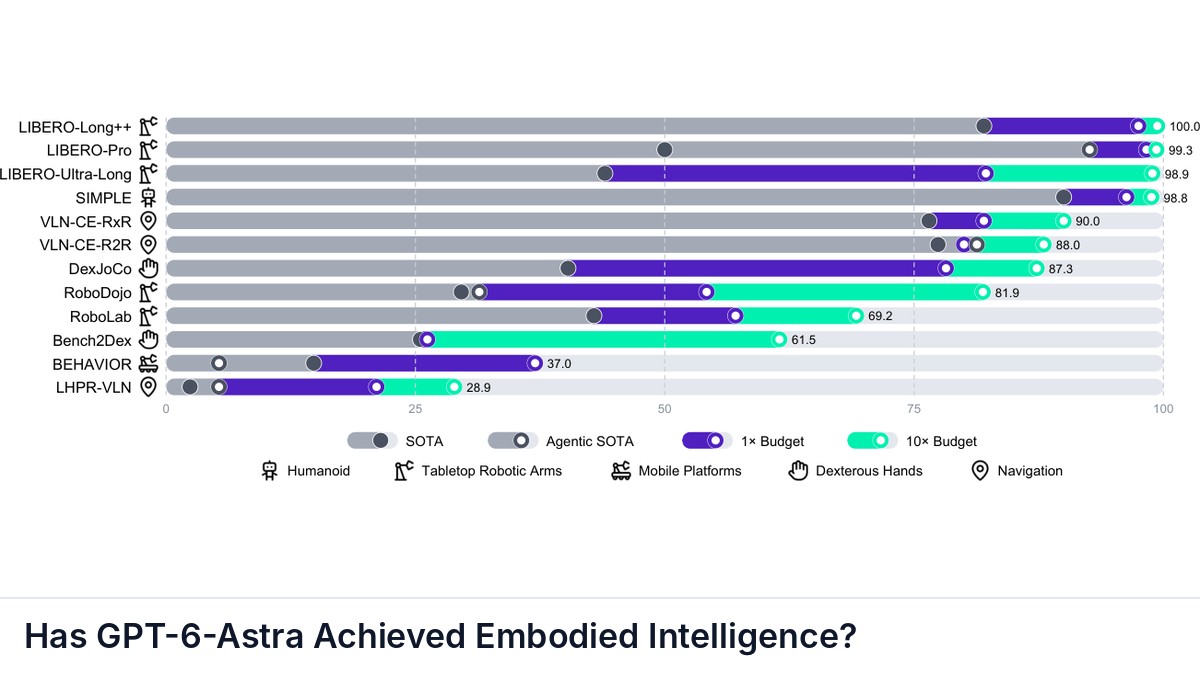
Has GPT-6-Astra Achieved Embodied Intelligence?
SenseNova, Joint Research Team, : et al.
GPT-6-Astra demonstrates a level of competence in robotic manipulation and navigation that challenges the conventional paradigm of building specialized models for individual tasks and embodiments.
OIL: An Object Interaction Layer for Humanoid Whole-Body Control
Pranay Dugar, Mohitvishnu S. Gadde, Rajesh Mangannavar et al.
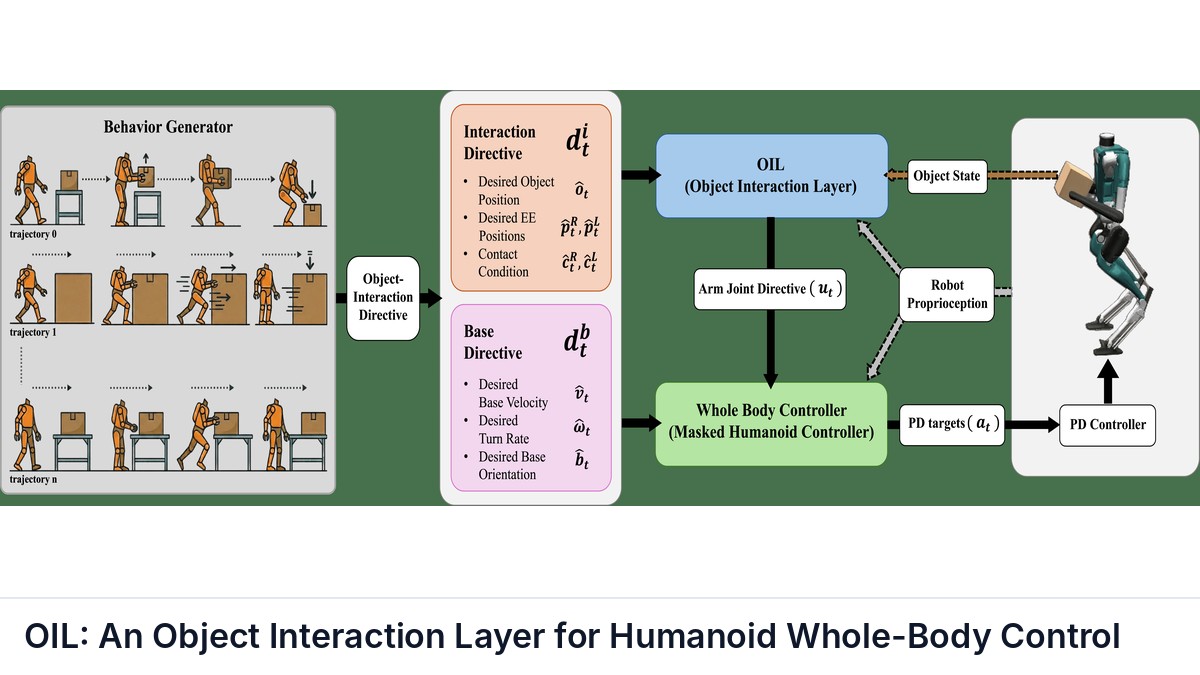
Recent progress in learned whole-body controllers for humanoid robots has enabled robust free-space motion by tracking kinematic targets such as joint or end-effector trajectories.
Video2DoorTraversal: Push Door Traversal via Simulated Door Twins
Xincheng Tang, Yiji Chen, Youhan Xie et al.
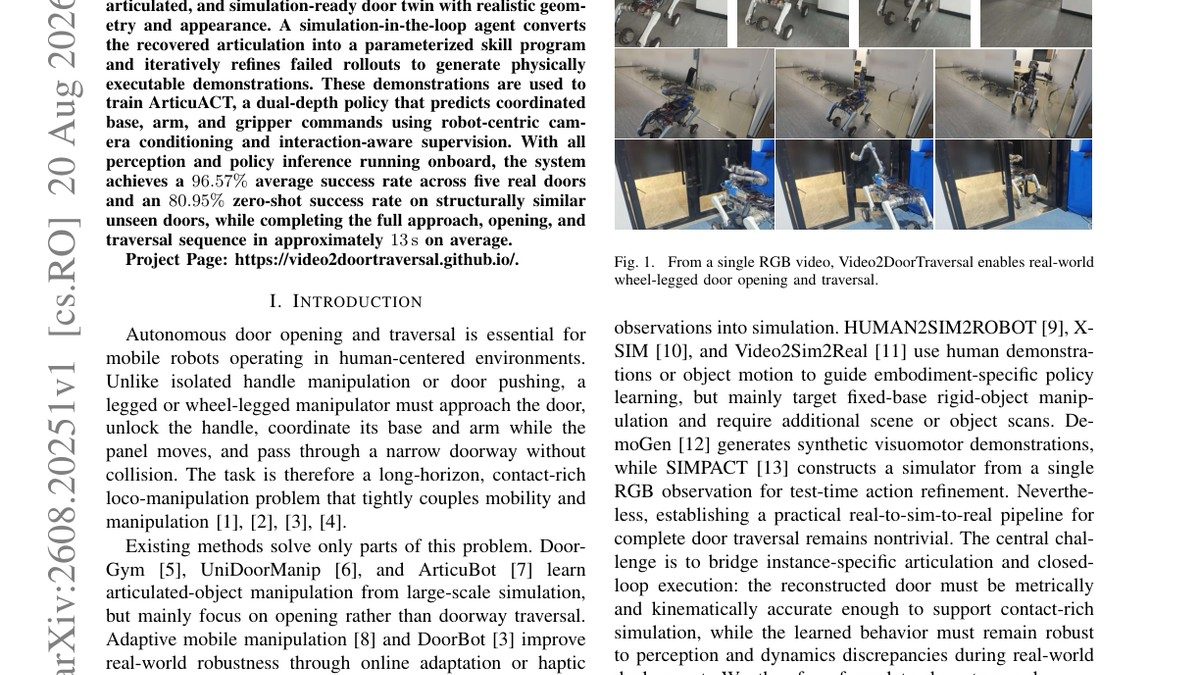
Door opening and traversal is a long-horizon loco-manipulation task that requires precise handle interaction and coordinated base-arm control. We present Video2DoorTraversal, a single-video real-to-sim-to-real framework for wheel-legged mobile manipulators.