
JEPA Policy: Diffusion-Free Imitation Learning via Paired Action and Future Representation Prediction
Jie Xu, Kangjin Yu, Ziyi Jin, Junjie Gao, Liqing Chen, Yixian Li, Shuai Tian, Zhongpu Xia · N/A · 2026
Framework
N/A
License
N/A
Stars
N/A
Summary
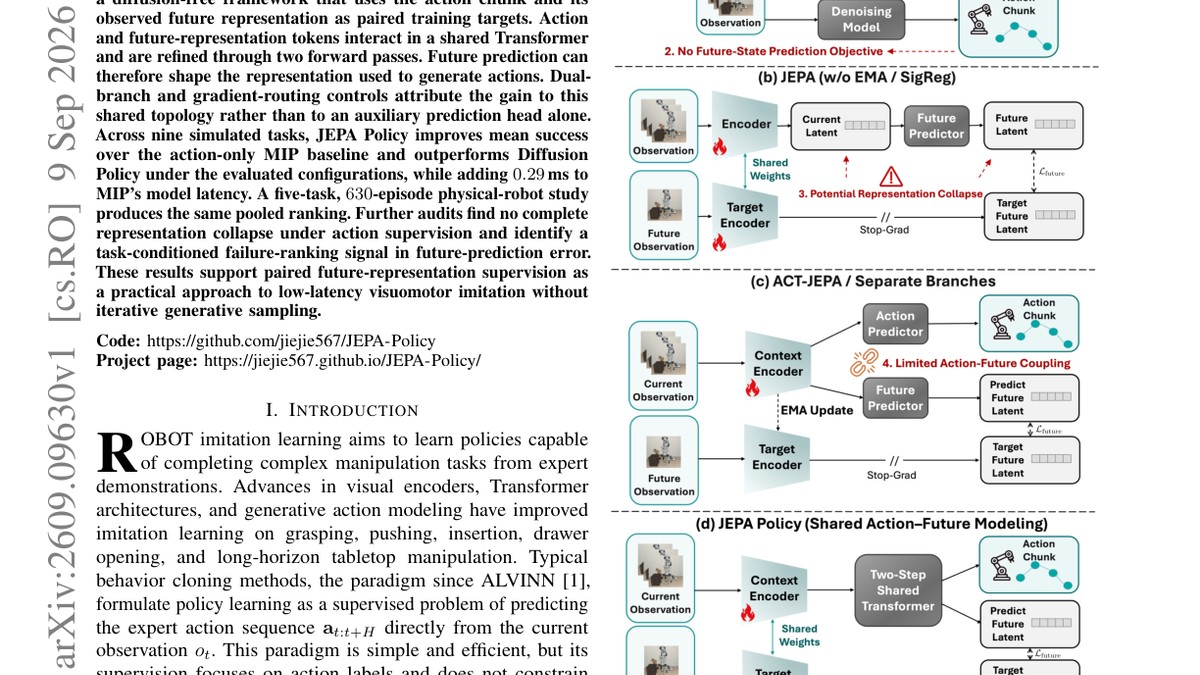
Standard behavior cloning supervises actions without explicitly constraining the future representation paired with each demonstrated action chunk. We introduce JEPA Policy, a diffusion-free framework that uses the action chunk and its observed future representation as paired training targets. Act...
Abstract Summary
Key Points
- Standard behavior cloning supervises actions without explicitly constraining the future represent...
- We introduce JEPA Policy, a diffusion-free framework that uses the action chunk and its observed ...
- Action and future-representation tokens interact in a shared Transformer and are refined through ...
- Future prediction can therefore shape the representation used to generate actions
- Dual-branch and gradient-routing controls attribute the gain to this shared topology rather than ...
JEPA Policy: Diffusion-Free Imitation Learning via Paired Action and Future Representation Prediction
|Authors: Jie Xu, Kangjin Yu, Ziyi Jin, Junjie Gao, Liqing Chen, Yixian Li, Shuai Tian, Zhongpu Xia
|Venue: arXiv preprint | Year: 2026
|arXiv: 2609.09630v1
Abstract
Standard behavior cloning supervises actions without explicitly constraining the future representation paired with each demonstrated action chunk. We introduce JEPA Policy, a diffusion-free framework that uses the action chunk and its observed future representation as paired training targets. Action and future-representation tokens interact in a shared Transformer and are refined through two forward passes. Future prediction can therefore shape the representation used to generate actions. Dual-branch and gradient-routing controls attribute the gain to this shared topology rather than to an auxiliary prediction head alone. Across nine simulated tasks, JEPA Policy improves mean success over the action-only MIP baseline and outperforms Diffusion Policy under the evaluated configurations, while adding 0.29 ms to MIP’s model latency. A five-task, 630-episode physical-robot study produces the same pooled ranking. Further audits find no complete representation collapse under action supervision and identify a task-conditioned failure-ranking signal in future-prediction error. These results support paired future-representation supervision as a practical approach to low-latency visuomotor imitation without iterative generative sampling.
Key Contributions
- Standard behavior cloning supervises actions without explicitly constraining the future represent…
- We introduce JEPA Policy, a diffusion-free framework that uses the action chunk and its observed …
- Action and future-representation tokens interact in a shared Transformer and are refined through …
- Future prediction can therefore shape the representation used to generate actions
- Dual-branch and gradient-routing controls attribute the gain to this shared topology rather than …
Topics
- vision
- reinforcement-learning
- control
- learning-from-demonstration
Code & Data
- GitHub repository: https://github.com/jiejie567/JEPA-Policy
BibTeX
@article{Xu2026_260909630v1,
  title     = {JEPA Policy: Diffusion-Free Imitation Learning via Paired Action and Future Representation Prediction},
  author    = {Jie Xu and Kangjin Yu and Ziyi Jin and Junjie Gao and Liqing Chen and Yixian Li and Shuai Tian and Zhongpu Xia},
  year      = {2026},
  eprint    = {2609.09630v1},
  archivePrefix = {arXiv},
  primaryClass  = {cs.RO},
  url       = {https://arxiv.org/abs/2609.09630v1}
}
Related Papers
A Low-Cost, Open Platform for End-to-End Autonomous Driving on a Miniature Ackermann Vehicle
Gustavo Claudio Karl Couto, Eric Aislan Antonelo, Gabriel George Zipperer · arXiv preprint · Sep 2026
This paper presents a low-cost, open experimental platform for research in end-to-end autonomous driving with miniature Ackermann vehicles. The platform combines a physical vehicle, a printed urban track, data collection tools, trajectory registration, and a Webots digital twin, enabling controll...
Can People Distinguish Human and AI Agency in Humanoid Teleoperation? A Preliminary Study of Agency Perception
Xiang Li, Koya Dendo, Keigo Minamida et al. · arXiv preprint · Sep 2026
Can people distinguish between human and AI agency in humanoid teleoperation? To explore this question, we developed \textit{Ghost-in-the-Loop}, a teleoperation framework that supports both human-operated and AI-generated control of a robot's voice, facial expressions, and gestures while maintain...
Design and Evaluation of a Touchscreen-Based Teleoperation Interface for Robotic Manipulators
Juan José García Cárdenas, Alperen Kenan, Hamidreza Raei et al. · arXiv preprint · Aug 2026
Intuitive teleoperation interfaces are crucial for the safe and effective operation of robotic manipulators in challenging environments. In the nuclear industry, surface contact tasks such as swab sampling require precise path and force tracking, obstacle avoidance, and sustained operator attenti...
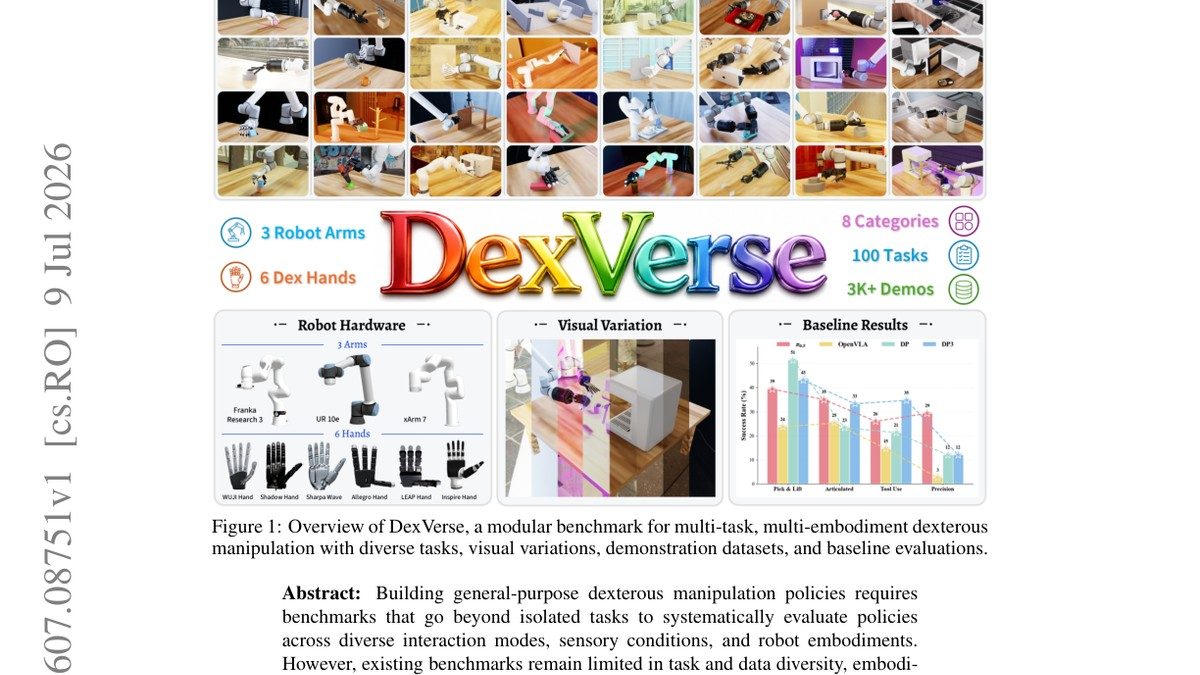
DexVerse: A Modular Benchmark for Multi-Task, Multi-Embodiment Dexterous Manipulation
Yunchao Yao, Zhuxiu Xu, Tianqi Zhang et al. · arXiv preprint · Jul 2026
Building general-purpose dexterous manipulation policies requires benchmarks that go beyond isolated tasks to systematically evaluate policies across diverse interaction modes, sensory conditions, and robot embodiments. However, existing benchmarks remain limited in task and data diversity, embod...