
Reinforcement Learning from Real-Robot Interaction without High-Quality State Estimates
Ryan Gao, Ashvin Anilkumar, Nicholas Corrado, William Cong, Josiah Hanna · N/A · 2026
Framework
N/A
License
N/A
Stars
N/A
Summary
A longstanding goal for robot reinforcement learning (RL) is that robots learn from their own physical experience, as humans and animals do.
Abstract Summary
Key Points
- A longstanding goal for robot reinforcement learning (RL) is that robots learn from their own physical experience, as humans and animals do.
- A key obstacle to learning directly from physical experience, especially outside instrumented lab environments, is that the state of the world is usually unobservable to the learner and must be estimated from on-board sensing.
- Errors in that estimate corrupt both the policy input and potentially the reward signal
- We study this challenge using the contact-rich task of a bipedal robot learning to score soccer goals.
- We estimate all key state variables on-board with an unscented Kalman filter (UKF) and no external instrumentation (e.g., motion capture or overhead cameras).
Task and System
We formulate the task of dribbling a soccer ball into a goal as a partially observable Markov decision process (POMDP) [ 24 ] defined by the tuple $(\mathcal{S},\mathcal{A},\mathcal{O},T,\Omega,R,d_{0},\gamma)$ where $\mathcal{S}$ is the state space, $\mathcal{A}$ is the action space, $\mathcal{O}$ is the observation space, $T$ is the transition function, $\Omega$ is the observation function, $R$ is the reward function, $d_{0}$ is the initial state distribution, and $\gamma\in[0,1)$ is the discount factor.
RSSM–RLPD for On-Robot Learning
This section introduces our main algorithmic contribution, RSSM–RLPD, which addresses partial ball visibility by augmenting the replay-mixture approach of RLPD [ 1 ] with an observation-gated recurrent state-space model. The actor and critics share a representation trained by prediction losses and the critic objective to retain information about ball motion relevant to the control task.
Experiments
We evaluate our approach on the task of learning to dribble a ball into a goal through physical interaction.
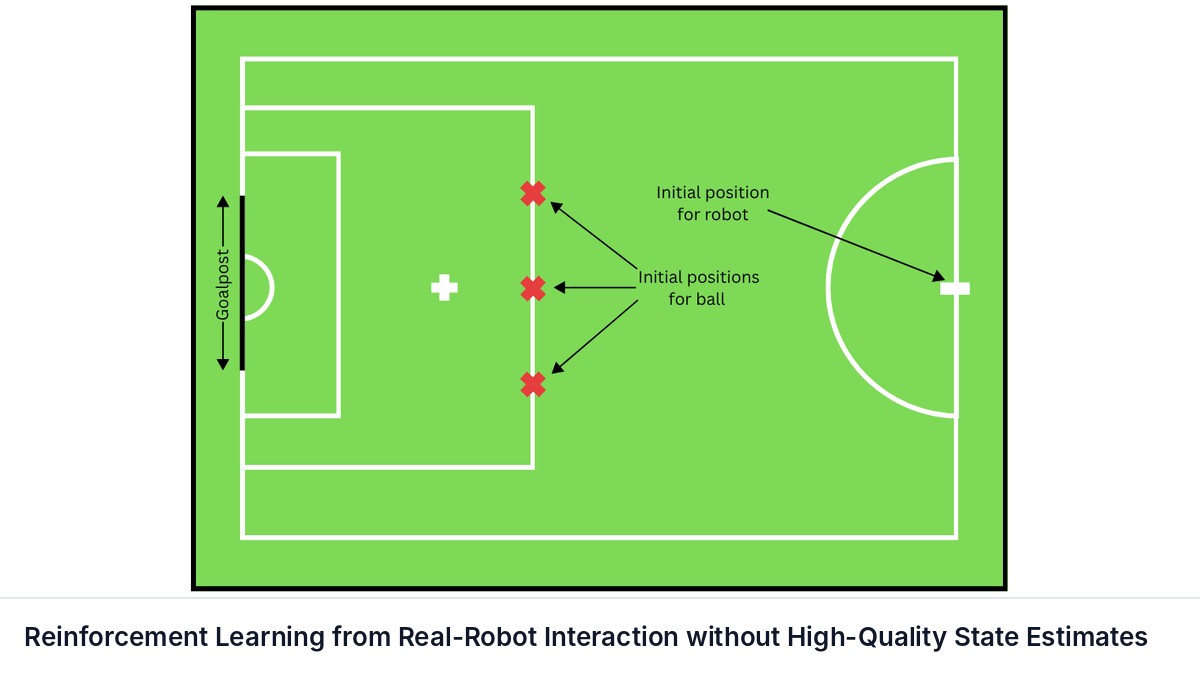
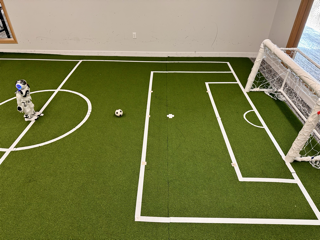
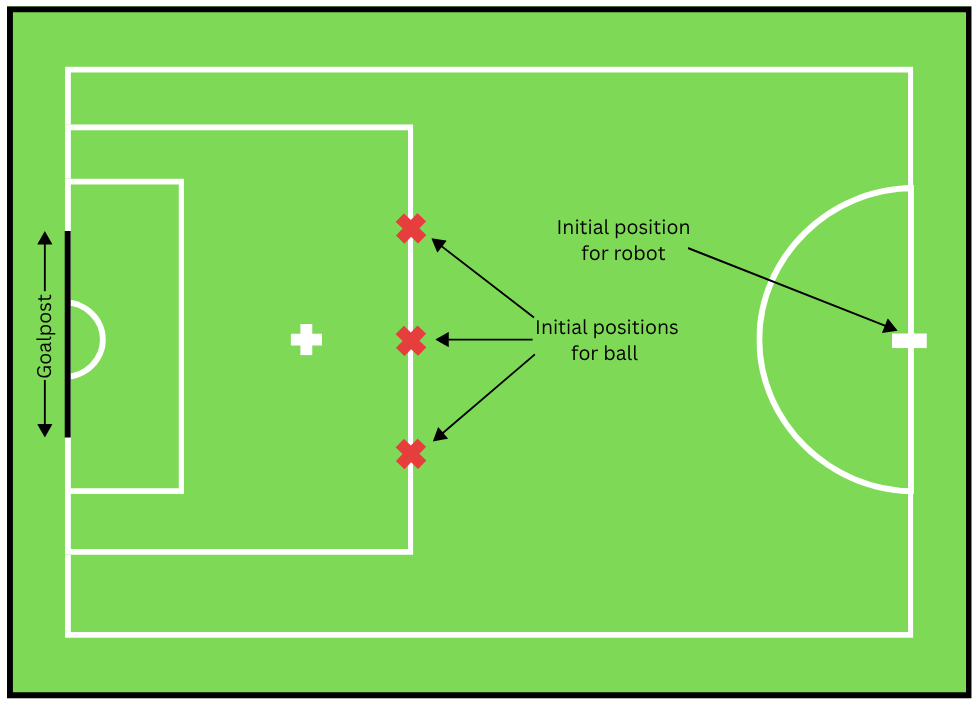
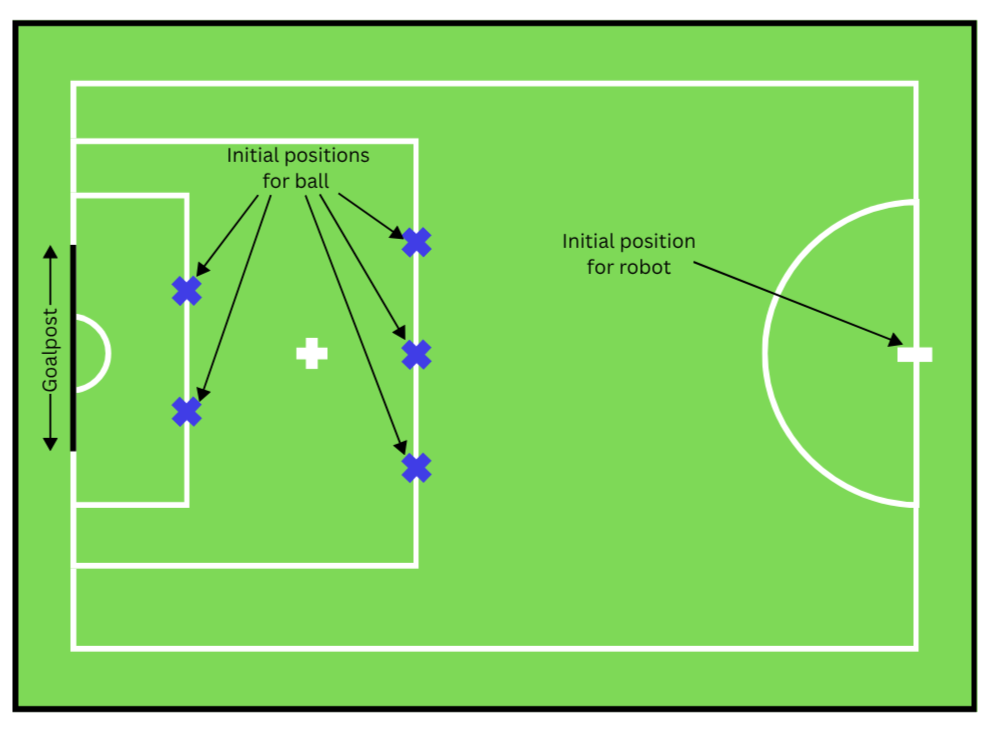
Our experiments combine hardware and simulation to leverage their complementary strengths: hardware captures real-world sensing noise and contact dynamics without simulation-induced approximations, while simulation enables multi-seed replication and systematic evaluation across a broader range of failure conditions. The physical task uses a $7\times 4.8$ m half-field.
Sources and Demonstrations
Figures are reproduced from Gao et al. See the full paper for experimental details and the project page, when the paper links one, for demonstrations and videos.
Related Papers
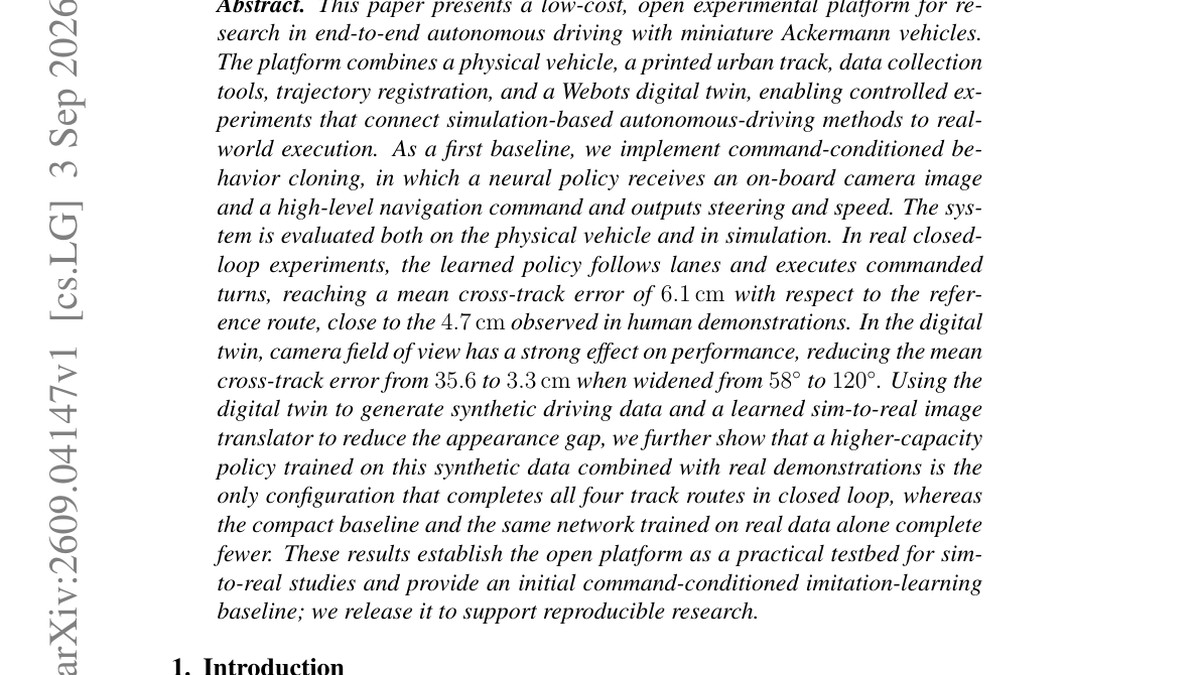
A Low-Cost, Open Platform for End-to-End Autonomous Driving on a Miniature Ackermann Vehicle
Gustavo Claudio Karl Couto, Eric Aislan Antonelo, Gabriel George Zipperer
This paper presents a low-cost, open experimental platform for research in end-to-end autonomous driving with miniature Ackermann vehicles.

A Sim-to-Real Integration Pipeline for Training and Deployment of Chunk-Based VLA Manipulation Policies
Mathilde Kappel, Clémence Grislain, Mohamed Chetouani et al.
Vision-Language-Action (VLA) models have become a prominent paradigm for mapping multimodal inputs, including semantic instructions, visual observations of the scene, and proprioceptive observations, to robot actions.
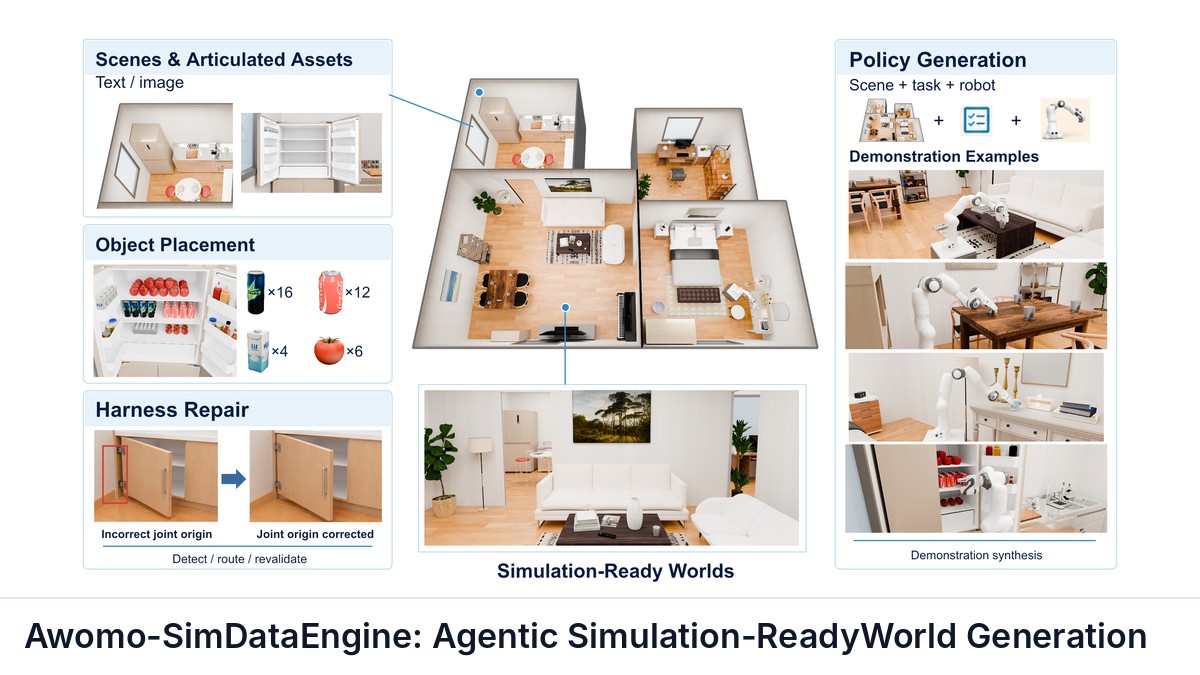
Awomo-SimDataEngine: Agentic Simulation-ReadyWorld Generation
PhysicalRSI Team, Danjiao Ma, Enhui Ma et al.
Generating useful robot-training data requires more than visually plausiblescenes: objects must support interaction, placements must remain physicallyvalid, and tasks must admit repeatable execution.
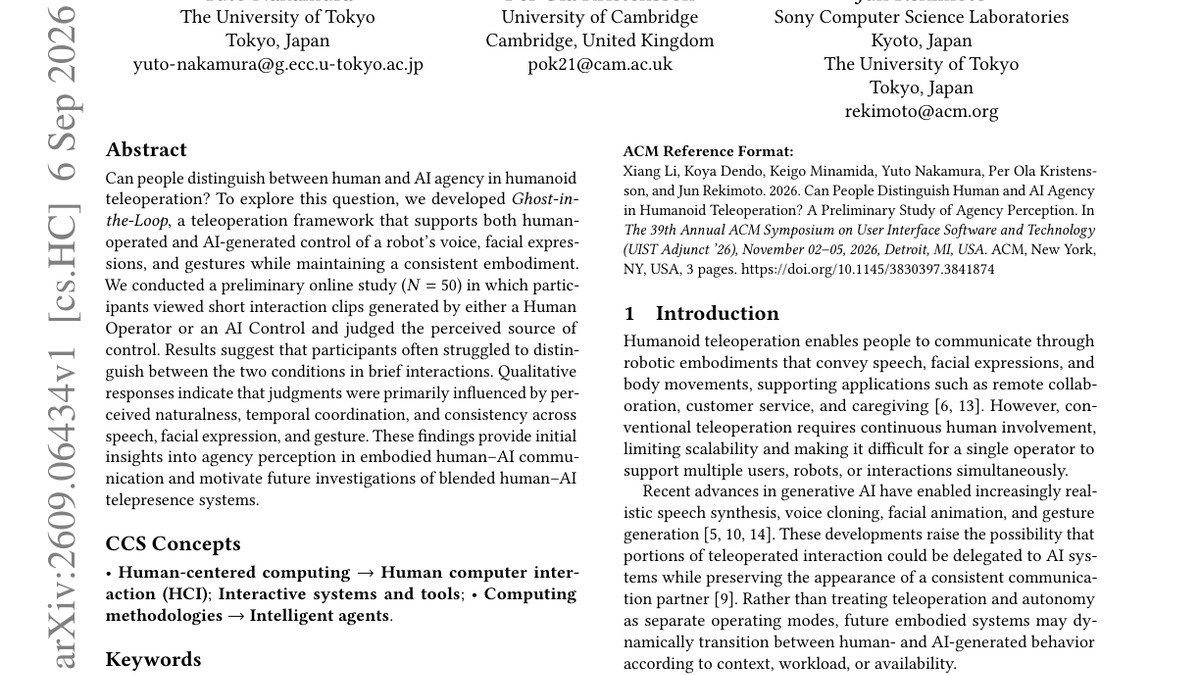
Can People Distinguish Human and AI Agency in Humanoid Teleoperation? A Preliminary Study of Agency Perception
Xiang Li, Koya Dendo, Keigo Minamida et al.
Can people distinguish between human and AI agency in humanoid teleoperation?