
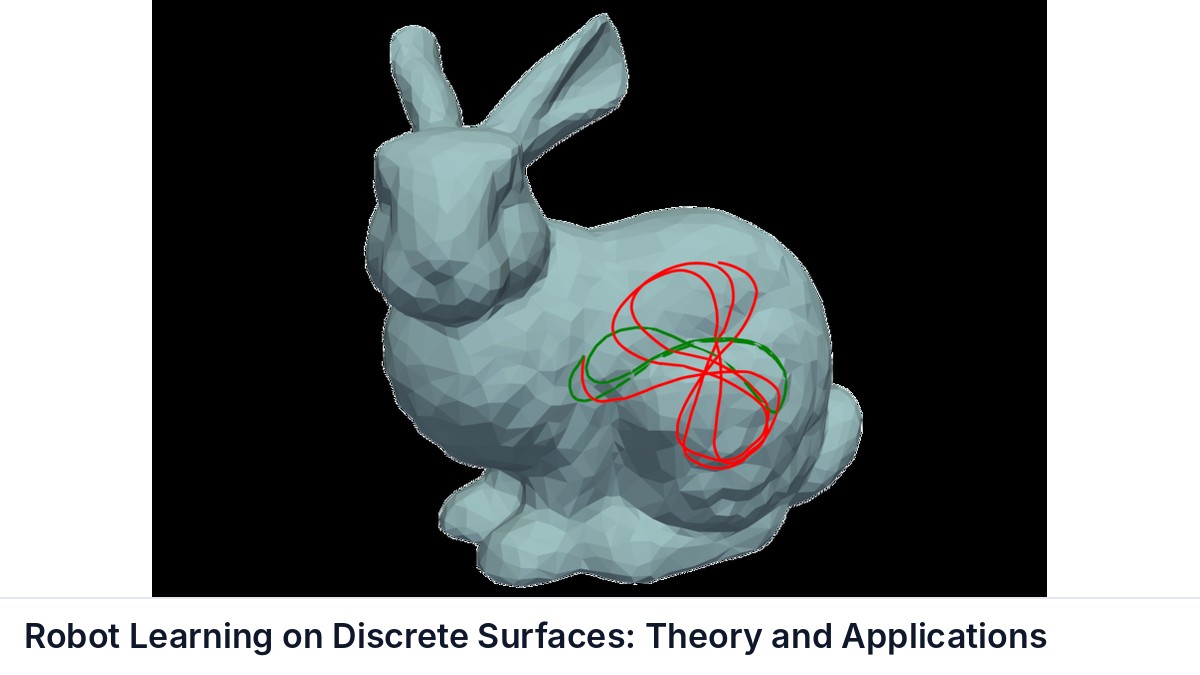
Robot Learning on Discrete Surfaces: Theory and Applications
Matteo Dalle Vedove, Fares J. Abu-Dakka, Luigi Palopoli, Daniele Fontanelli, Matteo Saveriano · N/A · 2026
Framework
N/A
License
N/A
Stars
N/A
Summary
All the objects composing our world are enclosed within surfaces. Yet, most robot learning and motion generation frameworks treat surfaces as constraints ignoring their intrinsic geometry.
Abstract Summary
Key Points
- All the objects composing our world are enclosed within surfaces
- Yet, most robot learning and motion generation frameworks treat surfaces as constraints ignoring their intrinsic geometry.
- This gap is acute for polyhedral meshes--the standard output of CAD and 3D reconstruction--whose discrete geometric structure remains unexploited.
- In this paper, we propose a unified discrete Riemannian framework that enables robot learning directly on polyhedral surface meshes.
- Using discrete differential geometry, we define logarithmic and exponential maps, parallel transport, and ambient-space projections that remain well-defined across faces, edges, and vertices.
Methodology
In this work, we aim at extending methods defined for Riemannian manifolds to polyhedral meshes. For this reason, it is necessary to investigate how to properly define the operators described in Sec. III-A , namely logarithmic and exponential maps, and parallel transport, in the space of meshes $\mathcal{M}$.
On smooth manifolds, it is always possible to define a locally linear approximation of $\mathbb{M}$ at a point $p$, the tangent space $T_{p}\mathbb{M}$.
Simulation Results
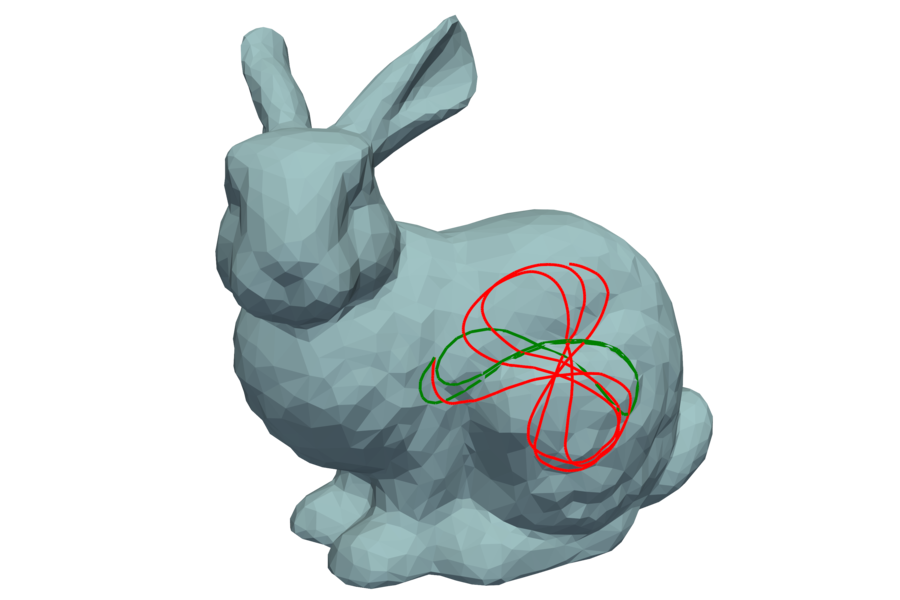
In this section, we evaluate and compare the proposed methodology against state-of-the-art approaches. Section V-A compares our DMP with the MeshDMP framework [ 9 ] , Sec V-B compares our geodesic-based squared exponential kernel with the one computed from the Laplace-Beltrami operator introduced in [ 10 ] , while Sec. V-C compares our Mesh Flow Matching against the RFM approach in [ 4 ] .
Our method has been implemented fully in C++ and it relies on the CGAL library for polyhedral mesh operations [ 49 , 50 ] . Experiments in Sec.
Experiments
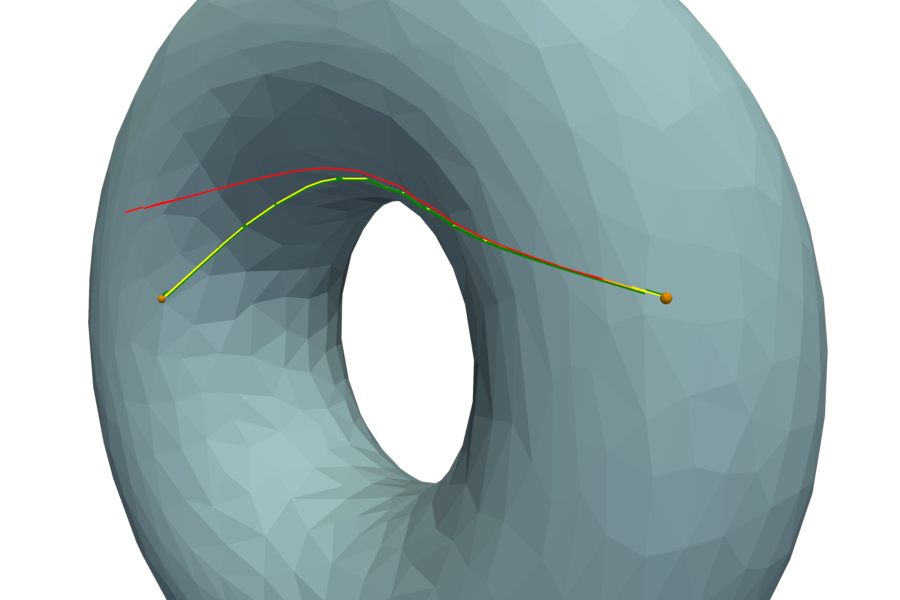
The key feature of DMPs is their high generalisation capability, which enables the execution of motion policies to new, unseen initial and final condition while preserving the topology of the learned path by exploiting spatial and temporal invariance properties.
As highlighted in ( 22 ) and ( 23 ), exploiting the definition of surface operators on discrete manifolds, it is possible to learn motion policies that can be transferred to different meshes.
Sources and Demonstrations
Figures are reproduced from Vedove et al. See the full paper for experimental details and the project page, when the paper links one, for demonstrations and videos.
Related Papers
A Browser-Native Digital Test Range for Benchmarking 4D Ocean-Glider Planning Algorithms
Edward Holmberg, Elias Ioup, Mahdi Abdelguerfi
Repeated in-situ evaluation of ocean-glider planners requires scarce vehicles, operators, deployment and recovery resources, and ocean conditions that cannot be reset for competing algorithms.
A Low-Cost, Open Platform for End-to-End Autonomous Driving on a Miniature Ackermann Vehicle
Gustavo Claudio Karl Couto, Eric Aislan Antonelo, Gabriel George Zipperer
This paper presents a low-cost, open experimental platform for research in end-to-end autonomous driving with miniature Ackermann vehicles.
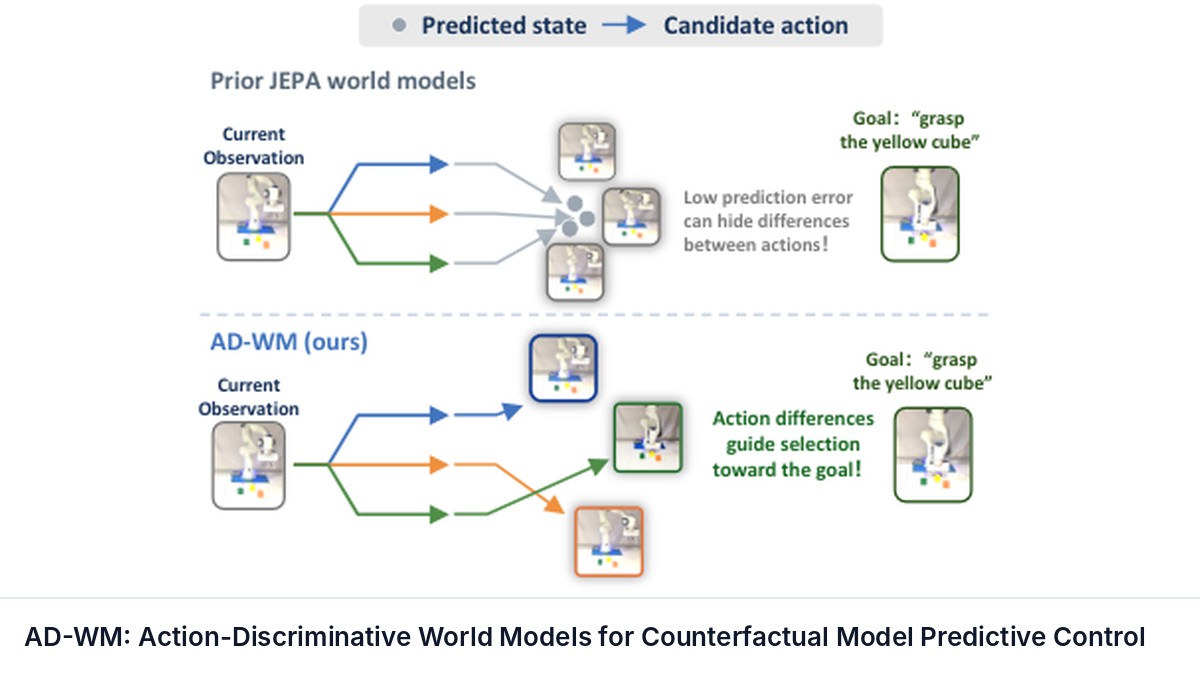
AD-WM: Action-Discriminative World Models for Counterfactual Model Predictive Control
Jiabin Qiu, Zixuan Chen, Hongye Cao et al.
Latent world models are typically trained to predict factual transitions, whereas model predictive control (MPC) must compare alternative actions from the same state. A model can therefore achieve low factual prediction error yet poorly distinguish candidate actions.
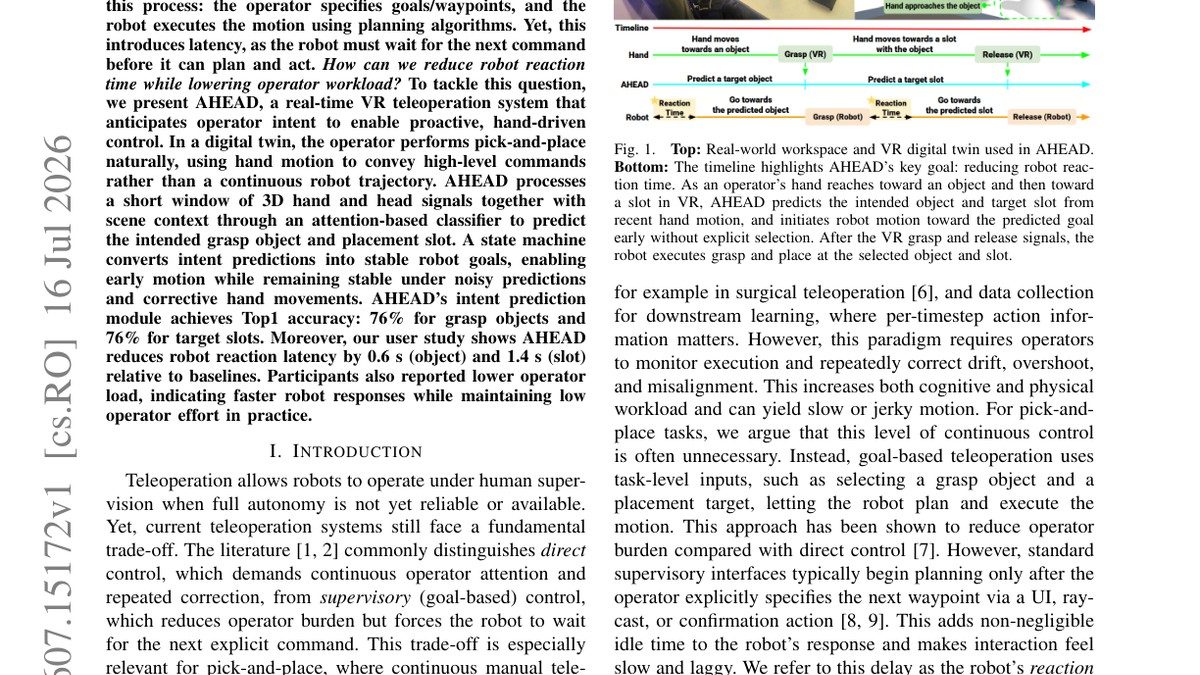
AHEAD: Anticipatory Hand-Driven Teleoperation via Human Intent Prediction
Seok Joon Kim, Junho Lee, Federica Spinola et al.
Direct hand-driven teleoperation maps an operator's hand motion to robot end-effector commands at every frame, enabling precise control, but it requires constant monitoring and correction during approach, grasp, and placement, which can be slow and fatiguing.