
Illumination-Aware Active Perception for Spacecraft Inspection
Sagarika Rao Valluri, Benjamin Riviere · N/A · 2026
Framework
N/A
License
N/A
Stars
N/A
Summary
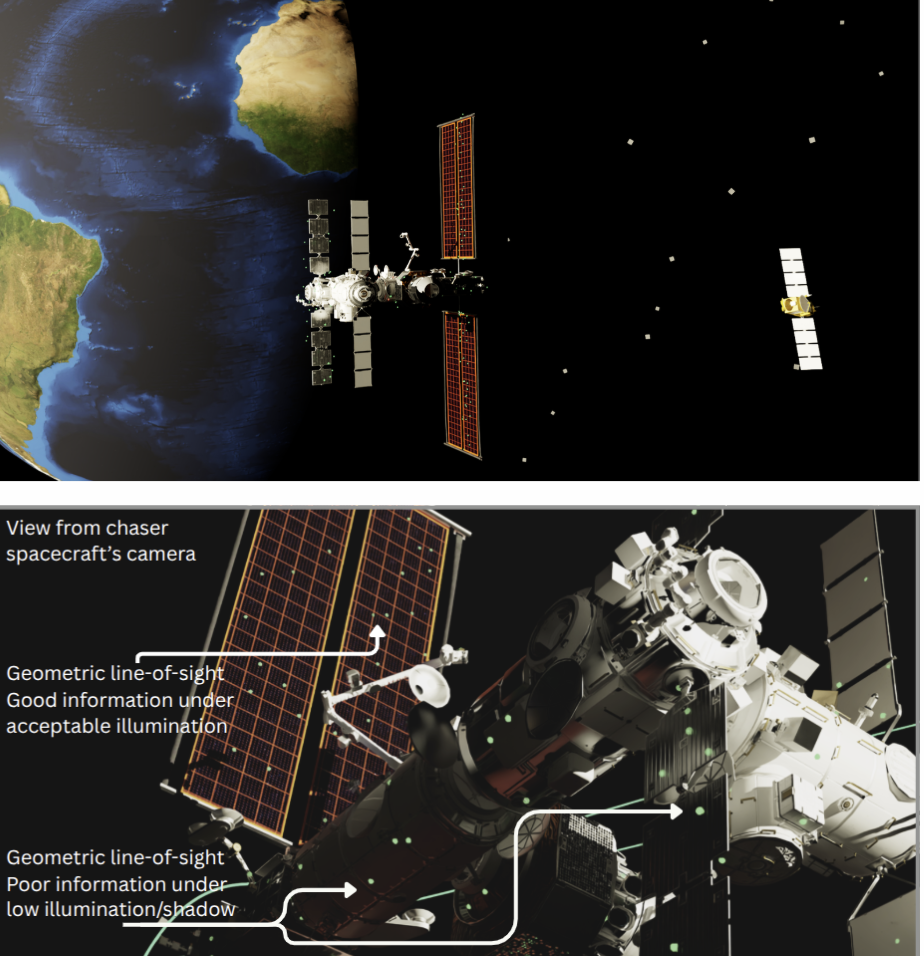
Harsh and rapidly varying orbital illumination introduces failure modes during spacecraft inspection. Existing planners rely on line-of-sight inspection metrics which perform occlusion checks against a known target and conflate geometric visibility with task-relevant information.
Abstract Summary
Key Points
- Harsh and rapidly varying orbital illumination introduces failure modes during spacecraft inspection
- Existing planners rely on line-of-sight inspection metrics which perform occlusion checks against a known target and conflate geometric visibility with task-relevant information.
- These metrics overlook illumination effects including eclipse, self-shadowing, and specular reflection from spacecraft materials and tend to declare components as inspected despite the corresponding images lacking sufficient information.
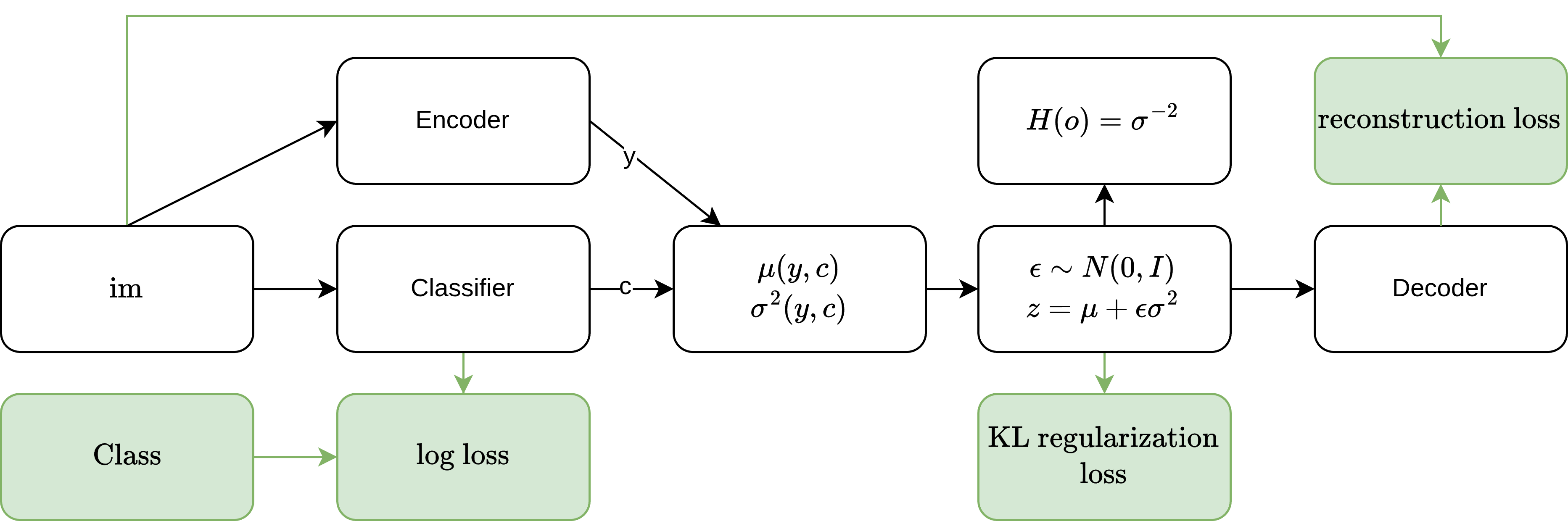
- We propose an inspection-planning framework that replaces geometric visibility with a learned measure of camera information derived from a classifier variational autoencoder (VAE) that operates directly on the captured image.
- The encoder model is trained to classify spacecraft surface components from rendered patches, and its total latent variance is used to learn the varying illumination of said components, replacing binary visibility checks with a continuous, image-grounded quantity.
Problem Statement
The inspection task is formulated as a Markov Decision Process (MDP) [ 27 ] as $M={S,A,T,R,\gamma}$ where $S$ corresponds to the state space, $A$ to the action space , $T$ is the transition kernel and $R$ is the reward function. No discount factor is used in determining the reward. We use k subscript for the points of interest (POI) index.
State Space : The complete state $s$ is a combination of the physical state $x$ and inspection $z$: $s=[x;z]$.
Guidance, Navigation, and Control (GN&C) System Architecture
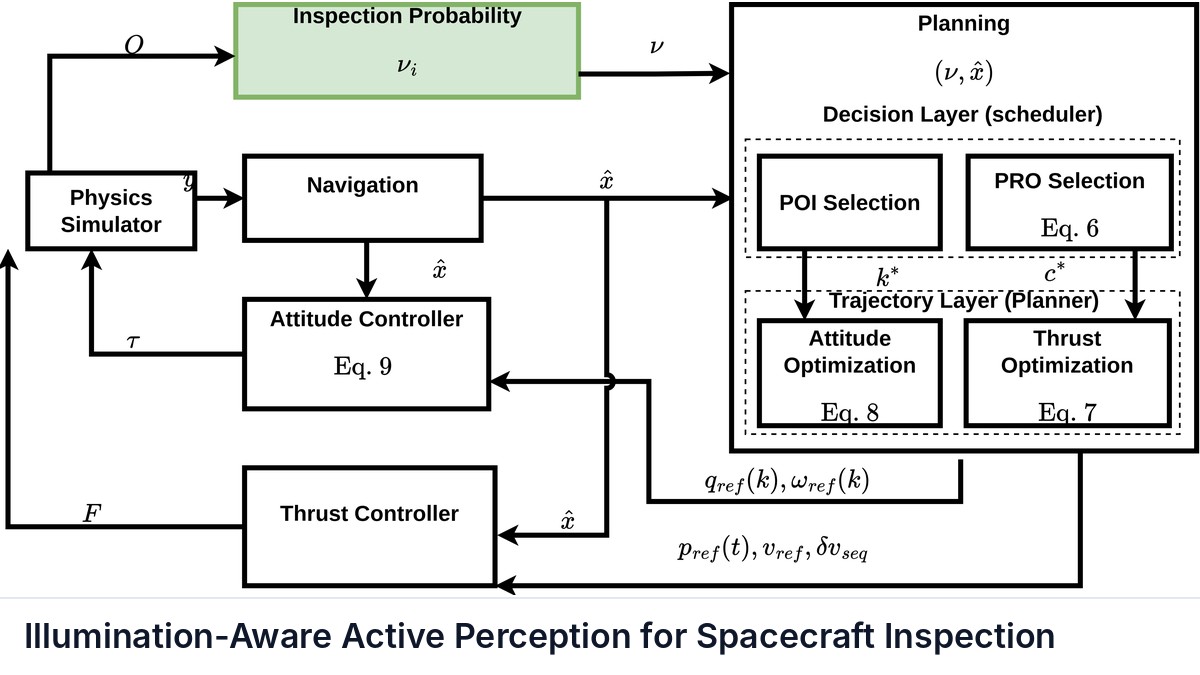
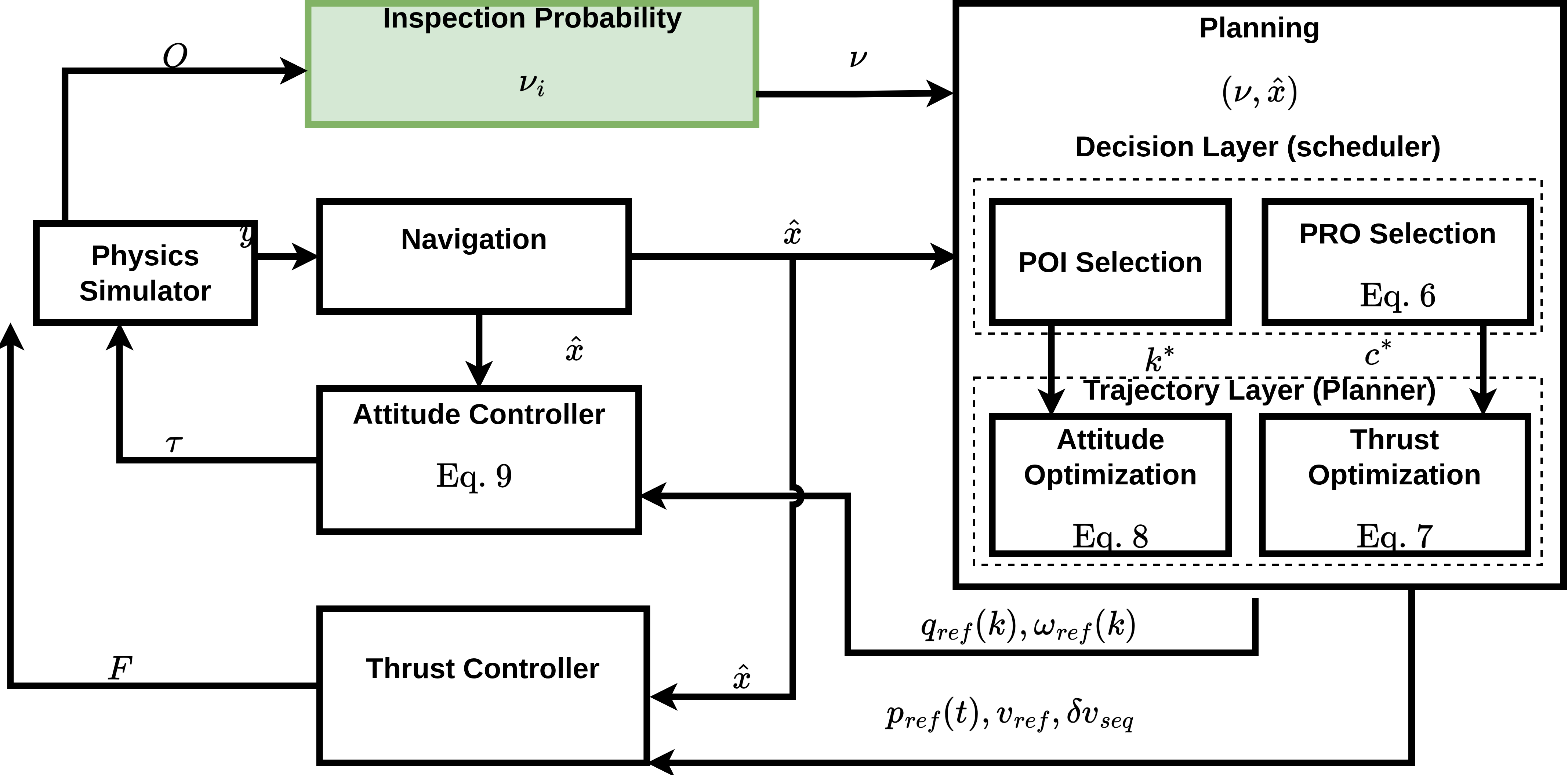
The GN&C system architecture is shown in (Fig. 2 ): navigation, discrete planning, continuous planning, attitude control, thrust control, and inspection metric and are discussed in the section below as part of a closed loop model.
Navigation The navigation model produces the perfect physical state $x=[q_{c};\dot{q}_{c};q_{t};\dot{q}_{t}]$ and all quantities are directly read from the simulator with zero measurement noise for chaser and target. Given perfect physical state we realize a hierarchical planning algorithm. Discrete Planning.
Methods
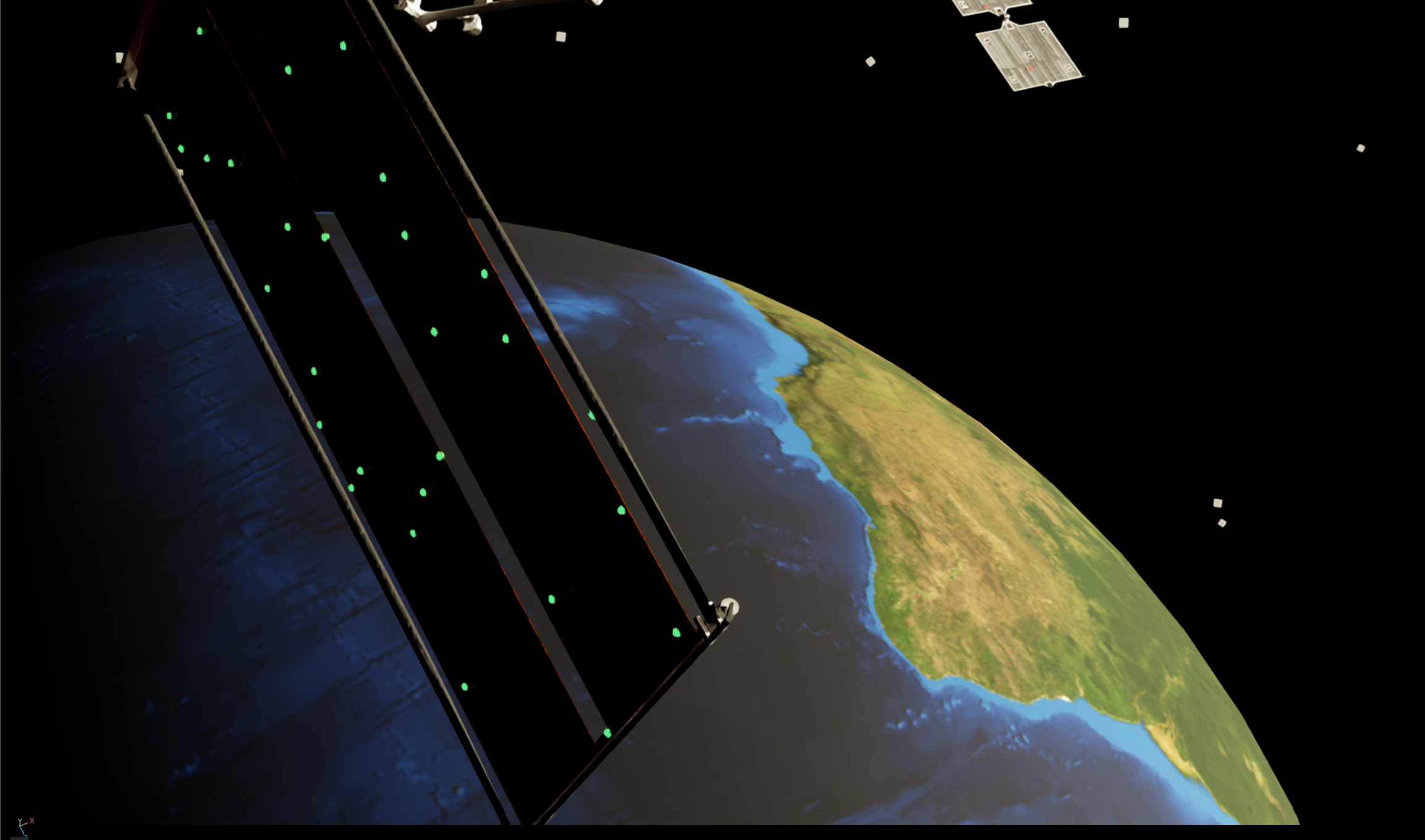
The complete GNC stack is implemented in NVIDIA Isaac Sim with the Lunar Gateway as a USD asset; the chaser carries a single forward-facing camera rendering $256\times 256$ RGB frames through the photorealistic ray-traced pipeline.
All three inspection probabilities share the planner machinery, PRO pool, SCP transfer, attitude QP, controllers, chaser, target, and environment, differing only in the detection probability $\nu_{k}(x)$ of the inspection transition in Eq. (1).
Experiments
A quantitative and qualitative analysis are presented to test the three different inspection probabilities. The experimental set up in IsaacSim used open source Nasa models [ 23 ] of the Lunar Gateway for the target and a general satellite model adapted from CloudSat models for the chaser along with an Earth, Moon and Sun module.
A quantitative analysis is presented to test the three detection probability functions $\nu_{1}$, $\nu_{2}$ and $\nu_{3}$ under identical initial conditions.
Sources and Demonstrations
Figures are reproduced from Valluri et al. See the full paper for experimental details and the project page, when the paper links one, for demonstrations and videos.
Related Papers
A Low-Cost, Open Platform for End-to-End Autonomous Driving on a Miniature Ackermann Vehicle
Gustavo Claudio Karl Couto, Eric Aislan Antonelo, Gabriel George Zipperer
This paper presents a low-cost, open experimental platform for research in end-to-end autonomous driving with miniature Ackermann vehicles.
Aim Short to Reach Far: Your Frozen World Model Can Plan Better Than You Think
Xvyuan Liu, Jianjie Fang, Chen Gao et al.
Planners built on visual world models commonly score each predicted outcome by its distance to the encoded goal image. We show that this target can limit control even with exact dynamics and globally optimal short-horizon search: reaching a goal may require actions that initially move away from it.
Autonomous Droplet Navigation via Model-Based Reinforcement Learning: Zero-Shot Transfer and Emergent Dynamics
Rajneesh Anand, Mayuresh V. Kothare
Self-driving laboratories (SDLs) are transforming chemical and materials discovery through closed-loop automation, yet automated infrastructure for physical manipulation of soft, deformable matter remains beyond current robotic platforms.
Autoware in Construction: Gap Analysis and LiDAR Perception Toward Off-Road Autonomous Driving
Yu Otsuki, Teja Emmey, Sena Matsushita et al.
Autoware is an open-source autonomous driving software platform widely adopted by researchers and industry developers.