
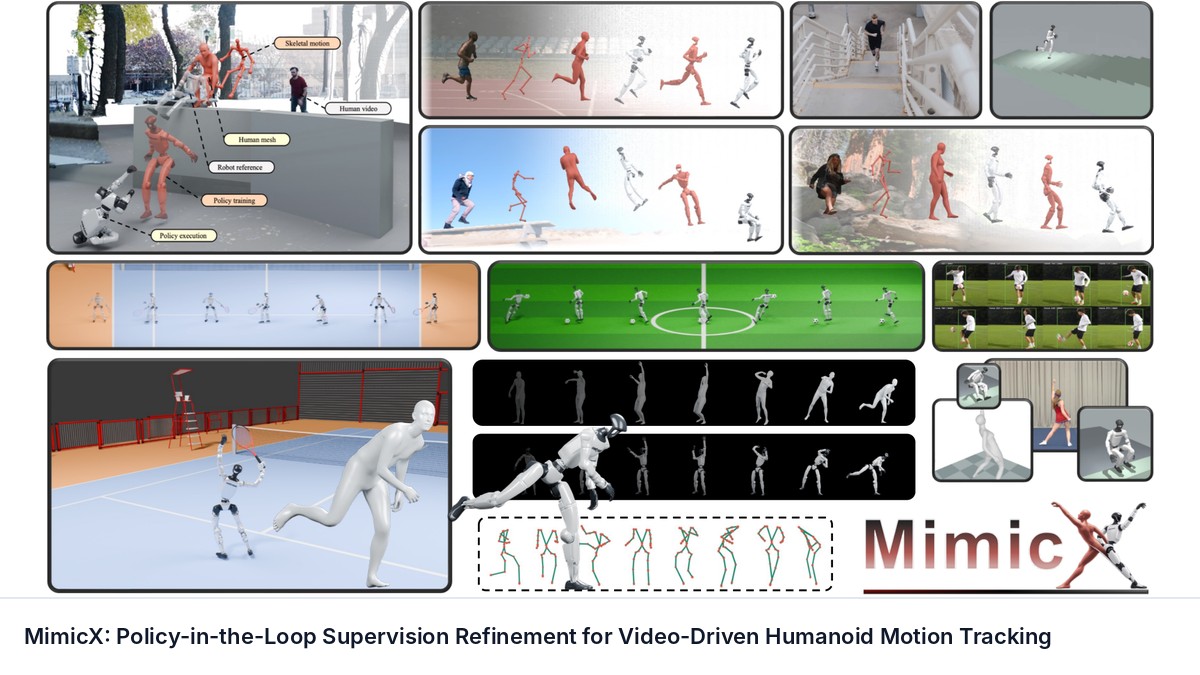
MimicX: Policy-in-the-Loop Supervision Refinement for Video-Driven Humanoid Motion Tracking
Shuaijun Liu, Chenglong Zhang, Xuhao Liu, Feiyang You, Yifan Liao, Shuyang Hao, Chaozhe Zhang, Chengyu Wu, Zhen Sun, Ningxin Su · N/A · 2026
Framework
N/A
License
N/A
Stars
N/A
Summary
Human videos provide rich motion targets for humanoid learning, yet visually plausible references can still produce persistent failures under physics-based execution. These failures reveal where training supervision should change.
Abstract Summary
Key Points
- Human videos provide rich motion targets for humanoid learning, yet visually plausible references can still produce persistent failures under physics-based execution.
- These failures reveal where training supervision should change
- We present MimicX, a policy-in-the-loop framework that uses execution feedback to refine video-driven humanoid motion tracking.
- Starting from reconstructed and retargeted motion, MimicX localizes difficult transitions and affected body regions, then jointly adapts tracking objectives and the reset curriculum for policy continuation.
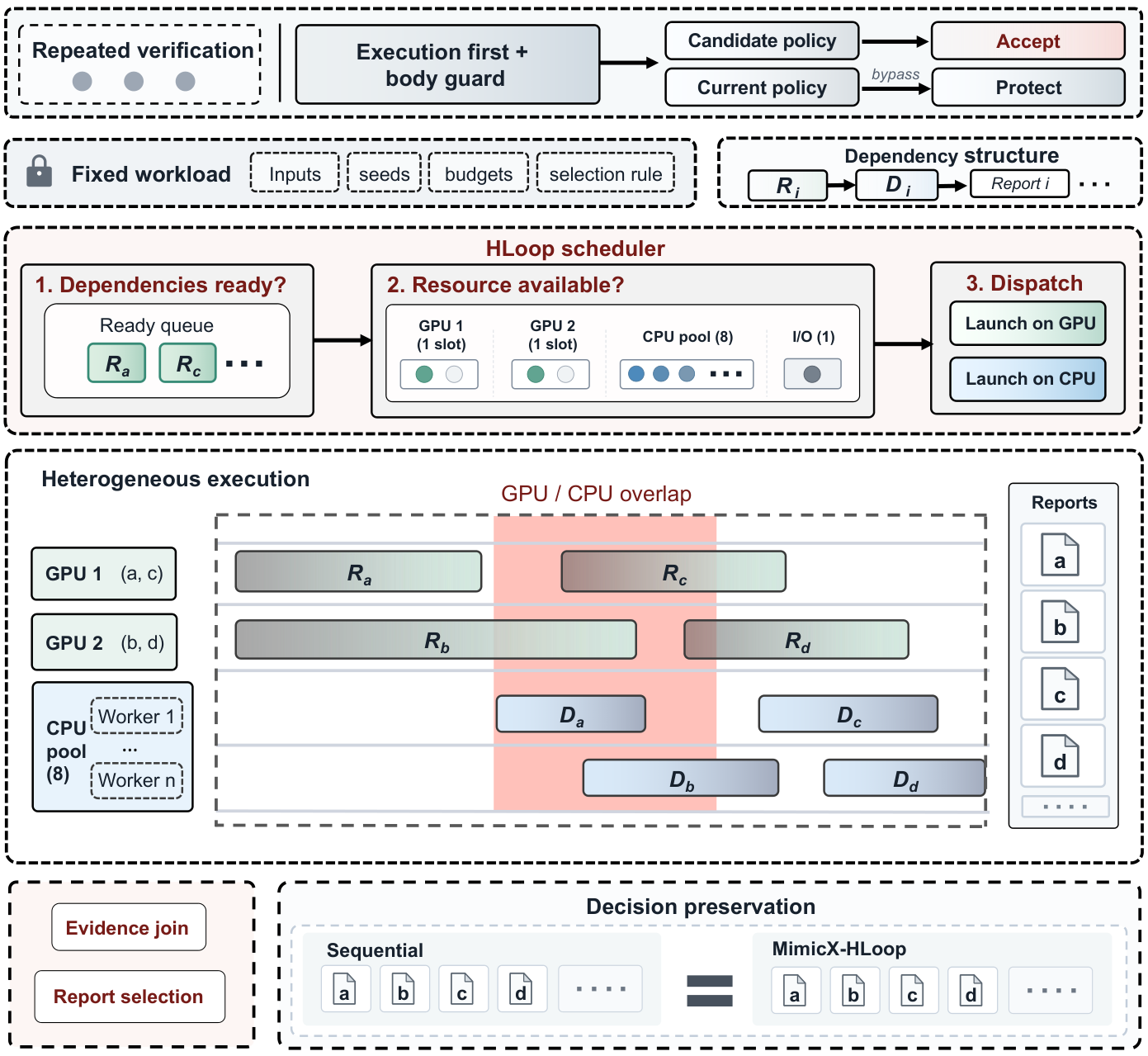
- Repeated rollout verification selects execution-priority improvements subject to tracking guards
Policy-in-the-Loop Supervision Refinement
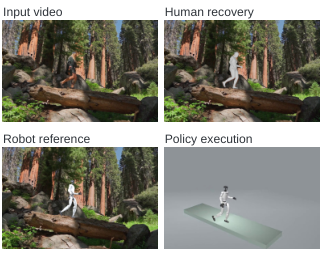
The outer loop uses execution errors to revise the supervision of a tracking policy. Its input is a motion reference and a current policy; its output is the policy retained after repeated execution verification. Given a monocular video, GVHMR reconstructs world-grounded SMPL-X motion and GMR retargets it to the humanoid ( Shen et al., 2024 ; Pavlakos et al., 2019 ; Araujo et al., 2025 ) .
Experimental Setup
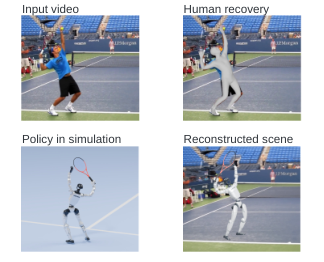
We evaluate whether execution feedback improves tracking, how the supervision components contribute, and whether verification and heterogeneous execution make refinement reliable and efficient. The core tasks are Tennis Swing, Football Juggling, Dance Sequence, and Kung Fu Sequence on a 29-DoF Unitree G1 in MuJoCo/MjLab. Simulation runs at 200 Hz and the PPO policy at 50 Hz.
Results
MimicX improves body-tracking error and Robust Execution Horizon in all twelve task-matched comparisons against Fixed Reference (Figure 5 , Table 1 ). Task-level averaging yields a 25.7% reduction in body error and a 255.6% increase in horizon. Tennis reaches full-horizon success in all nine evaluations.
These results show that execution-conditioned supervision improves both motion fidelity and progress through demanding transitions. The paired results show that the gains extend across error channels (Table 11 ).
Sources and Demonstrations
Figures are reproduced from Liu et al. See the full paper for experimental details and the project page, when the paper links one, for demonstrations and videos.
Related Papers
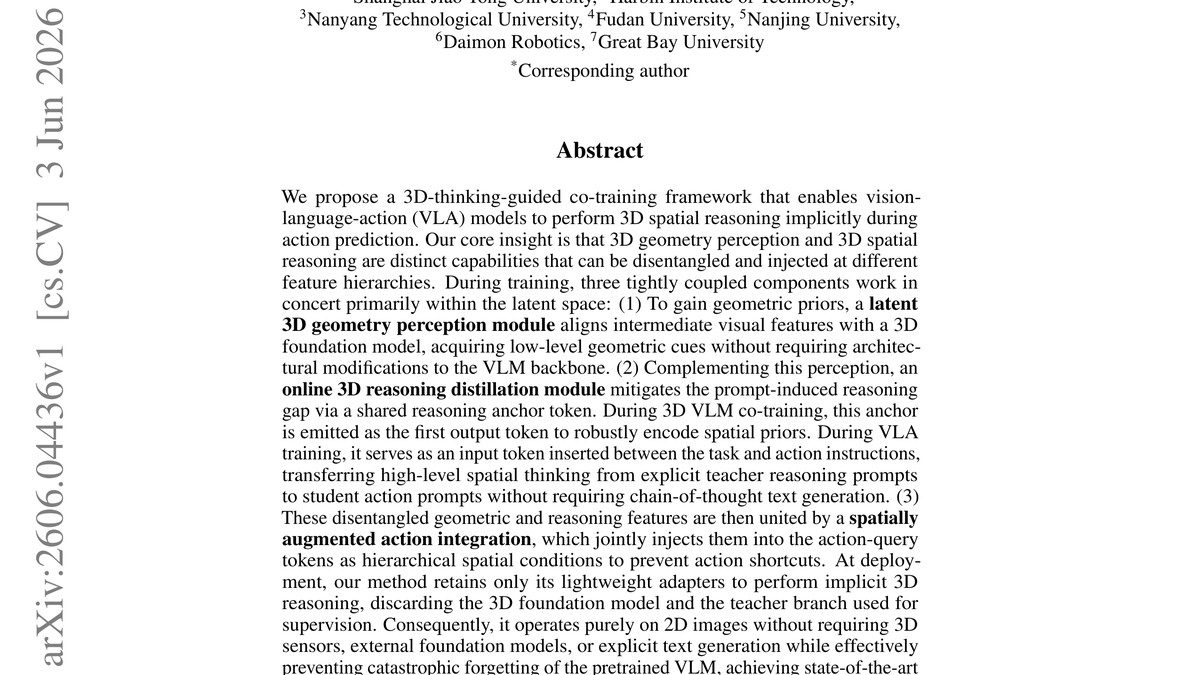
3DThinkVLA: Endowing Vision-Language-Action Models with Latent 3D Priors via 3D-Thinking-Guided Co-training
Jiaxin Shi, Xidong Zhang, Fucai Zhu et al.
We propose a 3D-thinking-guided co-training framework that enables vision-language-action (VLA) models to perform 3D spatial reasoning implicitly during action prediction.
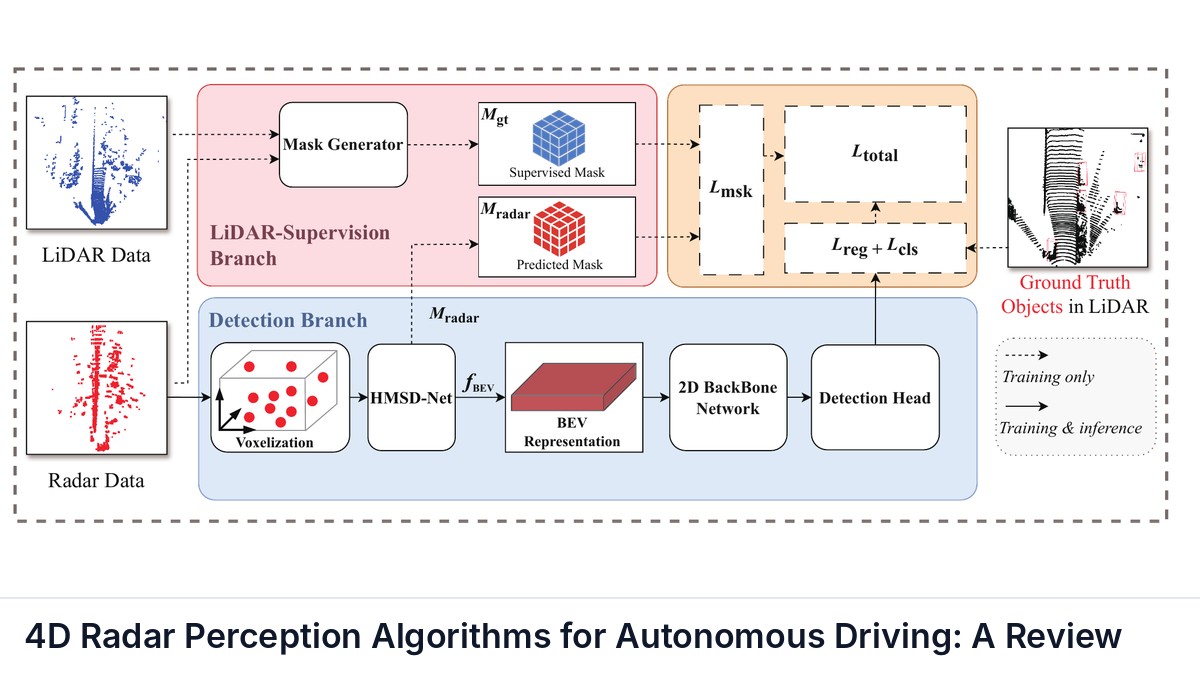
4D Radar Perception Algorithms for Autonomous Driving: A Review
Xumin Wu, Jun Zhou, Jilin Mei et al.
Research on 4D millimeter-wave radar perception algorithms has flourished in recent years, extending from signal processing and object detection to semantic segmentation, motion estimation, occupancy prediction, and dynamic scene reconstruction.
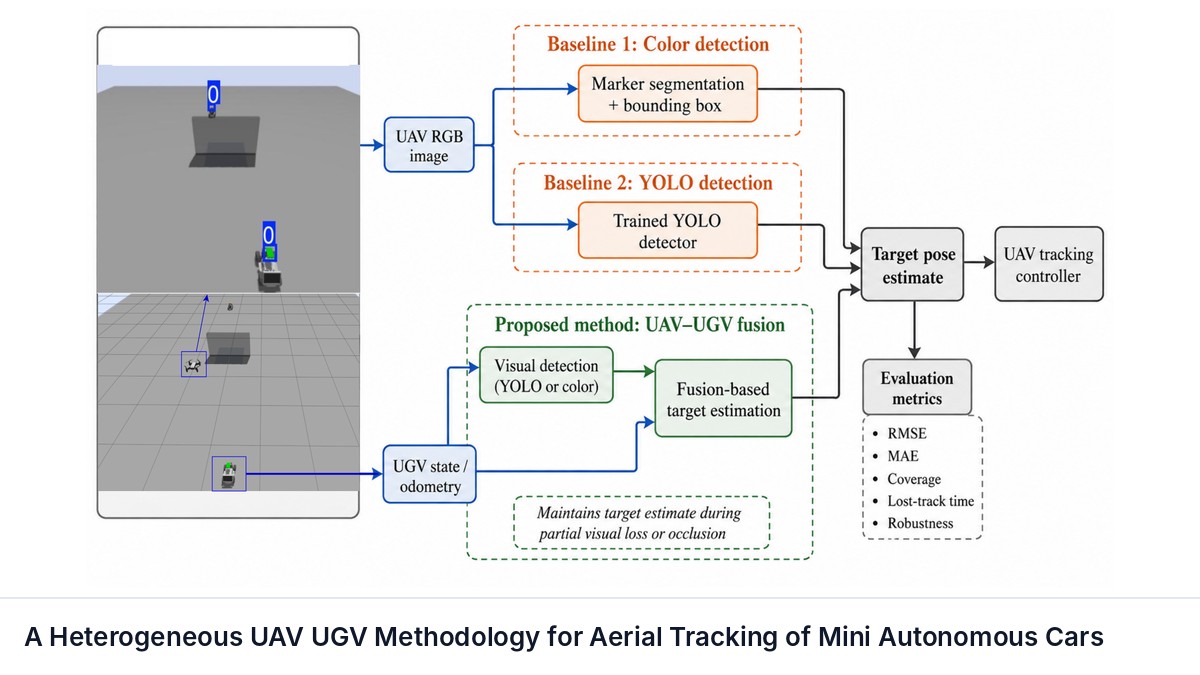
A Heterogeneous UAV UGV Methodology for Aerial Tracking of Mini Autonomous Cars
Santiago Fernandez, Angel da Silva, Hiago Sodre et al.
Aerial tracking of autonomous ground vehicles can provide useful situational awareness in environments where fixed external perception infrastructure is unavailable.
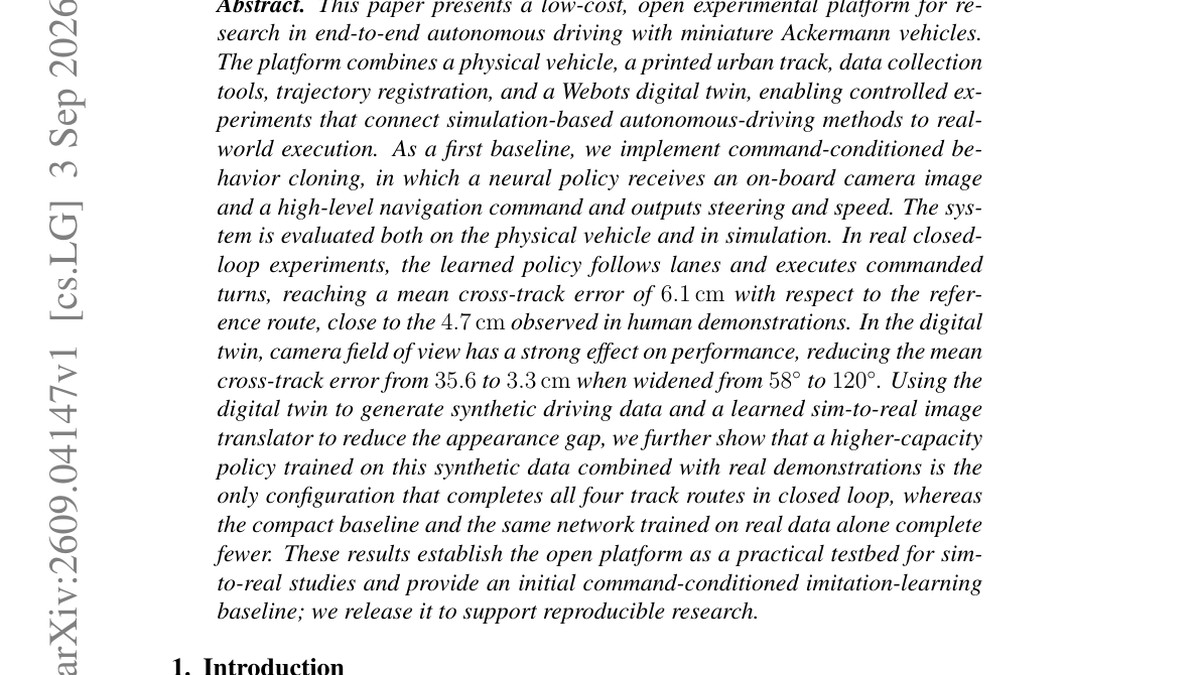
A Low-Cost, Open Platform for End-to-End Autonomous Driving on a Miniature Ackermann Vehicle
Gustavo Claudio Karl Couto, Eric Aislan Antonelo, Gabriel George Zipperer
This paper presents a low-cost, open experimental platform for research in end-to-end autonomous driving with miniature Ackermann vehicles.