
H-SPAR: Hydrodynamic-aware Simulation for Particle Transport and Autonomous Robots
Navid Zarrabi, Nariman Yousefi, Sajad Saeedi · N/A · 2026
Framework
N/A
License
N/A
Stars
N/A
Summary
Environmental robotic sampling requires considering the dual influence of water currents on robotic motion and particle transport. Existing marine robotics simulators generally model flow, autonomy, and sampling targets separately, limiting joint evaluation of mission cost and sampling performance.
Abstract Summary
Key Points
- Environmental robotic sampling requires considering the dual influence of water currents on robotic motion and particle transport.
- Existing marine robotics simulators generally model flow, autonomy, and sampling targets separately, limiting joint evaluation of mission cost and sampling performance.
- H-SPAR integrates spatially and temporally varying velocity fields, Lagrangian particle transport, probabilistic sampling, and ROS 2/Gazebo-based uncrewed surface vehicle (USV) autonomy.
- In this work, shared precomputed flow fields drive particle advection and current-induced forces during closed-loop vehicle execution.
- Path-planning experiments show that the existing current-aware planner SVF-RRT* achieves 69.4% lower upstream cost than conventional RRT* at the planning level, but this reduction falls to 41.7% during execution under time-varying currents, reflecting temporal flow variation, vehicle motion constraints, and path deviation omitted during planning.
H-SPAR: Hydrodynamic-aware Simulation for Particle Transport and Autonomous Robots
|Authors: Navid Zarrabi, Nariman Yousefi, Sajad Saeedi
|Venue: arXiv preprint | Year: 2026
|arXiv: 2610.01985v1
Abstract
Environmental robotic sampling requires considering the dual influence of water currents on robotic motion and particle transport. Existing marine robotics simulators generally model flow, autonomy, and sampling targets separately, limiting joint evaluation of mission cost and sampling performance. H-SPAR integrates spatially and temporally varying velocity fields, Lagrangian particle transport, probabilistic sampling, and ROS 2/Gazebo-based uncrewed surface vehicle (USV) autonomy. In this work, shared precomputed flow fields drive particle advection and current-induced forces during closed-loop vehicle execution. Path-planning experiments show that the existing current-aware planner SVF-RRT* achieves 69.4% lower upstream cost than conventional RRT* at the planning level, but this reduction falls to 41.7% during execution under time-varying currents, reflecting temporal flow variation, vehicle motion constraints, and path deviation omitted during planning. Coverage experiments show that sweep orientation changes the particle-sampling rate by up to 22.2% under the complete H-SPAR configuration. These findings highlight the importance of evaluating planning, vehicle execution, particle transport, and sampling together under consistent hydrodynamic conditions. The project webpage is available at https://sites.google.com/view/h-spar, and the open-source code is available on GitHub at https://github.com/naviiidz/h-spar-sim.
Key Contributions
- Environmental robotic sampling requires considering the dual influence of water currents on robot…
- Existing marine robotics simulators generally model flow, autonomy, and sampling targets separate…
- H-SPAR integrates spatially and temporally varying velocity fields, Lagrangian particle transport…
- In this work, shared precomputed flow fields drive particle advection and current-induced forces …
- Path-planning experiments show that the existing current-aware planner SVF-RRT* achieves 69.4% lo…
Topics
- planning
- benchmark
Code & Data
- GitHub repository: https://github.com/naviiidz/h-spar-sim.git
BibTeX
@article{Zarrabi2026_261001985v1,
  title     = {H-SPAR: Hydrodynamic-aware Simulation for Particle Transport and Autonomous Robots},
  author    = {Navid Zarrabi and Nariman Yousefi and Sajad Saeedi},
  year      = {2026},
  eprint    = {2610.01985v1},
  archivePrefix = {arXiv},
  primaryClass  = {cs.RO},
  url       = {https://arxiv.org/abs/2610.01985v1}
}
Related Papers
A Browser-Native Digital Test Range for Benchmarking 4D Ocean-Glider Planning Algorithms
Edward Holmberg, Elias Ioup, Mahdi Abdelguerfi
Repeated in-situ evaluation of ocean-glider planners requires scarce vehicles, operators, deployment and recovery resources, and ocean conditions that cannot be reset for competing algorithms.
Aim Short to Reach Far: Your Frozen World Model Can Plan Better Than You Think
Xvyuan Liu, Jianjie Fang, Chen Gao et al.
Planners built on visual world models commonly score each predicted outcome by its distance to the encoded goal image. We show that this target can limit control even with exact dynamics and globally optimal short-horizon search: reaching a goal may require actions that initially move away from it.
Beyond Episodic Evaluation: Memory Architectural Bottlenecks in Sequential Embodied Question Answering
Zikui Cai, Kaushal Janga, Tan Dat Dao et al.
Embodied question answering (EQA) is traditionally evaluated under an episodic formulation, where agents solve each task independently and reset internal state between episodes.
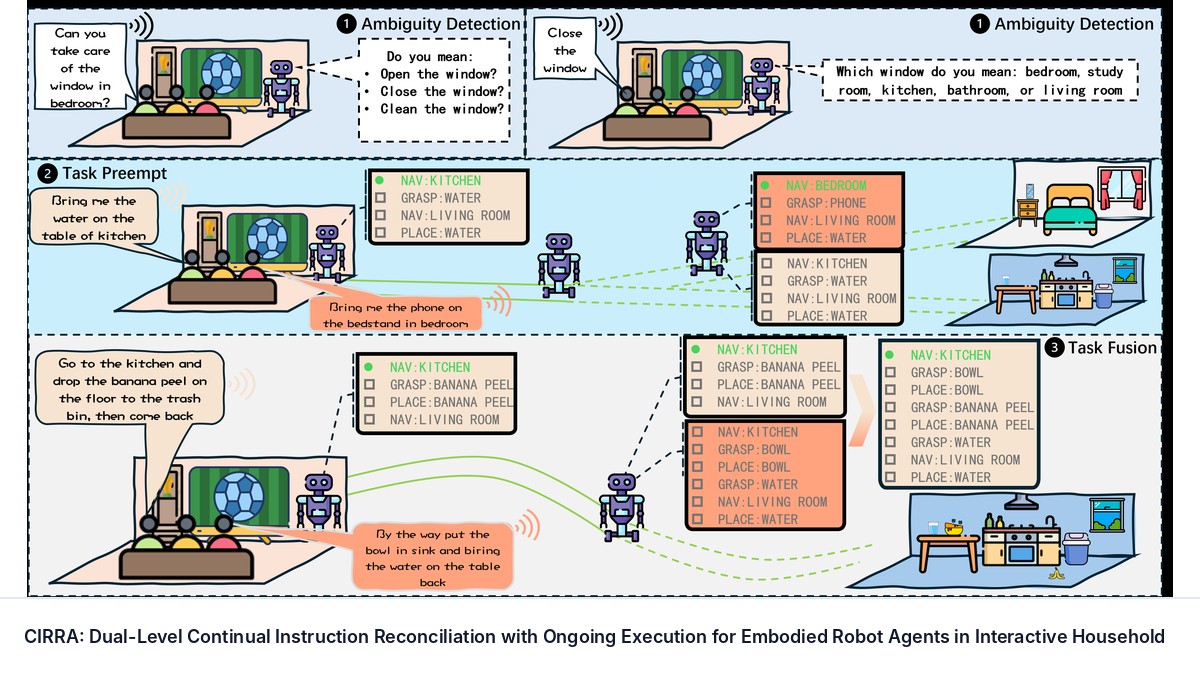
CIRRA: Dual-Level Continual Instruction Reconciliation with Ongoing Execution for Embodied Robot Agents in Interactive Household Tasks
Ci Zhang, Enfu Nan, Arman Akbari et al.
Household robots must accommodate new user instructions while executing ongoing tasks. Existing agents often regenerate or extensively revise the remaining task sequence, introducing plan ambiguity, logical inconsistency, and redundant execution.