
Value as Memory: Online Value-Guided Post-training for General Robot Policies
Wenye Yu, Yijin Chen, Kaiyi Xiong, Wenbo Han, Wendi Chen, Yang Jin, Han Xue, Jun Lv, Cewu Lu, Chuan Wen · N/A · 2026
Framework
N/A
License
N/A
Stars
N/A
Summary
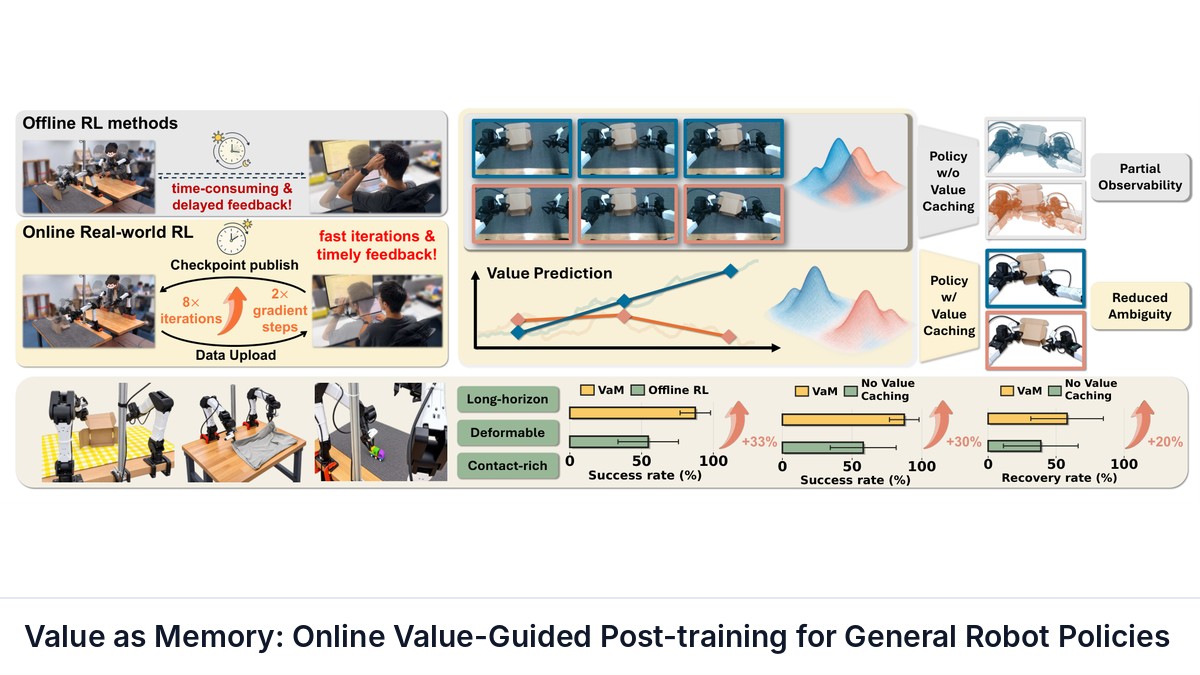
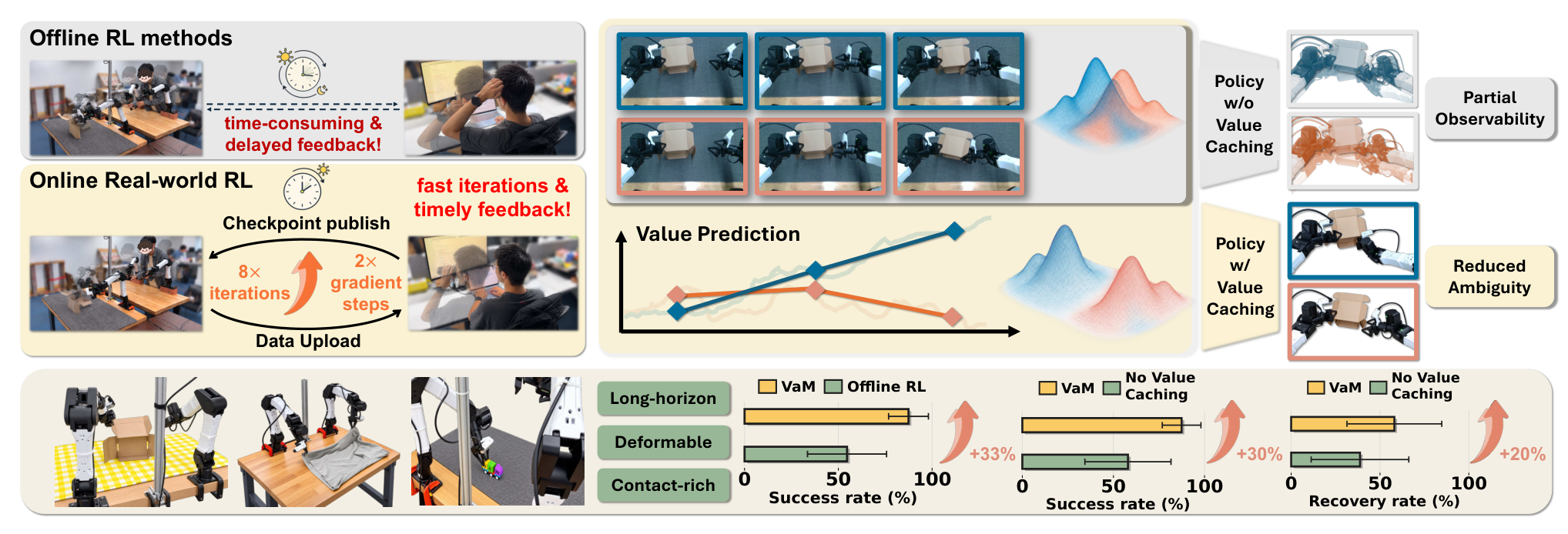
Real-world post-training of generalist robot policies faces two challenges: partial observability makes action selection ambiguous, while offline post-training methods delay feedback from deployment experience.
Abstract Summary
Key Points
- Real-world post-training of generalist robot policies faces two challenges: partial observability makes action selection ambiguous, while offline post-training methods delay feedback from deployment experience.
- We present Value as Memory (VaM), a framework that addresses these challenges through value caching and online real-world reinforcement learning (RL).
- Value caching conditions actions on recent value predictions as task-progress memory, while online updates enable timely policy improvement by combining offline demonstrations, off-policy interventions, and on-policy rollouts for sample-efficient adaptation.
- As a result, VaM transitions from offline RL warmup to online autonomous learning with sparse rewards.
- Across long-horizon tasks involving deformable objects and contact-rich manipulation, VaM yields a mean absolute success-rate gain of $29.4\%$ with value caching, while achieving a $32.8\%$ gain with online autonomous learning over matched offline training.
Preliminaries
We model iterative robot post-training as a Markov Decision Process (MDP) $\mathcal{M}=(\mathcal{S},\mathcal{A},P,r,\gamma)$, where $\mathcal{S}$ and $\mathcal{A}$ are the state and action spaces, $P(s_{t+1}\mid s_{t},a_{t})$ is the transition kernel, $r(s_{t},a_{t})$ is the reward function, and $\gamma\in[0,1)$ is the discount factor.
The policy $\pi_{\theta}(a_{t:t+H}\mid s_{t})$ has parameters $\theta$ and predicts the action sequence $a_{t:t+H}=(a_{t},\ldots,a_{t+H-1})$, where $H$ is the prediction horizon.
Method
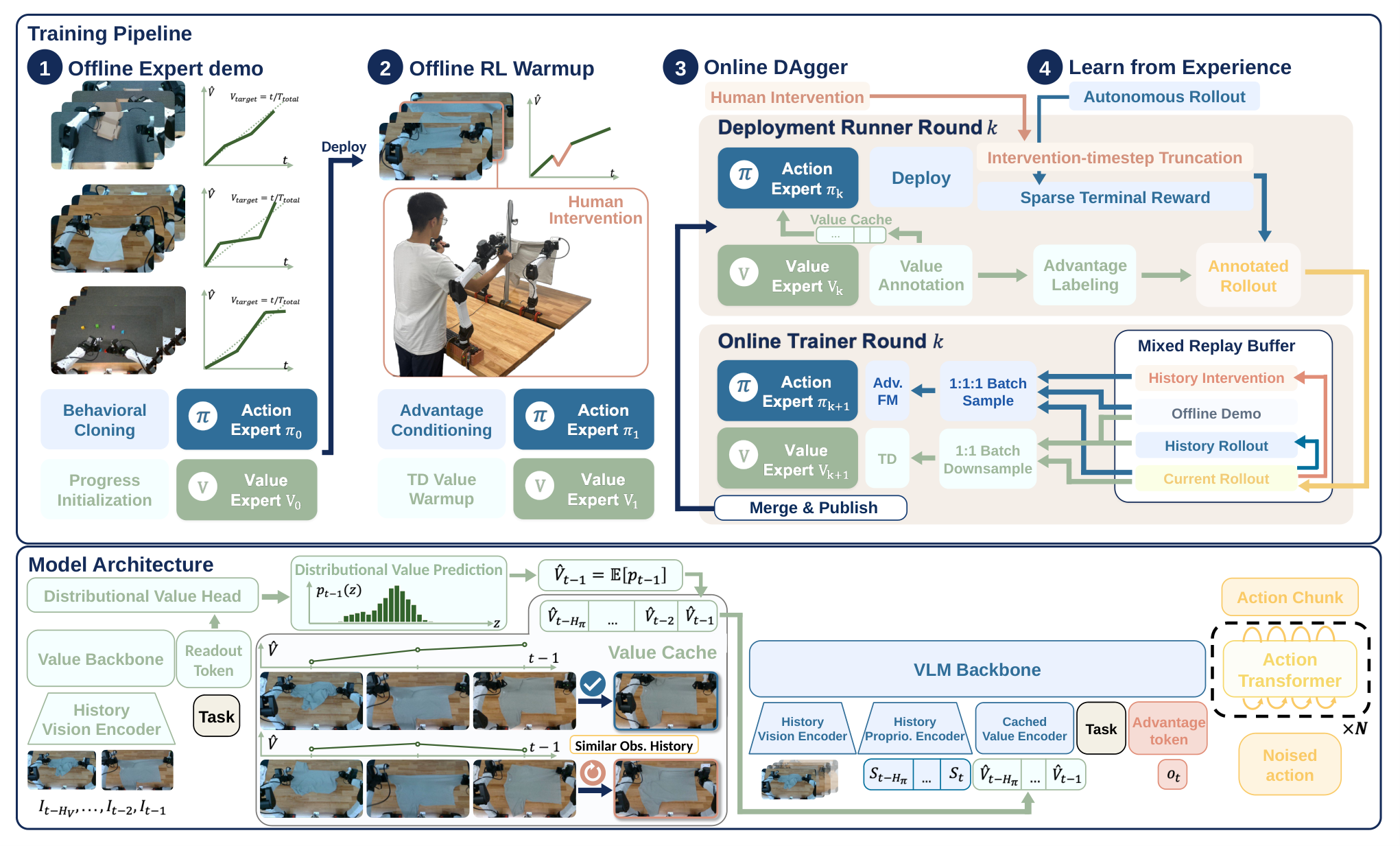
VaM uses a distributional value expert to supply recent progress predictions to the action expert through a value cache and advantage labels for policy post-training. Training proceeds through four stages: offline demonstration initialization, offline RL warmup, Online DAgger, and Learn from Experience (LfE). The value and action experts are updated in parallel during online RL.
Figure 2 summarizes this training pipeline and the value caching architecture.
Experiments
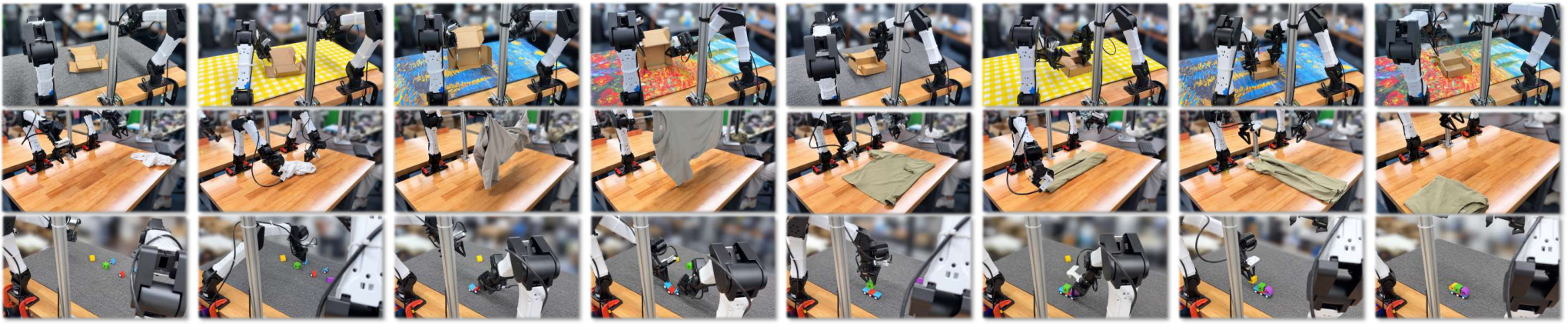
How much does value caching improve policy performance in RL post-training? Why does value caching improve policy performance? How much does VaM’s offline-to-online RL system enhance sample efficiency? We consider three real-world manipulation tasks, illustrated in Fig. 3 : Box Assembly , Laundry Folding , and Magnetic Bus Assembly .
All three tasks are long-horizon manipulation workflows that cover contact-rich assembly and deformable-object manipulation. Appendix A.1 provides the detailed procedure and success criterion for each task.
Sources and Demonstrations
Figures are reproduced from Yu et al. See the full paper for experimental details and the project page, when the paper links one, for demonstrations and videos.
Related Papers
A Balanced Data Diet: Addressing the Exploration Bottleneck in Mega-Scale RL for Robot Control
Octi Zhang, Mateo Guaman Castro, Patrick Yin et al.
General-purpose robots must perform a wide range of tasks from agile locomotion to dexterous manipulation.

A Sim-to-Real Integration Pipeline for Training and Deployment of Chunk-Based VLA Manipulation Policies
Mathilde Kappel, Clémence Grislain, Mohamed Chetouani et al.
Vision-Language-Action (VLA) models have become a prominent paradigm for mapping multimodal inputs, including semantic instructions, visual observations of the scene, and proprioceptive observations, to robot actions.
AHEAD: Anticipatory Hand-Driven Teleoperation via Human Intent Prediction
Seok Joon Kim, Junho Lee, Federica Spinola et al.
Direct hand-driven teleoperation maps an operator's hand motion to robot end-effector commands at every frame, enabling precise control, but it requires constant monitoring and correction during approach, grasp, and placement, which can be slow and fatiguing.
Behavioral Cloning Mystery
Seohong Park, Sergey Levine
Behavioral cloning (BC), despite its simplicity, exhibits many counterintuitive phenomena in the real world. For example, the performance of BC often keeps increasing as the model overfits more to the dataset, and fully closed-loop policies often completely fail without action chunking.