
Real-Time Service Robot Replanning via Simple Button Interaction for Improved Task Success and User Experience
Ryo Terashima, Yuga Yano, Koshun Arimura, Hakaru Tamukoh · N/A · 2026
Framework
N/A
License
N/A
Stars
N/A
Summary
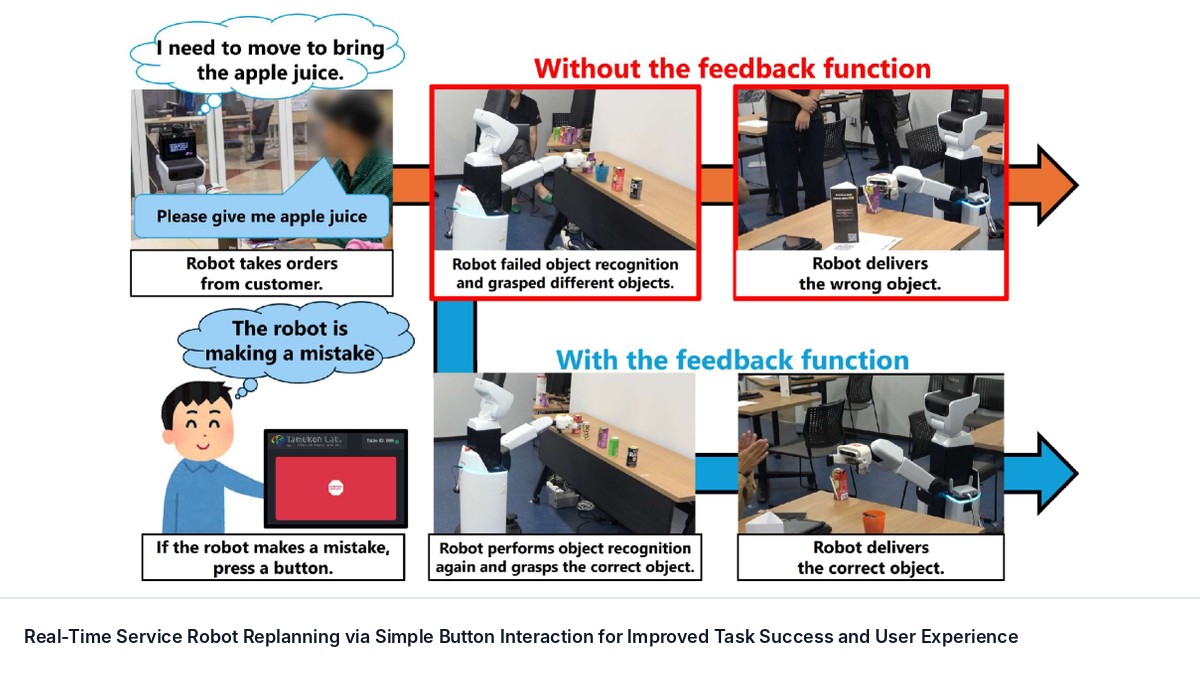
Service robots must respond to unexpected instructions in real-world environments. However, robots cannot detect all failures and exceptions during a task. To address these issues, we propose a real-time feedback function that enables robots to modify their behavior based on human feedback.
Abstract Summary
Key Points
- Service robots must respond to unexpected instructions in real-world environments
- However, robots cannot detect all failures and exceptions during a task
- To address these issues, we propose a real-time feedback function that enables robots to modify their behavior based on human feedback.
- In this system, users can intuitively send feedback to the robot by pressing a single button on a tablet when the robot fails to act correctly.
- Robots use this feedback to consider their failures and replan appropriate actions to complete the task.
Proposal
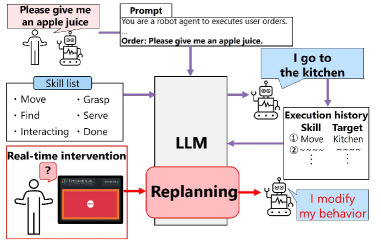
This study aims to enable the robot to recover from failures that it cannot detect, while minimizing the intervention burden imposed on the user. We propose a seamless real-time feedback function that enables humans to interact intuitively and easily with robots. Fig. 2 shows an overview of the proposed method.
The feedback function allows the robot to seamlessly modify its tasks by receiving feedback and modifying its behavior when the robot cannot detect failures itself.
Experiment
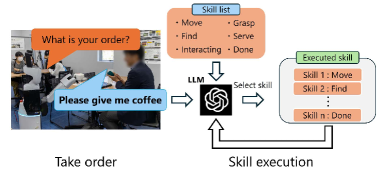
Restaurants increasingly require service robots to help waiters with tasks owing to labor shortages. Restaurant waiter tasks are challenging because robots require flexible responses to changes in orders, unexpected requests, and changes in real-world environments. Therefore, we focused on waiter tasks, including understanding orders, serving food, cleaning tables, and interacting with users.
In the experiment, we designed waiter tasks based on RoboCup@Home [ 17 ] , which is intended to operate a service robot indoors.
Sources and Demonstrations
Figures are reproduced from Terashima et al. See the full paper for experimental details and the project page, when the paper links one, for demonstrations and videos.
Related Papers
A Browser-Native Digital Test Range for Benchmarking 4D Ocean-Glider Planning Algorithms
Edward Holmberg, Elias Ioup, Mahdi Abdelguerfi
Repeated in-situ evaluation of ocean-glider planners requires scarce vehicles, operators, deployment and recovery resources, and ocean conditions that cannot be reset for competing algorithms.
A Low-Cost, Open Platform for End-to-End Autonomous Driving on a Miniature Ackermann Vehicle
Gustavo Claudio Karl Couto, Eric Aislan Antonelo, Gabriel George Zipperer
This paper presents a low-cost, open experimental platform for research in end-to-end autonomous driving with miniature Ackermann vehicles.
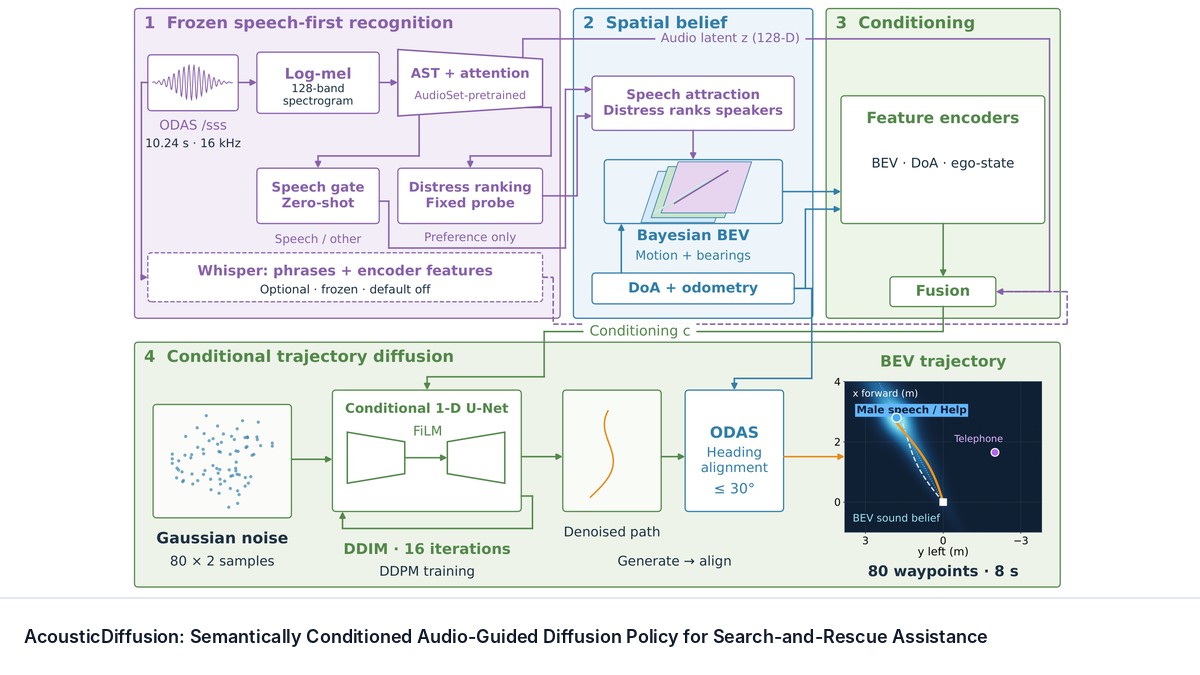
AcousticDiffusion: Semantically Conditioned Audio-Guided Diffusion Policy for Search-and-Rescue Assistance
Iana Zhura, Didar Seyidov, Dmitrii Plotnikov et al.
Navigating toward human callers is an important capability for rescue robots operating where visual contact is degraded or occluded. We present AcousticDiffusion, a semantically conditioned, audio-guided diffusion policy for human-directed navigation.
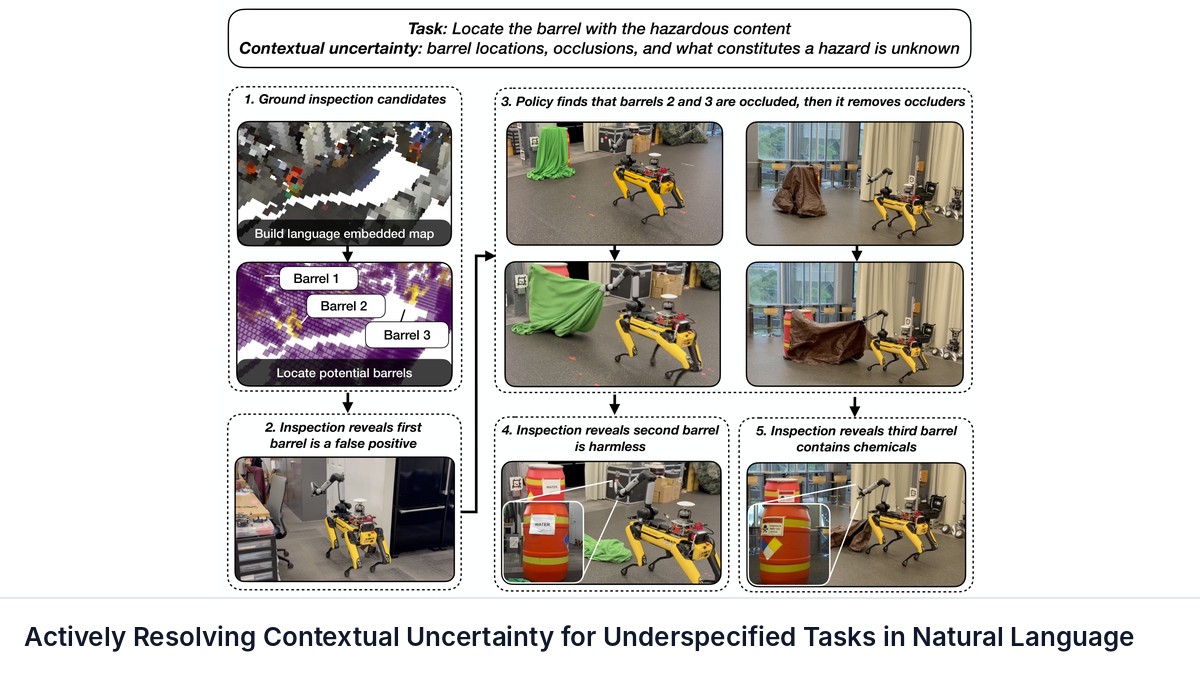
Actively Resolving Contextual Uncertainty for Underspecified Tasks in Natural Language
Zachary Ravichandran, Jonathan Diller, Fernando Cladera et al.
Foundation models provide robots with the ability to interpret natural language and reason about environmental context, yet most language-conditioned policies assume that goals are well-specified and that task-relevant information is provided upfront via a prior map.