

FoundationVIO: Enforcing Metric Scale in Feed-forward Visual-Inertial Odometry
Jin Rhee, Yuhao Zhang, Frank Dellaert, Maurice Fallon · N/A · 2026
Framework
N/A
License
N/A
Stars
N/A
Summary
Feed-forward geometric foundation models (GFMs) directly predict dense geometry and camera poses from batches of images. Emerging visual SLAM methods chain together consecutive GFM batches to form dense point cloud maps.
Abstract Summary
Key Points
- Feed-forward geometric foundation models (GFMs) directly predict dense geometry and camera poses from batches of images.
- Emerging visual SLAM methods chain together consecutive GFM batches to form dense point cloud maps
- A core challenge is how to address the ambiguous geometric scale of GFM predictions: independent predictions are locally consistent up-to-scale but not constrained by any direct physical measurements.
- Models trained on data with known scale improve the consistency of GFM reconstructions but again do not directly measure it.
- Consequently, trajectories and 3D reconstructions from GFM-enabled SLAM methods inherit this issue
Method
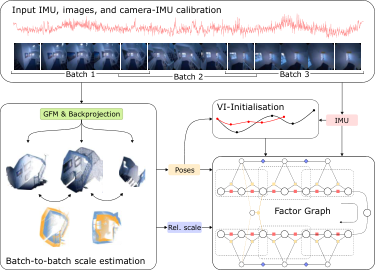
An overview of the proposed method is shown in Fig. 2 . We propose a factor-graph based design that takes IMU measurements, up-to-scale poses from GFM predictions, and relative scale measurements derived between consecutive predictions in order to create a natively metric scale trajectory and 3D reconstruction.
Evaluation
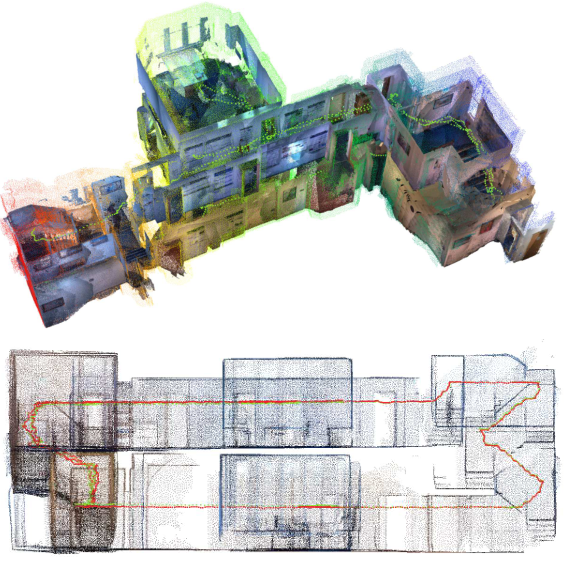
We evaluate both the trajectory and reconstruction quality of FoundationVIO across three datasets. We first compare FoundationVIO’s pose estimation accuracy with respect to both classical and GFM-enabled methods. Results are presented both with the system configured in odometry mode and also in SLAM mode with loop-closures enabled.
We then evaluate FoundationVIO’s dense 3D reconstructions against other state-of-the-art GFM-enabled SLAM methods. Finally, we evaluate the real-time performance of our method.
Sources and Demonstrations
Figures are reproduced from Rhee et al. See the full paper for experimental details and the project page, when the paper links one, for demonstrations and videos.
Related Papers
Aim Short to Reach Far: Your Frozen World Model Can Plan Better Than You Think
Xvyuan Liu, Jianjie Fang, Chen Gao et al.
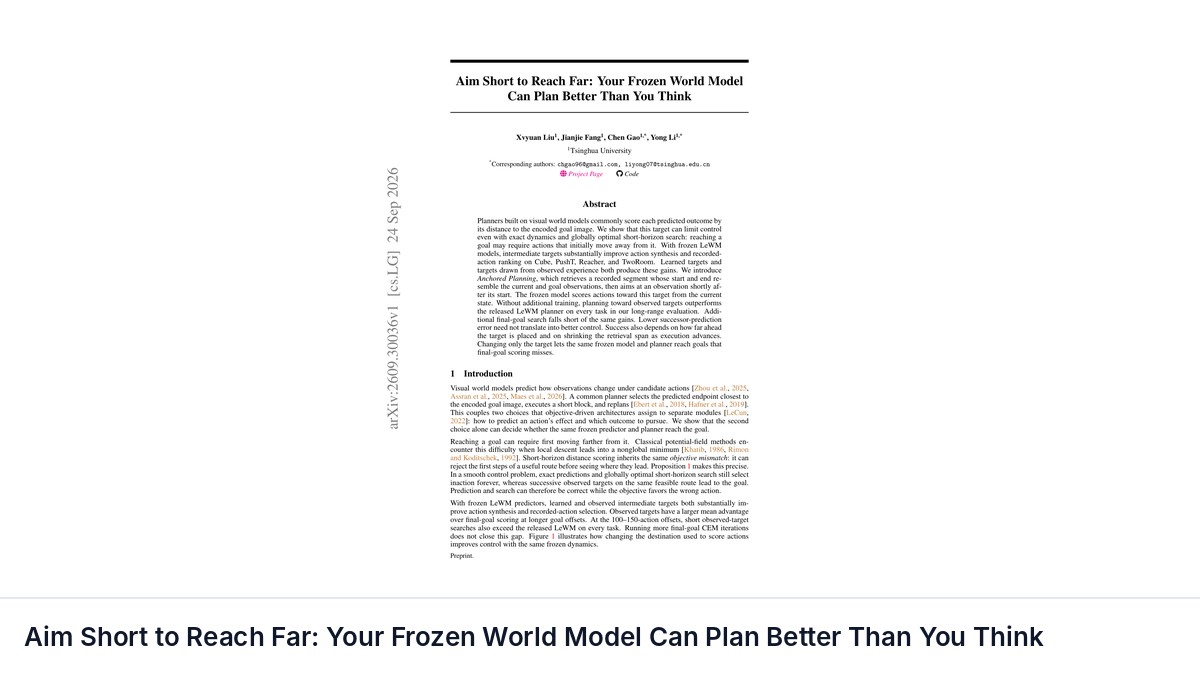
Planners built on visual world models commonly score each predicted outcome by its distance to the encoded goal image. We show that this target can limit control even with exact dynamics and globally optimal short-horizon search: reaching a goal may require actions that initially move away from it.
Beyond Episodic Evaluation: Memory Architectural Bottlenecks in Sequential Embodied Question Answering
Zikui Cai, Kaushal Janga, Tan Dat Dao et al.
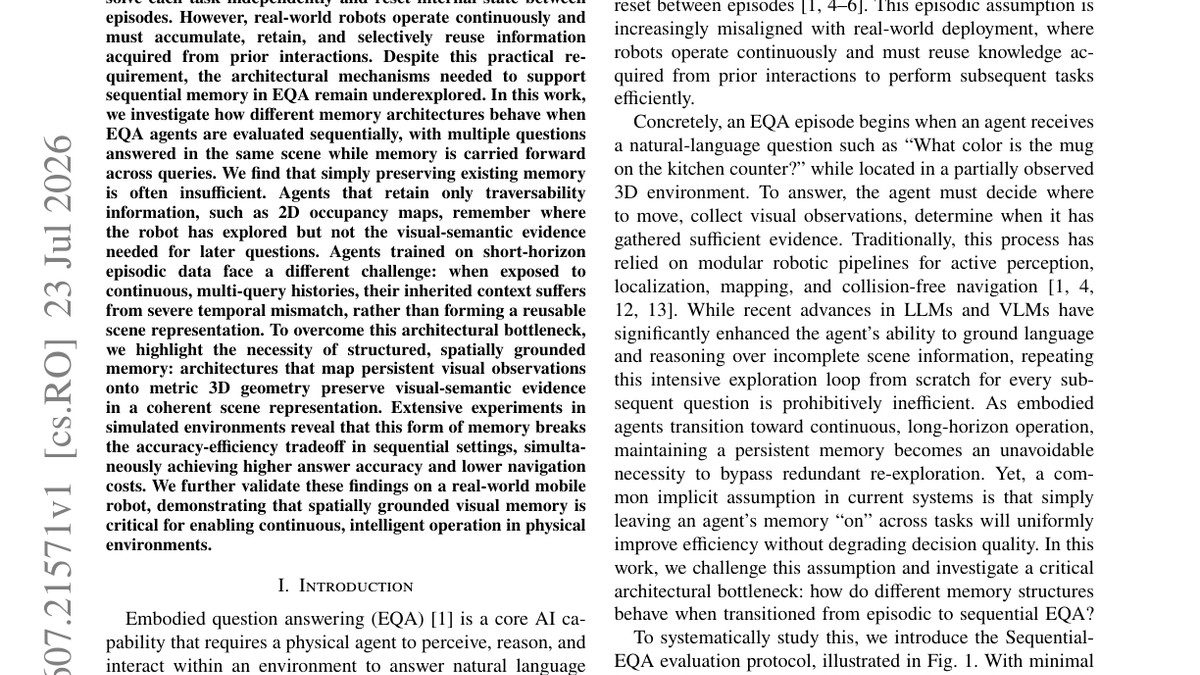
Embodied question answering (EQA) is traditionally evaluated under an episodic formulation, where agents solve each task independently and reset internal state between episodes.
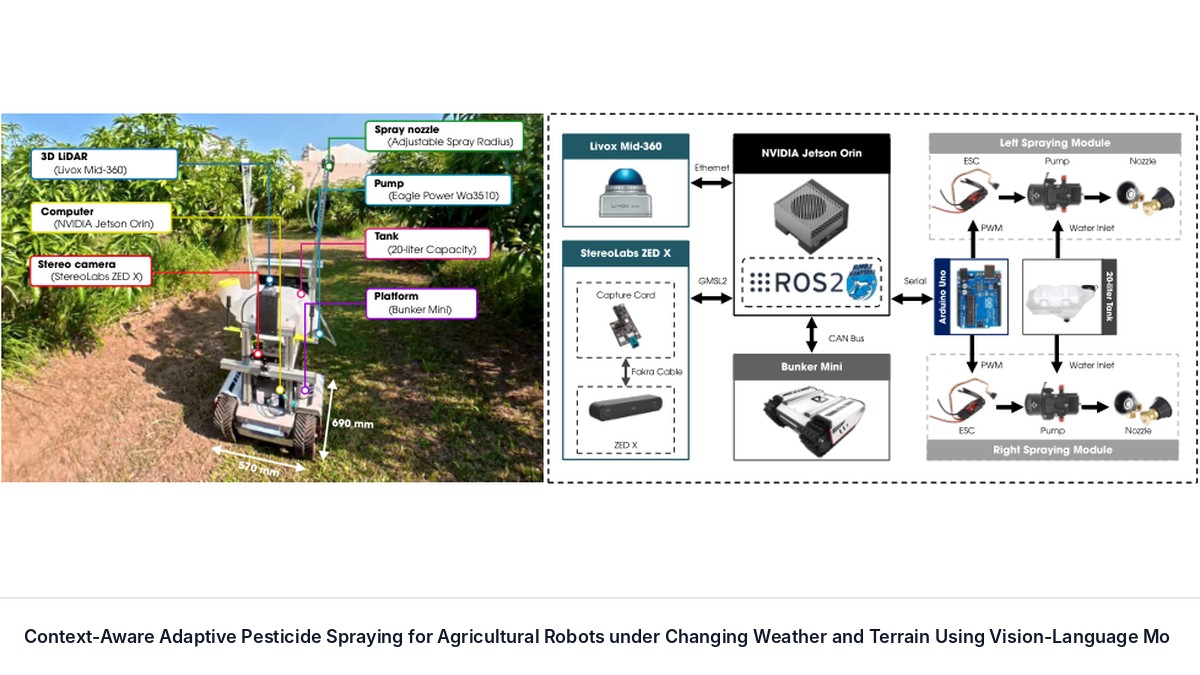
Context-Aware Adaptive Pesticide Spraying for Agricultural Robots under Changing Weather and Terrain Using Vision-Language Models
Cong-Thanh Vu, Yen-Chen Liu
Precision pesticide spraying is essential for optimizing application efficiency and ensuring uniform chemical distribution.
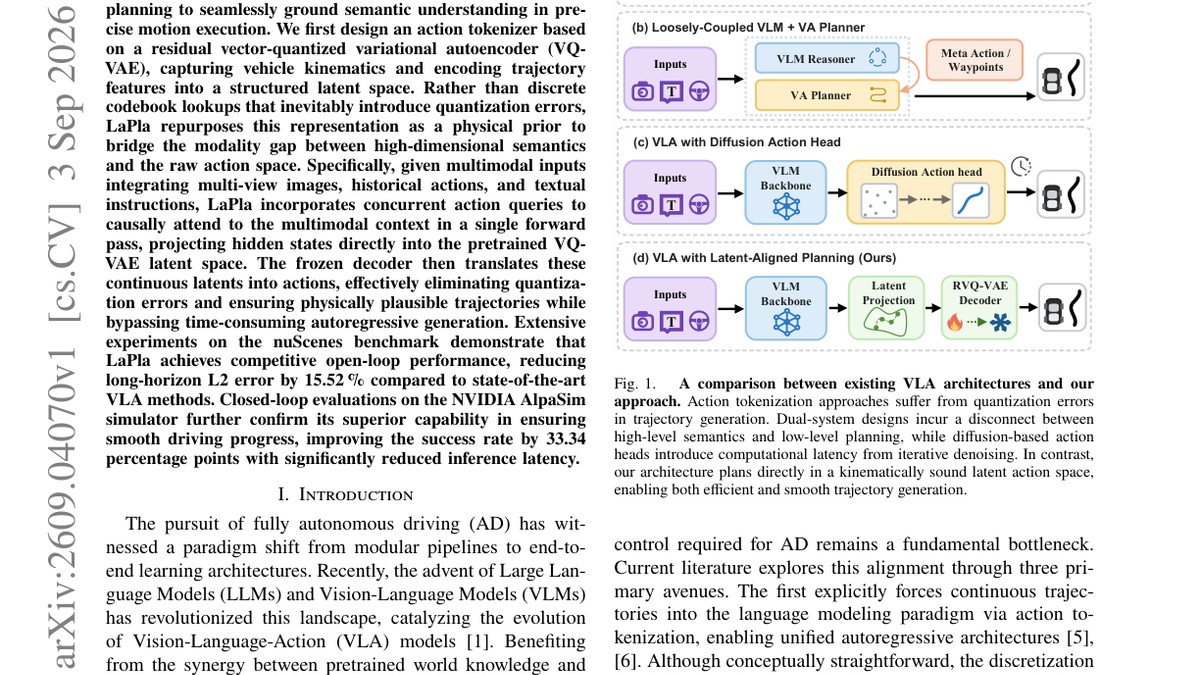
Continuous Actions from Discrete Minds: Latent-Aligned Planning for End-to-End Autonomous Driving
Ruoyu Yao, Yusen Xie, Qingzhao Liu et al.
Bridging the gap between the discrete reasoning of Vision-Language Models and the continuous, physics-constrained nature of autonomous driving remains a significant challenge.