
TacHair: Tactile Contact-Distribution Guided Online Correction for Robotic Hair Stroking and Perception
Ruiyi Hu, Yongqiang Zhao, Daniel Bak, Yupeng Wang, Xuyang Zhang, Shan Luo · N/A · 2026
Framework
N/A
License
N/A
Stars
N/A
Summary
Hair stroking is common in daily grooming and personal care, and is also widely used in hair-product evaluation, motivating robots with similar physical interaction capabilities.
Abstract Summary
Key Points
- Hair stroking is common in daily grooming and personal care, and is also widely used in hair-product evaluation, motivating robots with similar physical interaction capabilities.
- Existing robotic hair-care and surface-following methods mainly rely on trajectory planning, compliance, force regulation, or tactile-conditioned policies, but deformable hair can remain in contact while gradually drifting across the end-effector, making local interaction difficult to regulate.
- We propose TacHair, a tactile contact-distribution guided online correction framework that represents high-resolution tactile observations as a spatial hair-contact distribution.
- A visuotactile imitation policy generates the nominal stroking motion, while a separately trained residual module corrects local contact deviations, separating task progression from contact recovery.
- We evaluate TacHair in 525 real-robot trials across five head geometries and three hair conditions
Methodology
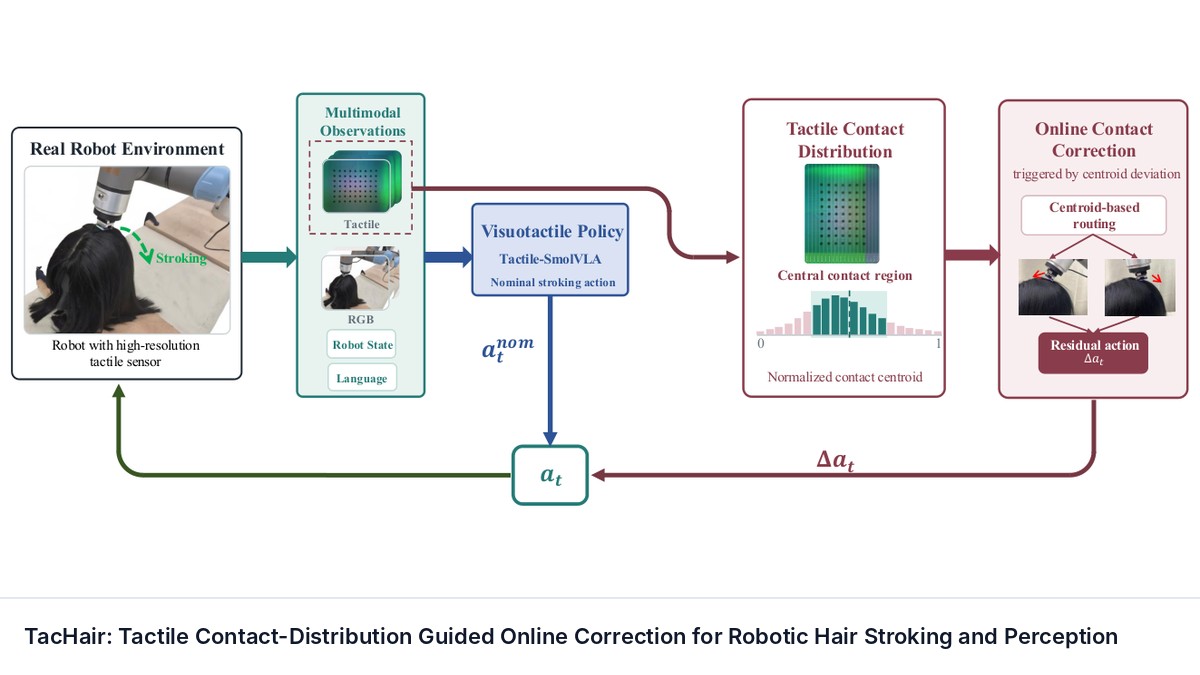
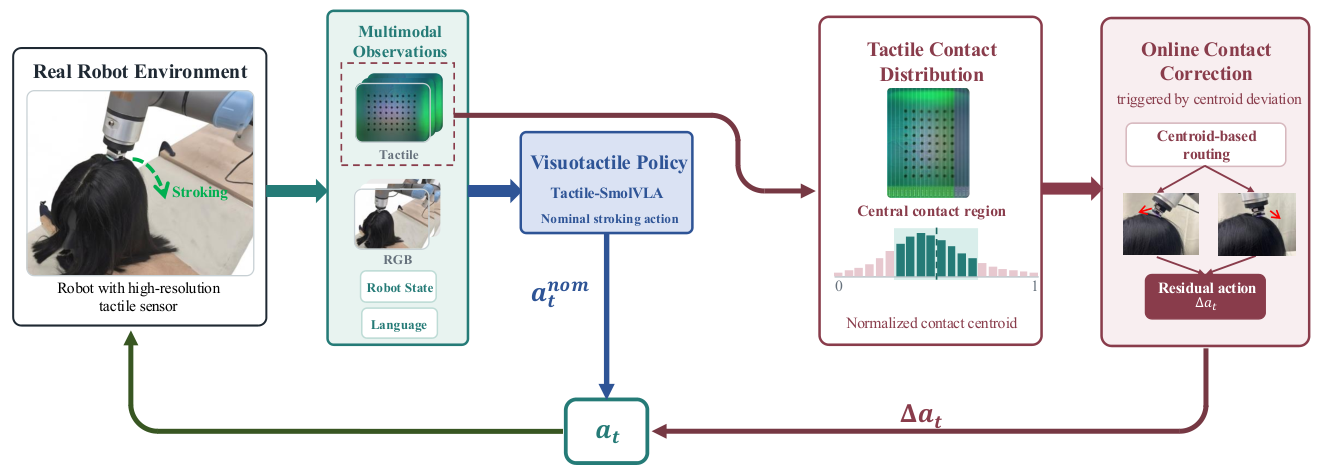
As shown in Fig. 1 and Fig. 2 , we consider robotic hair stroking as a sequential control problem in which the robot moves from the crown toward the back of a hair-covered head while maintaining stable local contact throughout the motion. At time step $t$, the robot observes an external RGB image $I_{t}^{v}$, a high-resolution tactile image $I_{t}^{\tau}$, and its joint state $q_{t}$.
We denote the corresponding observation as $o_{t}=(I_{t}^{v},I_{t}^{\tau},q_{t})$. The robot action $a_{t}$ is a six-dimensional absolute joint-position target.
Experiments
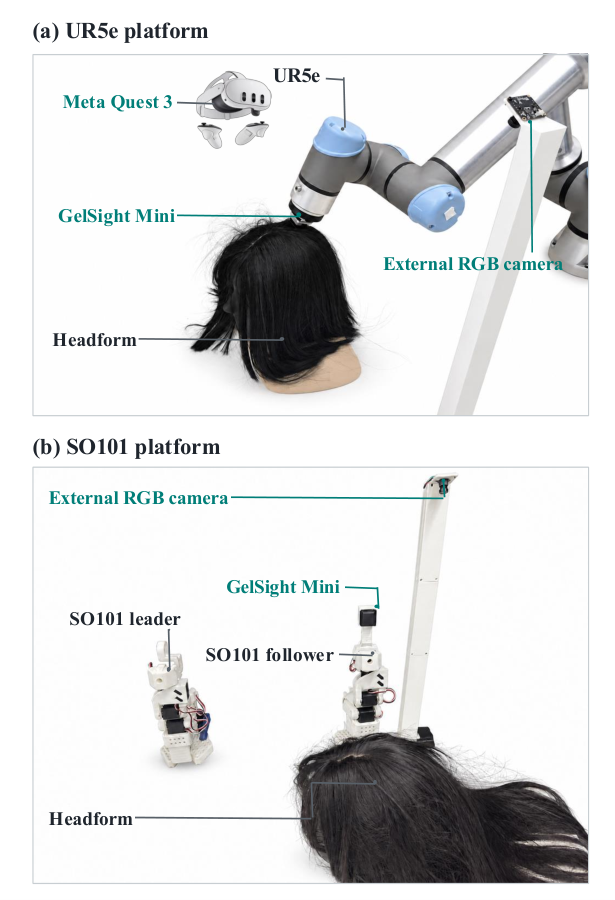
Our experimental system consists of perception, robotic, and teleoperation components, as shown in Fig. 3 . A GelSight Mini tactile sensor is mounted at the robot end effector, while a fixed third-person RGB camera provides global visual observations at $640\times 480$ resolution. We evaluate both the standard GelSight Mini membrane and a variant equipped with a custom silicone membrane.
The SO101 serves as the primary platform for quantitative evaluation, while the UR5e is used for additional cross-platform validation.
Sources and Demonstrations
Figures are reproduced from Hu et al. See the full paper for experimental details and the project page, when the paper links one, for demonstrations and videos.
Related Papers
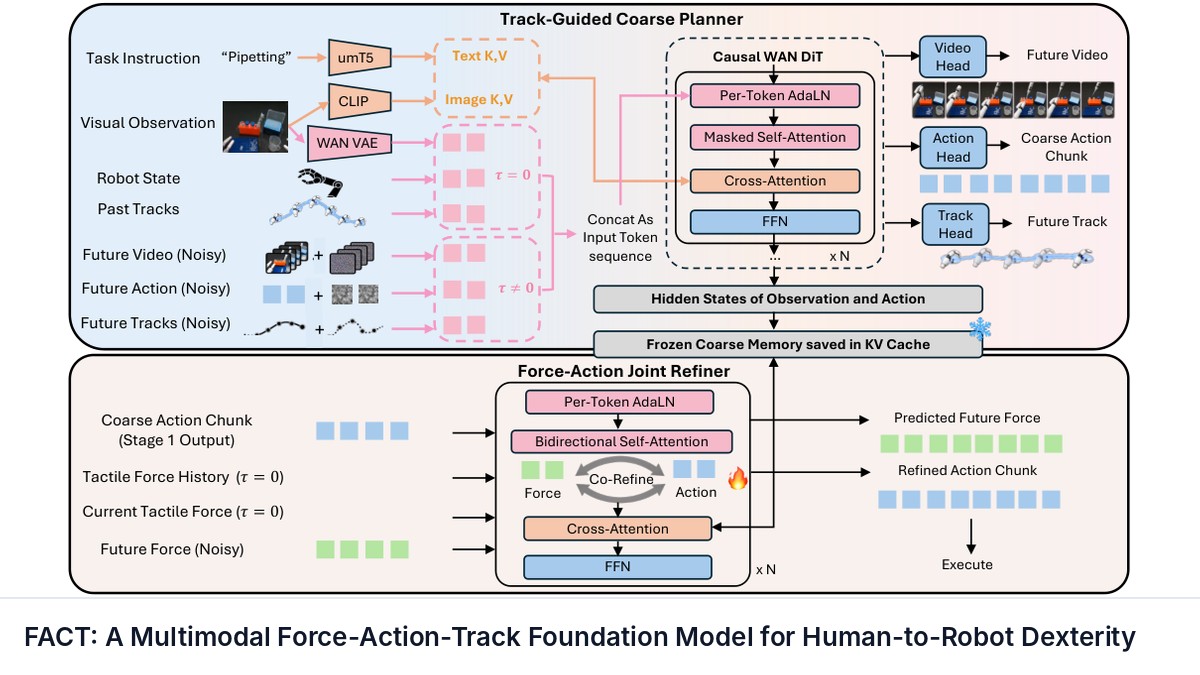
FACT: A Multimodal Force-Action-Track Foundation Model for Human-to-Robot Dexterity
Zhi Cao, Yining Hong, Jiaolong Yang et al.
Human demonstrations offer a scalable alternative to costly robot data collection for dexterous manipulation, but most human datasets lack force measurements.
Aim Short to Reach Far: Your Frozen World Model Can Plan Better Than You Think
Xvyuan Liu, Jianjie Fang, Chen Gao et al.
Planners built on visual world models commonly score each predicted outcome by its distance to the encoded goal image. We show that this target can limit control even with exact dynamics and globally optimal short-horizon search: reaching a goal may require actions that initially move away from it.
Beyond Episodic Evaluation: Memory Architectural Bottlenecks in Sequential Embodied Question Answering
Zikui Cai, Kaushal Janga, Tan Dat Dao et al.
Embodied question answering (EQA) is traditionally evaluated under an episodic formulation, where agents solve each task independently and reset internal state between episodes.
Design and Evaluation of a Touchscreen-Based Teleoperation Interface for Robotic Manipulators
Juan José García Cárdenas, Alperen Kenan, Hamidreza Raei et al.
Intuitive teleoperation interfaces are crucial for the safe and effective operation of robotic manipulators in challenging environments.