
SlotDiT: Object-Centric Representations for Diffusion Transformers
Gjergj Plepi, Sven Behnke · N/A · 2026
Framework
N/A
License
N/A
Stars
N/A
Summary
Text-conditioned latent diffusion models perform strongly in video generation and are promising backbones for robotic applications.
Abstract Summary
Key Points
- Text-conditioned latent diffusion models perform strongly in video generation and are promising backbones for robotic applications.
- However, existing approaches rely on pixel-level or VAE-based latent representations that lack explicit semantic structure, leaving the impact of the representation space largely unexplored.
- Slot-based object-centric representations offer a structured alternative by decomposing scenes into object-level latents, or slots.
- While they have shown success in dynamics modeling and planning, they have not yet been explored for diffusion-based generative modeling.
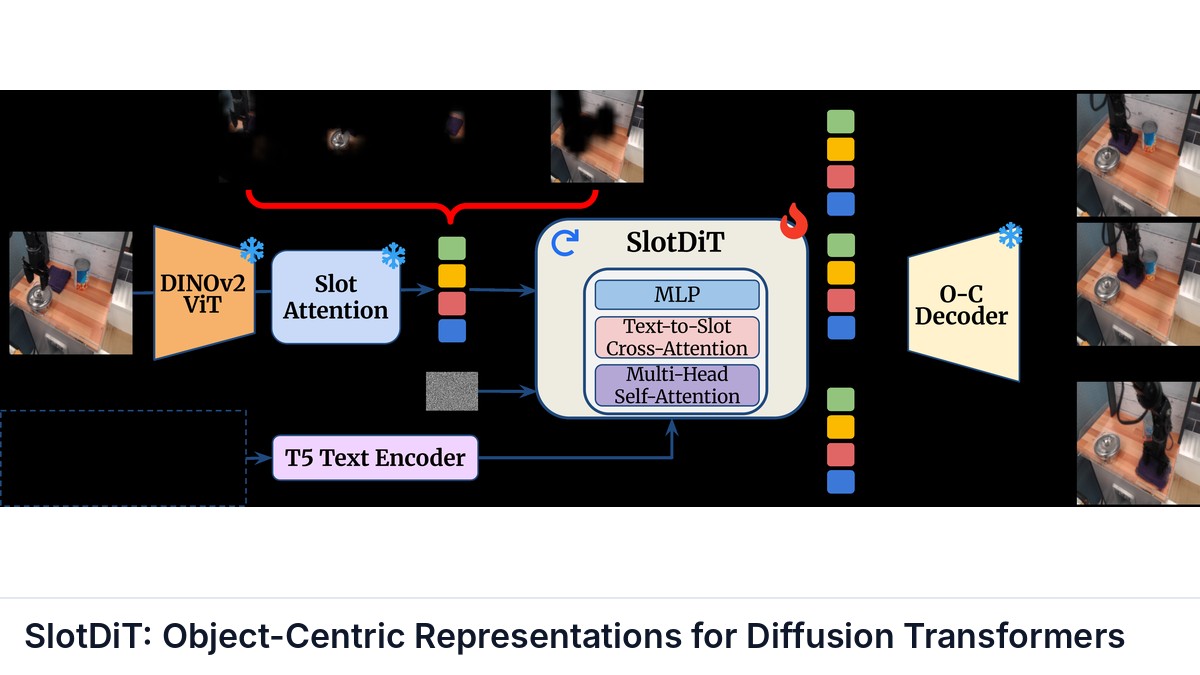
- We introduce SlotDiT, a text-guided Diffusion Transformer (DiT) that operates in a slot-based latent space.
Methodology
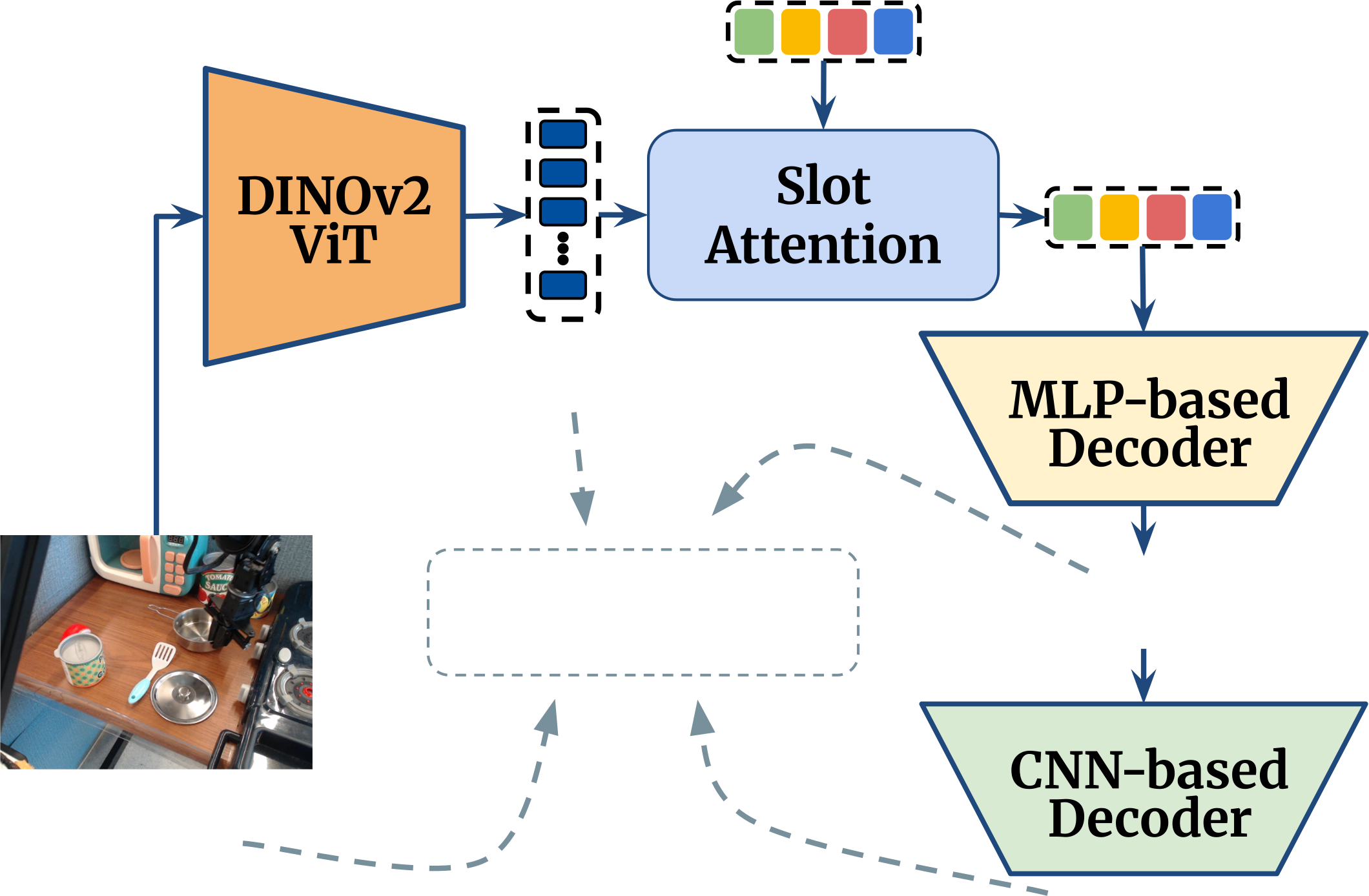
We propose SlotDiT , depicted in Figure 2 , a latent Diffusion Transformer (DiT) that learns in a slot-based object-centric latent space. Given a single reference image $\textbf{X}_{1}$ and a language instruction $\mathcal{C}$, SlotDiT first encodes the scene into a set $\textbf{S}_{1}$ of $N_{\mathbf{S}}{}$ object-centric latent vectors, called slots (Sec. 3.1 ).
Then, conditioned on the instruction and observed scene context, the model iteratively denoises future slot trajectories from Gaussian noise to generate $N-1$ future sets of slots.
Experiments
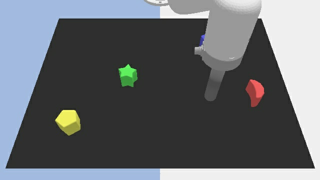
To evaluate SlotDiT , we investigate three key research questions: (i) can diffusion transformers operate effectively in an object-centric latent space? (ii) do slot-based representations improve task-solving and motion-following capabilities in robotic environments compared to established latent spaces? and (iii) do slots offer a more computationally efficient representation?
To this end, we evaluate SlotDiT on two downstream tasks: text-guided video generation and robot control.
Sources and Demonstrations
Figures are reproduced from Plepi et al. See the full paper for experimental details and the project page, when the paper links one, for demonstrations and videos.
Related Papers
Aim Short to Reach Far: Your Frozen World Model Can Plan Better Than You Think
Xvyuan Liu, Jianjie Fang, Chen Gao et al.
Planners built on visual world models commonly score each predicted outcome by its distance to the encoded goal image. We show that this target can limit control even with exact dynamics and globally optimal short-horizon search: reaching a goal may require actions that initially move away from it.
Beyond Episodic Evaluation: Memory Architectural Bottlenecks in Sequential Embodied Question Answering
Zikui Cai, Kaushal Janga, Tan Dat Dao et al.
Embodied question answering (EQA) is traditionally evaluated under an episodic formulation, where agents solve each task independently and reset internal state between episodes.
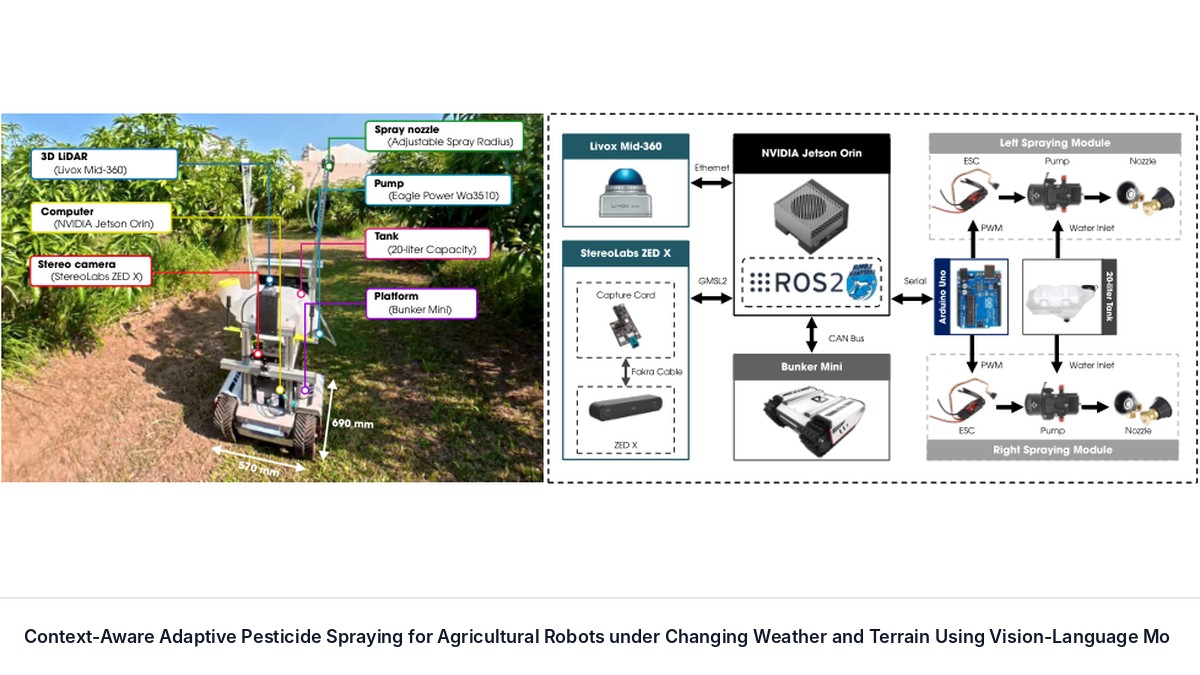
Context-Aware Adaptive Pesticide Spraying for Agricultural Robots under Changing Weather and Terrain Using Vision-Language Models
Cong-Thanh Vu, Yen-Chen Liu
Precision pesticide spraying is essential for optimizing application efficiency and ensuring uniform chemical distribution.
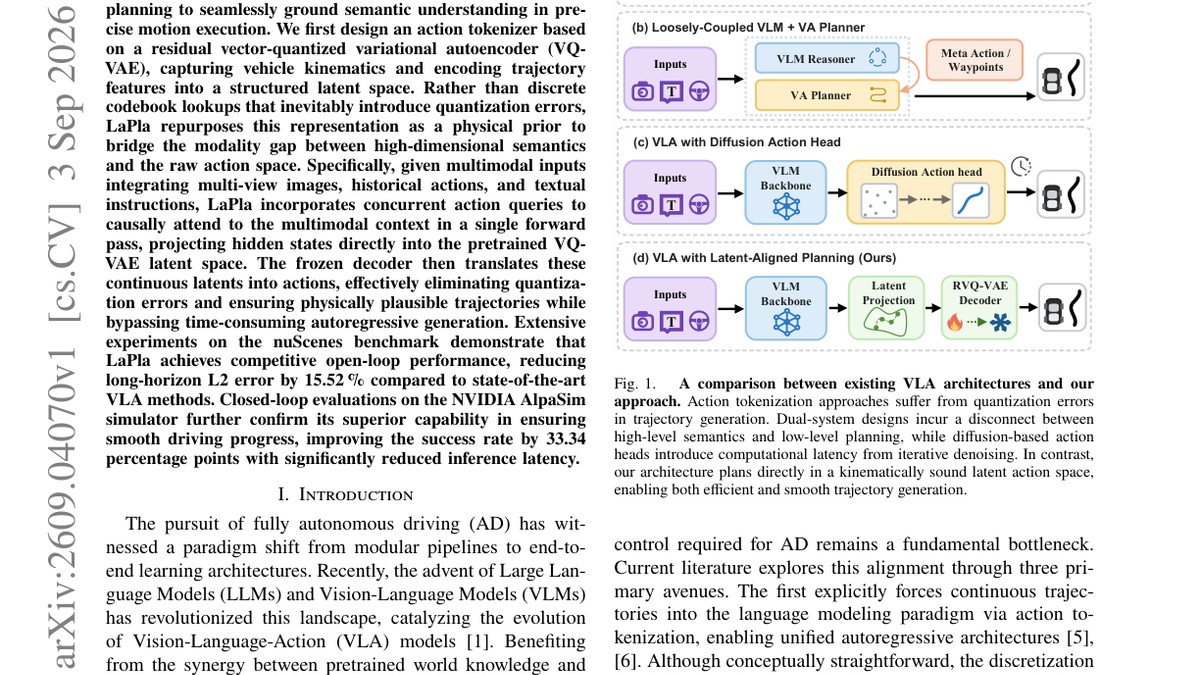
Continuous Actions from Discrete Minds: Latent-Aligned Planning for End-to-End Autonomous Driving
Ruoyu Yao, Yusen Xie, Qingzhao Liu et al.
Bridging the gap between the discrete reasoning of Vision-Language Models and the continuous, physics-constrained nature of autonomous driving remains a significant challenge.