
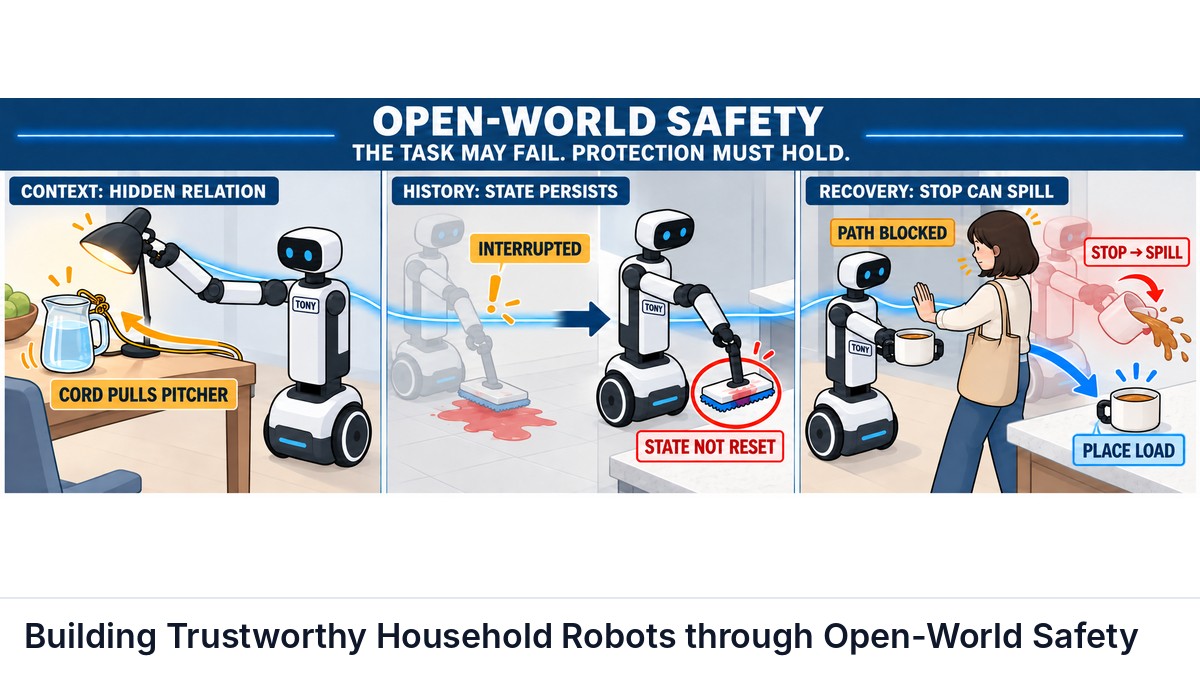
Building Trustworthy Household Robots through Open-World Safety
Yu-Lin Tsai, Muxi Lyu, Roei Herzig, Koushik Sen, Raluca Ada Popa, David Wagner · N/A · 2026
Framework
N/A
License
N/A
Stars
N/A
Summary
Foundation models are expanding robot capabilities, enabling robots to handle more diverse objects, follow sophisticated instructions, and operate in complex environments. These advances bring us to a future in which robots become part of everyday household life.
Abstract Summary
Key Points
- Foundation models are expanding robot capabilities, enabling robots to handle more diverse objects, follow sophisticated instructions, and operate in complex environments.
- These advances bring us to a future in which robots become part of everyday household life
- However, cluttered, dynamic household environments also expose robots to unfamiliar objects, tasks, and interactions, making reliable zero-shot task completion an ongoing challenge for robotics research.
- From a security perspective, we argue for open-world safety: household robots should preserve specified safety requirements in unseen situations, including when they cannot complete the requested task.
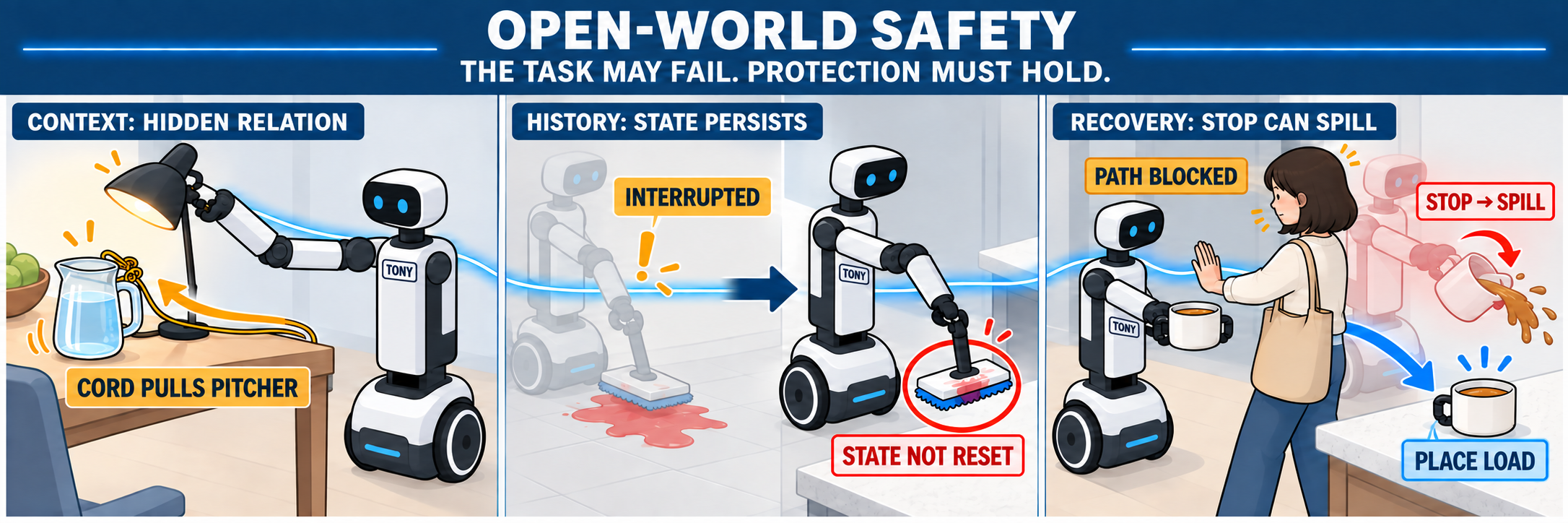
- Safety protections must account for context and interactions that persist across actions and tasks
Open-World Safety: Scope and Foundations
As introduced in Section I , our scope of the term open-world safety is physical: can a household robot avoid harming people, animals, property, or itself while it acts, refuses, switches tasks, or recovers?
We note that such focus is consistent with ISO 13482, which addresses hazards from personal-care robots to people and, where relevant, domestic animals and property under intended or reasonably foreseeable use [ 11 ] . We leave privacy and broader social harms aside unless they lead the robot to cause physical harm.
Where Open-World Safety Can Fail
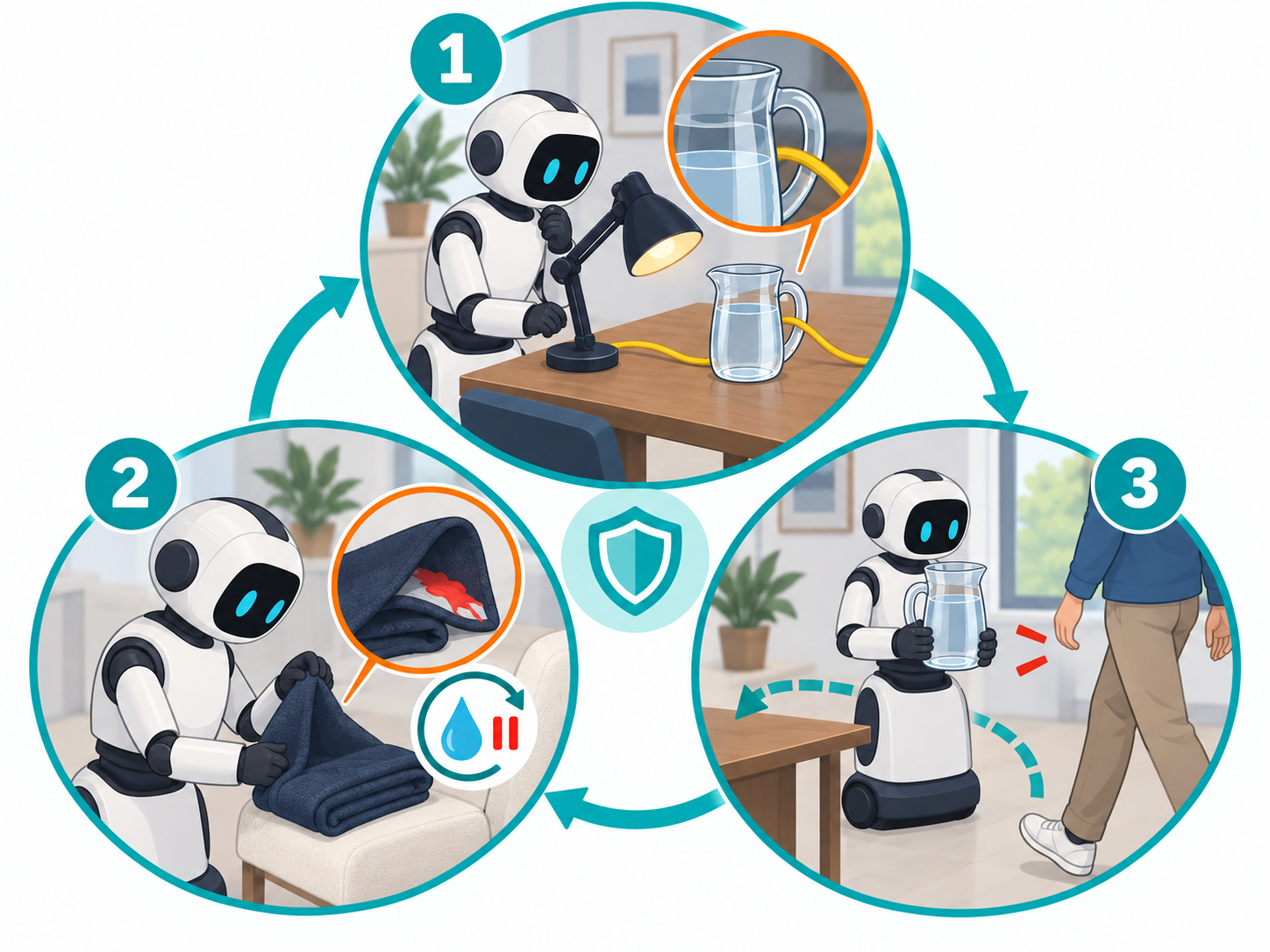
A household robot can lose the physical protection even when each component behaves as designed within its own scope. Therefore in this section, we raise and examine three representative failure routes that would violate open-world safety. First, the robot may encode the wrong safety constraint because it misses a safety-relevant property or relationship with the objects.
Second, it may apply a correct safety constraint using missing or stale evidence after the interaction changes.
Research Agenda: Realizing and Evaluating Open-World Safety
Research agenda for open-world safety A protection remains active until an authorized change or verified physical evidence supports its release. A. Determine and maintain the protection — validity Who may set or change it? Embodied instruction hierarchy What does it require here? Safety-directed active grounding When may it be released? Evidence-gated safety memory B.
Open Science
This position paper reports no new experiments, datasets, trained models, implemented defenses, or benchmark results. The examples are thought experiments, and the proposed mechanisms and evaluations are research directions rather than completed artifacts. These materials support inspection of the paper, but no experimental artifact is needed to reproduce results because the paper reports no new empirical results.
LLM usage considerations
LLMs were used for editorial purposes in this manuscript, and all outputs were inspected by the authors to ensure accuracy and originality. Language-model assistants helped revise wording, and organization. They were not part of the paper’s methodology and produced no experimental data or evaluation results.
The authors determined the position and technical claims, read the cited sources, checked the claims and bibliographic records, and take responsibility for the final manuscript.
Ethical Considerations
This paper reports no human-subject study or hazardous physical experiment. It nevertheless advocates testing failures that could cause physical harm if reproduced carelessly. Such work should begin in simulation and use controlled fixtures, benign substitutes, explicit stopping procedures, and independent emergency intervention during physical validation.
Sources and Demonstrations
Figures are reproduced from Tsai et al. See the full paper for experimental details and the project page, when the paper links one, for demonstrations and videos.
Related Papers
3DThinkVLA: Endowing Vision-Language-Action Models with Latent 3D Priors via 3D-Thinking-Guided Co-training
Jiaxin Shi, Xidong Zhang, Fucai Zhu et al.
We propose a 3D-thinking-guided co-training framework that enables vision-language-action (VLA) models to perform 3D spatial reasoning implicitly during action prediction.
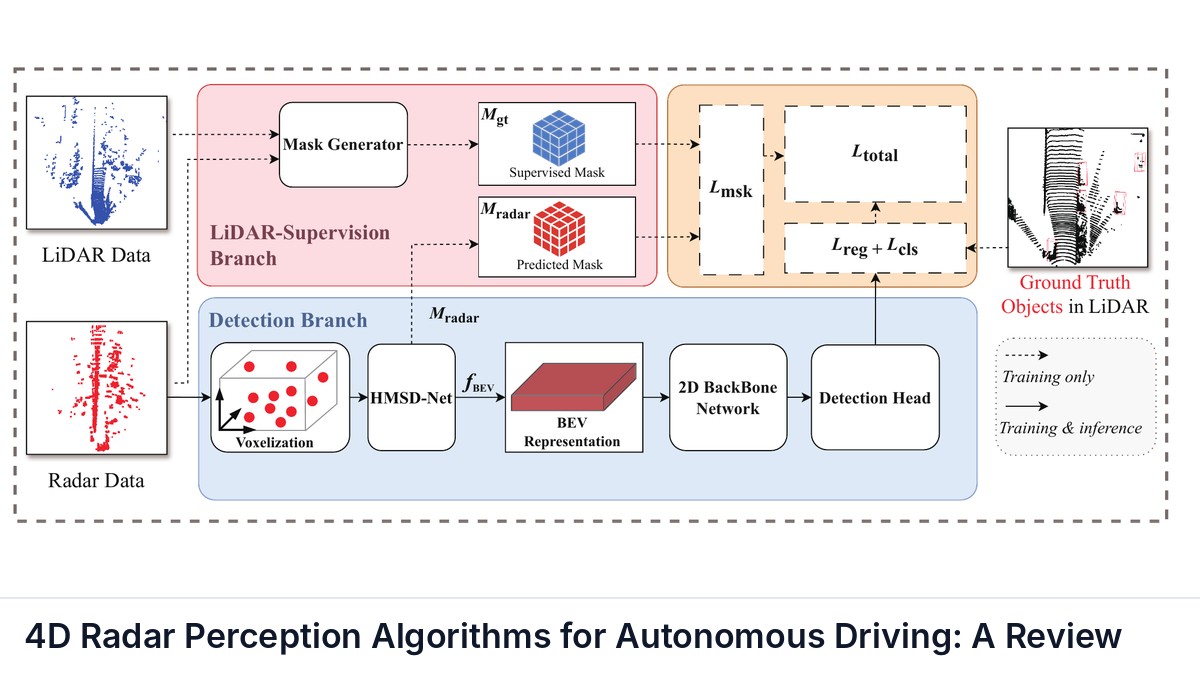
4D Radar Perception Algorithms for Autonomous Driving: A Review
Xumin Wu, Jun Zhou, Jilin Mei et al.
Research on 4D millimeter-wave radar perception algorithms has flourished in recent years, extending from signal processing and object detection to semantic segmentation, motion estimation, occupancy prediction, and dynamic scene reconstruction.
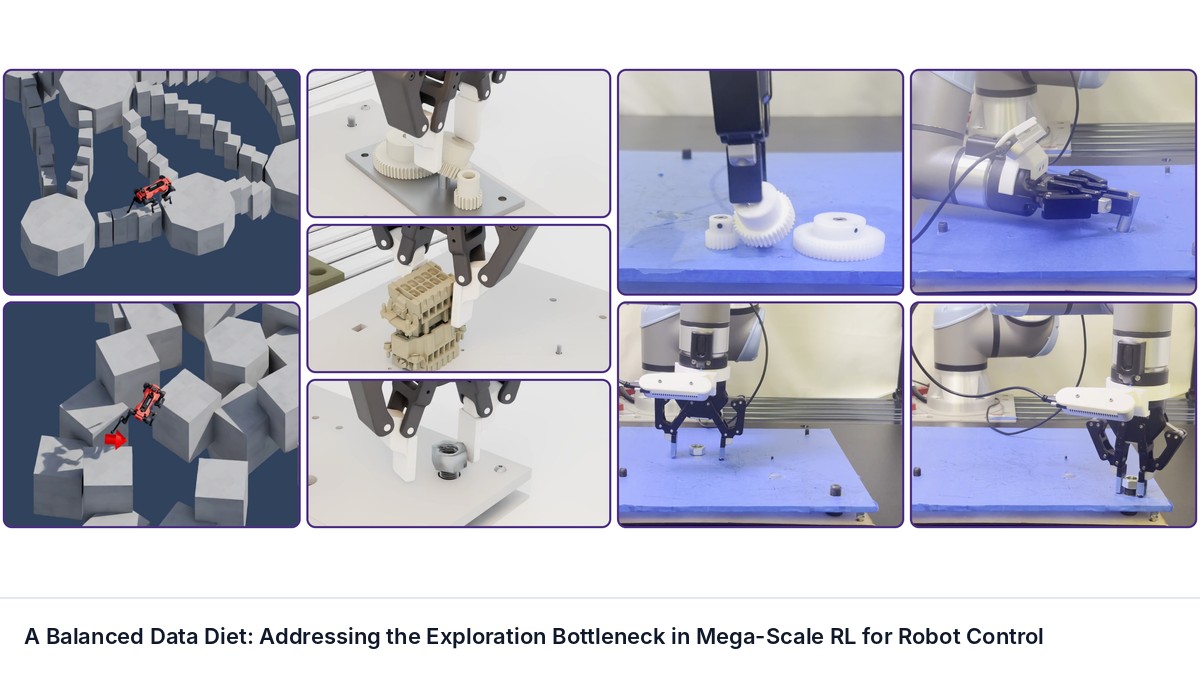
A Balanced Data Diet: Addressing the Exploration Bottleneck in Mega-Scale RL for Robot Control
Octi Zhang, Mateo Guaman Castro, Patrick Yin et al.
General-purpose robots must perform a wide range of tasks from agile locomotion to dexterous manipulation.
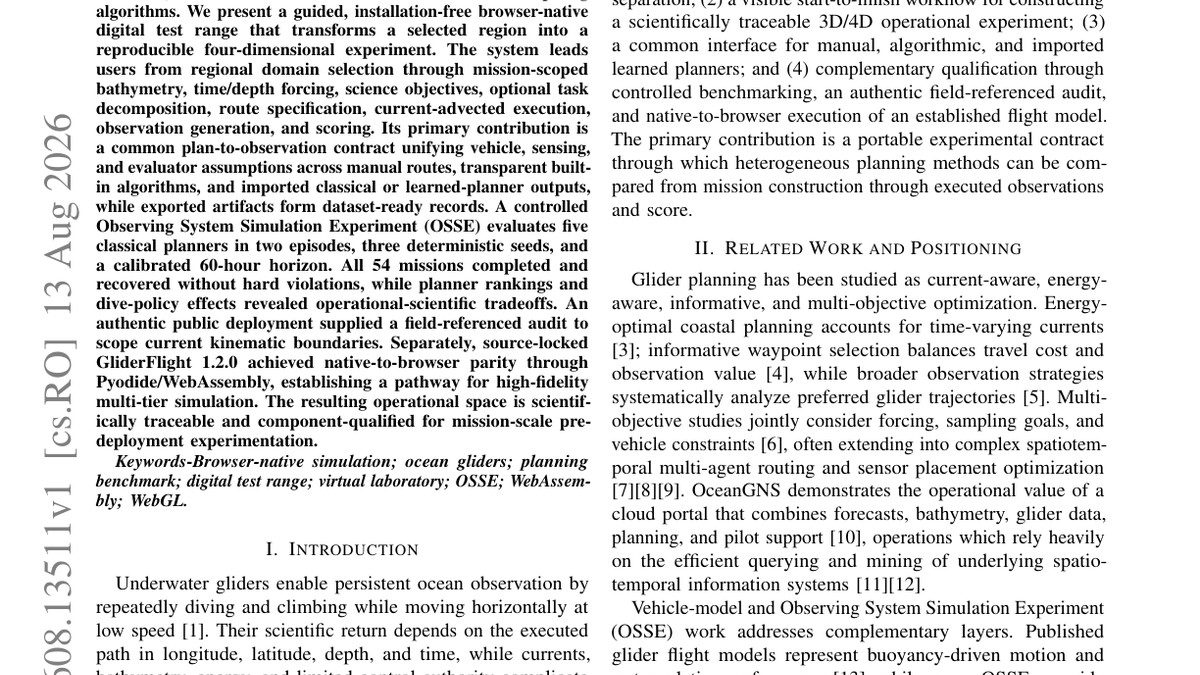
A Browser-Native Digital Test Range for Benchmarking 4D Ocean-Glider Planning Algorithms
Edward Holmberg, Elias Ioup, Mahdi Abdelguerfi
Repeated in-situ evaluation of ocean-glider planners requires scarce vehicles, operators, deployment and recovery resources, and ocean conditions that cannot be reset for competing algorithms.