
MOSAIC-SV: Real-Time Adaptive Identification of Vessel Dynamics for the Control and Deployment of Aquatic Robots
Wensen Liu, Jerry Peng, Shravani Vedagiri, Aaron M. Johnson · N/A · 2026
Framework
N/A
License
N/A
Stars
N/A
Summary
Model-based control of an aquatic robotic platform depends on a hydrodynamic model that is costly to identify and specific to the hull, payload, and conditions it was measured in.
Abstract Summary
Key Points
- Model-based control of an aquatic robotic platform depends on a hydrodynamic model that is costly to identify and specific to the hull, payload, and conditions it was measured in.
- Here, we present MOSAIC-SV, a deployable real-time adaptive dynamics identification and control system that identifies a control-sufficient dynamics model from a spec-sheet engineering prior, without dedicated identification trials, and re-estimates it at every control step of a closed-loop mission while the controller plans on it.
- A physically admissible unscented Kalman filter re-estimates hydrodynamic, disturbance, and actuator parameters at every control step of the closed-loop mission; while a command-dependent consider projection withholds corrections the current command cannot attribute between actuator effectiveness and external force; and a model predictive path integral controller plans on the current estimate.
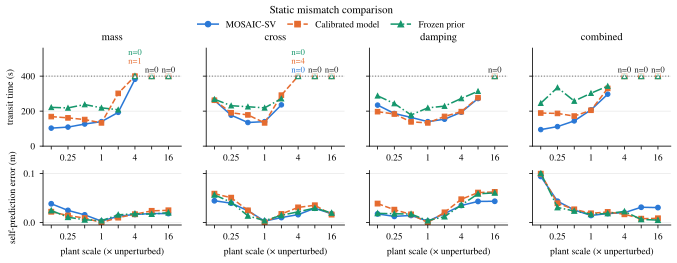
- In simulation on a CyberShip II plant, MOSAIC-SV recovers the transit performance of the calibrated model under static mismatch and transient changes, and stays within 20% of its own transit time at the unscaled prior when its inertia or damping prior is wrong by an order of magnitude.
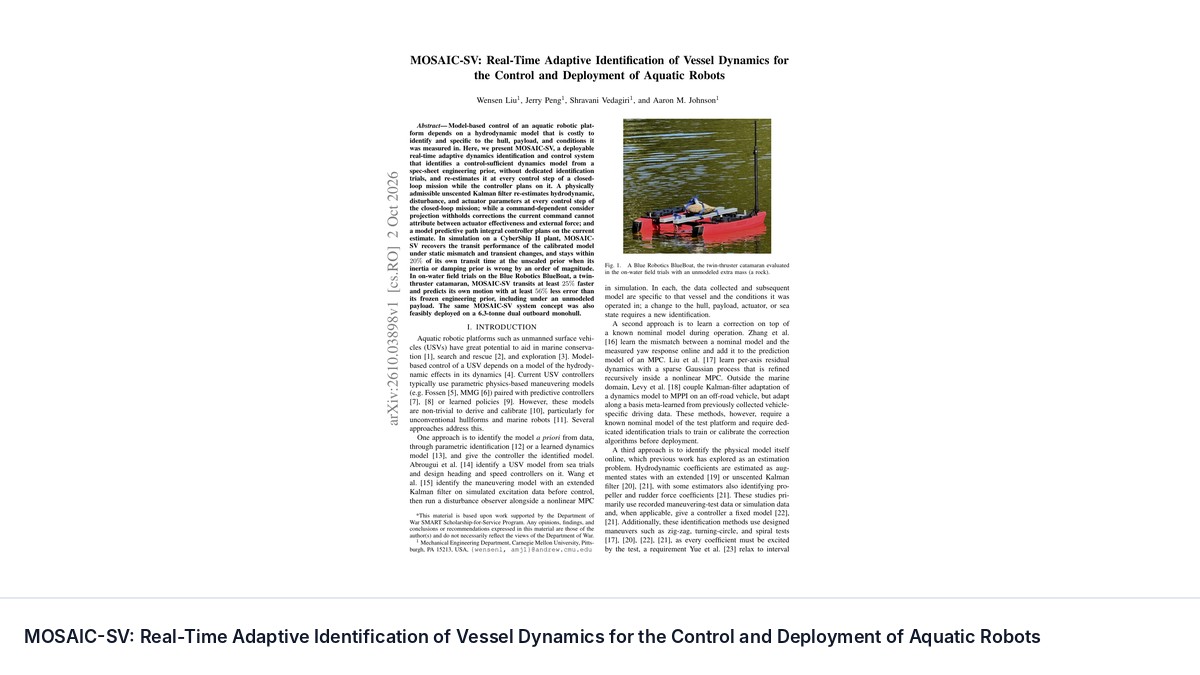
- In on-water field trials on the Blue Robotics BlueBoat, a twin-thruster catamaran, MOSAIC-SV transits at least 25% faster and predicts its own motion with at least 56% less error than its frozen engineering prior, including under an unmodeled payload.
VESSEL MODEL
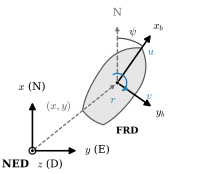
We define a vessel’s state $s=[\eta^{\top},\nu^{\top}]^{\top}$ with standard North-East-Down (NED) global pose $\eta=[x,y,\psi]^{\top}$, where $x$ is North and $y$ is East, and Forward-Right-Down (FRD) body velocities $\nu=[u,v,r]^{\top}$ (Fig. 2 a).
PARAMETER ESTIMATOR DESIGN
We estimate the model parameters $\theta$, detailed in § III-A , from online state transitions during a mission, using the navigation state $s_{t}$ provided by the vessel’s state estimator.
We represent the parameter belief as a Gaussian $\mathcal{N}(\hat{\theta}_{t},P_{t})$ propagated by a scaled unscented Kalman filter (UKF), with predicted mean and covariance $\hat{\theta}^{-}_{t}$ and $P^{-}_{t}$, process-noise covariance $Q$, measurement $z_{t}$, nonlinear measurement map $h$, and observation-noise covariance $R$.
CONTROLLER DESIGN
We plan vessel commands with model predictive path integral control (MPPI) [ 33 ] on the transition $\Phi_{\Delta t}$ defined in ( 14 ).
At each control step we define a nominal control sequence $\mathcal{U}=[a_{0},\ldots,a_{N-2}]$ over a horizon of $N$ states and sample $N_{s}$ perturbed sequences, where $E^{k}=[E^{k}_{0},\ldots,E^{k}_{N-2}]$ is the perturbation sequence and $\Sigma$ is a diagonal per-command sampling covariance.
Results
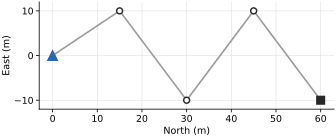
We evaluate the estimator-controller system from § III –§ IV , MOSAIC-SV, in closed-loop simulation against two non-adaptive planning models, and on water against the frozen engineering prior. In simulation, we use a calibrated model of CyberShip II, a 1:70-scale supply-vessel model whose inertia, Coriolis, and damping coefficients are published from tank identification [ 35 , 12 ] .
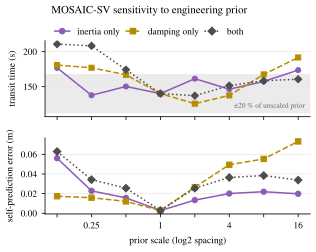
Sources and Demonstrations
Figures are reproduced from Liu et al. See the full paper for experimental details and the project page, when the paper links one, for demonstrations and videos.
Related Papers

3D Euler-Angle Orientation Control for Two-Ray Fading Mitigation in Maritime Air-to-Sea Communications
Mohammed Bajja, Abdoul Karim A. H. Saliah, Hajar El Hammouti et al.
Maritime Air-to-Sea links are dominated by a line-of-sight ray and a sea-surface reflected ray whose destructive combination produces deep fades. Existing mitigation strategies optimize Unmanned Aerial Vehicle position or trajectory but leave attitude unexploited.
A Balanced Data Diet: Addressing the Exploration Bottleneck in Mega-Scale RL for Robot Control
Octi Zhang, Mateo Guaman Castro, Patrick Yin et al.
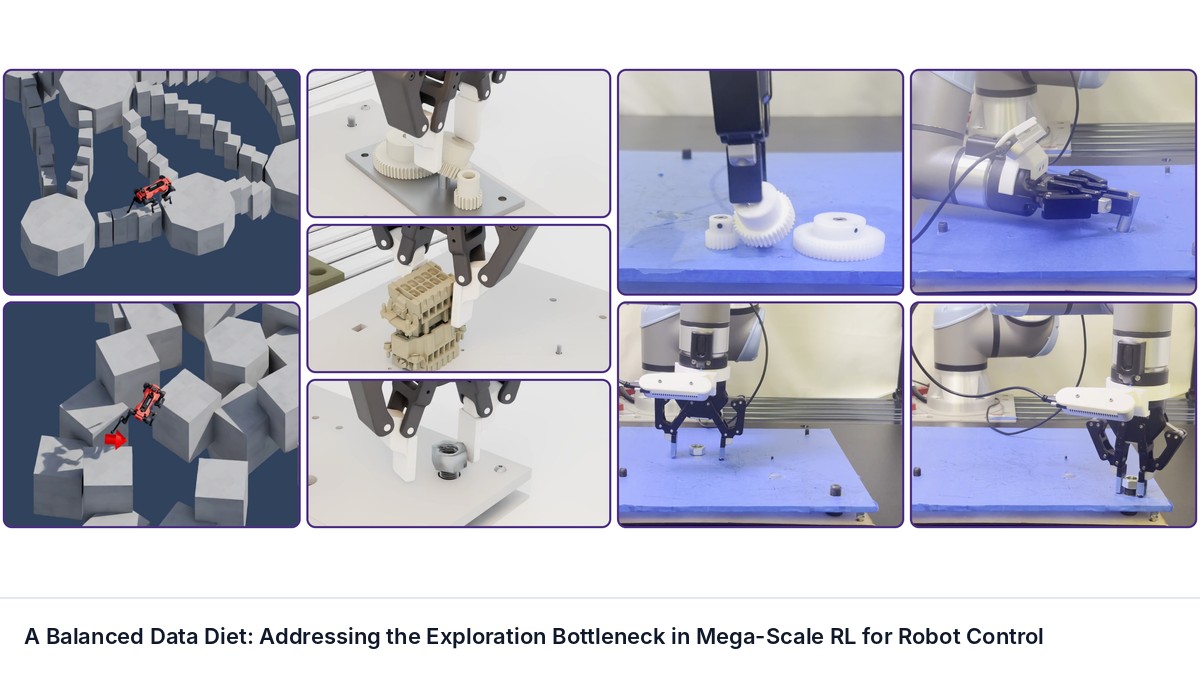
General-purpose robots must perform a wide range of tasks from agile locomotion to dexterous manipulation.
A bioinspired internal model-based online estimator for planar pursuit
Tengyue Liu, Xincheng Li, Sofia Morales Ferreira et al.
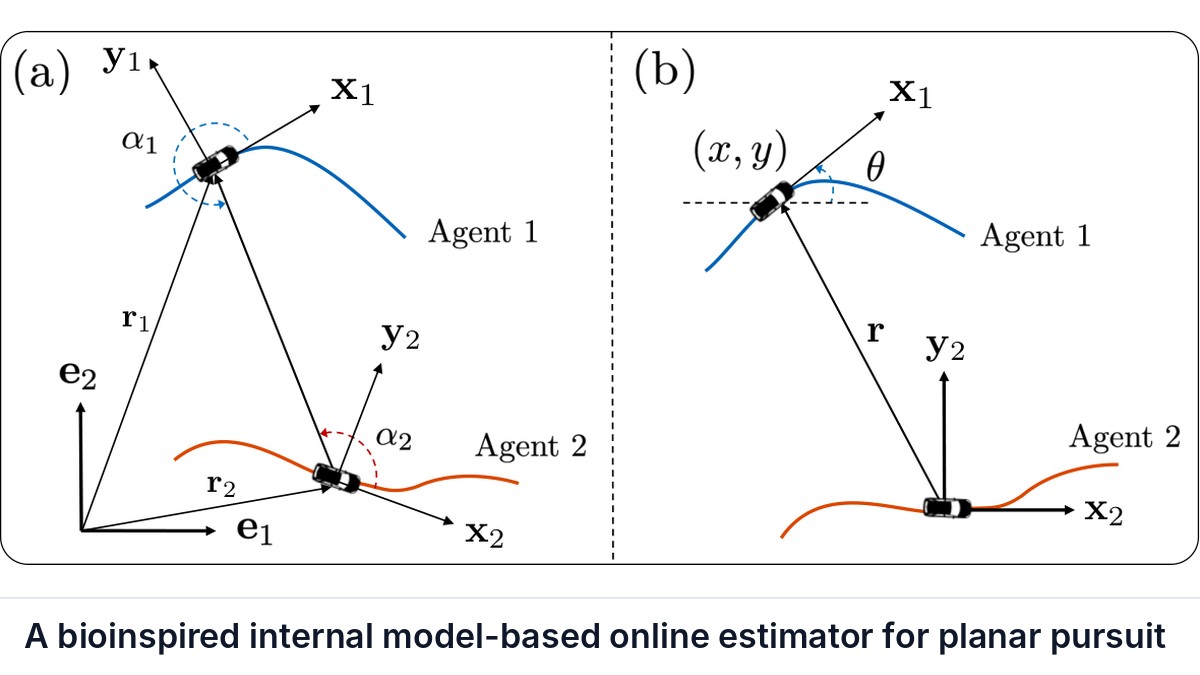
Bioinspired feedback controls for pursuit, tracking, and collective motion are often expressed in terms of the relative configuration between interacting agents.
A Biomimetic Gaze Control to Restore Head-Neck Movements
Colin Rubow, Haohan Zhang
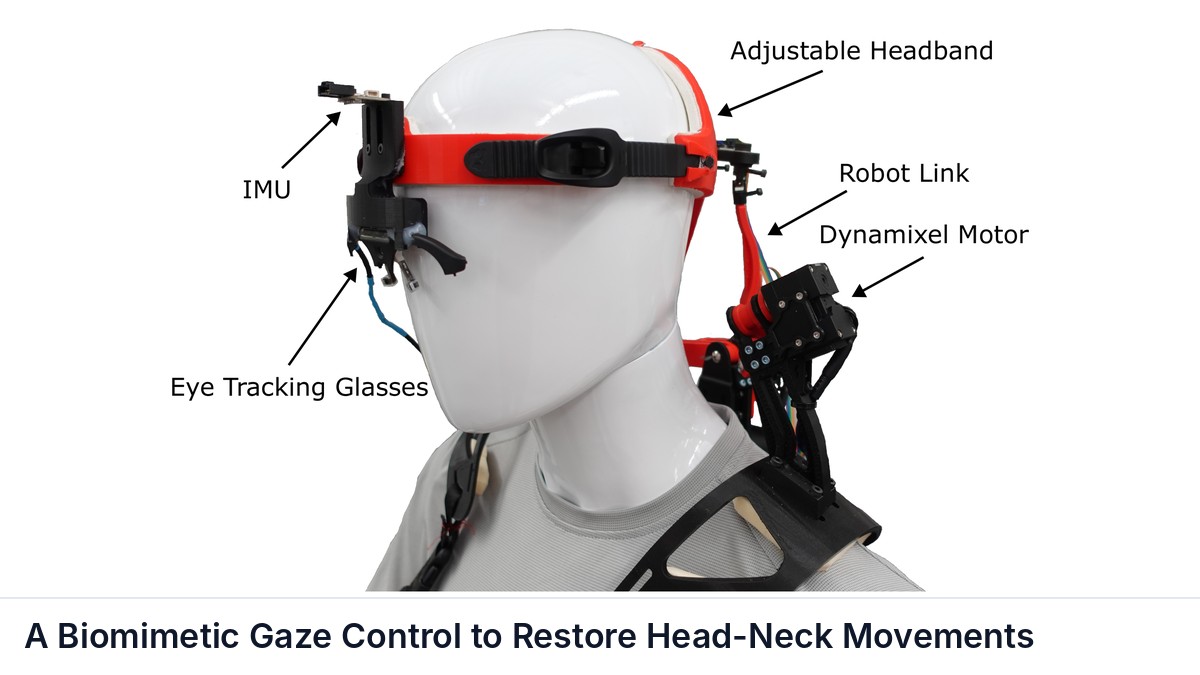
Powered neck exoskeletons are developed to restore head-neck motions for those with neck muscle weakness. Current methods using hand-held input devices to control these robotic systems are unintuitive or non-viable for these populations.