
SceneBloom: Agentic Indoor Environment Generation with Realistic and Diverse Layouts for Embodied Learning
Yuhan Liu, Lianhui Qin, Shenji Wan · N/A · 2026
Framework
N/A
License
N/A
Stars
N/A
Summary
Training generalizable embodied agents requires realistic, varied, and simulation-ready indoor environments. Language-guided methods support semantic planning and object-level reasoning, but precise spatial grounding remains difficult.
Abstract Summary
Key Points
- Training generalizable embodied agents requires realistic, varied, and simulation-ready indoor environments.
- Language-guided methods support semantic planning and object-level reasoning, but precise spatial grounding remains difficult.
- Visual generative models offer rich priors over plausible arrangements, yet their outputs require geometric reasoning to become physically valid 3D scenes.
- We introduce SceneBloom, an agentic framework that combines visual layout sampling with contract-guided 3D compilation.
- A hierarchical sampler uses diffusion priors to generate furniture arrangements within functional zones.
SceneBloom: Agentic Indoor Environment Generation with Realistic and Diverse Layouts for Embodied Learning
|Authors: Yuhan Liu, Lianhui Qin, Shenji Wan
|Venue: arXiv preprint | Year: 2026
|arXiv: 2610.32978v1
Abstract
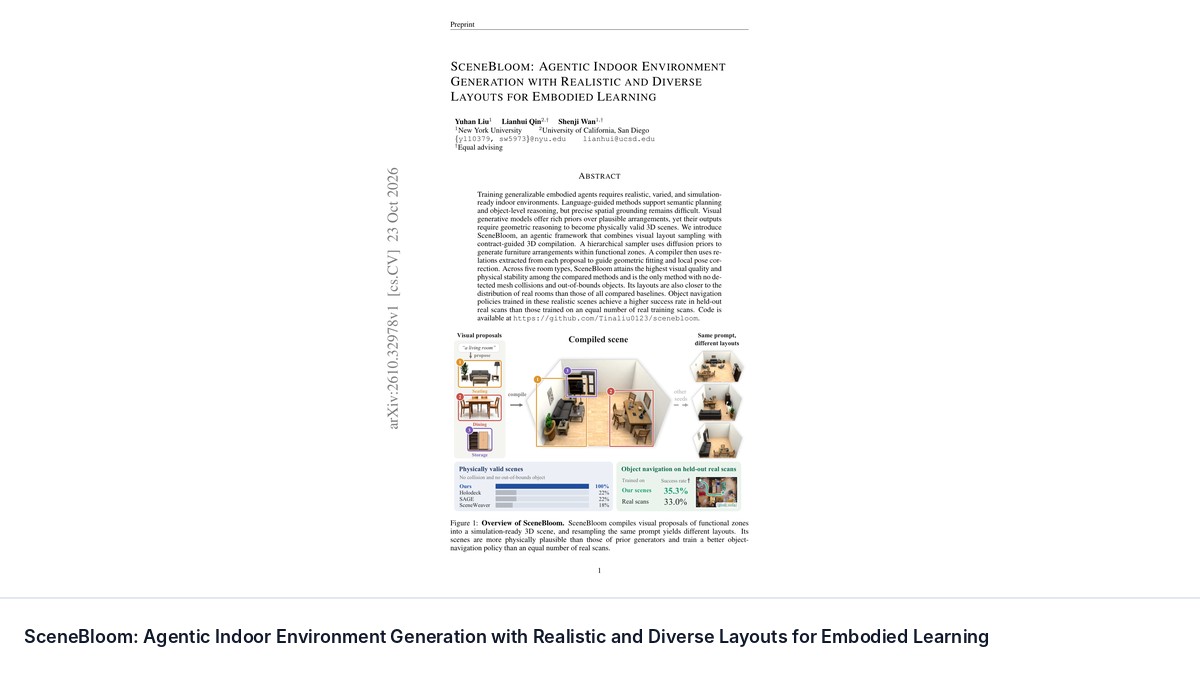
Training generalizable embodied agents requires realistic, varied, and simulation-ready indoor environments. Language-guided methods support semantic planning and object-level reasoning, but precise spatial grounding remains difficult. Visual generative models offer rich priors over plausible arrangements, yet their outputs require geometric reasoning to become physically valid 3D scenes. We introduce SceneBloom, an agentic framework that combines visual layout sampling with contract-guided 3D compilation. A hierarchical sampler uses diffusion priors to generate furniture arrangements within functional zones. A compiler then uses relations extracted from each proposal to guide geometric fitting and local pose correction. Across five room types, SceneBloom attains the highest visual quality and physical stability among the compared methods and is the only method with no detected mesh collisions and out-of-bounds objects. Its layouts are also closer to the distribution of real rooms than those of all compared baselines. Object navigation policies trained in these realistic scenes achieve a higher success rate in held-out real scans than those trained on an equal number of real training scans. Code is available at https://github.com/Tinaliu0123/scenebloom.
Key Contributions
- Training generalizable embodied agents requires realistic, varied, and simulation-ready indoor en…
- Language-guided methods support semantic planning and object-level reasoning, but precise spatial…
- Visual generative models offer rich priors over plausible arrangements, yet their outputs require…
- We introduce SceneBloom, an agentic framework that combines visual layout sampling with contract-…
- A hierarchical sampler uses diffusion priors to generate furniture arrangements within functional…
Topics
- vision
- reinforcement-learning
- planning
Code & Data
- GitHub repository: https://github.com/Tinaliu0123/scenebloom
BibTeX
@article{Liu2026_261032978v1,
  title     = {SceneBloom: Agentic Indoor Environment Generation with Realistic and Diverse Layouts for Embodied Learning},
  author    = {Yuhan Liu and Lianhui Qin and Shenji Wan},
  year      = {2026},
  eprint    = {2610.32978v1},
  archivePrefix = {arXiv},
  primaryClass  = {cs.CV},
  url       = {https://arxiv.org/abs/2610.32978v1}
}
Related Papers
A Low-Cost, Open Platform for End-to-End Autonomous Driving on a Miniature Ackermann Vehicle
Gustavo Claudio Karl Couto, Eric Aislan Antonelo, Gabriel George Zipperer
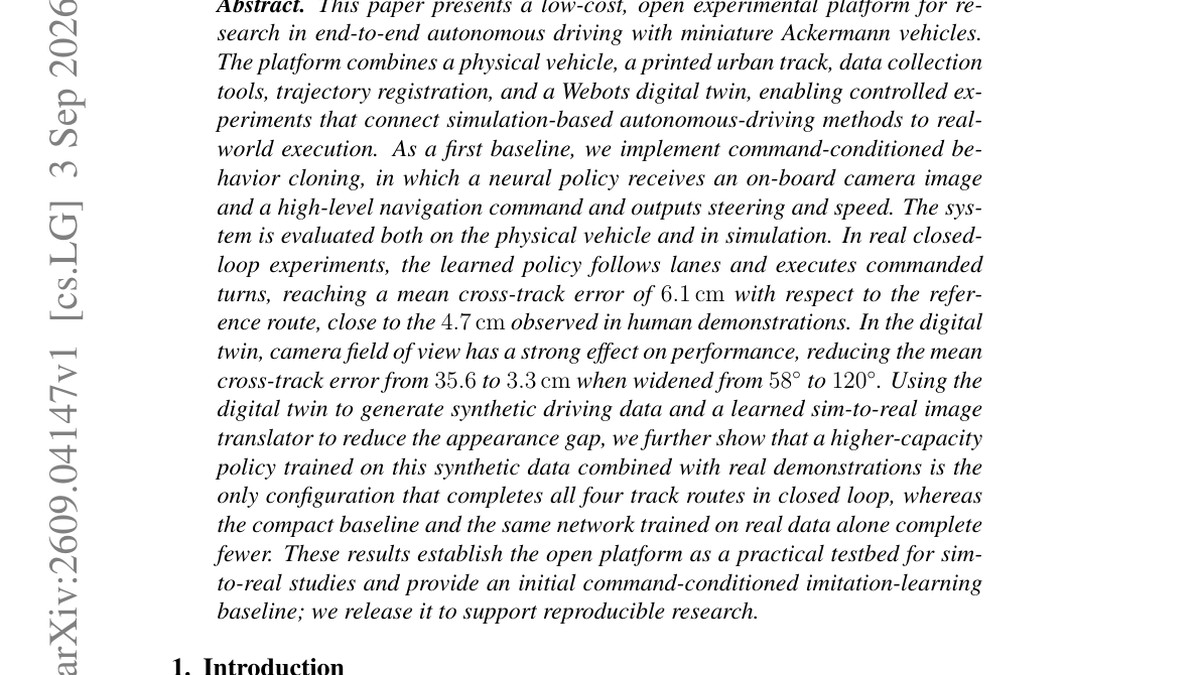
This paper presents a low-cost, open experimental platform for research in end-to-end autonomous driving with miniature Ackermann vehicles.
AcousticDiffusion: Semantically Conditioned Audio-Guided Diffusion Policy for Search-and-Rescue Assistance
Iana Zhura, Didar Seyidov, Dmitrii Plotnikov et al.
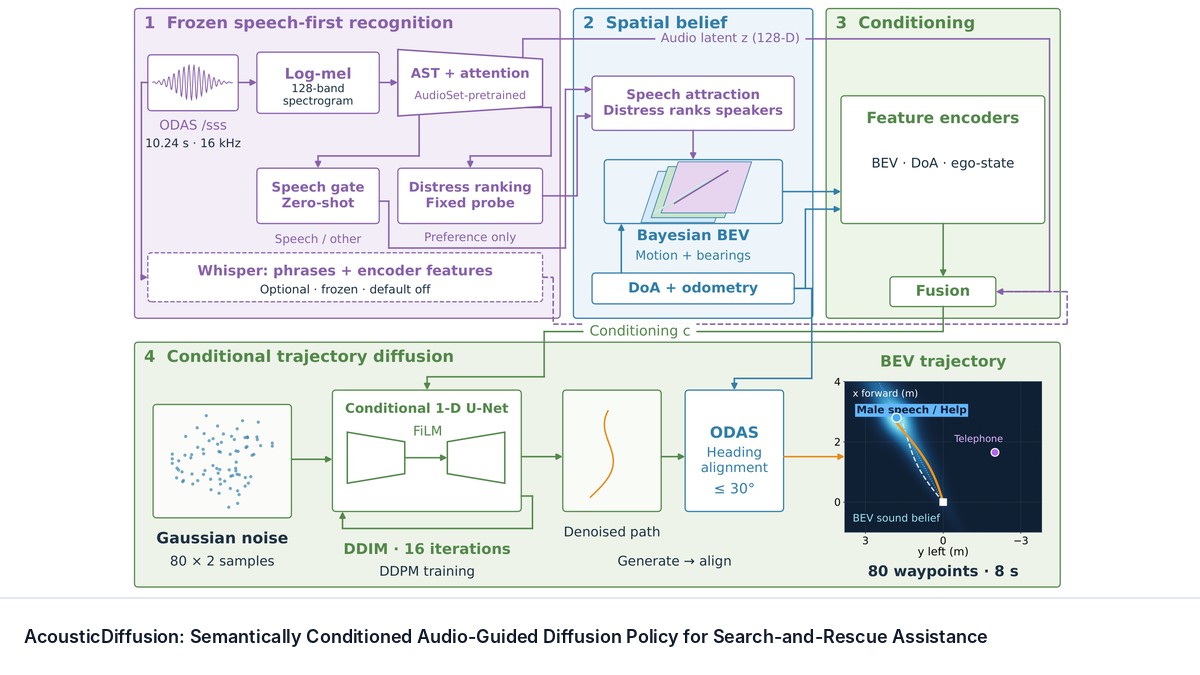
Navigating toward human callers is an important capability for rescue robots operating where visual contact is degraded or occluded. We present AcousticDiffusion, a semantically conditioned, audio-guided diffusion policy for human-directed navigation.
Aim Short to Reach Far: Your Frozen World Model Can Plan Better Than You Think
Xvyuan Liu, Jianjie Fang, Chen Gao et al.
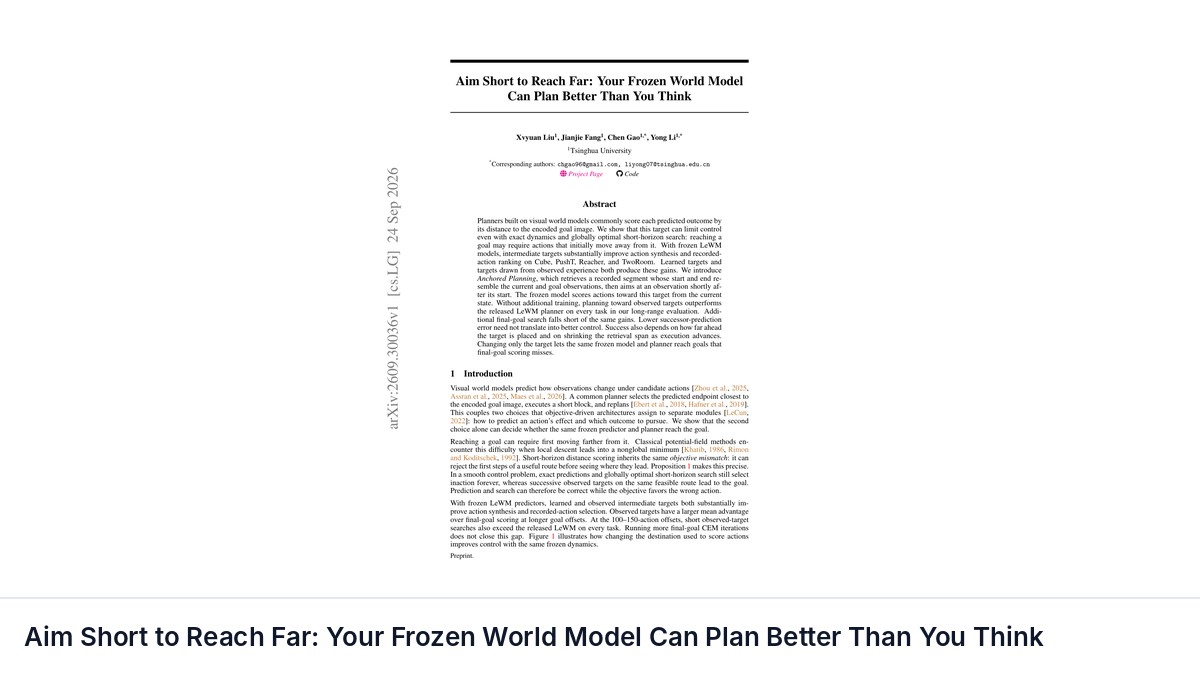
Planners built on visual world models commonly score each predicted outcome by its distance to the encoded goal image. We show that this target can limit control even with exact dynamics and globally optimal short-horizon search: reaching a goal may require actions that initially move away from it.
Autonomous Droplet Navigation via Model-Based Reinforcement Learning: Zero-Shot Transfer and Emergent Dynamics
Rajneesh Anand, Mayuresh V. Kothare
Self-driving laboratories (SDLs) are transforming chemical and materials discovery through closed-loop automation, yet automated infrastructure for physical manipulation of soft, deformable matter remains beyond current robotic platforms.