
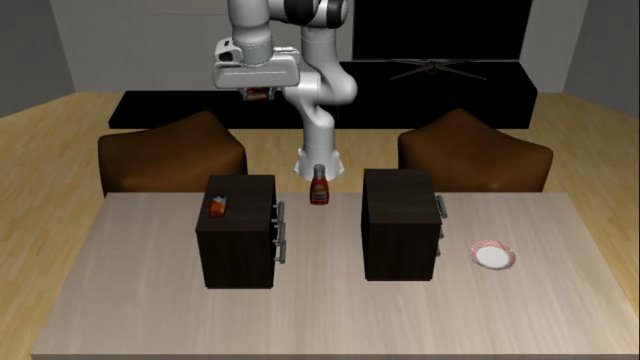
RoboMemArena: A Comprehensive and Challenging Robotic Memory Benchmark
Huashuo Lei, Wenxuan Song, Huarui Zhang, Jieyuan Pei, Ziyue Zheng · · 2026
Framework
N/A
License
N/A
Stars
76
Summary
Memory is a critical component of robotic intelligence, as robots must rely on past observations and actions to accomplish long-horizon tasks in partially observable environments.
Abstract Summary
Key Points
- Proposes RoboMemArena, a novel approach for perception in robotics.
- Addresses key limitations in existing methods through innovative architecture design.
- Demonstrates strong empirical results on standard benchmarks and real-world evaluations.
- Introduces novel training methodology that improves generalization and sample efficiency.
- Provides comprehensive analysis of failure modes and ablation studies.
RoboMemArena
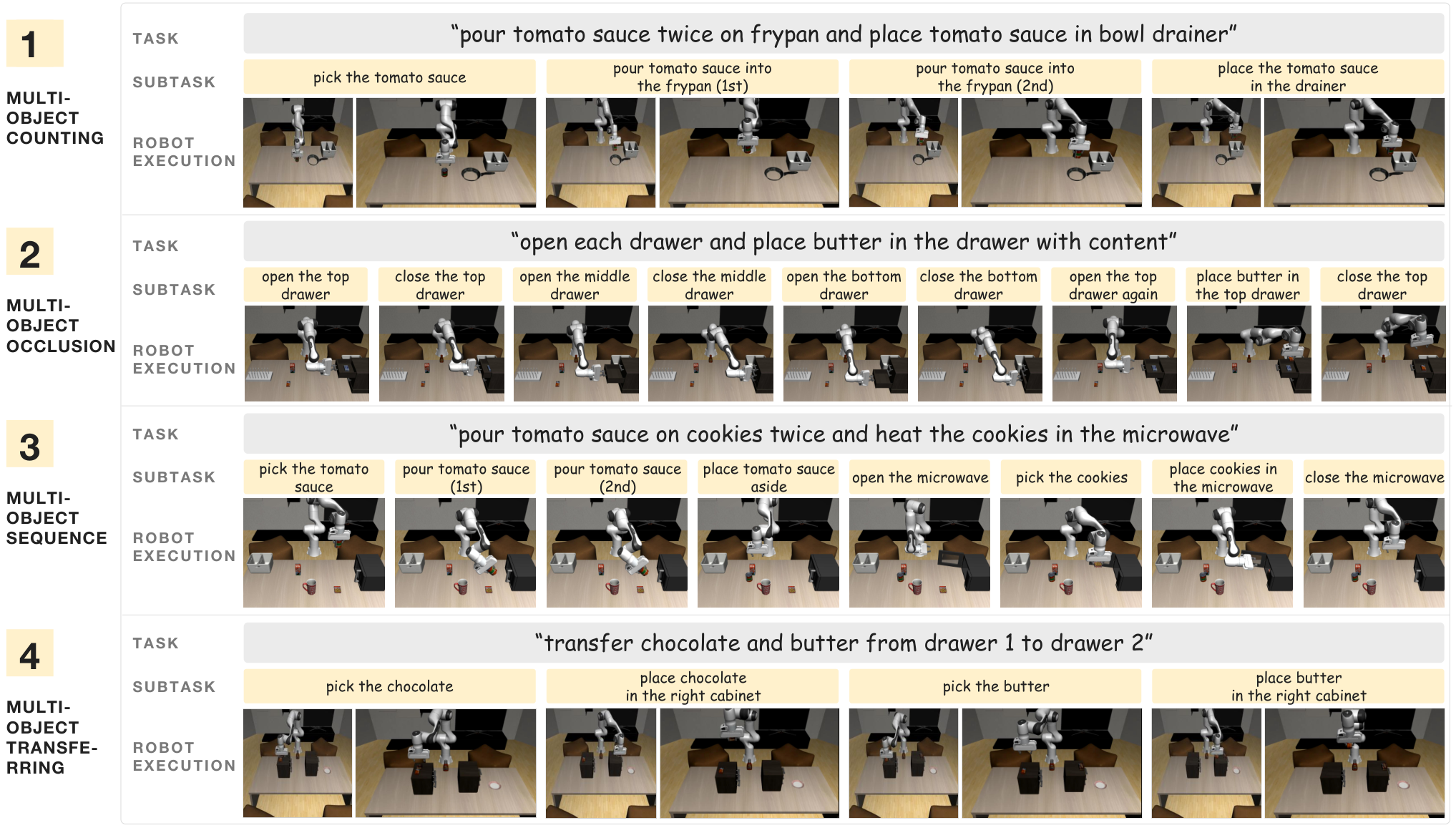
In this section, we introduce RoboMemArena , a complex and challenging robotic memory benchmark, in four parts: (1) We present a task suite with four memory-demand categories ( i.e. , transferring, occlusion, counting, and sequential execution) as well as paired real-world tasks ( Section 3.1 ).
(2) We propose a data generation pipeline that combines VLM-based task decomposition, autonomous execution, and multi-conditioned keyframe extraction ( Section 3.2 ). (3) We compare our RoboMemArena with existing robotic benchmarks ( Section 3.3 ).
PrediMem: Building Hierarchical Memory with Predictive Coding
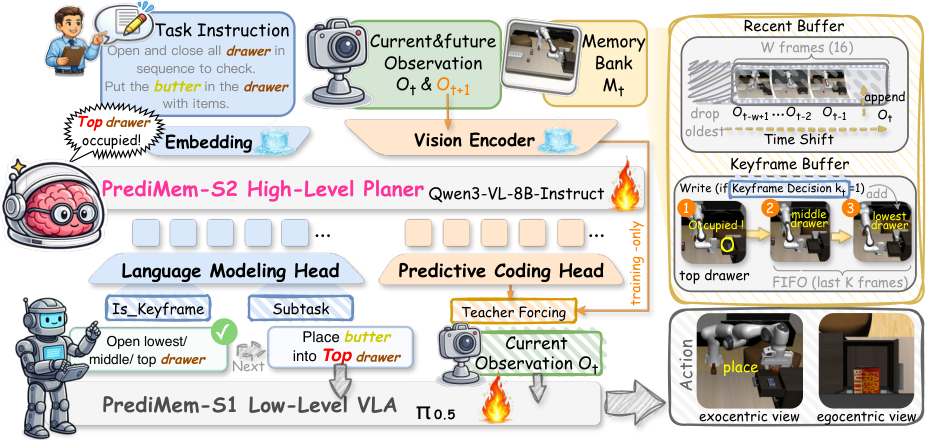
We introduce PrediMem , a hierarchical Mem ory framework with Predi ctive coding for embodied memory. It consists of a high-level planner (System 2, denoted by S2), a low-level execution policy (System 1, denoted by S1), a keyframe-grounded memory bank, and an auxiliary predictive coding head.
As shown in Figure 3 , the memory bank $\mathcal{M}_{t}$ combines a long-term keyframe buffer $\mathcal{M}_{t}^{\mathrm{key}}$ with a recent sliding window with fixed horizon $\mathcal{M}_{t}^{\mathrm{rec}}$, i.e.
Experiments
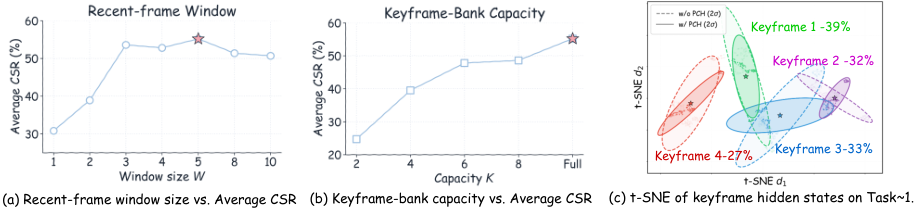
We evaluate RoboMemArena and the PrediMem framework around five questions: Does RoboMemArena expose a memory gap in existing VLAs, and can PrediMem close it? Does the end-to-end trained robot memory system surpass powerful closed-source agents? How much do the predictive coding head and the keyframe bank contribute, and how does predictive coding shape the learned memory representations?
How does the scaling of memory influence model performance? How do different baselines perform in the real-world evaluation of RoboMemArena ? Baselines.
VLM Input Prompt for Data Generation
We use a VLM input prompt template to generate long-horizon robot data by decomposing a coarse task description into executable subtasks and matching each subtask to a predefined planner. Below we show a representative input-only example. System Prompt. You are a robotic data-generation assistant for long-horizon, memory-dependent manipulation tasks. You will be given: 1. One RGB image of the current environment. 2.
VLM Training Prompt and JSON Format
We train S2 with a fixed multi-image prompt template. Below we show a representative Task 1 prompt template adapted from swift_compiled_data.jsonl . System Prompt. You are a robotic planning assistant specialized in memory-based task understanding. Your task is to infer the current primitive action from multi-image observation: 1. Historical keyframes from earlier in the same trajectory. 2.
A recent 5-timestep visual window ending at the current frame. Important rules: - Historical keyframes are earlier than the current window.
Asynchronous Inference Protocol
Given instruction $\ell$ and observation $o_{0}$, S2 runs asynchronously on the recent-frame buffer and memory bank $\mathcal{M}_{t}$, emitting subtask $c_{t}$ and keyframe decision $k_{t}$; the buffered subtask is overwritten whenever a newer S2 result arrives.
Memory-Dependent Subtask Ratio Annotation
We define a subtask as memory-dependent when the correct current subtask cannot be determined from the current observation alone and requires more information from earlier subtasks or observations. Equivalently, a subtask is counted as memory-dependent if removing the execution history or observation would make the correct high-level decision ambiguous.
Reactive Policy Failure Modes
The quantitative gap between reactive and memory-augmented policies maps to two concrete failures. First, the reactive policy cannot distinguish whether a drawer has already been checked once the visual state resets. Second, it cannot preserve the instruction-level constraint that all drawers must be opened before the final placement. Detailed failure modes are provided in Table S3 .
Sources and Demonstrations
Figures are reproduced from Lei et al. See the full paper for experimental details and the project page, when the paper links one, for demonstrations and videos.
Related Papers
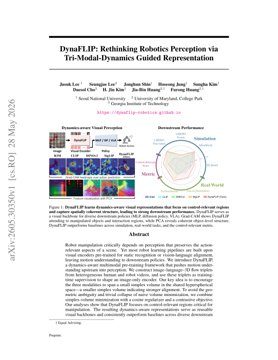
DynaFLIP: Rethinking Robotics Perception via Tri-Modal-Dynamics Guided Representation
Jusuk Lee, Seungjae Lee, Jonghun Shin et al.
Robot manipulation critically depends on perception that preserves the action-relevant aspects of a scene. Yet most robot learning pipelines are built upon visual encoders pre-trained for static recog
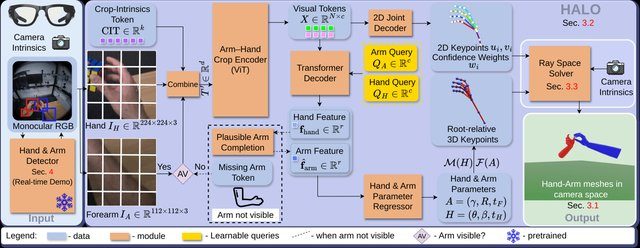
EgoForce: Forearm-Guided Camera-Space 3D Hand Pose from a Monocular Egocentric Camera
Christen Millerdurai, Shaoxiang Wang, Yaxu Xie et al.
Reconstructing the absolute 3D pose and shape of the hands from the user's viewpoint using a single head-mounted camera is crucial for practical egocentric interaction in AR/VR, telepresence, and hand-centric manipulation tasks, where sensing must remain compact and unobtrusive.
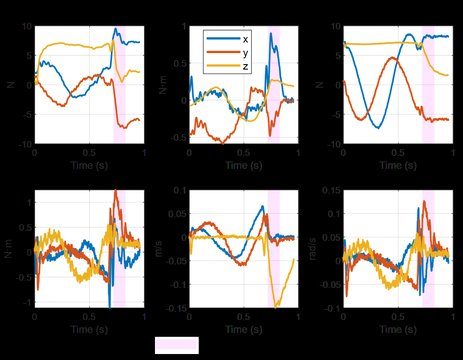
SI-Diff: A Framework for Learning Search and High-Precision Insertion with a Force-Domain Diffusion Policy
Yibo Liu, Stanko Oparnica, Simon Shewchun-Jakaitis et al.
Contact-rich manipulation is fundamental in robotics but poses significant challenges due to uncertainties in relative poses, such as misalignments and small clearances in peg-in-hole tasks.
3DThinkVLA: Endowing Vision-Language-Action Models with Latent 3D Priors via 3D-Thinking-Guided Co-training
Jiaxin Shi, Xidong Zhang, Fucai Zhu et al.
We propose a 3D-thinking-guided co-training framework that enables vision-language-action (VLA) models to perform 3D spatial reasoning implicitly during action prediction.